


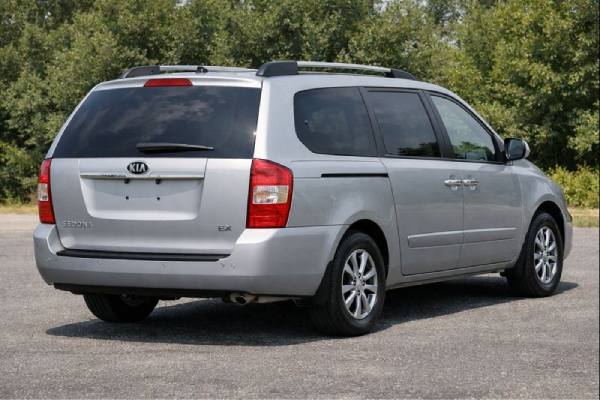
The 2011–2012 facelift Kia Sedona (VQ) with the 3.5-liter G6DC V6 is the “quietly capable” choice in the minivan world: strong torque for a loaded cabin, simple front-wheel-drive packaging, and a drivetrain that rewards routine maintenance. With 271 hp and a 6-speed automatic, it’s more about easy, low-stress momentum than sporty response, and it does a better job than many expect at highway cruising and long family trips.
Ownership tends to hinge on a few predictable areas: sliding-door hardware, aging rubber and seals, and keeping fluids fresh—especially the transmission fluid on high-mileage vans. If you shop carefully and stay ahead of preventative service, this Sedona can deliver a lot of space and comfort per dollar, with fewer “surprise” problems than more complex, newer designs.
Owner Snapshot
- Strong V6 pulls confidently with 7 passengers and luggage, and feels relaxed on the highway.
- Big cargo flexibility with a practical third row and wide-opening rear hatch.
- Straightforward FWD layout keeps driveline complexity and repair costs reasonable.
- Budget for sliding-door diagnosis or latch-related repairs as the van ages.
- Plan oil changes about every 8,000–10,000 km (5,000–6,000 mi) or 6 months, depending on use.
Jump to sections
- Kia Sedona VQ facelift profile
- Kia Sedona VQ 3.5 V6 data
- Kia Sedona VQ equipment and safety
- Known faults and recalls
- Service plan and used checklist
- Road feel and fuel use
- Rivals and value check
Kia Sedona VQ facelift profile
In facelift form (2011–2012), the VQ Sedona is best understood as a traditional, comfort-first minivan with a surprisingly stout powertrain. The G6DC 3.5-liter V6 (often described as part of the “Lambda II” family) brings a clean, linear power delivery that suits what a minivan does all day: moving weight without drama. It won’t feel quick off the line like a modern turbo SUV, but it rarely feels strained—especially when merging, climbing grades, or carrying a full family load.
This generation is also refreshingly straightforward. The platform is front-engine, front-wheel drive, with a conventional hydraulic brake system and a 6-speed automatic. That simplicity has two owner benefits: predictable repair paths and fewer high-dollar electronics compared with newer vans packed with radar sensors and networked modules. Most “wear” issues come from normal minivan life—power doors cycling thousands of times, heavy braking in city traffic, and suspension components working under constant load.
The 2011–2012 facelift years sit at a nice sweet spot: late enough to benefit from mid-cycle refinements, yet early enough to avoid some modern complexity. Cabin packaging is what you want from a minivan—wide sliding doors, a low step-in height, and a cargo bay that can switch between “family road trip” and “weekend hardware-store run” without heroic effort. If you prioritize space-per-dollar and you’re comfortable with a slightly older design, this Sedona makes sense.
What tends to separate a great Sedona from a frustrating one is condition and history. Look for evidence of consistent oil services, transmission fluid changes, and any documented repairs or updates for the power sliding doors. A well-maintained example can feel tighter than you’d expect for its age, while a neglected one can develop annoying symptoms—door warning chimes, rattles, and drivability quirks—that are more about deferred maintenance than flawed engineering.
Kia Sedona VQ 3.5 V6 data
Below are practical, model-matched specifications for the 2011–2012 facelift Sedona (VQ) with the 271 hp 3.5 V6 and 6-speed automatic. Treat exact capacities and torque values as verification items—small changes can occur by VIN, market, and option content.
Powertrain and efficiency
| Item | Spec |
|---|---|
| Code | G6DC |
| Engine layout and cylinders | V6 (6 cylinders), DOHC, 4 valves/cyl |
| Bore × stroke | 92.0 × 87.0 mm (3.62 × 3.43 in) |
| Displacement | 3.5 L (3,470 cc) |
| Induction | Naturally aspirated |
| Fuel system | MPFI (port injection) |
| Compression ratio | 10.6:1 |
| Max power | 271 hp (202 kW) @ 6,300 rpm |
| Max torque | 336 Nm (248 lb-ft) @ 4,500 rpm |
| Timing drive | Chain |
| Rated efficiency (typical, 2WD auto) | ~11.2 L/100 km (21 mpg US / 25 mpg UK) combined |
| Real-world highway @ 120 km/h (75 mph) | ~10.5–12.0 L/100 km (20–22 mpg US) depending on load and wind |
Transmission and driveline
| Item | Spec |
|---|---|
| Transmission | 6-speed automatic (Sportmatic/manual mode) |
| Drive type | FWD |
| Differential | Open |
Chassis and dimensions
| Item | Spec |
|---|---|
| Suspension (front/rear) | MacPherson struts / multi-link with struts |
| Steering | Rack and pinion, power-assisted; ~3.51 turns lock-to-lock |
| Brakes | Front vented discs ~297 mm (11.7 in); rear discs ~302 mm (11.9 in) |
| Wheels and tyres (common) | P225/70 R16 or P235/60 R17 |
| Ground clearance | ~168 mm (6.6 in) |
| Length / width / height | ~5,131 / 1,984 / 1,760 mm (202.0 / 78.1 / 69.3 in) |
| Wheelbase | ~3,020 mm (118.9 in) |
| Turning circle (kerb-to-kerb) | ~12.1 m (39.6 ft) |
| Kerb weight | ~1,984–2,087 kg (4,374–4,601 lb) |
| GVWR | varies by market/trim (verify on door label) |
| Fuel tank | ~80 L (21.1 US gal / 17.6 UK gal) |
| Cargo volume | ~912 L (32.2 ft³) seats up; ~2,268 L (80.1 ft³) behind 2nd row; ~4,007 L (141.5 ft³) max (method varies) |
Performance and capability
| Item | Spec |
|---|---|
| Acceleration 0–100 km/h (0–62 mph) | ~8.5–10.0 s (trim, tyres, and test method vary) |
| Top speed | ~180–190 km/h (112–118 mph) |
| Braking 100–0 km/h | commonly ~40–44 m (tyres and pads matter) |
| Towing capacity | up to ~1,588 kg (3,500 lb) braked (equipment-dependent) |
| Payload | varies; check door label for your van |
Fluids and service capacities (verify by VIN)
| Item | Specification (typical) | Capacity (approx.) |
|---|---|---|
| Engine oil | API SM/SN; commonly 5W-20 or 5W-30 by climate | ~5.2 L (5.5 US qt) with filter |
| Coolant | Phosphate-based ethylene glycol mix (often 50/50) | ~7–9 L (varies) |
| Transmission/ATF | ATF spec per OEM (verify exact fluid spec) | service fill varies; full fill higher |
| A/C refrigerant | R-134a (typical for this era) | verify under-hood label |
| Key torque specs | Oil drain plug, wheel lug nuts | verify by service manual for your market |
Safety and driver assistance (typical for 2011–2012)
| Item | Notes |
|---|---|
| Crash ratings | IIHS ratings exist for this generation; facelift years may include belt refinements |
| Headlight rating (IIHS) | Often not a focus for this era; verify by equipment |
| ADAS suite | Generally no modern AEB/ACC/LKA; stability control and ABS are the core systems |
Kia Sedona VQ equipment and safety
Trims and options (typical structure). In many markets, Sedona trims cluster around value-focused and comfort-focused grades—often comparable to LX (base) and EX (upmarket). The practical differences are usually not about the engine (the 3.5 V6 is common) but about convenience equipment and how “family-friendly” the cabin feels day to day. Expect the higher grade to add items like power sliding doors, upgraded audio, additional power seat adjustments, parking sensors or a camera (market-dependent), and nicer interior materials.
How to identify equipment quickly. On a used lot, you can often spot the trim by a few reliable tells:
- Wheel size and tyre package (16-inch setups skew base; 17-inch often indicates higher trim).
- Power sliding door switches and overhead console layout.
- Seat material (cloth vs leather) and presence of heated front seats.
- Rear entertainment or upgraded audio badging where fitted.
Year-to-year changes that matter (2011 vs 2012). The facelift window is narrow, so differences are subtle. The most meaningful “change” for owners is often not styling but small safety and restraint updates and the way certain parts evolved in service campaigns over time. When shopping, treat 2012 as a mild refinement year rather than a redesign. Either year can be a good buy if condition is strong.
Safety systems you can count on. These Sedonas generally focus on the fundamentals:
- Front airbags plus side torso airbags and curtain airbags (often covering multiple rows).
- ABS and electronic stability control (ESC) on many trims/markets; verify it’s present, because ESC can vary on early builds in some regions.
- ISOFIX/LATCH child-seat anchors in the second row (and sometimes third-row tether points depending on configuration). Always check anchor access—minivans can hide anchors under trim flaps that break over time.
Crash-test reality for this generation. Safety ratings exist, but they reflect the test procedures of the era. For example, many 2011–2012 vans were evaluated under moderate-overlap and side-impact regimes, while today’s small-overlap and advanced pedestrian/VRU testing may not apply. Interpreting older ratings correctly matters: a strong showing in period tests is good news, but it does not automatically mean the van matches modern designs in crash compatibility and crash avoidance technology.
ADAS expectations. If you are used to newer vehicles, set your expectations: automatic emergency braking, adaptive cruise control, and lane centering typically are not part of this generation’s equipment. In practice, that means tyres, brakes, wipers, and headlight condition play an outsized role in “active safety.” On a 2011–2012 Sedona, fresh tyres and healthy brakes can be a bigger real-world safety upgrade than chasing minor option differences between trims.
Known faults and recalls
Aging Sedonas usually don’t fail in exotic ways—they develop patterns. Below is a practical map of what tends to show up, organized by prevalence and cost tier. Mileage bands are approximate because usage matters as much as odometer readings.
Common (worth checking on every van)
- Power sliding door not fully latching (medium cost).
Symptoms: warning chime, “door ajar” indicator, door appears closed but reopens or won’t “pull-in” on the final latch stage.
Likely cause: worn latch assembly, actuator/controller issues, misalignment from hinge wear, or track contamination.
Remedy: clean and lubricate tracks, verify alignment, then diagnose latch and controller; replace the failing component rather than guessing. This is a high-cycle system, so wear is normal. - Ignition coils and spark plugs (low to medium cost).
Symptoms: misfire under load, rough idle, flashing check-engine light, fuel smell.
Likely cause: coil breakdown with heat/age; plugs past interval.
Remedy: replace plugs on schedule and coils as needed (often best done in matched sets if multiple are weak). - Oil seepage and gasket aging (low to medium cost).
Symptoms: oil smell after a drive, wetness around valve covers, small drips.
Likely cause: valve cover gaskets harden; PCV (positive crankcase ventilation) issues can increase seepage.
Remedy: replace gaskets and confirm PCV function to reduce repeat leaks.
Occasional (depends on climate and prior service)
- Cooling system wear (medium cost).
Symptoms: slow coolant loss, intermittent overheating in traffic, heater performance changes.
Likely cause: radiator end-tank aging, hose fatigue, thermostat sticking, water pump seepage.
Remedy: pressure test, replace weak components proactively, and renew coolant on time. - Transmission shift quality changes (medium to high cost if ignored).
Symptoms: harsh 2–3 shift, delayed engagement, shudder on light throttle, “hunting” on grades.
Likely cause: old fluid, adaptive shift values, solenoid wear, mounts.
Remedy: verify fluid condition and correct spec; consider staged drain-and-fill services rather than a harsh flush on a high-mileage unit.
Rare but serious (verify history)
- Fuel system recall-related risk (high severity).
Symptoms: fuel odor, wetness near fuel rail area, engine bay smell after shutdown.
Likely cause: a known defect addressed by a recall campaign on certain vehicles/production ranges.
Remedy: confirm recall completion via official VIN records; do not ignore fuel smell.
Software and calibrations
This era is lighter on software “fixes” than newer vehicles, but it still matters. If you have persistent transmission behavior issues, idle problems, or repeat fault codes, ask a dealer-level shop to check for applicable ECU/TCU updates tied to your VIN. Calibrations can also matter after throttle-body cleaning or battery disconnects—some vans need a proper relearn to restore smooth idle and shift behavior.
Recalls, TSBs, and coverage actions
Your best move is simple: run the VIN through an official recall lookup and ask for printouts of completed campaigns. For the Sedona, pay extra attention to sliding-door service bulletins and any fuel-system related recalls. A seller who can show documentation (not just promises) is offering real value—because it reduces your chance of inheriting an unfinished safety repair.
Service plan and used checklist
A practical Sedona maintenance plan is less about chasing perfection and more about reducing wear on the systems that get punished in minivan life: hot-running V6 oil, transmission heat, braking loads, and constant door cycling.
Core maintenance schedule (distance or time, whichever comes first)
- Engine oil and filter: every 8,000–10,000 km (5,000–6,000 mi) or 6 months for mixed city use; you can extend modestly with mostly highway driving and verified oil condition.
- Engine air filter: inspect every 15,000 km (10,000 mi); replace around 30,000 km (20,000 mi) or sooner in dusty areas.
- Cabin air filter: every 15,000–20,000 km (10,000–12,000 mi) or annually for HVAC performance.
- Spark plugs: commonly around 160,000 km (100,000 mi) on long-life plugs; shorten if you see misfire history or rough running.
- Coolant: every 5 years or 100,000–160,000 km (60,000–100,000 mi) depending on coolant type; keep it clean to protect the radiator and water pump.
- Brake fluid: every 2 years regardless of mileage (moisture is the enemy).
- Transmission fluid: a smart “longevity” interval is every 50,000–80,000 km (30,000–50,000 mi), especially with heavy city use, hills, or towing.
- Tyre rotation and alignment: rotate every 10,000–12,000 km (6,000–7,500 mi); align if you see edge wear or steering pull.
- Accessory belt and hoses: inspect annually; replace at the first signs of cracking, glazing, or coolant sweating.
- 12 V battery: test annually after year 3; many last 4–6 years depending on climate.
Fluid choices and capacities (decision-friendly guidance)
- Oil viscosity: 5W-20 or 5W-30 is typical for this V6; choose based on climate and the oil spec listed for your market.
- Oil capacity: roughly 5.2 L with filter is a useful planning number; confirm on the dipstick after filling and warming.
- Coolant: use the correct phosphate-based coolant type compatible with aluminum engines; avoid mixing unknown coolants.
Essential “used buyer” checklist
- Cold start: listen for timing-chain rattle (brief is normal; persistent is not), check for misfire, and verify smooth idle.
- Transmission behavior: confirm clean engagement into Drive and Reverse, smooth upshifts, and no shudder under light throttle.
- Sliding doors: run both doors through multiple open/close cycles; watch for incomplete latching, warning chimes, or uneven movement.
- Cooling system: inspect for dried coolant residue around the radiator, hoses, and water pump area; verify stable temperature in traffic.
- Brakes and tyres: check for steering shake under braking and uneven tyre wear—both can signal deferred suspension work.
- Rust and corrosion hotspots: inspect rear subframe areas, brake lines, and door sills, especially in salted-road climates.
- Paperwork: demand proof of recall completion and regular oil service. The best Sedonas are boring on paper—in a good way.
Long-term durability outlook. If you keep fluids fresh and stay proactive on doors, cooling, and brakes, the 3.5 V6 Sedona can remain dependable deep into high mileage. The van’s age is the bigger “risk” than its design: rubber, connectors, and mechanical wear become the main story after a decade.
Road feel and fuel use
On the road, the 2011–2012 Sedona V6 feels built for steady, calm progress. The suspension is tuned for comfort first, with enough control to keep the body from feeling loose when loaded, but it won’t hide physics: a full-size minivan has weight and a higher center of gravity. Still, straight-line stability is a strong point, and the long wheelbase helps it track cleanly on highways.
Ride, handling, and NVH
- Ride quality: compliant over broken pavement, especially with stock tyre sizes and healthy dampers. When shocks age, you’ll feel extra bobbing over dips and a “second bounce” after bumps.
- Steering feel: light to medium effort, with modest feedback. That’s normal for the segment and makes parking easier.
- Braking feel: typically predictable; if you feel pedal pulsation, look for warped rotors or sticky calipers, which can happen on heavy vehicles.
- Cabin noise: moderate wind and road noise by modern standards, but the engine itself is usually smooth when mounts are healthy.
Powertrain character
The G6DC V6 delivers its best effort in the midrange. Around town, it feels confident pulling away from lights even with passengers. Under hard acceleration, the 6-speed automatic tends to downshift promptly, but it can “hunt” on rolling hills if you hover at the edge of a gear change—using a manual mode or a slightly deeper throttle often settles it.
If you test drive one and the drivetrain feels lazy, don’t assume that’s “just how it is.” Old spark plugs, weak coils, a dirty throttle body, or tired engine mounts can dull the van dramatically. A healthy example feels smoother and more eager than many shoppers expect.
Real-world efficiency
For a 3.5-liter gasoline minivan, fuel use is reasonable but not small. Typical observed ranges:
- City: ~12.5–14.5 L/100 km (16–19 mpg US / 19–23 mpg UK) depending on traffic and warm-up time.
- Highway (100–120 km/h): ~10.0–12.0 L/100 km (20–24 mpg US / 24–29 mpg UK).
- Mixed: ~11–13 L/100 km (18–21 mpg US / 22–25 mpg UK).
Cold weather increases consumption more than many drivers expect because trip length matters. Short trips can push fuel use sharply higher because the engine spends more time warming up and the transmission runs thicker fluid.
Load and towing notes
With towing-capable equipment, the Sedona can handle moderate trailers, but plan for a clear fuel penalty and more heat in the transmission. For regular towing, shorten transmission fluid intervals, inspect brakes more often, and make sure the cooling system is in top shape before summer trips.
Rivals and value check
In the 2011–2012 era, the Sedona competed with heavy hitters like the Honda Odyssey, Toyota Sienna, Chrysler Town and Country, and Dodge Grand Caravan. Each rival has a distinct personality, so the “best” choice depends on what you value most.
Where the Sedona (VQ) 3.5 wins
- Value and simplicity. You often get strong features for the money, and the mechanical layout is conventional. For owners paying out of pocket, that matters.
- V6 strength. The 271 hp output is competitive for the time, and it helps the van feel less stressed when loaded.
- Practical packaging. The cargo area numbers and seating flexibility remain genuinely useful, not just “on paper.”
Where rivals can be stronger
- Honda Odyssey: often sharper driving dynamics and strong interior execution. The tradeoff is that some repairs and parts costs can be higher, and condition varies widely.
- Toyota Sienna: frequently praised for long-term durability and resale strength. It can cost more up front, and you may pay extra for comparable features.
- Chrysler Town and Country / Dodge Grand Caravan: usually very affordable used, with practical stow-and-go seating on many trims. Reliability can be more variable, so inspection quality matters a lot.
The smart way to compare
Instead of comparing brand reputations, compare specific examples:
- A Sedona with documented transmission fluid services and healthy sliding doors can be a safer ownership bet than a better-known rival with patchy maintenance.
- If you prioritize advanced driver assistance, none of these 2011–2012 vans will feel modern—so you may want a newer generation entirely.
- If your budget is tight and you need maximum space, the Sedona’s strongest case is cost per usable seat and cost per cubic foot of cargo.
Bottom line
The 2011–2012 Sedona V6 is most compelling for buyers who want a traditional minivan experience—strong engine, big interior, straightforward mechanics—and who are willing to judge vehicles by condition rather than badges. If you find a clean, well-serviced one with smooth door operation and verified recall history, it can deliver excellent real-world value.
References
- 2012 Kia Sedona Specifications 2012 (Specifications)
- 2012 Kia Sedona 2012 (Safety Rating)
- Fuel Economy of the 2011 Kia Sedona 2011 (Fuel Economy)
- Microsoft Word – SC188 – Owner Follow-Up Notice.docx 2020 (Recall Notice)
- Kia Global Information System – TSB 2021 (TSB)
Disclaimer
This article is for informational purposes only and is not a substitute for professional inspection, diagnosis, or repair. Specifications, torque values, fluid types, capacities, service intervals, and procedures can vary by VIN, market, and equipment; always verify details using your vehicle’s official service information and labels before purchasing parts or performing work.
If this guide helped you, consider sharing it on Facebook, X (Twitter), or your favorite forum to support our work and help other owners shop and maintain their Sedona with confidence.