

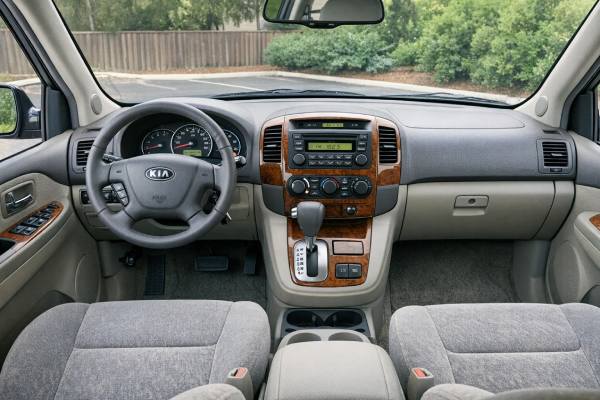
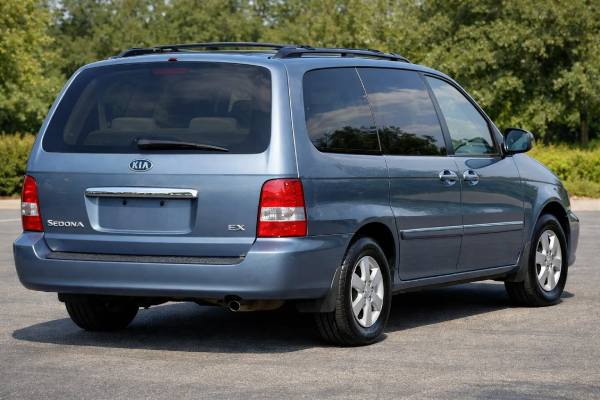
The 2002–2005 facelift Kia Sedona (KV-II) is the “value MPV” from an era when minivans were built for long family trips, not showroom flair. With the 3.5-liter G6CU V6 rated at 195 hp and a conventional automatic transmission, it focuses on smooth torque, predictable road manners, and easy parts availability rather than sporty responses. The big ownership story today is age-related upkeep: cooling, rubber bushings, door hardware, and overdue fluid services matter more than the headline horsepower.
If you shop one carefully, the Sedona can still be a comfortable people-mover with honest, repairable mechanicals. If you buy on price alone, it can become a backlog of “small” jobs that add up—especially if the timing-belt history is unclear and the van has lived a hard stop-and-go life.
Essential Insights
- Strong low-to-mid-rpm pull for a loaded van, with a simple V6/automatic layout that most shops understand.
- Big cabin and practical seating, with easy step-in height and a family-friendly ride tune.
- Good value on the used market when maintenance records are complete.
- Timing-belt and cooling-system condition are deal-makers; neglect here can turn expensive quickly.
- Plan oil changes around 8,000–10,000 km (5,000–6,000 mi) or 6 months for best long-term durability.
What’s inside
- Kia Sedona KV-II facelift explained
- Kia Sedona 3.5 G6CU specs
- Kia Sedona trims and safety kit
- Common faults and recalls
- Service schedule and buying advice
- Road manners and fuel use
- Sedona vs competing MPVs
Kia Sedona KV-II facelift explained
Think of the 2002–2005 Sedona facelift as a “matured” version of Kia’s second-generation people carrier: same core platform idea, but with steady refinements to safety systems, features, and drivetrain calibration. In many markets this body is closely related to the Kia Carnival of the same era; in North America it wears the Sedona badge and, for these years, is most often seen with the 3.5-liter G6CU V6.
From an engineering and ownership point of view, the Sedona’s strengths are straightforward. The G6CU V6 is a conventional, belt-driven DOHC 24-valve engine designed for smoothness rather than peak efficiency. In day-to-day driving it feels relaxed, especially with passengers aboard, because it doesn’t need high rpm to keep the van moving. The chassis is tuned for comfort, with a stable, slightly soft ride that suits highways and imperfect urban roads. Steering is light and predictable, and the long wheelbase helps it track straight in crosswinds—more “family coach” than “sport van.”
The flip side is age and mass. These vans are heavy for their size class, and that affects everything: brakes work hard, tires wear faster if alignment is off, and fuel economy is never a highlight. After two decades, many examples also show the typical minivan wear points—sliding door rollers and latches, power door mechanisms (where equipped), seat hardware, and interior plastics that have lived through thousands of kid-miles.
If you want the best experience, you buy a Sedona that has been maintained like a “system” (cooling, belts, fluids, suspension), not one that only got oil changes. The platform can be dependable when its known service needs are met on time, and it can be frustrating when owners postpone the big-ticket maintenance—especially timing belt and cooling repairs—until something fails.
Kia Sedona 3.5 G6CU specs
Below are practical, “ownership-relevant” specifications for the facelift Sedona with the 3.5-liter G6CU V6. Exact figures can vary slightly by market, trim, and equipment, so use this as a planning baseline and confirm against your VIN documentation.
Powertrain and efficiency
| Item | Specification |
|---|---|
| Code | G6CU |
| Engine layout and cylinders | V6, 6 cylinders, DOHC, 4 valves/cyl |
| Bore × stroke | 93.0 × 85.8 mm (3.66 × 3.38 in) |
| Displacement | 3.5 L (3497 cc) |
| Induction | Naturally aspirated |
| Fuel system | Multi-port fuel injection (MPI) |
| Compression ratio | ~10.0:1 (varies by market calibration) |
| Max power | 195 hp (145 kW) @ ~5500 rpm |
| Max torque | ~290 Nm (214 lb-ft) @ ~3500 rpm |
| Timing drive | Belt |
| Rated efficiency (EPA-style reference) | 14 city / 21 highway / 16 combined mpg (US) (typical published figure) |
| Real-world highway @ 120 km/h (75 mph) | ~11.5–13.5 L/100 km (17–20 mpg US), condition-dependent |
Transmission and driveline
| Item | Specification |
|---|---|
| Transmission | Automatic (commonly 5-speed in many markets/years) |
| Drive type | FWD |
| Differential | Open |
Chassis and dimensions (typical US-spec range)
| Item | Specification |
|---|---|
| Suspension (front/rear) | Independent front; rear design varies by market/trim, tuned for load comfort |
| Steering | Power-assisted rack-and-pinion (typical) |
| Brakes | 4-wheel discs on many trims; confirm rotor sizes by VIN |
| Wheels/tyres (common) | 215/70 R15 or 225/60 R16 (market dependent) |
| Ground clearance | ~150–170 mm (5.9–6.7 in), trim dependent |
| Length / width / height | ~4930 / 1895 / 1750 mm (194.1 / 74.6 / 68.9 in) |
| Wheelbase | ~2910 mm (114.6 in) |
| Turning circle (kerb-to-kerb) | ~11.4–12.0 m (37–39 ft) |
| Kerb (curb) weight | ~2000–2150 kg (4410–4740 lb), equipment dependent |
| Fuel tank | ~75–80 L (19.8–21.1 US gal / 16.5–17.6 UK gal) |
Performance and capability (realistic expectations)
| Item | Typical figure |
|---|---|
| 0–100 km/h (0–62 mph) | ~10–11 s (trim/load dependent) |
| Top speed | ~170–180 km/h (106–112 mph) |
| Towing capacity | Often ~1500–1800 kg braked (3300–4000 lb), market dependent |
| Payload | Commonly ~500–700 kg (1100–1540 lb), equipment dependent |
Fluids and service capacities (planning guide)
| System | Specification |
|---|---|
| Engine oil | 5W-30 (API SL/SM-era equivalent); capacity typically ~4.5–5.0 L (4.8–5.3 US qt) |
| Coolant | Ethylene glycol long-life coolant, 50/50 mix; capacity varies by radiator/heater spec |
| Transmission/ATF | Often SP-III family ATF for Hyundai/Kia-era automatics; verify by transmission label |
| Brake fluid | DOT 3 or DOT 4 (confirm cap/handbook) |
| A/C refrigerant | R-134a; charge varies by front/rear A/C setup |
Safety and driver assistance (era-appropriate)
| Item | What to expect |
|---|---|
| Crash ratings | IIHS moderate overlap front test results apply to 2002–05 models built after March 2002 (ratings vary by test element) |
| ADAS | None in the modern sense; expect ABS and basic stability/traction systems on some trims/markets |
Kia Sedona trims and safety kit
Trim naming varies by region, but most facelift Sedonas fall into a “value” base model and a better-equipped upper trim (often seen as LX/EX-style naming in North America). When you shop, focus less on badge names and more on functional equipment, because that changes the ownership experience.
Common configuration differences you’ll actually feel:
- Seating layout: Most are 7-passenger with second-row captain’s chairs, but some markets offer 8-passenger benches. The bench can be more practical for three kids; captain’s chairs often feel more comfortable and give better access to the third row.
- Doors: Power sliding doors (when fitted) are convenient but add failure points: cables, motors, and control modules. Manual doors are simpler and cheaper to keep right.
- Wheels and tires: 15-inch packages ride softer and cost less in tires; 16-inch packages can feel a touch more controlled but cost more.
- Cooling and HVAC: Dual-zone or rear HVAC is great for family use, but it adds extra blend doors and lines to maintain.
- Audio and convenience: Factory premium audio, steering wheel controls, and trip computers are “nice to have,” but not worth buying a rough example for.
Quick identifiers when viewing a used van:
- Look for door buttons on the B-pillar and key fob to confirm power sliding doors.
- Check the instrument cluster for ABS and traction/stability indicators at key-on (then verify they go out).
- Inspect the rear HVAC controls and vents if rear climate is claimed.
- Confirm the spare-tire location and tools—missing hardware is common on older vans.
Safety ratings and what they mean for these years
For 2002–2005 Sedonas, the most useful “real-world” safety snapshot comes from IIHS frontal crash testing of this generation. The key takeaway is that ratings can apply to specific build periods and safety-system changes. In other words, a Sedona built after a specified production change can behave differently in a crash than an earlier build, even if it looks identical.
Safety systems (what’s realistic to expect)
Most facelift Sedonas rely on conventional passive safety and basic active safety:
- Front airbags are common; some markets include side airbags, others do not.
- ABS is common; stability control availability varies widely by market and trim.
- Child-seat provisions: Expect ISOFIX/LATCH-type anchors depending on market rules, but always verify anchor presence and access because seat designs differ by row.
- Headlights: Lighting performance is highly dependent on lens condition. Cloudy lenses and weak bulbs can make an older van feel far less safe at night than its original spec suggests.
Bottom line: buy the best safety equipment you can verify on the vehicle itself, then restore it—tires, brakes, and headlights often improve real safety more than chasing a trim badge.
Common faults and recalls
At this age, the Sedona’s reliability is less about “bad design” and more about whether known wear items have been handled before they cascade. Below is a practical map of problems by prevalence and cost tier, with symptoms and fixes.
Common (expect to see), low to medium cost
- Sliding door wear (rollers, hinges, latches):
Symptoms: rough travel, sagging, wind noise, door that needs a slam.
Cause: worn rollers/hinges, misalignment, old grease.
Fix: replace worn roller sets, adjust alignment, clean and re-lube tracks. - Engine oil leaks from gaskets:
Symptoms: oil smell, drips on driveway, damp valve-cover areas.
Cause: hardened valve-cover gaskets, aging seals.
Fix: replace gaskets, clean PCV system, confirm no excess crankcase pressure. - Cooling system “slow failures”:
Symptoms: coolant smell, intermittent overheating in traffic, low coolant level.
Cause: radiator end tanks, hose joints, thermostat fatigue, water pump seep.
Fix: pressure test, replace weak components as a set, renew coolant properly.
Occasional, medium to high cost
- Timing belt overdue or incorrectly serviced:
Symptoms: no warning until failure; sometimes squeal or visible belt cracking.
Cause: missed interval, reused tensioners/idlers, cheap parts.
Fix: full timing-belt kit service (belt + tensioner + idlers), ideally with water pump if driven by the belt or serviced in the same area. - Automatic transmission shift quality:
Symptoms: flare on upshift, delayed engagement, shudder, harsh downshifts.
Cause: old ATF, internal wear, solenoid issues in neglected units.
Fix: correct-spec fluid service (not “universal”), scan for codes, address solenoids early.
Safety-related recalls and service actions (high importance)
- Throttle cable freezing recall (example of an age-critical safety campaign):
Risk pattern: freezing conditions can cause throttle cable resistance, affecting pedal return.
Best practice: confirm recall completion by VIN history and dealer documentation, especially if the van is used in cold climates.
Pre-purchase checks to request (worth your time)
- Proof of timing-belt kit service (invoice showing parts list, not just “belt changed”).
- Cooling system service evidence (radiator/hoses/thermostat history, not just top-ups).
- Transmission fluid history with the correct specification.
- Recall completion printout and a quick functional check (throttle return feel, wheel bearing noise, brake performance).
If the seller can’t document the big-ticket items, assume you’ll be doing them—then price the van accordingly.
Service schedule and buying advice
A 2002–2005 Sedona rewards “boring discipline.” Here’s a practical schedule that fits how these vans age today. If your handbook differs, follow the official interval—especially for timing components.
Maintenance schedule (distance/time)
- Engine oil and filter: every 8,000–10,000 km (5,000–6,000 mi) or 6 months. Short-trip use and hot climates benefit from the shorter end.
- Engine air filter: inspect every 15,000 km (10,000 mi); replace every 30,000 km (20,000 mi) or sooner in dusty areas.
- Cabin air filter (if fitted): every 15,000–20,000 km (10,000–12,000 mi).
- Coolant: every 3–5 years (type dependent). If history is unknown, flush and refill once, then track with a sticker.
- Spark plugs: typically every 80,000–100,000 km (50,000–60,000 mi) depending on plug type; replace coils/wires only if testing shows weakness.
- Fuel filter: replace if serviceable externally; otherwise focus on injector cleanliness and fuel quality.
- Timing belt kit: treat as a must-do around 90,000–100,000 km (55,000–65,000 mi) or 5–6 years unless documentation proves otherwise.
- Serpentine/aux belt: inspect at every oil change; replace around 80,000–120,000 km (50,000–75,000 mi) or at cracking/noise.
- ATF: every 50,000–80,000 km (30,000–50,000 mi) for longevity, especially in city driving.
- Brake fluid: every 2 years.
- Brake inspection: every 15,000 km (10,000 mi); older vans often need caliper slide service to prevent uneven pad wear.
- Tyre rotation and alignment: rotate every 10,000–12,000 km (6,000–8,000 mi); align yearly or at any abnormal wear.
- Suspension and steering joints: inspect yearly; bushings and links are common wear items now.
- 12 V battery test: yearly; typical replacement window is 4–6 years depending on climate.
Practical fluid notes (verify by VIN)
- Use the correct ATF specification—this is not an area for guessing.
- If the van runs hot under load, address radiator efficiency and fan operation before blaming the engine.
Essential torque values (planning ranges; verify in service manual)
- Wheel lug nuts: typically 90–110 Nm (66–81 lb-ft)
- Engine oil drain plug: often 30–40 Nm (22–30 lb-ft)
- Spark plugs: often 18–25 Nm (13–18 lb-ft)
Buyer’s guide: what to seek and what to avoid
Seek:
- Documented timing-belt kit service, recent coolant work, and clean ATF.
- Smooth transmission engagement (cold and hot), stable idle, and consistent temperature gauge behavior.
- Doors that operate smoothly and quietly—door repairs can be surprisingly time-consuming.
Avoid (unless priced as a project):
- Any overheating history, coolant contamination, or repeated low-coolant “mystery losses.”
- Harsh or delayed gear engagement, or a seller who says “it just needs a fluid change.”
- Visible corrosion at structural seams or subframes, especially in salted-road regions.
A good Sedona is not “perfect,” but it should feel consistent: stable temperature, predictable shifting, and doors that behave the same every time.
Road manners and fuel use
The facelift Sedona drives like a classic early-2000s minivan: calm, slightly soft, and built to make long trips easy rather than exciting. Around town, the V6’s torque helps it step away from lights without drama, and the automatic transmission generally keeps things smooth when it’s healthy and filled with the correct fluid. You’ll feel the van’s mass most during quick lane changes and downhill braking, where a well-sorted suspension and fresh brakes matter more than horsepower.
Ride, handling, and NVH
- Ride quality: tuned for comfort. It absorbs rough pavement well, especially on taller tires. Worn shocks and bushings can make it floaty or noisy, so suspension condition defines the experience.
- Handling balance: safe understeer and steady tracking. It’s not a “sharp” van, but it feels predictable when tires and alignment are right.
- Steering: light effort with modest feedback—normal for the era.
- Cabin noise: expect noticeable road and wind noise by modern standards. Fresh door seals, correct tire pressures, and good wheel bearings make a real difference.
Powertrain character
The 3.5 V6 is typically smooth and linear. Throttle response is better when the intake tract is clean and there are no vacuum leaks. If you feel hesitation, check for simple causes first: tired ignition components, dirty throttle body, or aging sensors. Transmission behavior should be consistent; hunting or flare often points to fluid condition or internal wear rather than “normal behavior.”
Real-world efficiency
Published figures for this generation are not the reason you buy one. In practice:
- City: commonly ~14–16 mpg US (14.7–16.8 L/100 km) depending on traffic and idle time.
- Highway (100–120 km/h / 60–75 mph): often ~17–21 mpg US (11.2–13.8 L/100 km), depending on wind, load, tires, and roof boxes.
- Mixed: many owners land around ~16–18 mpg US (13.1–14.7 L/100 km).
If fuel economy is far worse than expected, look at tire alignment, dragging brakes, old oxygen sensors, and coolant temperature control (a thermostat stuck open can hurt efficiency).
Sedona vs competing MPVs
When comparing the 2002–2005 Sedona to its main rivals, it helps to be honest about priorities: cost, reliability, and “how much hassle you can tolerate.” Here’s how it typically stacks up.
Versus Toyota Sienna (early 2000s)
- Sienna advantages: stronger reputation for long-run reliability, often better fit and finish, and fewer “niggle” repairs.
- Sedona advantage: usually far cheaper to buy, often with more features for the money.
- Verdict: if you want the lowest risk and can pay more, Sienna tends to win; if budget matters most, a well-maintained Sedona can still make sense.
Versus Honda Odyssey (same era)
- Odyssey advantages: very strong packaging and driving refinement, and excellent usability.
- Sedona advantage: purchase price and simpler “value van” positioning; sometimes lower insurance and parts costs depending on region.
- Verdict: Odyssey is often the better van when both are in equal condition—but equal condition is the key.
Versus Chrysler Town and Country / Dodge Caravan
- Chrysler advantages: parts availability in many markets, flexible seating systems on some trims, and often good road-trip comfort.
- Sedona advantage: some owners prefer the Sedona’s simple V6 feel and overall value proposition.
- Verdict: condition decides the winner; both can be fine when maintained and frustrating when neglected.
Versus Nissan Quest and Ford Windstar/Freestar
- Rival advantages: market-specific—some offer better ergonomics or driving feel.
- Sedona advantage: typically easier to buy cheaply and keep on the road if you stay ahead of the maintenance backlog.
- Verdict: the best buy is usually the cleanest, best-documented example, regardless of badge.
The practical takeaway
If you want a minivan that feels “modern,” this generation won’t deliver that. But if you want maximum space per dollar and you’re willing to maintain a 20-year-old vehicle proactively—especially timing belt, cooling, and transmission fluid—the facelift Sedona can still be a rational, comfortable family hauler.
References
- 2004 Kia Sedona 2026 (Safety Rating)
- Vehicle Detail Search – 2004 KIA SEDONA 4 DR page_action | NHTSA 2026 (Recall Database)
- RCAK-05V329-5204 2005 (Recall Database)
- Manuals 2026 (Owner’s Manual)
- euroncap_kia_carnival_2003_2stars.pdf 2003 (Safety Rating)
Disclaimer
This article is for informational purposes only and is not a substitute for professional inspection, diagnosis, or repair. Specifications, torque values, service intervals, and procedures can vary by VIN, market, and equipment; always verify details using official Kia documentation for your specific vehicle and consult a qualified technician for safety-critical work.
If you found this guide useful, consider sharing it on Facebook or X (Twitter) to help others find reliable ownership information.