

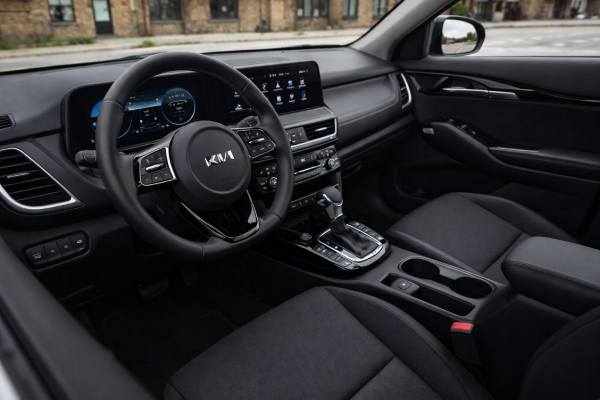

The 2024 facelift Kia Seltos AWD (SP2) with the 1.6-liter turbo is the “big-engine” choice in the lineup: it trades a little fuel economy for stronger passing power, a more confident merge feel, and better load tolerance when the cabin is full. The key engineering change for this version is not only the higher output (195 hp) but also the drivetrain pairing—an 8-speed automatic with an on-demand all-wheel drive system—aimed at smoother everyday behavior than some earlier dual-clutch setups used in certain markets and years.
Ownership tends to be straightforward if you treat it like a modern turbo direct-injection crossover: warm it up gently, keep the oil fresh, and stay ahead of recall completion and software updates. Do those basics well, and the Seltos can be a durable, easy-to-live-with compact SUV that feels a class above on powertrain refinement for the price.
What to Know
- Strong midrange pull and easier highway passing than the base 2.0-liter versions, especially at 80–120 km/h.
- AWD adds real traction in rain, slush, and steep gravel driveways without the weight and complexity of a true 4×4.
- The 8-speed automatic suits daily driving well and avoids the low-speed “grabby” feel some DCT setups can have.
- Plan for more frequent oil service than a naturally aspirated engine—short-trip driving is harder on turbo DI oil.
- Practical baseline: change engine oil and filter every 8,000 km (5,000 mi) or 6 months if you do lots of short trips.
Navigate this guide
- Kia Seltos facelift AWD explained
- Kia Seltos facelift tech specs
- Kia Seltos facelift trims and safety
- Reliability issues, recalls, and fixes
- Maintenance plan and buyer’s guide
- Driving character and real efficiency
- Rivals and smart alternatives
Kia Seltos facelift AWD explained
This 2024 facelift Seltos SP2 AWD sits in a sweet spot for drivers who want a compact crossover that doesn’t feel “small” when traffic opens up. The 1.6-liter turbo engine brings the kind of usable torque you notice most in real life: pulling away uphill without drama, overtaking without a full-throttle downshift, and holding speed on long grades with fewer gear changes. In day-to-day terms, it’s the Seltos variant that feels least strained when you drive it like a normal adult—with passengers, luggage, and a quick highway merge.
The AWD system is on-demand (not a true low-range 4×4), meaning it primarily drives the front wheels and sends torque rearward when slip is detected or when conditions suggest it’s helpful. That design keeps weight and friction losses lower than full-time AWD, but it also means you should set expectations correctly: it’s excellent for wet roundabouts, snowy residential streets, muddy campsite entrances, and stabilizing power delivery on rough pavement, but it won’t replace a dedicated off-road system for deep ruts or rock crawling.
The facelift matters, too. Beyond styling, a mid-cycle update often brings small but meaningful changes: revised software calibrations for transmission logic and driver-assistance systems, updated sensors, and incremental improvements in noise control. Those details don’t show up on a brochure line-item list, but they affect how “settled” a car feels over months of use. The 8-speed automatic pairing is especially important for owners who value smooth creeping in traffic, predictable low-speed response, and consistent behavior in stop-and-go commuting.
Where this Seltos is at its best:
- Mixed urban/suburban driving where torque and traction reduce effort.
- Regular highway use where passing performance matters.
- Variable climates (rain, snow, cold mornings) where AWD and modern stability control reduce stress.
Where it asks more of you as an owner:
- Like most turbo direct-injection engines, it rewards consistent oil changes and quality fuel.
- If you do very short trips, you should shorten maintenance intervals because oil contamination and moisture buildup happen faster in a turbo DI engine.
If you approach it as a modern, software-driven vehicle—keep it serviced, keep it updated, and don’t ignore warning lights—this specific powertrain setup can be one of the more satisfying “daily” configurations in the Seltos range.
Kia Seltos facelift tech specs
Below are specs focused on the 2024 facelift Seltos AWD with the 1.6-liter turbo and 8-speed automatic. Markets and trims can shift numbers slightly, so treat these as the core baseline for this configuration.
Powertrain and efficiency
| Item | Spec |
|---|---|
| Engine code | G4FP family (Smartstream 1.6 T-GDi) |
| Layout | Inline-4, turbocharged, direct injection (T-GDi) |
| Bore × stroke | 75.6 × 89.0 mm (2.98 × 3.50 in) |
| Displacement | 1.6 L (approx. 1,598 cc class) |
| Max power | 195 hp (145 kW) |
| Max torque | 264 Nm (195 lb-ft) |
| Induction | Single turbocharger |
| Rated efficiency (typical AWD 1.6T) | ~9.0 L/100 km combined (26 mpg US combined) |
| Real-world highway @ 120 km/h | Commonly lands around 8.5–10.0 L/100 km depending on wind, tyres, and temperature. |
Transmission and driveline
| Item | Spec |
|---|---|
| Transmission | 8-speed automatic |
| Drive type | On-demand AWD |
| Differential | Open diffs with brake-based traction control (typical for class) |
| AWD hardware | Multi-plate coupling with rear drive module (typical for this layout) |
Chassis and dimensions
| Item | Spec |
|---|---|
| Suspension (front/rear) | MacPherson strut / multi-link (AWD models) |
| Brakes (front/rear) | 305 mm (12.0 in) vented disc / 262 mm (10.3 in) solid disc |
| Popular tyre size (common on higher trims) | 235/45 R18 |
| Ground clearance | 185 mm (7.3 in) |
| Length / width / height | 4369 / 1801 / 1615 mm (172.0 / 70.9 / 63.6 in) |
| Wheelbase | 2629 mm (103.5 in) |
| Turning circle (kerb-to-kerb) | 10.6 m (34.8 ft) |
| Curb weight | ~1457–1506 kg (3,212–3,320 lb) |
| Fuel tank | 50.0 L (13.2 US gal / 11.0 UK gal) |
| Cargo volume | 753 L (26.6 ft³) seats up / 1,778 L (62.8 ft³) seats down |
Performance and capability
| Item | Spec |
|---|---|
| 0–60 mph | ~7.1 s (typical tested figure for this configuration) |
| 0–100 km/h | Typically mid-7s seconds (varies by surface and temperature) |
| Braking distance | Varies strongly by tyres and test method; performance tyres can shorten distances noticeably. |
| Towing capacity | Market- and equipment-dependent; verify for your VIN before planning towing. |
| Payload | Varies by trim/market; check door jamb label for your exact figure. |
Fluids and service capacities (decision-level guidance)
For fluids and torque values, always verify against official service information for your VIN and market. The items below are the most useful “what will it take to service?” checkpoints:
- Engine oil: use the viscosity and spec listed on the oil cap/handbook for your market; turbo DI engines generally prefer high-quality synthetic oils and shorter intervals under short-trip use.
- ATF: use the specified Kia/Hyundai automatic transmission fluid for the 8-speed unit; do not use “universal ATF.”
- AWD: rear drive module and coupling fluids (where serviceable) should be changed on a severe-duty schedule if you do lots of steep, low-speed climbing or deep winter use.
Kia Seltos facelift trims and safety
On the 2024 facelift Seltos, the 195 hp turbo AWD setup is usually tied to higher trims, because it’s positioned as the performance and “premium daily” option in the range. Trim names vary by market, but the pattern is consistent: base models emphasize value and fuel economy, while the turbo AWD models add stronger acceleration, larger wheels, and a higher chance of getting the full driver-assistance suite as standard.
Trims and options that actually change ownership
When you’re shopping this configuration, focus less on cosmetic badges and more on the mechanical and functional items that affect cost and feel:
- Wheel and tyre packages: 18-inch wheels with wider tyres look great and sharpen steering response, but they can raise tyre replacement costs and make pothole impacts harsher. If your roads are rough, a smaller wheel option (where available) often rides better and is less fragile.
- Seat material and heating/ventilation: heated seats are not just comfort; they reduce HVAC load in winter and can improve perceived efficiency because you don’t need as much cabin heat.
- Headlights: some trims use better-performing headlight units than others. Since headlights can be expensive, it’s worth confirming what’s fitted on your exact trim—especially if you do rural night driving.
- Infotainment and camera systems: higher trims may add a better camera setup and parking sensors. These reduce low-speed repair risk, which is an underappreciated ownership advantage.
Quick identifiers that help in real life:
- The turbo AWD models often have distinct wheel designs, more aggressive exterior trim, and (in some markets) unique badging.
- A test drive is revealing: the turbo model should feel notably stronger at 60–100 km/h than the naturally aspirated versions.
Safety ratings: what they mean for this model
Safety ratings can differ by test body, year, and market specification. A useful way to interpret them is to focus on the same three pillars across test organizations:
- Crashworthiness: structure and restraint performance in front/side impacts.
- Crash avoidance: AEB performance and lane-support behavior in standardized tests.
- Visibility: headlight performance (often varies by trim).
If you’re choosing between trims, headlights and the availability of the full ADAS suite can matter almost as much as the headline crash score, because those features work every day—not only in rare crash scenarios.
Driver assistance (ADAS): what to expect and how it affects service
Most 2024 facelift Seltos examples will have a modern baseline of safety tech, but the exact mix can still vary:
- AEB (automatic emergency braking): may include pedestrian detection; calibration and sensor cleanliness matter.
- Lane keeping / lane centering: can be sensitive to windshield replacements, wheel alignments, or camera disturbances.
- Blind-spot monitoring and rear cross-traffic alert: valuable in dense cities, but bumper repairs can require sensor aiming.
- Adaptive cruise control (if equipped): increases comfort on long drives; after front-end repairs, radar alignment can be required.
Ownership tip: if the car has had a windshield replacement or front bumper work, request proof of ADAS calibration. A correctly calibrated system doesn’t just reduce warning lights—it improves consistency and trust when you actually use the features.
Reliability issues, recalls, and fixes
No modern turbo crossover is “set and forget,” but the reliability profile is often predictable if you understand what tends to go wrong, when it shows up, and what the correct fix looks like. Below is a practical map of common concerns for a turbo AWD compact SUV like this Seltos configuration.
Common vs occasional vs rare (and what it costs)
Common (low to medium cost, often maintenance-linked)
- Oil dilution and accelerated oil degradation (short trips):
Symptoms: rising oil level, fuel smell in oil, rough cold idle.
Root cause: turbo DI engines run richer during warm-up; short trips don’t evaporate fuel and moisture.
Remedy: shorten oil intervals; ensure correct oil spec; occasional longer drive to fully warm the oil. - Intake valve deposits (DI carbon build-up):
Symptoms: mild hesitation, rough idle, reduced efficiency at higher mileage.
Root cause: direct injection doesn’t wash valves with fuel.
Remedy: quality fuel, keep the PCV system healthy, and clean only if symptoms develop.
Occasional (medium cost, depends on environment)
- Cooling system sensors and thermostats:
Symptoms: temperature swings, slow warm-up, check-engine light.
Root cause: modern electronically controlled cooling parts can fail with age/heat cycling.
Remedy: correct diagnostic scan; replace the faulty component rather than chasing coolant. - Turbo plumbing and boost leaks:
Symptoms: hiss under boost, reduced power, underboost codes.
Root cause: hose clamps, charge-pipe joints, or seals.
Remedy: pressure test the intake tract; fix the leak, then recheck.
Rare (higher cost)
- AWD coupling or rear drive module issues:
Symptoms: shudder, binding, AWD warning messages.
Root cause: fluid breakdown under severe use, mismatched tyres, or component wear.
Remedy: verify correct tyres (matching size and similar wear), check whether driveline fluids are serviceable on your version, and diagnose with factory scan tools.
Software and calibrations: don’t ignore the “invisible” fixes
On vehicles like this, software updates can resolve drivability quirks (shift logic, throttle mapping, sensor plausibility checks) that feel like hardware problems. If you notice odd shift timing, inconsistent stop-and-go response, or repeated ADAS warnings, check for ECU/TCU and camera/radar software updates before replacing parts.
Recalls and service actions: how to verify completion
Treat recall completion as part of your maintenance routine, not as “something the previous owner probably did.” Verification steps that work:
- Run an official VIN recall check for your market.
- Ask a dealer to print the vehicle’s campaign completion history.
- Keep the proof with your service records (it matters at resale).
Pre-purchase checks that pay off
If you’re buying used (or even “nearly new”), request:
- Full service history with dates and mileage.
- Evidence of correct oil interval discipline (turbo engines reveal neglect quickly).
- Tyre matching (brand/model and similar tread depth) to protect the AWD system.
- A diagnostic scan for stored/hidden codes—especially powertrain and ADAS modules.
A well-maintained turbo AWD Seltos tends to be a reliable daily driver; a neglected one tends to become an expensive guessing game. Your goal is to avoid the guessing game.
Maintenance plan and buyer’s guide
This section is designed to be used like a checklist. The exact interval and fluid spec can vary by market and VIN, but the structure below keeps you out of the common failure zones for turbo DI engines and AWD drivetrains.
Practical maintenance schedule (distance/time)
Every 8,000 km (5,000 mi) or 6 months (severe use / short trips)
- Engine oil and filter (turbo DI engines benefit from conservative intervals).
- Inspect coolant level and hoses.
- Inspect tyres (pressure and uneven wear) and rotate if needed.
Every 12,000–16,000 km (7,500–10,000 mi) or 12 months (normal use)
- Engine oil and filter (if you do longer trips and steady-state driving).
- Cabin air filter (more often if dusty/pollen-heavy region).
- Brake inspection (pads, rotor condition, slide pins).
Every 24,000–30,000 km (15,000–20,000 mi)
- Engine air filter (earlier in dusty environments).
- Full underbody inspection: CV boots, suspension bushings, exhaust hangers.
- Alignment check if tyre wear shows toe issues.
Every 48,000–60,000 km (30,000–40,000 mi)
- Brake fluid (time-based matters): typically every 2–3 years is a safe rhythm.
- Transmission fluid service: follow the factory schedule; consider earlier service if you tow (where allowed), drive mountainous routes, or do heavy city use.
Every 80,000–120,000 km (50,000–75,000 mi)
- Spark plugs (turbo engines are harder on plugs; misfires often show up first under boost).
- Coolant replacement per factory interval.
AWD-specific
- If the rear drive unit and coupling are serviceable in your market, treat fluid service as a “severe-use” item if you drive in deep winter conditions, on sand, or do steep low-speed climbs. Matching tyres front-to-rear is not optional for AWD longevity.
Fluid specifications and capacities (what to confirm)
Because specs vary by market, use this as a verification list rather than a promise:
- Engine oil: confirm viscosity and performance spec (the handbook and oil cap are your authority).
- Coolant: confirm the correct long-life coolant type and mix ratio.
- ATF: confirm the exact Kia/Hyundai ATF for the 8-speed automatic; do not mix fluids.
- Brake fluid: DOT rating per handbook (confirm before topping up).
- A/C refrigerant: type and charge quantity are system-specific—verify during service.
Essential torque values (decision-level, not a repair manual)
Owners typically need just a few “do not guess” torque numbers:
- Wheel lug nuts (use the factory spec for your wheel type).
- Spark plugs (especially important on aluminum heads).
- Drain plugs and filter housings (over-tightening causes expensive leaks).
If you do your own maintenance, invest in a reliable torque wrench and the correct service data for your VIN. That single habit prevents a large share of avoidable failures.
Buyer’s guide: what to seek and what to avoid
Seek
- Evidence of consistent oil changes (receipts matter).
- A trim with the headlight performance you want (night driving is a quality-of-life issue).
- Matching tyres with even wear—this protects the AWD system.
- Clean service history with documented recall completion.
Be cautious with
- Vehicles that have been tuned or modified for boost (higher stress and higher heat).
- A car with repeated warning lights cleared “just before sale.”
- Cheap mismatched tyres (often a sign of cost-cutting elsewhere).
Long-term durability outlook
If serviced on time, this powertrain configuration can hold up well. The biggest durability lever is not “luck”—it’s oil discipline, proper fluids, and avoiding AWD abuse through mismatched tyres or neglected driveline service.
Driving character and real efficiency
The reason to choose this Seltos variant is how it behaves when you ask more of it than gentle commuting. The turbo engine’s extra torque changes the rhythm of driving: you can stay in the flow of traffic with less throttle, fewer downshifts, and more confidence when a gap opens up.
Ride, handling, and NVH
For a compact crossover, the Seltos balances an upright seating position with reasonably controlled body motions. The AWD versions with multi-link rear suspension tend to feel more settled over mid-corner bumps than torsion-beam setups common in the segment. Steering is tuned for easy maneuvering, not sports-car feedback, but it tracks straight on highways and doesn’t require constant correction.
Noise, vibration, and harshness (NVH) is where the drivetrain pairing matters:
- The 8-speed automatic is generally smoother at low speed than many dual-clutch setups, especially when creeping in traffic or doing tight parking maneuvers.
- At highway speed, tyre choice becomes the dominant noise factor—wider 18-inch tyres often generate more road noise on rough pavement.
Powertrain character: what it feels like
Expect a responsive midrange rather than dramatic top-end power. Turbo engines shine in the 2,000–4,500 rpm band, which matches real-world passing needs. In normal driving, the transmission tends to upshift early for efficiency, then drop one or two gears when you request torque. If you use drive modes (where equipped), you’ll usually notice:
- Sharper throttle mapping in sportier modes.
- More eager downshifts and higher rev holding under load.
- Slightly more engine noise because the engine is kept in the power band.
Real-world efficiency: what owners usually see
As a practical expectation for this AWD turbo setup, many drivers land around 9–10 L/100 km combined in mixed use, with highway-only trips often better and short-trip city use often worse. Temperature and speed matter more than most owners expect: cold starts, short trips, and sustained high speeds have an outsized impact on fuel use in turbo direct-injection engines.
If you want to improve real-world efficiency without “hypermiling,” the best habits are boring: keep tyre pressures correct, avoid repeated hard accelerations from low speed, and don’t let oil and filters run past their service life.
Traction and control in poor weather
AWD doesn’t create grip—tyres do—but it helps you use available grip more effectively. With good all-season tyres (or proper winter tyres in snow regions), this Seltos configuration feels composed pulling away on slick roads and less nervous when you meet sudden puddles or slush ridges mid-corner. The stability control tuning is usually conservative, which is good for safety, but it can feel intrusive if you’re trying to power out of deep snow. In those cases, smooth inputs and momentum matter more than throttle.
Rivals and smart alternatives
The 2024 facelift Seltos AWD 1.6T sits in a crowded part of the market, but its personality is fairly clear: it’s a compact crossover that prioritizes usable power and everyday traction without moving into larger, heavier “near-midsize” territory. When comparing, focus on three things that change the ownership experience: drivetrain behavior in traffic, real-world efficiency at highway speeds, and the cost of tyres and brakes for your chosen wheel package.
Where the Seltos AWD 1.6T tends to win
- Passing performance for the class: 195 hp and a strong torque curve make it feel less breathless than many base engines in the segment.
- Drivetrain smoothness: the 8-speed automatic and turbo torque are a good daily combination if you dislike CVT “rubber band” feel.
- Packaging: strong cargo usability for its footprint, with a practical seats-down load area.
Where rivals can be stronger
- Fuel economy-focused options: some competitors with smaller turbo engines or hybrid systems will beat the Seltos on city consumption.
- Ride comfort on rough roads: rivals with smaller wheels or softer tuning may feel more forgiving in pothole-heavy areas.
- Safety-test specifics: depending on trim and headlight fitment, some competitors may score better in certain updated crash-test categories; always compare the exact model year and equipment level.
Smart comparison approach (quick checklist)
When cross-shopping, test these exact scenarios:
- Stop-and-go creep: does the transmission behave smoothly at 5–15 km/h?
- 80–120 km/h passing: does it downshift cleanly and pull without strain?
- Parking and visibility: do you trust the camera and sensors, and are repairs likely to be expensive?
- Night drive: are the headlights strong enough for your roads?
- Tyre replacement reality: price the tyres for the exact wheel size you’re considering before you buy.
Bottom line on choosing this configuration
Pick this Seltos if you value confident acceleration, predictable automatic transmission behavior, and extra traction in real weather. If your top priority is the lowest fuel cost per kilometer, or you drive mostly dense city routes with short trips, a more efficiency-focused rival (or a hybrid alternative) may suit you better. But if you want one compact crossover that covers a wide range of “normal life” driving without feeling underpowered, this turbo AWD setup is one of the more satisfying ways to spec the Seltos.
References
- 2024 Kia Seltos Specifications 2024 (Manufacturer Specifications)
- Gas Mileage of 2024 Kia Seltos 2024 (Official Fuel Economy Data)
- 2024 Kia Seltos 4-door SUV 2024 (Safety Rating)
- Check for Recalls: Vehicle, Car Seat, Tire, Equipment | NHTSA 2026 (Recall Database)
Disclaimer
This article is for informational purposes only and is not a substitute for professional diagnosis, inspection, or repair. Specifications, torque values, service intervals, and procedures can vary by VIN, market, production date, and installed equipment—always verify against the official documentation for your vehicle and follow manufacturer service guidance.
If this guide helped you, please consider sharing it on Facebook, X/Twitter, or your favorite community to support our work.