

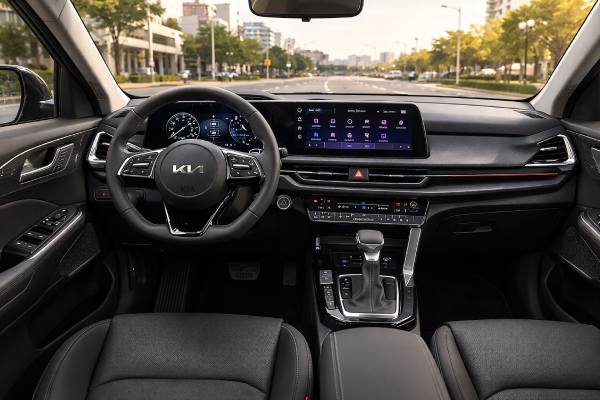

The 2026 facelift version of the Kia Seltos (SP2) with the 2.0-liter G4NH is the “sensible” powertrain choice in the lineup: a naturally aspirated four-cylinder tuned for smooth response, predictable maintenance, and long-term drivability rather than peak output. In most markets, this engine is paired with a simple front-drive layout or an on-demand AWD system and a comfort-focused chassis that prioritizes everyday stability, easy parking, and consistent brake feel.
What matters for owners is not just the headline power figure, but how the package behaves over time. The G4NH tends to be less sensitive to short-trip use than direct-injected turbo engines, and it usually rewards regular fluid service and cooling-system care with low drama. The facelift also brings updated driver assistance and infotainment details that affect safety calibration, sensor alignment, and repair costs after minor accidents.
What to Know
- Smooth, low-stress 2.0-liter power delivery that fits commuting and mixed driving well.
- Typically lower complexity than turbo-DI options, which can help long-term ownership.
- Practical size with easy city maneuvering and a family-friendly cargo area.
- Budget for periodic drivetrain fluid service if equipped with AWD, especially in hot/cold climates.
- Plan oil service at 8,000–10,000 km (or 6–12 months) in severe use (short trips, dust, heavy traffic).
Navigate this guide
- Kia Seltos SP2 2026 ownership and design
- Kia Seltos 2.0 G4NH specs and measurements
- Kia Seltos trims, equipment, and driver assist
- Common faults, recalls, and long-term durability
- Maintenance plan and smart buying checklist
- Real-world driving and efficiency
- Rivals: how this Seltos stacks up
Kia Seltos SP2 2026 ownership and design
The 2026–present facelift Seltos SP2 with the 2.0 G4NH is built around an ownership-friendly idea: keep the powertrain predictable, keep controls familiar, and let the vehicle’s value come from packaging and comfort rather than chasing class-leading performance. If you drive mostly in town, do mixed commuting, or prioritize low-effort operation, this engine and chassis combination makes sense because it behaves consistently across temperature swings and traffic patterns.
From an engineering standpoint, the naturally aspirated 2.0 avoids several cost drivers that show up later in turbocharged direct-injection vehicles: high boost heat load, turbo oil coking risk with short-trip use, and the “it feels great until it doesn’t” pattern that can happen when maintenance is deferred. That does not mean the G4NH is maintenance-free—it still needs clean oil, healthy cooling, and attention to belt and hose condition—but it typically responds well to routine care.
The facelift matters in subtle ownership ways. Updated front-end styling often comes with revisions to bumper structure, radar mounting, and camera placement. That changes how body shops must measure and align ADAS components after even minor front-end repairs. If the car has adaptive cruise control or lane centering, you should assume some calibration time (and cost) after windshield replacement, alignment work, or suspension repairs—especially if ride height changes due to worn springs or incorrect tire sizes.
On the road, this Seltos is usually tuned for calmness: moderate steering effort, a suspension setup that protects ride comfort on broken pavement, and stability-control programming that feels conservative in the wet. It is not an off-road vehicle, but if AWD is fitted it can add confidence on snowy starts and steep wet driveways. Think of AWD here as traction management, not rock-crawling hardware.
Who is it best for?
- Owners who want a simple daily driver that does not punish them for city miles.
- Buyers who keep cars 6–10 years and prefer predictable service costs.
- Drivers who value cabin practicality, safety tech, and resale stability over speed.
Kia Seltos 2.0 G4NH specs and measurements
Specs vary by market, transmission, tire package, and whether the vehicle is FWD or AWD. The tables below focus on the common configuration: SP2 facelift with the 2.0-liter G4NH around 147 hp, paired with an automatic/CVT-style transmission in most regions.
Powertrain and efficiency (typical market configuration)
| Item | Specification |
|---|---|
| Code | G4NH |
| Engine layout and cylinders | Inline-4 (I-4), DOHC, 16 valves (4/cyl) |
| Bore × stroke | ~81.0 × 97.0 mm (~3.19 × 3.82 in) |
| Displacement | 2.0 L (1,999 cc) |
| Induction | Naturally aspirated (NA) |
| Fuel system | MPI/port injection (market-dependent calibration) |
| Compression ratio | ~10–11:1 (varies by calibration) |
| Max power | ~147 hp (~110 kW) @ rpm (market-dependent) |
| Max torque | commonly ~180–190 Nm (~133–140 lb-ft) @ rpm (market-dependent) |
| Timing drive | Chain |
| Rated efficiency | commonly ~7.0–8.5 L/100 km (34–28 mpg US / 40–33 mpg UK), varies widely |
| Real-world highway @ 120 km/h | commonly ~7.5–9.0 L/100 km (31–26 mpg US / 38–31 mpg UK), tires and wind matter |
Transmission and driveline
| Item | Specification |
|---|---|
| Transmission | Typically CVT/IVT-type automatic; some markets offer a conventional automatic |
| Drive type | FWD common; AWD available in some markets |
| Differential | Open (traction managed via brake-based systems) |
Chassis and dimensions (SP2 platform typical)
| Item | Specification |
|---|---|
| Suspension (front/rear) | Front MacPherson strut / rear torsion beam or multi-link (varies by AWD and market) |
| Steering | Electric power steering |
| Brakes | 4-wheel discs common; sizes vary by trim |
| Wheels/tyres (popular size) | 215/60 R17 or 235/45 R18 (trim-dependent) |
| Ground clearance | commonly ~175–190 mm (~6.9–7.5 in), market-dependent |
| Length / width / height | ~4,385 / 1,800 / 1,620–1,645 mm (~172.6 / 70.9 / 63.8–64.8 in) |
| Wheelbase | ~2,630 mm (~103.5 in) |
| Turning circle (kerb-to-kerb) | commonly ~10.4–10.6 m (~34–35 ft) |
| Kerb (curb) weight | typically ~1,300–1,450 kg (~2,866–3,197 lb), AWD adds weight |
| Fuel tank | commonly ~50 L (~13.2 US gal / 11.0 UK gal) |
| Cargo volume | market method varies; typically ~700+ L seats up in VDA-style counting; larger seats-down |
Performance and capability (typical)
| Item | Specification |
|---|---|
| 0–100 km/h (0–62 mph) | commonly ~10.5–12.0 s (tire and transmission matter) |
| Top speed | typically ~175–190 km/h (109–118 mph) |
| Braking 100–0 km/h | commonly ~38–42 m (125–138 ft), tire-dependent |
| Towing capacity | often limited; commonly 0–1,200 kg depending on region and cooling package |
| Payload | typically ~400–550 kg (~882–1,213 lb), varies by GVWR |
Fluids and service capacities (check VIN-specific data)
| Item | Typical specification |
|---|---|
| Engine oil | API SP / ILSAC GF-6 (market equivalent); 0W-20 or 5W-30 by climate; capacity commonly ~4.0–4.5 L (4.2–4.8 US qt) |
| Coolant | Long-life ethylene-glycol, 50/50 mix; capacity varies |
| Transmission fluid | CVT/IVT-specific fluid only (do not substitute ATF) |
| Differential / transfer case (AWD) | Hypoid gear oil as specified; capacity varies |
| A/C refrigerant | R-1234yf or R-134a depending on region; charge varies |
Safety and driver assistance (availability varies)
| Item | Notes |
|---|---|
| Crash ratings | IIHS ratings depend on year/test version; some Seltos model years are covered under a multi-year rating page. Euro NCAP coverage is market-dependent and may not exist for some regions. |
| ADAS suite | AEB, lane keeping/centering, blind-spot monitoring, rear cross-traffic alert, driver attention monitoring; adaptive cruise is trim/market dependent |
Kia Seltos trims, equipment, and driver assist
For the 2026–present facelift Seltos SP2, trim structure is market-driven, so the best way to think about “trims” is by functional groups: wheels and tires, lighting, infotainment, and driver assistance hardware. Those groups affect not only comfort and safety, but also running costs—especially tires, alignments, and sensor calibration after repairs.
Trims and options: what actually changes
Most regions will offer a base or mid trim with smaller wheels (often 16–17 inches) and a higher trim with 18-inch wheels, more aggressive tires, and upgraded headlights. Bigger wheels can look great, but they usually bring higher tire cost, a bit more road noise, and greater sensitivity to pothole impacts. If your roads are rough, the “mid wheel” setup is often the sweet spot for ride and durability.
Infotainment and convenience equipment often scales by trim:
- Larger center display, built-in navigation (some markets), and improved phone integration
- Additional USB-C ports and faster charging, sometimes with wireless charging
- Premium audio on upper trims (and more speaker count)
- Heated/ventilated seats and driver seat memory where available
Mechanical and functional differences
With the G4NH 2.0, the biggest functional split is usually FWD versus AWD availability and rear suspension type. Some markets reserve multi-link rear suspension for AWD or higher trims. If you drive on broken pavement or want better body control in corners, the multi-link setup can feel more composed. The torsion-beam setup can still ride well, but it is more sensitive to rear-bushing wear and alignment changes after curb impacts.
Watch also for:
- Brake size and pad compound differences (higher trims may feel stronger under repeated stops)
- Cooling package differences (hot climate/towing prep may include different fans or radiators)
- Tire load rating differences (important if you carry heavy loads frequently)
Safety ratings: what to interpret carefully
Safety ratings depend on the testing body, the exact vehicle configuration, and the test year. A “good” rating on one year does not automatically mean an identical result on another year if the test protocol changed. For US-market vehicles, NHTSA data and IIHS ratings are the most relevant; for Europe, Euro NCAP applies only when the vehicle is sold and tested there. For markets without Euro NCAP testing, you should rely on local homologation standards and manufacturer safety equipment lists.
ADAS and calibration realities
Driver assistance is more than a checkbox list. It is a set of sensors that must see correctly:
- Forward camera (usually behind the windshield) needs correct glass and alignment
- Radar (often behind the grille area) can require calibration after bumper repairs
- Blind-spot sensors can be affected by rear quarter panel repairs or non-OEM paint thickness
- Lane centering performance depends heavily on tire wear and alignment
If you want the safest, least-hassle ownership setup, choose a trim where AEB and lane keeping are standard, and confirm the vehicle has had windshield replacements done correctly (OEM glass and calibration receipts are a big plus).
Common faults, recalls, and long-term durability
The facelift Seltos SP2 with the 2.0 G4NH generally aims at low drama, but any modern crossover can develop repeatable patterns. The most useful way to plan is to separate issues by how often they show up and how expensive they are when they do.
Common (low to medium cost)
- Battery and charging system weakness (12 V)
Symptoms: slow cranking, random warning lights, infotainment reboots.
Likely cause: aging battery, low-charge use pattern, poor ground connection.
Remedy: battery test under load, check charging voltage, clean grounds; replace battery typically within 4–6 years depending on climate. - Suspension wear noises
Symptoms: clunks over bumps, vague steering on-center.
Likely cause: stabilizer links, bushings, or top mounts wearing early on rough roads.
Remedy: replace links/bushings; check alignment and tire wear immediately after. - Brake vibration and uneven pad deposits
Symptoms: steering shake under braking from highway speeds.
Likely cause: uneven friction deposits due to gentle braking patterns or overheated pads.
Remedy: proper bedding procedure, rotor resurfacing/replacement if severe, use correct pad compound.
Occasional (medium cost)
- CVT/IVT drivability complaints (if equipped)
Symptoms: shudder on takeoff, “rubber band” feel, flare-like RPM behavior.
Likely cause: fluid degradation from heat, adaptive learning mismatch, or belt/chain wear.
Remedy: correct fluid service (use only specified fluid), perform adaptation relearn if supported; diagnose early—ignoring it can raise costs. - Cooling system maintenance sensitivity
Symptoms: temperature creep in traffic, heater performance changes, coolant smell.
Likely cause: low coolant, small leaks, aging hoses/clamps, poor bleeding after service.
Remedy: pressure test, correct coolant type and mix, proper bleeding procedure.
Rare (higher cost, but worth knowing)
- Timing chain noise or correlation faults
Symptoms: cold-start rattle, check-engine timing correlation codes, rough idle.
Likely cause: tensioner wear or chain stretch (rare when oil service is consistent).
Remedy: inspect with scan data and mechanical checks; replace components if out of spec. - ADAS sensor misalignment after repairs
Symptoms: lane system drifts, AEB warnings, adaptive cruise unavailable.
Likely cause: bumper/radar bracket misalignment, windshield camera angle error, poor alignment.
Remedy: verify mounting points and ride height, then calibrate with the correct procedure.
Recalls, TSBs, and how to verify
Recalls and service actions can change during a model’s life. Always verify by VIN through an official database and request dealer printouts showing completion. If you are importing a vehicle, note that regional recall coverage may not transfer cleanly across markets.
Pre-purchase checks that save money:
- Full service history with oil intervals that match real use (city miles = shorter intervals).
- Evidence of correct transmission fluid type and service (if CVT/IVT).
- Even tire wear and a recent alignment sheet (especially if ADAS is present).
- No unresolved warning lights and all driver assist features functioning in a test drive.
Maintenance plan and smart buying checklist
A simple maintenance plan is the single best reliability “mod” for the 2.0 G4NH Seltos. The goal is to protect the engine from oil degradation, keep the cooling system healthy, and—if equipped—keep the AWD and transmission fluids fresh enough to prevent heat-related wear.
Practical schedule (distance/time)
Use the shorter interval when you do short trips, heavy traffic, dust, steep hills, extreme heat/cold, or frequent idling.
| Item | Normal use | Severe use |
|---|---|---|
| Engine oil and filter | 10,000–12,000 km or 12 months | 6,000–8,000 km or 6 months |
| Tire rotation | 10,000–12,000 km | 8,000–10,000 km |
| Engine air filter | 20,000–30,000 km | 15,000–20,000 km (dusty areas) |
| Cabin air filter | 15,000–20,000 km | 10,000–15,000 km |
| Brake fluid | Every 2 years | Every 2 years |
| Coolant | 5 years/100,000 km typical first change | 4 years/80,000 km if harsh climate |
| Spark plugs | 60,000–100,000 km (type-dependent) | Earlier if misfire history |
| Transmission fluid (CVT/IVT) | 60,000–100,000 km if serviceable | 40,000–60,000 km if hot/stop-go |
| AWD coupling/diff fluids (if equipped) | 60,000–80,000 km | 40,000–60,000 km |
Fluids and specs (decision-level guidance)
- Engine oil: follow the oil grade specified for your climate; many markets favor 0W-20 for efficiency, but hot climates and high-load use sometimes justify 5W-30 where approved.
- Transmission: if CVT/IVT, do not use generic ATF—wrong fluid can create shudder and belt/chain wear.
- Coolant: use the specified long-life coolant and correct mix ratio; mixing types is a common source of sludge and heater issues.
Essential torque values (typical examples; verify per service manual)
| Fastener | Typical torque (range) |
|---|---|
| Wheel lug nuts | ~90–110 Nm (66–81 lb-ft) |
| Engine oil drain plug | ~25–35 Nm (18–26 lb-ft) |
Buyer’s checklist (15-minute walkaround + 15-minute drive)
- Cold start: listen for rattle, misfire, or unstable idle in the first 30 seconds.
- Transmission behavior: from a stop, the car should pull smoothly without shudder; gentle hill starts are revealing.
- Steering and braking: do several moderate stops from 70–90 km/h; feel for vibration.
- Tires: check for inside-edge wear (alignment) and mismatched brands/sizes (AWD stress).
- ADAS function: verify lane keeping warning, camera clarity, and no persistent sensor errors.
- Leaks and smells: check for coolant odor after a drive and oil seepage around the engine front and valve cover area.
Long-term durability outlook: With consistent oil service, correct transmission fluid practices, and basic suspension upkeep, this powertrain is usually a strong “keep it a decade” candidate. The biggest cost surprises tend to come from neglected driveline fluids (AWD/CVT) and repair-quality issues after accidents, not from the base engine design.
Real-world driving and efficiency
The 2.0 G4NH Seltos is not built to feel fast; it is built to feel easy. The throttle mapping is typically mild at small pedal angles, which helps smooth city driving and reduces wheelspin on wet paint lines. When you ask for full acceleration, the engine works best in the midrange; it does not have the effortless surge of a turbo, so passing maneuvers reward planning.
Ride, handling, and NVH
- Ride: Generally compliant over small bumps, with sharper impacts depending on wheel size. If your roads are rough, 17-inch wheels often feel noticeably calmer than 18s.
- Handling: Neutral and confidence-first. It will not feel sporty, but it usually tracks straight on the highway and remains stable in crosswinds for the class.
- Steering: Light to moderate effort with predictable response. Feedback is limited (normal for electric steering), but the on-center zone is usually easy to place.
- Cabin noise: Expect more tire noise as wheel size increases. Roof racks and aggressive tires can add noticeable highway hum.
Powertrain character
If equipped with a CVT/IVT-style transmission, the vehicle may hold RPM under acceleration rather than “stepping” through gears. That behavior is normal, but it should not feel like shuddering or slipping. Drive modes can change the feel more than the raw output: “Eco” often softens throttle and relaxes transmission response, while “Sport” tends to sharpen pedal mapping and hold higher RPM.
Real-world efficiency expectations
Your actual fuel use is dominated by speed and tire choice:
- City-heavy use: commonly ~8.5–10.5 L/100 km (28–22 mpg US / 33–27 mpg UK)
- Highway 100–120 km/h: commonly ~7.5–9.0 L/100 km (31–26 mpg US / 38–31 mpg UK)
- Mixed commuting: commonly ~8.0–9.5 L/100 km (29–25 mpg US / 35–30 mpg UK)
Cold weather usually adds a meaningful penalty because the engine must warm up and the cabin heat demand rises. Short trips can push consumption dramatically higher than longer commutes, even if you drive gently.
Traction and control (if AWD)
On-demand AWD systems in this class typically prioritize efficiency and only send significant torque rearward when slip is detected or when certain modes request it. In snow, the biggest factor is still tires. Good winter tires will outperform AWD on all-seasons in most real conditions. If you live in a hilly area with frequent rain or snow, AWD adds convenience and reduces wheelspin, but it does not turn the Seltos into a trail vehicle.
If towing is permitted in your market, keep loads modest and watch temperatures on long grades. Naturally aspirated engines can feel strained at altitude, so plan passing distances and avoid sustained wide-open throttle when heavily loaded.
Rivals: how this Seltos stacks up
The compact crossover class is crowded, so the right comparison depends on what you value: interior packaging, ride comfort, AWD capability, or long-term operating costs. The 2.0 G4NH Seltos tends to compete best on “daily livability” rather than outright speed.
Versus comfort-and-space rivals
- Honda HR-V / Toyota Corolla Cross: These often emphasize refinement and resale value. The Seltos usually answers with a roomier-feeling cabin for its footprint and strong feature value on mid trims. If you prioritize a calm ride and simple controls, all are good; if you want more tech per dollar, Seltos trims can be compelling.
- Hyundai Kona: Often feels more “tech-forward” and can have different powertrain choices. The Seltos generally leans more practical in rear-seat space and cargo friendliness.
Versus “driving feel” rivals
- Mazda CX-30: Tends to feel more premium and more connected in steering/handling. The tradeoff is often tighter rear space and sometimes higher parts cost. If driving enjoyment matters most, CX-30 is strong; if passenger space matters, Seltos is usually easier to live with.
- Subaru Crosstrek: Strong reputation for standard AWD (depending on market) and outdoor-friendly packaging. The Seltos often counters with more modern infotainment layouts and a quieter, more city-oriented tuning. Crosstrek can be the better “rough road” pick; Seltos can be the better “urban comfort” pick.
Versus turbo-focused competitors
- VW Taos and similar small turbos: Turbo competitors can feel stronger in passing and at altitude, but that performance can come with higher sensitivity to oil quality, heat management, and long-term component complexity. If your priority is keeping the car a long time with predictable service, the naturally aspirated 2.0 Seltos remains a rational choice.
Bottom-line advantage summary
Choose this Seltos if you want:
- A calm daily driver with straightforward power delivery
- Lower complexity than turbo-DI options in typical use
- A practical cabin and good feature packaging, especially mid trims
Consider another rival if you need:
- Strong acceleration at highway speeds or high altitude
- Maximum off-pavement confidence (true AWD-first platforms)
- Premium interior feel above value-focused trims
References
- 2023 Kia Seltos 4-door SUV 2023 (Safety Rating)
- Check for Recalls: Vehicle, Car Seat, Tire, Equipment | NHTSA 2026 (Recall Database)
- Seltos | Kia India 2026 (Manufacturer Specifications)
- Kia Cars Owner’s Manual | Sonet | Seltos | Carens 2026 (Owner’s Manual)
Disclaimer
This article is for informational purposes only and is not a substitute for professional diagnosis, inspection, or repair. Specifications, torque values, service intervals, and procedures vary by VIN, market, model year, and equipment; always verify details using official manufacturer service information and the documentation for your exact vehicle.
If this guide helped you, please consider sharing it on Facebook, X (Twitter), or your favorite forum to support our work.