

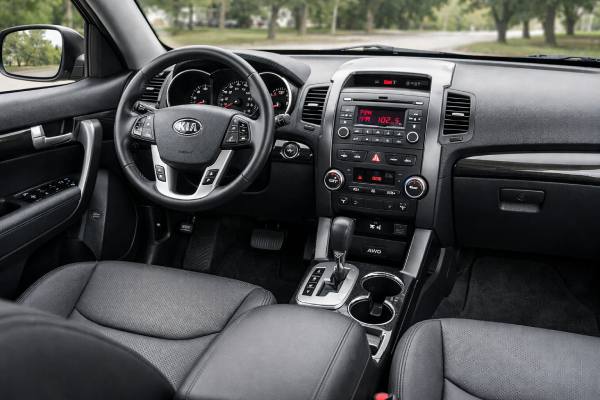
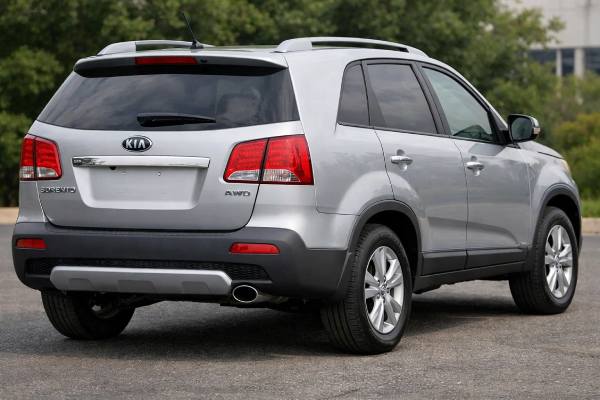
The 2011–2012 Sorento XM with the 3.5-liter G6DC V6 is the “muscle” option in this generation: smooth, strong at highway speeds, and well matched to Kia’s 6-speed automatic. In many markets, listings call the 2WD version “RWD,” but the XM Sorento is fundamentally a front-engine, transverse crossover—so most 2WD examples are front-driven rather than true rear-wheel drive. The practical takeaway is still useful: fewer driveline parts than AWD, a bit less weight, and simpler maintenance.
Ownership success with the V6 is mostly about heat and fluids. Keep the cooling system healthy, don’t ignore small oil leaks, and service the transmission on a realistic schedule if the car sees city driving, hills, or towing. Do that, and this configuration can be a durable, family-friendly SUV with confident passing power.
Owner Snapshot
- Strong, quiet V6 that makes highway merging and overtakes easy, even with passengers.
- Simpler driveline than AWD versions, which can reduce long-term driveline wear and fluid services.
- Solid cabin and cargo flexibility, especially with the optional third row.
- Budget for age-related rubber and cooling-system work (hoses, thermostat, radiator tanks) as mileage rises.
- Plan oil changes every 10,000–12,000 km (6,000–7,500 mi) or 12 months (shorter under severe use).
Contents and shortcuts
- Sorento XM V6 buyer’s overview
- Sorento XM G6DC specs and measurements
- Sorento XM trims, packages, and safety gear
- Known issues, recalls, and service bulletins
- Maintenance plan and smart buying checklist
- Real-world driving and performance notes
- How this Sorento stacks up against rivals
Sorento XM V6 buyer’s overview
If you’re shopping the 2011–2012 Sorento XM range, the 3.5 G6DC V6 sits at the top of the “effortless daily driver” spectrum. The engine is naturally aspirated, so power delivery is linear—no turbo lag, no sudden surges, just steady pull that builds as revs climb. That character matters in real life: it feels calmer when merging into fast traffic, and it doesn’t need downshifts as often as the four-cylinder versions when the cabin is full.
The V6 also changes how the chassis feels. Because it adds weight up front, the Sorento tends to feel more planted at speed, but slightly less eager in tight corners than lighter configurations. Good tires and fresh dampers make a bigger difference than most people expect on a 10+ year-old SUV: the XM platform responds well to quality replacement shocks/struts and correct alignment.
About the “RWD” label: many classified listings use “RWD” as shorthand for “not AWD.” On the XM Sorento, true rear-drive architecture is not the norm. For buyers, the important distinction is still clear—2WD vs AWD—because it affects traction, tire wear patterns, fluid service needs, and some repair costs. A 2WD Sorento generally has fewer components to age (no rear differential, no transfer case, no coupling), which can be a long-term advantage if you don’t need extra traction.
Where the V6 Sorento XM makes the most sense:
- Highway-heavy commuting where relaxed passing power matters.
- Family duty with frequent passengers and cargo.
- Light-to-moderate towing (market equipment and ratings vary).
Where you should be cautious:
- If the vehicle has unknown transmission service history, especially with lots of city use.
- If it shows signs of overheating or repeated coolant top-ups—fixing heat-related neglect can get expensive fast.
Sorento XM G6DC specs and measurements
Below are practical, commonly seen specifications for the 2011–2012 Sorento XM with the 3.5 G6DC V6 and 2WD (“RWD” in some listings). Exact figures can vary by market, trim, wheel size, and seating configuration—use the tables as a decision guide, then confirm by VIN.
Powertrain and efficiency
| Item | Specification |
|---|---|
| Engine code | G6DC |
| Layout | Front-engine, transverse |
| Cylinders / valvetrain | V6, DOHC, 24 valves (4 valves/cyl) |
| Displacement | 3.5 L (3,470 cc) |
| Induction | Naturally aspirated |
| Fuel system | Multi-point injection (MPI) |
| Compression ratio | ~10.0–10.5:1 (market-dependent) |
| Max power | 276 hp (206 kW) @ ~6,300 rpm |
| Max torque | ~336 Nm (248 lb-ft) @ ~5,000 rpm |
| Timing drive | Chain |
| Rated efficiency (typical) | ~10.5–11.5 L/100 km (22–20 mpg US / 27–25 mpg UK) combined, setup dependent |
| Real-world highway @ 120 km/h | ~9.0–10.5 L/100 km (26–22 mpg US / 31–27 mpg UK) with correct tires and alignment |
Transmission and driveline
| Item | Specification |
|---|---|
| Transmission | 6-speed automatic (common), manual mode |
| Drive type | 2WD (commonly front-wheel drive on this platform) |
| Differential | Open |
Chassis and dimensions (typical XM range)
| Item | Typical value / range |
|---|---|
| Suspension (front/rear) | MacPherson strut / multi-link |
| Steering | Electric power steering (EPS) |
| Brakes | 4-wheel discs (sizes vary by trim) |
| Common tire sizes | 235/65 R17, 235/60 R18, 235/55 R19 |
| Ground clearance | ~184–185 mm (7.2–7.3 in), trim dependent |
| Length / width / height | ~4,685–4,700 / ~1,885 / ~1,710–1,745 mm |
| Wheelbase | ~2,700 mm (106.3 in) |
| Turning circle | ~10.8–11.0 m (35–36 ft) |
| Curb weight | ~1,750–1,900 kg (3,850–4,190 lb), configuration dependent |
| Fuel tank | ~64 L (16.9 US gal / 14.1 UK gal), market dependent |
Performance and capability (typical)
| Item | Typical result |
|---|---|
| 0–100 km/h (0–62 mph) | ~8.5–9.5 s |
| Top speed | ~190 km/h (118 mph) |
| Braking 100–0 km/h | ~38–42 m (tires and brakes dependent) |
| Towing capacity | Often up to ~1,587 kg (3,500 lb) when properly equipped (verify by VIN/market) |
| Payload | Often ~500–650 kg (1,100–1,430 lb), equipment dependent |
Fluids and service capacities (verify by VIN)
| Fluid | Spec (typical) | Capacity (approx.) |
|---|---|---|
| Engine oil | API SN+/SP-equivalent; commonly 5W-20 or 5W-30 by climate | ~5.0–5.5 L (5.3–5.8 US qt) with filter |
| Coolant | Long-life OAT/HOAT family (market-specific) | ~7–9 L total system |
| ATF | OEM-spec fluid required (commonly SP-IV family in this era) | Total ~7–9 L; service fill is less |
| A/C refrigerant | R-134a | Charge per under-hood label |
Key torque specs (typical ranges; verify in official documentation):
- Wheel lug nuts: 90–110 Nm (66–81 lb-ft)
- Spark plugs: 18–22 Nm (13–16 lb-ft)
- Engine oil drain plug: 35–45 Nm (26–33 lb-ft)
Sorento XM trims, packages, and safety gear
Trim naming varies by region, but most 2011–2012 Sorento XM lineups follow the same logic: base trims focus on value, mid trims add the comfort features most people actually use, and top trims bundle appearance and convenience upgrades.
Trims and options that affect ownership
- Wheel size choices (17/18/19 inches): Larger wheels sharpen initial turn-in but cost more in tires and can make the ride harsher as shocks age. For long-term comfort and cost control, 17–18 inch setups are usually easiest to live with.
- 5-seat vs 7-seat configuration: The optional third row is best for occasional use. Check the rear seat latches and cargo-floor panels for damage, and expect higher wear on rear suspension components if the vehicle has lived a heavily loaded life.
- Tow package: Proper wiring integration matters. A poorly installed aftermarket harness can cause electrical gremlins. If towing is a priority, look for a clean, fused installation and evidence of regular transmission servicing.
- Infotainment tiers: Older navigation units can be slow. Make sure Bluetooth pairing, steering-wheel controls, and backup camera (if equipped) work reliably.
Quick identifiers when listings are vague:
- Badges and VIN data are the only dependable way to confirm engine and driveline. Visual cues (wheels, exhaust tips, interior trim) can mislead because parts swap easily.
- On test drive, the V6 should feel smooth and eager above midrange rpm, without surging, misfires, or heavy vibration.
Safety ratings and what matters for shoppers
This Sorento era performs well for its time, but always interpret ratings within the test-year context. More important than the headline rating is the real-world state of the car you’re buying:
- Tire quality and matching sets matter because stability control depends on predictable grip.
- Brake maintenance matters because the ABS/ESC system is only as good as the hydraulic hardware behind it.
- Structural repair quality matters if the vehicle has had crash work. Uneven panel gaps, overspray, and inconsistent paint texture deserve extra scrutiny.
Safety systems and driver assistance (ADAS)
For 2011–2012, most “active safety” is stability-based rather than camera/radar-based:
- ABS, ESC, traction control, and brake assist are typical.
- Multiple airbags (front, side, and curtain) are common, but exact counts vary by market and trim.
- ISOFIX/LATCH anchors are typically provided; confirm accessibility and that anchor points have not been bent by improper installations.
Service note: if an ABS/ESC warning light is present, do not treat it as optional. Wheel speed sensors, wiring, and tone rings are common causes, but unresolved faults reduce both safety and drivability on slick roads.
Known issues, recalls, and service bulletins
At 10+ years old, most Sorento XM V6 issues fall into the “aging components plus maintenance gaps” category. The goal is to spot patterns early and fix root causes before they cascade into expensive repairs.
Common issues (likely) — low to medium cost
- Valve cover gasket seepage
Symptoms: Oil smell after driving, light oil film around the rear of the engine, drips on splash shields.
Root cause: Heat-cycled rubber gaskets harden and lose clamp load over time.
Remedy: Reseal valve covers, inspect PCV system, and clean the area so you can monitor future leaks accurately. - Cooling system aging
Symptoms: Coolant smell, dampness at hose joints, crusty deposits near the radiator corners, occasional temperature creep under load.
Root cause: Rubber hoses soften, clamps lose tension, and plastic tanks age. Thermostats can stick.
Remedy: Pressure test, replace weak hoses/thermostat proactively, flush/refill with the correct coolant type, and ensure proper bleed procedure. - Suspension wear (bushings and links)
Symptoms: Clunks over bumps, unstable braking feel, wandering steering, uneven tire wear.
Root cause: Rubber bushings and ball joints degrade with age and road salt exposure.
Remedy: Inspect with load on the suspension, replace worn arms/links, then align.
Occasional issues — medium cost
- 6-speed automatic shift complaints
Symptoms: Delayed engagement, shift flare, shudder at steady speeds, harsh downshifts.
Root cause: Aged ATF, adaptation learned on degraded fluid, early torque converter clutch wear, or software-related shift strategy differences.
Remedy: Verify no stored transmission codes, check fluid condition, then service with the correct fluid spec. If shudder persists after proper service, deeper diagnosis is needed before parts replacement. - EPS noises or steering knock
Symptoms: Light knocking through the wheel on rough surfaces, intermittent heaviness.
Root cause: Wear in intermediate shaft joints, column couplers, or (less commonly) rack components.
Remedy: Inspect the simple mechanical interfaces first; avoid replacing the rack without proof.
Rare but high severity
- Overheating with secondary damage
Symptoms: Recurrent coolant loss, misfires after a heat event, contaminated fluids, repeated temperature spikes.
Root cause: Continued driving while hot, poor prior repairs, compromised sealing surfaces.
Remedy: Treat overheating history as a major risk unless documented professional repair and stable temperatures are proven.
Recalls and service actions: verification process
Because campaigns vary by region and VIN range, follow a consistent process:
- Run an official VIN recall check for your country.
- Ask for dealer service history printouts if possible.
- Scan the car for stored/pending codes across modules, not just the engine ECU.
A good used example will have documentation of completed actions and a service trail that matches its mileage and condition.
Maintenance plan and smart buying checklist
The best maintenance strategy for a Sorento XM V6 is preventive: keep fluids fresh, keep the cooling system healthy, and renew wear items before they create secondary problems. Use the shorter of distance or time.
Practical maintenance schedule
| Item | Interval | Notes |
|---|---|---|
| Engine oil and filter | 10,000–12,000 km or 12 months | Severe use: 6,000–8,000 km; consistent oil changes support timing chains and cam phasers |
| Engine air filter | Inspect 15,000 km; replace 30,000–45,000 km | Sooner in dust |
| Cabin air filter | 15,000–30,000 km | Helps HVAC performance |
| Coolant | 5 years / 100,000 km (typical) | If unknown history, refresh and reset baseline |
| Spark plugs (iridium) | 150,000–170,000 km (typical) | Earlier if misfire symptoms appear |
| Serpentine belt/tensioner | Inspect 30,000 km; replace ~100,000–140,000 km | Also inspect idlers |
| Automatic transmission fluid | 60,000–80,000 km | Sooner with heat, hills, or towing |
| Brake fluid | Every 2 years | Protects ABS/ESC hydraulics |
| Brake inspection | 15,000 km | Check slider pins and pad taper |
| Tire rotation | 8,000–10,000 km | Keep a matching set to protect handling |
| Alignment check | Yearly or with tire wear | Prevents noise and instability |
| 12 V battery test | Annually after year 4 | Replace when weak; low voltage can trigger false faults |
Essential fluid and parts guidance
- Use the exact ATF spec the transmission requires. Mixing “universal” fluids is a common cause of shift quality problems.
- Coolant chemistry matters. Mixing types can reduce corrosion protection. If you’re unsure what’s in the system, drain, flush, and refill correctly rather than topping off with a random bottle.
- Tires are a safety system. Choose a quality tire with the proper load rating and keep pressures correct. Old, hardened tires can make the Sorento feel unstable even when suspension parts are fine.
Buyer’s guide: what to check before purchase
- Cold start: Listen for prolonged rattles (beyond a brief startup moment), belt squeal, or uneven idle.
- Temperature stability: Let it warm fully. The needle should stay steady under load with the heater on.
- Transmission: Smooth engagement into Drive/Reverse and consistent shifting under light and moderate throttle.
- Suspension and steering: No sharp clunks; steering should return smoothly to center.
- Underbody: Check for oil leaks, coolant traces, exhaust corrosion, and damaged undertrays hiding seepage.
- Electronics: Confirm HVAC modes, windows, locks, and infotainment functions.
Durability outlook: with realistic fluid intervals and cooling system care, the V6 Sorento XM can age well. The cost spikes usually come from neglect—overheating episodes, old ATF, or driving on worn suspension until tires and steering components are damaged.
Real-world driving and performance notes
The G6DC V6 gives the Sorento XM a refined, confident personality. Around town it’s easy to drive smoothly because throttle response is linear and predictable. On the highway, it feels relaxed at speed and has enough reserve power to pass without drama.
Ride, handling, and NVH
- Ride quality: Best on smaller wheels with taller sidewalls. If the car “thumps” over sharp edges, suspect worn shocks/struts or overinflated tires before blaming the platform.
- Cornering: Secure and predictable. It’s not sporty, but it holds a line well when suspension bushings are healthy.
- Braking feel: Typically solid. If the pedal feels soft or inconsistent, brake fluid age and caliper slider condition are common culprits.
- Noise: The V6 is usually quiet under steady throttle. Road noise is more tire-dependent than engine-dependent.
Powertrain character and transmission logic
A healthy 6-speed automatic should:
- Upshift smoothly in light driving.
- Downshift promptly when you ask for passing power.
- Avoid repeated gear hunting on gentle grades.
If it hunts, shudders, or hesitates, treat it as a diagnostic clue, not “just how it is.” Many issues are fixable early with correct fluid service and sensor checks, but ignoring them can lead to larger transmission work later.
Real-world fuel economy
For most owners, the V6 Sorento’s fuel use is speed-sensitive:
- City short trips: ~12–14 L/100 km (17–20 mpg US / 20–24 mpg UK)
- Highway 100–120 km/h: ~9–10.5 L/100 km (22–26 mpg US / 27–31 mpg UK)
- Mixed: ~10.5–12.5 L/100 km (19–22 mpg US / 23–27 mpg UK)
Cold weather, roof boxes, and heavy all-season tires can push numbers higher. Alignment and tire choice can also swing consumption more than many owners expect.
Load and towing behavior
With the V6, moderate towing feels natural, but you should plan for:
- A meaningful fuel penalty (often +20–40% depending on speed and trailer size).
- Greater thermal stress on the transmission, which is why ATF service intervals should be shorter for tow vehicles.
- Better stability when the trailer is loaded correctly and the suspension is not worn.
How this Sorento stacks up against rivals
The Sorento XM V6 2WD offers a strong mix of power and practicality at used-market prices that are often attractive. But rivals can outperform it in specific categories depending on what you value most.
Versus larger three-row family SUVs
- Bigger rivals (Highlander/Pilot class): Often have a more comfortable third row and a more “big family hauler” feel. They can also cost more to buy and maintain depending on local parts pricing and market demand.
- Sorento advantage: Typically easier to park and often better value for similar mileage and condition.
Versus two-row crossovers
- Simpler rivals (CR-V/RAV4 class): Usually cheaper to fuel and sometimes cheaper to maintain, especially in four-cylinder form.
- Sorento advantage: The V6 delivers stronger highway performance and load handling, which matters if you carry passengers or tow.
Versus platform-adjacent competitors
- Santa Fe (same era): Often very similar in mission. The best approach is to shop both and buy the cleaner example with better maintenance documentation.
Why condition beats the spec sheet
At this age, the deciding factor is rarely “which model is best.” It’s:
- Cooling system health
- Transmission behavior and service history
- Suspension condition and tire quality
- Evidence of consistent maintenance
If those boxes are checked, the Sorento XM V6 2WD can be a satisfying, durable ownership choice with strong real-world performance and a straightforward maintenance path.
References
- Vehicle Detail Search – 2011 KIA SORENTO 2026 (Recall Database)
- 2011 Kia Sorento – IIHS 2026 (Safety Rating)
- 2011 Kia Sorento 2026 (Fuel Economy)
- Owner’s Manuals and Documents 2026 (Owner’s Manual)
- Kia Sorento 2009 (Safety Rating)
Disclaimer
This article is for informational purposes only and is not a substitute for professional diagnosis, inspection, or repair. Specifications, torque values, service intervals, and procedures vary by VIN, market, production date, and installed equipment—always verify details using official owner/service documentation for your exact vehicle and follow manufacturer procedures.
If this guide helped, please consider sharing it on Facebook, X (Twitter), or your favorite forum to support our work.