
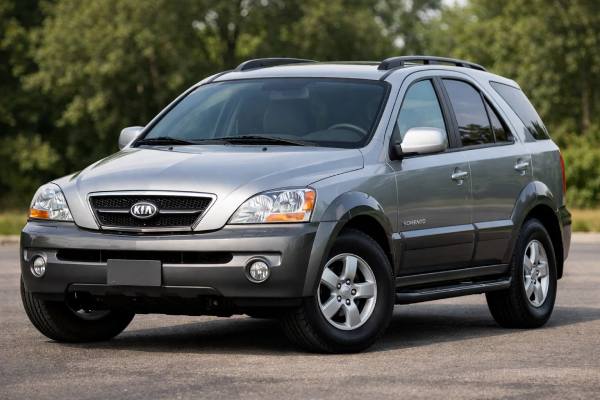
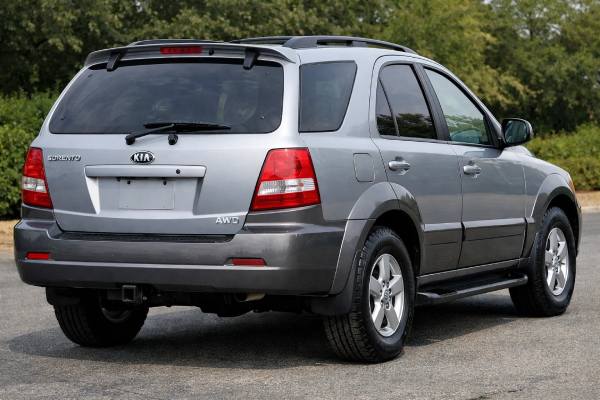
The 2002–2006 Kia Sorento BL with the 3.5 V6 (G6CU) and AWD is one of the more “truck-like” midsize SUVs of its era. It uses body-on-frame construction, a strong low-range capable AWD/4WD system (market-dependent), and a simple, naturally aspirated V6 paired to a conventional automatic. That recipe makes it appealing for buyers who want real towing ability, rough-road durability, and straightforward servicing—without the complexity of modern turbo engines or multi-clutch AWD.
Ownership, however, is less about chasing high tech and more about staying ahead of age-related maintenance: timing belt service, cooling system health, drivetrain fluids (especially transfer case and differentials), and corrosion prevention. Get those basics right and the Sorento can be a dependable workhorse. Skip them and it can become an expensive project, particularly if previous owners used it for towing or winter driving.
Top Highlights
- Body-on-frame layout and low-range capability suit towing, bad roads, and light off-road use better than many crossover SUVs.
- The 3.5 V6 is smooth and predictable, with strong mid-range pull for highway merging and loaded driving.
- Drivetrain fluid care matters: transfer case and both differentials should be serviced on a schedule, not “lifetime.”
- Plan for a timing belt service about every 90,000 km (60,000 mi) or 6 years (whichever comes first).
- Rust protection is an ownership advantage multiplier—wash the underbody in winter and treat corrosion early.
Section overview
- Sorento BL AWD V6 explained
- Sorento BL AWD 3.5 data
- Sorento BL AWD equipment and safety
- Fault patterns and campaigns
- Service plan and purchase check
- Real driving and economy
- Against similar SUVs
Sorento BL AWD V6 explained
This Sorento sits in a shrinking category: a midsize SUV that feels engineered for load, longevity, and traction rather than pure comfort. The BL Sorento uses a ladder-frame (body-on-frame) structure, which generally tolerates towing stresses and rough surfaces better than a unibody crossover. You’ll notice that in the way the vehicle carries weight: it tends to feel stable with passengers and cargo, and it can handle a trailer with less “soft” movement through the rear structure than many car-based SUVs from the same period.
The G6CU 3.5 V6 is a naturally aspirated 24-valve engine that prioritizes smoothness and usable torque over high-rev power. In practical terms, it pulls strongly from low-to-mid rpm, which is exactly what a heavy SUV needs. Paired with a traditional torque-converter automatic, the power delivery is easy to modulate in traffic, on gravel, and when backing up a trailer. It is not quick by modern standards, but it is consistent and predictable.
The “AWD” label in listings can be confusing on older Sorentos because market names varied. Many are effectively a 4WD system with driver-selectable modes (often including low range), while others use an on-demand torque split system that behaves more like modern AWD until additional traction is needed. Either way, the key ownership point is the same: there are more moving parts than a 2WD model—front differential, transfer case, additional driveshafts and CV joints—so fluid maintenance and leak checks matter more.
Where the Sorento shines is honest utility: ground clearance that suits rutted tracks, gearing that helps on steep grades (when low range is present), and a chassis that can take years of real-world use. Where it asks more from you is upkeep discipline: timing belt intervals, cooling system condition, and drivetrain fluids decide whether this is a dependable tool or a constant repair list.
Sorento BL AWD 3.5 data
Below is a practical spec set for the 2002–2006 Sorento BL AWD with the G6CU 3.5 V6. Values can vary by market, emissions calibration, gearbox version, tyre size, and trim. Use this as a planning baseline and verify against VIN-specific documentation.
Powertrain and efficiency
| Item | Specification |
|---|---|
| Engine code | G6CU |
| Layout | V6, naturally aspirated |
| Valvetrain | DOHC, 24 valves (4 valves/cyl) |
| Displacement | 3.5 L (≈ 3497 cc) |
| Bore × stroke | ≈ 93.0 × 85.8 mm (≈ 3.66 × 3.38 in) |
| Fuel system | MPFI (multi-port fuel injection) |
| Compression ratio | ≈ 10.0:1 (market-dependent) |
| Max power | 139 kW (192 hp) @ ~5,500 rpm (typical) |
| Max torque | ~290–300 Nm (~214–221 lb-ft) @ ~3,000–3,500 rpm (typical) |
| Timing drive | Belt |
| Rated efficiency | commonly ~13–15 L/100 km combined (18–15 mpg US) depending on gearing/tyres |
| Real-world highway @ 120 km/h | often ~10.5–12.5 L/100 km (22–19 mpg US) if mechanically healthy |
Transmission and driveline
| Item | Specification |
|---|---|
| Transmission | 4-speed automatic (typical for this generation/engine) |
| Drive type | AWD/4WD (market and trim dependent) |
| Transfer case | Present on many trims; some include low range (verify by selector and tag) |
| Differentials | Front + rear final drives; typically open diffs |
Chassis and dimensions
| Item | Specification |
|---|---|
| Platform/structure | Body-on-frame SUV |
| Suspension (front/rear) | Independent front / solid rear axle with links (common configuration) |
| Steering | Power-assisted rack-and-pinion (typical); ratio varies |
| Brakes | Ventilated front discs / rear discs (typical); sizes vary by trim |
| Common tyre sizes | Often 235/70 R16 or 245/70 R16 (market dependent) |
| Ground clearance | commonly ~200 mm (~7.9 in) class |
| Length / width / height | approx. 4,570 / 1,860 / 1,730 mm (≈ 180 / 73 / 68 in) class |
| Wheelbase | approx. 2,710 mm (≈ 106.7 in) class |
| Turning circle | typically ~11–12 m (≈ 36–39 ft), tyre dependent |
| Curb weight | often ~1,850–1,980 kg (≈ 4,080–4,365 lb), trim dependent |
| Fuel tank | commonly ~75 L (≈ 19.8 US gal / 16.5 UK gal) class |
Performance and capability (typical expectations)
| Item | Typical range |
|---|---|
| 0–100 km/h (0–62 mph) | ~10–12 s (weight and gearing dependent) |
| Top speed | ~175–185 km/h (109–115 mph) |
| Towing capacity | often up to ~2,000–2,270 kg (4,400–5,000 lb) when properly equipped (market dependent) |
| Payload | frequently ~500–650 kg (1,100–1,430 lb), trim dependent |
Fluids and service capacities (planning guide)
| System | Spec and typical notes |
|---|---|
| Engine oil | Usually 5W-30 or 10W-30 meeting period API specs; capacity often ~4.5–5.0 L (≈ 4.8–5.3 US qt) |
| Coolant | Ethylene glycol long-life coolant; capacity varies by radiator and heater circuit |
| ATF | Often SP-III specification for Hyundai/Kia-era automatics (verify on dipstick/service data) |
| Transfer case | Gear oil or ATF depending on unit; verify fill plug label/manual |
| Differentials | Commonly 75W-90 gear oil (verify for LSD additives if equipped) |
| A/C refrigerant | Typically R-134a; charge varies by condenser and rear A/C fitment |
Key torque specs (safe decision-making set)
| Fastener | Typical range |
|---|---|
| Wheel lug nuts | ~90–110 Nm (66–81 lb-ft) |
| Engine oil drain plug | ~30–40 Nm (22–30 lb-ft) |
| Spark plugs | commonly ~18–25 Nm (13–18 lb-ft) depending on plug seat type |
| Brake caliper bracket bolts | often ~90–120 Nm (66–89 lb-ft) |
These numbers are intentionally conservative and typical; always verify exact values for your VIN and market before applying torque.
Sorento BL AWD equipment and safety
Trims and options that matter on this AWD V6
On the BL Sorento, trims often differ less in “luxury” and more in the functional details that affect operating cost and capability. When shopping, look past badges and focus on four practical identifiers:
- 4WD/AWD control hardware: Some vehicles have a clear mode selector (buttons or lever/rotary control) that indicates a transfer case and sometimes low range. Others rely on an on-demand system with fewer driver inputs. If you want snow and trail capability, the presence of low range is a major differentiator.
- Cooling package and towing equipment: Factory tow wiring, a hitch receiver, and evidence of transmission cooling upgrades can be meaningful. A V6 Sorento can tow well, but only if the cooling system and ATF have been cared for.
- Wheel and tyre package: Larger wheels can sharpen steering response but may worsen ride on broken pavement and increase tyre cost. For mixed use, the common 16-inch packages with higher sidewalls are often the sweet spot.
- Brake and stability equipment: Depending on year and market, ABS and stability control may be standard or optional. If stability control is present, it is a worthwhile safety and traction benefit, especially on wet roads and during emergency maneuvers.
Quick identifiers in photos and during inspection:
- Transfer case presence often shows up as a distinct driveline layout under the vehicle and sometimes a dedicated mode switch.
- Rear axle type (solid axle) is visible from behind; it’s robust for load but can transmit more road texture.
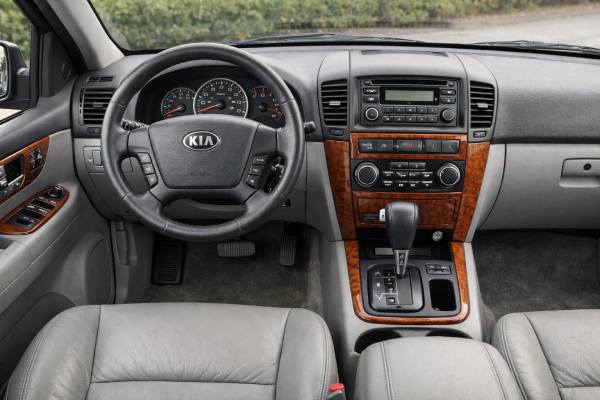
- Interior cues like seat material or audio brand matter less than underbody condition and service history.
Safety ratings and what they mean here
For early-2000s SUVs, the challenge is not only the rating score but the testing era. Protocols changed significantly through the 2000s, and not every body style/market received full public testing by every agency. As a result, you may find partial ratings, market-specific results, or no official star score for the exact configuration you’re viewing.
What you can evaluate reliably, even without a perfect one-to-one rating:
- Structural integrity clues: Uneven panel gaps, mismatched paint, and wrinkled inner fenders can signal prior crash repairs that compromise safety.
- Airbag system health: The SRS light should illuminate briefly at startup and then go out. A permanently lit or missing light is a red flag.
- Seatbelts and anchors: Confirm smooth retraction and that child-seat anchor points are intact and not rust-damaged.
Safety systems and driver assistance (period-correct expectations)
Driver assistance (ADAS) as we define it today—automatic emergency braking, adaptive cruise, lane centering—does not meaningfully apply to this generation. What matters instead is the foundation:
- Airbags: Front airbags are typical; side and curtain coverage varies by year/trim/market.
- ABS: Highly recommended; verify by warning lights and a safe test on loose gravel (if appropriate).
- Stability control: If equipped, it improves emergency handling and reduces the chance of a spin on slick roads.
- Child-seat provisions: Look for ISOFIX/LATCH anchors (common but market dependent). Confirm the anchor points are not corroded or damaged.
After service work—especially steering, suspension, or brake repairs—confirm the vehicle tracks straight, ABS activates normally, and warning lights remain off. Older SUVs often develop “silent” safety issues when wheel-speed sensors, tone rings, or wiring become corroded; they can disable ABS/stability functions without affecting basic braking feel.
Fault patterns and campaigns
A BL Sorento AWD V6 can be durable, but it does not forgive neglect. Below is a practical way to think about issues: what tends to happen often, what hurts the budget, and what you can catch early.
Common, lower-cost issues (still worth addressing)
- Valve cover gasket seepage (common, low/medium):
Symptoms: Oil smell after driving, dampness around valve covers, minor drips onto exhaust heat shields.
Root cause: Aged rubber gaskets plus heat cycling.
Remedy: Replace gaskets; clean PCV system so crankcase pressure does not push oil outward. - Ignition wear (common, medium):
Symptoms: Misfires under load, rough idle, flashing check engine light, worse fuel use.
Root cause: Aged plugs/coils/wires depending on market configuration.
Remedy: Replace spark plugs on schedule; address coil packs proactively if misfires are recurring. - Crank/cam sensor aging (occasional, medium):
Symptoms: Random stalling, long cranking, intermittent no-start, fault codes related to timing correlation.
Root cause: Sensor heat and age.
Remedy: Replace sensor(s); inspect harness routing and connectors for oil contamination.
High-impact mechanical risks
- Timing belt overdue (common in the used market, high if ignored):
Symptoms: Often none until failure; sometimes squeal, noise, or visible cracking if inspected.
Root cause: Belt age/mileage beyond interval; tensioner/idler wear.
Remedy: Replace belt, tensioners, and idlers as a kit; consider water pump replacement “while in there” to avoid duplicate labor. - Cooling system weakness (occasional, high if overheated):
Symptoms: Rising temperature on climbs, coolant smell, disappearing coolant, weak cabin heat, radiator crusting.
Root cause: Radiator aging, thermostat sticking, hose deterioration, or neglected coolant.
Remedy: Pressure test, replace weak parts, refresh coolant. Overheating a V6 can trigger head-gasket or warpage issues. - Automatic transmission stress (occasional, high):
Symptoms: Delayed engagement, flare on upshift, harsh shifts when hot, burnt ATF smell.
Root cause: Heat from towing, neglected ATF, internal wear.
Remedy: Service ATF early and often; ensure correct fluid spec. If symptoms persist, budget for professional diagnosis rather than repeated fluid swaps.
AWD/4WD-specific wear points
- Transfer case leaks and fluid neglect (common, medium/high):
Symptoms: Drips at seals, whining, binding, or unusual vibration.
Root cause: Seal aging, vent blockage, long fluid intervals.
Remedy: Fix leaks first, then refill with correct fluid. Always remove the fill plug before draining to avoid being stuck with an empty unit you cannot refill. - Front CV joints and boots (common, medium):
Symptoms: Clicking on full lock, grease sling inside wheel wells, vibration under load.
Root cause: Torn boots and contamination.
Remedy: Replace axle or reboot early; late repairs spread wear to wheel bearings.
Recalls, TSBs, and service actions
Because this is a 2002–2006 vehicle, recall relevance depends on VIN, market, and whether the remedy was completed. The best practice is simple:
- Run an official VIN recall check in your region.
- Ask for dealer printouts or service records showing completion.
- Treat missing proof as “not done” and plan accordingly.
Even if a recall is not active, many “campaign-style” fixes for fuel lines, crash sensors, or wiring issues can show up as old paperwork in the glovebox. When you find that documentation, keep it—it adds real value at resale.
Service plan and purchase check
This section is written for real ownership: what to service, when to do it, and what to inspect before you buy. With an older AWD SUV, the goal is not perfection—it’s avoiding the few failure modes that cost more than the vehicle’s value.
Practical maintenance schedule (distance or time, whichever comes first)
- Engine oil and filter: every 7,500–10,000 km (5,000–6,000 mi) or 6–12 months.
If the engine sees short trips, winter idling, or towing, stay closer to 7,500 km. - Engine air filter: inspect every 15,000 km, replace about 30,000 km (sooner in dust).
- Cabin air filter: every 15,000–30,000 km depending on pollen and city use.
- Spark plugs: typically 60,000–100,000 km depending on plug type (verify installed plugs).
- Coolant: every 5 years or 100,000 km as a planning baseline; replace sooner if rusty or contaminated.
- Brake fluid: every 2 years, regardless of mileage.
- ATF: every 40,000–60,000 km on an older unit, especially if towing occurred.
- Transfer case fluid: every 40,000–60,000 km (and after deep water exposure).
- Front and rear differential oil: every 40,000–60,000 km.
- Tyre rotation: every 10,000 km; AWD systems are sensitive to uneven tyre diameters.
- Alignment check: annually or after any suspension work or curb impact.
- 12 V battery testing: yearly after year 3; plan replacement around 4–6 years depending on climate.
Fluid specifications and decision-making notes
Because this generation spans multiple markets, confirm specs by VIN. Still, you can make smart choices with these rules:
- Use the correct ATF specification for the transmission family. If a shop wants to use “universal ATF,” ask them to show compatibility documentation.
- Gear oils must match the unit. Some transfer cases use ATF, others use gear oil. The wrong choice can cause noise or clutch/chain wear.
- Do not ignore small leaks. A transfer case or front differential can run low quietly, and replacement costs can exceed the vehicle value.
Buyer’s guide: what to inspect (and what it usually costs)
Underbody and corrosion (high priority):
- Frame rails, rear suspension mounts, brake lines, fuel lines, and the area around the rear axle.
- Surface rust is manageable; perforation, flaky scaling near mounts, or brake line swelling is a serious negotiating point.
Engine and cooling system:
- Cold start behavior, idle stability, and coolant level/condition.
- Look for dried coolant trails on radiator end tanks and around hose junctions.
Timing belt proof:
- Ask for an invoice with date and mileage.
- If proof is missing, assume it’s due and budget for it immediately.
Driveline behavior:
- Listen for clunks on engagement, vibration under load, and clicking on turns.
- Test AWD/4WD modes if selectable. Binding, loud bangs, or refusal to shift modes can indicate neglected driveline service.
Electronics and warning lights:
- Confirm ABS and SRS lights behave normally at startup.
- Scan for codes even if the dash is clear; some sellers clear codes temporarily.
Long-term durability outlook
A well-maintained BL Sorento AWD V6 can be a strong value if you treat it like a drivetrain-first vehicle. The body and cabin will age, but the SUV can keep working for years when the cooling system, timing belt, and drivetrain fluids are handled on time. The buyers who enjoy these most are the ones comfortable with preventive maintenance, not the ones expecting “modern car” neglect tolerance.
Real driving and economy
Ride, handling, and noise (NVH)
On the road, the BL Sorento feels closer to a traditional SUV than a modern crossover. The body-on-frame structure and rear solid axle usually deliver a firm, slightly busy ride over sharp bumps, but they also provide a stable platform when loaded. On highways, the Sorento tends to feel planted, especially with good tyres and fresh suspension bushings. Steering is typically light-to-moderate and not especially talkative, but it is predictable—exactly what you want in winter conditions.
Cabin noise depends heavily on maintenance. Fresh door seals, healthy wheel bearings, and tyres with a quiet tread pattern can make the vehicle feel surprisingly refined for its age. Worn wheel bearings, aggressive all-terrain tyres, and drivetrain fluid neglect can create the “old SUV roar” many people mistake as normal.
Powertrain character
The 3.5 V6’s biggest advantage is how it makes torque without drama. Throttle response is generally smooth, and the engine has enough displacement to move the vehicle without constant downshifts—until you add steep hills or towing. The 4-speed automatic is the limiting factor: it is reliable when cared for, but it has wider gear spacing than modern transmissions. Expect:
- More rpm on highway grades.
- Noticeable kickdown when passing.
- Heat build-up when towing in hot weather (a reason to be strict about ATF condition).
If your Sorento has driver-selectable modes (and especially low range), it can be impressively controllable on loose surfaces. Low range is less about extreme off-roading and more about mechanical sympathy: it reduces strain on the transmission when crawling, launching a boat, or climbing steep gravel at low speed.
Real-world fuel use
This is a heavy, older SUV with a naturally aspirated V6 and a 4-speed automatic. Fuel economy is rarely its selling point. A realistic range for a healthy AWD V6 is:
- City: ~15–18 L/100 km (16–13 mpg US) depending on traffic and warm-up time.
- Highway (100–120 km/h): ~10.5–12.5 L/100 km (22–19 mpg US).
- Mixed driving: ~13–15.5 L/100 km (18–15 mpg US).
Cold weather, short trips, roof racks, and winter tyres can add 1–3 L/100 km. If your numbers are far worse, check for dragging brakes, incorrect tyre pressures, old oxygen sensors, misfires, or a thermostat stuck open (which keeps the engine running rich).
Load, towing, and stability
With the right setup, the Sorento can tow confidently, but keep expectations realistic:
- Use a proper hitch and wiring, and confirm trailer brake support where required.
- Watch temperatures on long grades; stop and cool down if shifting becomes harsh or the engine temp creeps.
- Expect a meaningful consumption penalty: +20–40% under moderate towing is common for this class and era.
If towing is a core use case, prioritize vehicles with documented ATF service history and evidence that the cooling system has been maintained. Those two factors often separate a good tow rig from a transmission rebuild candidate.
Against similar SUVs
To judge the BL Sorento AWD V6 fairly, compare it to other early-2000s midsize SUVs that still offered real driveline hardware. The Sorento’s unique position is value: it often costs less than the Japanese body-on-frame options while delivering similar functional capability.
Where the Sorento AWD V6 can be the smarter choice
- If you want low-range capability on a budget: Many crossovers cannot match the slow-speed control and drivetrain robustness of a low-range equipped Sorento. For snowed-in driveways, rural roads, and light trail use, that matters.
- If you do your own maintenance: The Sorento’s mechanical layout is straightforward. Parts availability is generally decent, and many jobs are conventional (fluids, belts, sensors), not exotic.
- If towing is occasional, not constant: The Sorento can tow well, but it demands maintenance discipline. For a few trips per year, it can be excellent value.
Where rivals often win
- Long-term corrosion resistance: Some competitors from Toyota and Nissan often show better rust resistance in certain markets, although local climate and prior care dominate outcomes.
- Transmission sophistication: A few rivals offered 5-speed automatics earlier, improving both drivability and fuel use.
- Resale and ecosystem: Popular models tend to have more specialist knowledge, aftermarket support, and resale demand.
Quick comparison guide (buyer intent focused)
- Choose the Sorento BL AWD V6 if you want body-on-frame strength and traction hardware for the money, and you are willing to maintain it like a drivetrain-first vehicle.
- Choose a more car-based crossover if your use is mostly city and highway and you prioritize fuel economy and ride comfort over towing and rough-road durability.
- Choose a higher-priced Japanese body-on-frame rival if you want the same functional category with stronger resale and, often, a deeper repair ecosystem—accepting the upfront cost.
The bottom line
A good BL Sorento AWD V6 is not “the best” in every metric, but it can be one of the most rational purchases for buyers who value capability per dollar. The deciding factor is condition and history. If it has documentation for timing belt service, consistent drivetrain fluid changes, and minimal corrosion, it can be a satisfying long-term tool. If those basics are missing, it is usually cheaper to buy a better example than to rescue a neglected one.
References
- RCQN-05V353-8363.pdf 2005 (Recall Document)
- RCQN-04V305-1376.pdf 2004 (Recall Document)
- RCQN-06V093-8363.pdf 2006 (Recall Document)
Disclaimer
This article is for informational purposes only and is not a substitute for professional inspection, diagnosis, or repair. Specifications, torque values, service intervals, and procedures can vary by VIN, market, model year, and installed equipment. Always verify details using official documentation for your exact vehicle and follow safe workshop practices.
If you found this guide useful, consider sharing it on Facebook, X (Twitter), or your favorite forum to help others keep these older SUVs on the road.