
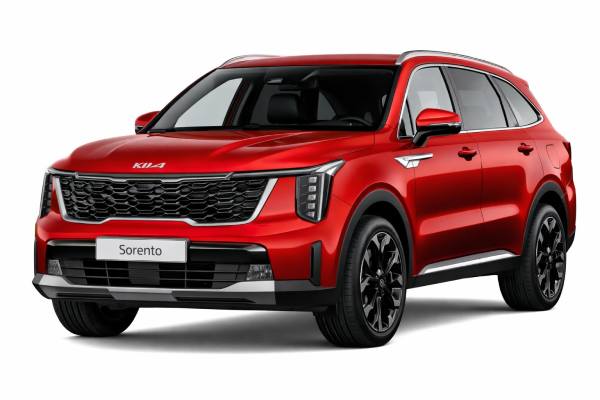

The 2024–present facelifted Kia Sorento (MQ4) with the 2.5-liter Smartstream four-cylinder and AWD is built around a simple promise: three-row practicality with modern driver-assistance and low-drama ownership, without the complexity (or cost) of electrification. The 2.5 is a high-compression, direct-injection gasoline engine tuned for smooth daily torque rather than headline acceleration, and it pairs well with the Sorento’s family-first chassis: predictable braking, stable straight-line tracking, and a suspension set up for comfort.
Where this version stands out is its “engineering middle ground.” You get a conventional automatic transmission, a capable on-demand AWD system, and a platform designed to carry real people and cargo—while still fitting into normal parking spaces. If you maintain fluids on time and buy the right trim, it can be one of the calmer long-term bets in the midsize three-row class.
What to Know
- Comfortable, stable ride with a roomy second row and usable third row for shorter trips.
- AWD adds confidence on wet roads and light snow without the weight and friction of a full-time 4×4 system.
- The 2.5-liter non-turbo is mechanically simpler than turbo options, but it’s not quick when fully loaded.
- Plan on earlier oil changes if you do short trips or lots of city driving—many owners use 8,000 miles (13,000 km) or 12 months as a practical ceiling.
- Change rear differential and transfer case oil around 60,000–80,000 km (40,000–50,000 miles) if you keep the vehicle long-term or tow regularly.
Navigate this guide
- Sorento MQ4 AWD essentials
- Sorento MQ4 2.5 specs
- Sorento trims and safety tech
- Reliability and known faults
- Maintenance plan and buying tips
- Driving feel and efficiency
- Rival check and alternatives
Sorento MQ4 AWD essentials
This Sorento is the “do-it-all” configuration: the mainstream 2.5-liter gasoline engine, a conventional automatic, and an on-demand AWD system that prioritizes efficiency in normal driving but can send torque rearward when front traction drops. In day-to-day use, it behaves like a front-driver most of the time, which keeps steering effort light and reduces tire scrub in tight parking maneuvers. When conditions worsen—heavy rain, slush, steep gravel driveways—the coupling engages quickly enough that you feel a steady, controlled pull rather than dramatic wheelspin.
The 2024 facelift matters because it improves the ownership experience in three places you notice every week:
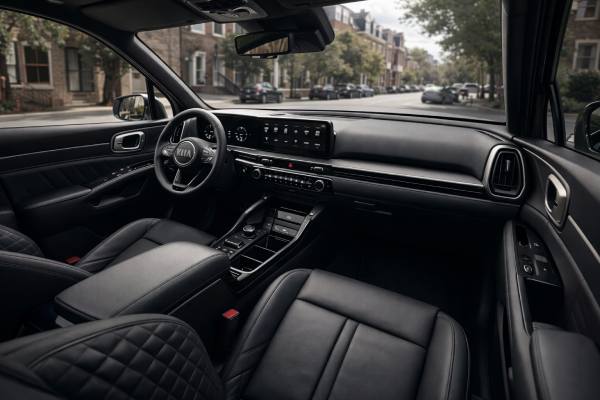
- Cabin interface: larger screens and a cleaner dash layout (varies by market/trim), plus better camera and sensor integration on higher trims.
- Driver assistance maturity: lane-centering and adaptive cruise tend to feel less “twitchy” as calibration improves year by year, and the facelift period often brings more standard safety tech.
- Side-impact hardware updates (market-dependent): some late-model changes include extra structure and additional rear-seat protection hardware tied to updated crash-test requirements.
The Smartstream 2.5 in this tune is about predictable response. It doesn’t have turbo surge, and it won’t overwhelm the front tires in slippery conditions. That makes it easy to drive smoothly and easy to modulate in snow. The tradeoff is that passing performance depends on planning—especially with seven occupants or when towing.
From an ownership standpoint, this setup rewards two habits:
- Keep fluids fresh, especially AWD oils. The rear differential and transfer case don’t hold much fluid, so contamination matters.
- Treat it like a family tool, not a sports SUV. If you drive it with gentle throttle and steady speeds, the engine and transmission feel relaxed and the cabin stays quiet.
If your priority is the simplest Sorento drivetrain to live with long-term (and you don’t need hybrid mileage), the non-turbo 2.5 AWD is often the sweet spot—provided you accept that performance is “adequate,” not lively.
Sorento MQ4 2.5 specs
Below are practical, owner-relevant specifications for the facelift-era Sorento MQ4 with the 2.5-liter 191 hp engine and AWD. Exact figures can vary by market, trim, wheels/tires, and measurement standards, so consider these “most common” baselines.
Powertrain and efficiency
| Item | Specification |
|---|---|
| Code | Smartstream G2.5 (market variants include GDi or MPI / GDi+MPI) |
| Engine layout and cylinders | Inline-4 (I-4), DOHC, 4 cylinders, 4 valves/cyl |
| Bore × stroke | 88.5 × 101.5 mm (3.48 × 4.00 in) |
| Displacement | 2.5 L (2,497 cc) |
| Induction | Naturally aspirated (NA) |
| Fuel system | Gasoline direct injection (GDI) in many markets; some regions list MPI or dual-injection |
| Compression ratio | ~13.0:1 |
| Max power | 191 hp (142 kW) @ ~6,100 rpm |
| Max torque | Commonly listed as 181 lb-ft (245 Nm) @ ~4,000 rpm (market-dependent) |
| Timing drive | Chain |
| Rated efficiency | Typical EPA-style figures (AWD): 23/28/25 mpg US city/hwy/combined (≈10.2 / 8.4 / 9.4 L/100 km) |
| Real-world highway @ 120 km/h | Often ~8.5–9.5 L/100 km (25–28 mpg US), depending on tires, wind, load, and temperature |
Transmission and driveline
| Item | Specification |
|---|---|
| Transmission | 8-speed automatic (torque-converter), trim/market dependent |
| Drive type | On-demand AWD (center coupling; front-biased) |
| Differential | Open rear differential (traction is primarily via brake-based torque control) |
Chassis and dimensions
| Item | Specification |
|---|---|
| Suspension (front/rear) | MacPherson strut / multi-link |
| Steering | Electric power steering; ratio ~13.9:1 (varies) |
| Brakes | 4-wheel discs; front ~325 mm (12.8 in), rear ~305 mm (12.0 in) (common setup) |
| Wheels/tires (popular) | 235/55 R19 or 235/60 R18 depending on trim |
| Ground clearance | ~175 mm (6.9 in) typical |
| Length / width / height | ~4,816 / 1,900 / 1,694 mm (189.6 / 74.8 / 66.7 in) |
| Wheelbase | ~2,814 mm (110.8 in) |
| Turning circle (kerb-to-kerb) | ~11.6 m (38.0 ft) typical |
Performance and capability
| Item | Specification |
|---|---|
| Acceleration | 0–100 km/h (0–62 mph): ~9.3–9.8 s (trim/weight dependent) |
| Top speed | Often not officially published; typically ~190–200 km/h (118–124 mph) governed |
| Braking distance | 100–0 km/h: ~56 m; 62–0 mph: ~184 ft (typical test figure on stock tires) |
| Towing capacity | Commonly up to 907 kg (2,000 lb) for the non-turbo 2.5 (check trim/market) |
| Payload | Varies widely; consult door-jamb label (often ~450–600 kg / 990–1,320 lb range depending on trim) |
Cargo volume (typical three-row layout)
| Configuration | Volume |
|---|---|
| Seats up (behind 3rd) | ~357 L (12.6 ft³) |
| 3rd row folded (behind 2nd) | ~1,087 L (38.4 ft³) |
| 2nd and 3rd folded (max) | ~2,138 L (75.5 ft³) |
Fluids and service capacities (common references)
| Fluid | Typical specification | Capacity (approx.) |
|---|---|---|
| Engine oil | SAE 0W-20 (API SP / ILSAC GF-6 common) | ~5.8–6.8 L (6.1–7.2 US qt) with filter (market dependent) |
| Coolant | Ethylene glycol-based, aluminum-safe | ~8.5–9.0 L (9.0–9.5 US qt) typical |
| ATF | Kia/Hyundai SP4-M1 family (varies) | ~6.7–7.0 L (7.1–7.4 US qt) drain/refill vs dry-fill varies |
| Rear differential (AWD) | GL-5 gear oil (often 75W-85) | ~0.53–0.63 L |
| Transfer case (AWD) | Spec varies by market; often listed separately | ~0.62–0.68 L |
| A/C refrigerant | R-134a or R-1234yf depending on build/market | ~575–850 g depending on front-only vs front+rear A/C |
Key torque specs (critical fasteners)
| Item | Torque |
|---|---|
| Wheel lug nuts | 107–127 Nm (79–94 lb-ft) |
Sorento trims and safety tech
Trim names and packaging vary by region, but the 2024–present Sorento lineup typically follows a familiar ladder: an entry model focused on value, mid trims that add comfort and technology, and upper trims that bundle premium audio, upgraded lighting, and more advanced driver-assistance features. For the 2.5-liter 191 hp engine specifically, it’s common to see it offered on lower-to-mid trims, while turbo and electrified powertrains occupy the top of the range.
Trims and options that change how it drives
When you’re shopping, prioritize the options that affect function—not just appearance:
- AWD hardware and modes: Some trims add extra drive-mode logic (snow/mud/sand style calibrations) or a more assertive “lock” behavior at low speed. Even when the hardware is similar, software tuning can change how quickly the rear axle engages.
- Wheel and tire size: The best daily compromise is often the smaller wheel package (commonly 18-inch) with a taller sidewall. It rides better, protects rims, and usually costs less at replacement time. Larger wheels can sharpen steering response but tend to raise road noise and reduce impact comfort.
- Brake and cooling packages (where offered): If you tow or drive in mountains, seek trims that include additional cooling or trailer-prep wiring from the factory rather than relying on aftermarket solutions.
Quick identifiers for used buyers
If you’re verifying equipment on a used listing, look for:
- Steering wheel buttons for adaptive cruise and lane-centering (indicates higher ADAS capability).
- Camera count: a surround-view system usually shows multiple exterior cameras (front grille, mirror housings, tailgate).
- Instrument cluster style: higher trims often pair larger clusters with navigation-linked cruise functions.
Safety ratings and what they mean for 2024–present
Safety ratings are tied to test protocols and sometimes to mid-cycle hardware updates. In Europe, the Sorento’s MQ4 generation earned a 5-star rating under the 2020-era protocols, with strong adult and child occupant scores and a lower (but still solid) vulnerable road user score relative to newer “active bonnet” designs.
In the U.S., the Sorento has performed well in crashworthiness testing, and later model years benefit from updates aligned with tougher side-impact requirements. The important practical takeaway is that trim and headlight configuration matter: some ratings hinge on which headlights are fitted and whether key crash-prevention features are standard.
Driver assistance (ADAS) overview
Depending on trim and market, you may see most or all of the following:
- Forward collision avoidance (AEB) for vehicles and, on higher trims, pedestrians/cyclists; some systems include junction turning support.
- Adaptive cruise control (ACC) with stop-and-go; higher trims may add navigation-based speed adjustments.
- Lane keeping and lane following (lane centering) that works best on clearly marked highways.
- Blind-spot monitoring and rear cross-traffic alerts, often paired with rear automatic braking on higher trims.
- Parking aids: front/rear sensors, 360° cameras, and remote parking features on upper trims.
After windshield replacement, front camera alignment and radar calibration can be critical. If the car “feels wrong” after glass work—late braking alerts, inconsistent lane behavior—assume calibration is needed before you assume a sensor is failing.
Reliability and known faults
The 2.5-liter non-turbo Sorento is generally a low-complexity choice in the MQ4 family, but it still benefits from realistic expectations and proactive maintenance. Below is a prevalence-based guide to the most typical concerns owners report across modern GDI-era SUVs, along with what to watch for.
Common (more likely over ownership)
- Direct-injection intake carbon buildup (medium cost, usually higher mileage):
Symptoms: rough cold idle, reduced response, misfire codes under load.
Likely cause: oil vapor and soot deposit on intake valves (common on GDI engines).
Remedy: quality fuel, regular long drives, and (when needed) intake valve cleaning (walnut blasting or approved chemical service). - AWD fluid neglect (low-to-medium cost, prevention-focused):
Symptoms: subtle vibration on tight turns, occasional clunk when engaging drive, driveline noise.
Likely cause: aged or contaminated rear diff/transfer case oil, especially with towing or lots of short trips.
Remedy: early fluid changes and correct spec oils; inspect for seepage around seals. - Battery sensitivity (low cost):
Symptoms: start/stop oddities, random warning lights, slow cranking.
Likely cause: weak 12 V battery (modern vehicles are electronics-heavy).
Remedy: periodic battery testing, clean terminals, replace proactively around 4–6 years in harsh climates.
Occasional (depends on use and environment)
- Cooling system seepage or thermostat behavior (medium cost):
Symptoms: slow coolant loss, intermittent overheating in traffic, weak cabin heat.
Likely cause: hose clamps, water pump seep, thermostat sticking.
Remedy: pressure test, replace the weak component early—don’t top up indefinitely. - Coil/plug wear showing as misfires (low-to-medium cost):
Symptoms: misfire codes, hesitation on acceleration, poor economy.
Likely cause: normal wear, sometimes accelerated by short trips or heat cycling.
Remedy: replace plugs at the proper interval; swap coils if misfire follows the coil. - Brake hardware noise (low cost):
Symptoms: squeal at low speed, light vibration.
Likely cause: pad compound, corrosion film from short trips, or uneven bedding.
Remedy: proper bedding after pad replacement; occasional firm braking to clean rotors (when safe).
Rare but higher-impact (watch and diagnose early)
- Transmission shift quality issues (medium-to-high cost if ignored):
Symptoms: harsh 2–3 shift, flare, or delayed engagement.
Likely cause: software calibration, adaptation, or (rarely) internal wear.
Remedy: verify software updates, perform adaptation reset procedures where appropriate, diagnose before replacing parts. - ADAS sensor faults after repairs (medium cost):
Symptoms: persistent camera/radar warnings, lane assist unavailable.
Likely cause: misalignment after bumper or windshield work, damaged brackets, wiring stress.
Remedy: calibration and bracket inspection first; replace sensors only after proper aiming checks.
Recalls, service actions, and how to verify
Rather than relying on seller claims, verify recall completion by VIN through official channels and dealer service records. If a listing can’t show proof, assume you’ll spend time at a dealer to confirm software and campaign status. For a modern Sorento, this is especially relevant for lighting electronics, ADAS modules, and body controllers, where software updates can be the official fix.
Maintenance plan and buying tips
A practical maintenance plan for the Sorento 2.5 AWD has two goals: protect the high-compression, injection-heavy engine and keep the AWD system smooth as the miles add up. Below is a real-world schedule that fits how these vehicles are commonly used (family errands, short commutes, occasional highway travel, and sometimes towing). Always reconcile this with your VIN-specific service information.
Routine schedule you can actually follow
Every 8,000 miles (13,000 km) or 12 months
- Engine oil and filter (use the correct viscosity and a quality filter).
- Tire rotation; check tire wear pattern (it’s your early warning for alignment drift).
- Inspect brakes, suspension joints, and underbody for impact damage.
Every 16,000 miles (26,000 km)
- Engine air filter inspection/replacement depending on dust conditions.
- Cabin filter replacement (more often in cities or if you run HVAC constantly).
- Clean sunroof drains (if equipped) to avoid water intrusion.
Every 48,000 miles (78,000 km) or 48 months
- Brake fluid replacement (DOT 4 in many markets).
- Thorough brake hardware service (clean and lubricate slide pins; check caliper boots).
Around 60,000–80,000 km (40,000–50,000 miles)
- Rear differential and transfer case oil (AWD). This is one of the best “small money, big payoff” services.
- Inspect engine mounts and driveline boots; replace cracked boots before grease loss ruins a joint.
Around 156,000 km (96,000 miles)
- Spark plugs on the non-turbo 2.5 are often scheduled here (market-dependent).
- At this mileage, also consider preventative intake cleaning if you’re experiencing rough idle or reduced response.
Fluid specs and capacities (decision-making level)
Use official-spec fluids (or exact equivalents), especially for:
- ATF (the wrong friction characteristics can cause shift quality issues).
- AWD oils (small capacity systems dislike “close enough” fluids).
- Coolant (mix ratio and water quality matter; avoid hard water).
Buyer’s guide: what to check on a used Sorento 2.5 AWD
Walk-around and underbody
- Uneven tire wear (signals alignment issues or worn bushings).
- Underbody scrapes near the exhaust, subframes, and AWD components.
- Fluid seepage at rear diff and transfer case seals.
Test drive
- Tight parking lot turns: listen for binding, clunks, or vibration.
- Highway cruise: steering should track straight with minimal correction.
- Moderate acceleration from 40–80 km/h: watch for hesitation or shudder.
Service history to request
- Proof of oil changes at reasonable intervals (short-trip vehicles should be serviced more often).
- Any AWD fluid services (if none, budget to do them immediately).
- Documentation of software updates and campaign completion.
Long-term durability outlook
If you keep oil clean, maintain cooling health, and service AWD fluids earlier than “lifetime” language suggests, the 2.5 AWD Sorento can be a durable daily vehicle. The biggest ownership risks tend to be neglect and mismatched fluids, not exotic mechanical failures.
Driving feel and efficiency
In real-world driving, the Sorento 2.5 AWD feels composed rather than sporty. The steering is light at low speed, the chassis is stable on the highway, and the suspension is tuned to take the edge off rough pavement. Most owners will notice three things quickly: it’s easy to place in traffic, it stays calm with passengers onboard, and it doesn’t punish you for using it as a family hauler.
Ride, handling, and NVH (noise, vibration, harshness)
- Ride quality: With the more common 18-inch wheel setups, impacts are rounded off well. Larger wheels can introduce sharper “thumps” over pothole edges and more tire roar on coarse asphalt.
- Handling balance: Safe and predictable. It resists roll reasonably well for a three-row SUV, but it won’t feel eager in quick transitions.
- Cabin noise: Wind noise is usually well controlled at steady cruise; the louder component tends to be tire noise, which is why tire choice matters a lot at replacement time.
Powertrain character
The naturally aspirated 2.5 behaves best when you drive it like a modern non-turbo: smooth throttle, let the transmission downshift when you need speed, and don’t expect instant passing punch at low rpm. Under heavier loads (full cabin, roof box, hills), you’ll notice the engine uses rpm to make power. That’s normal—just plan passing moves and accept that it’s working.
Transmission logic is usually tuned for economy:
- It upshifts early in gentle driving.
- It will downshift decisively if you push past mid-throttle.
- Sport modes (where equipped) generally hold gears longer and sharpen throttle mapping, which can make the car feel more responsive without adding real torque.
Real-world efficiency (what owners typically see)
Expect results to swing based on speed and temperature:
- City-heavy use: ~10.5–12.0 L/100 km (19–22 mpg US) if trips are short.
- Highway at 100–110 km/h: often ~8.0–9.0 L/100 km (26–29 mpg US).
- Highway at 120 km/h: commonly ~8.5–9.5 L/100 km (25–28 mpg US).
- Winter penalty: short trips in cold weather can add 10–20% consumption due to warm-up time and thicker fluids.
AWD behavior in slippery conditions
On-demand AWD systems shine when they’re paired with the right tires. With all-season tires in light snow, the Sorento feels confident and stable, especially when pulling away from stops. With true winter tires, it becomes meaningfully more secure in braking and cornering—not just acceleration. If you live in a snow belt, tires will do more for you than any drive mode.
Towing and load
If you tow within the non-turbo 2.5’s typical rating, the Sorento remains stable, but acceleration is modest and fuel consumption rises quickly. For frequent towing or steep mountain use, the turbo or a different powertrain may be the better fit. For occasional small trailers, this setup is usually fine—just keep speeds sensible and stay ahead of maintenance.
Rival check and alternatives
The Sorento 2.5 AWD competes in a crowded class where “good enough” isn’t always enough—especially when rivals offer stronger engines or hybrid mileage. The key is to compare what you actually need: third-row use, towing, efficiency, or tech.
Where the Sorento 2.5 AWD wins
- Balanced ownership equation: conventional automatic, non-turbo engine, and modern safety tech.
- Cabin usability: thoughtful storage, a functional third row for shorter occupants, and good cargo flexibility.
- Value per feature: it often undercuts similarly equipped competitors, especially when you want AWD plus driver assistance.
Where it gives up ground
- Performance when loaded: the 2.5 non-turbo is the slow lane of this segment. If you routinely carry six or seven people, rivals with stronger torque feel less strained.
- Hybrid advantage: if fuel costs or city mileage are a major priority, hybrid alternatives can be meaningfully cheaper to run.
How it stacks up against common rivals
- Toyota Highlander: often smoother hybrid availability and strong resale, but can cost more equipped similarly; third row is comparable, and pricing can escalate quickly with packages.
- Honda Pilot: typically stronger naturally aspirated power and excellent family ergonomics; if you prioritize easy power with passengers, it can feel more effortless than the Sorento 2.5.
- Hyundai Santa Fe: platform cousins can be a smart cross-shop; compare packaging, warranty terms, and the exact safety tech standardization year-to-year.
- Mazda CX-90: tends to offer a more premium driving feel and strong powertrain options, but pricing and packaging may not match the Sorento’s value-focused trims.
- Subaru Ascent: standard AWD is a plus; compare interior space, fuel economy, and how each system behaves on long highway trips and in winter.
Practical recommendation
Choose the Sorento 2.5 AWD if you want:
- A calm, modern family SUV with AWD confidence and straightforward mechanicals.
- A feature set that feels “current” without forcing a premium trim.
Skip it (or choose a different Sorento powertrain) if you need:
- Frequent towing, steep mountain driving, or consistently quick passing power with a full cabin.
- Hybrid-level fuel savings in heavy city use.
References
- 2024 Kia Sorento Specifications 2024
- Recommended lubricants and capacities 2024 (Owner’s Manual)
- Air conditioning system 2024 (Owner’s Manual)
- Official Kia Sorento 2020 safety rating 2020 (Safety Rating)
- 2024 Kia Sorento 2024 (Safety Rating)
Disclaimer
This article is for informational purposes only and is not a substitute for professional diagnosis, inspection, or repair. Specifications, torque values, fluid types, capacities, service intervals, and procedures vary by VIN, market, model year, and equipment. Always verify details using your official owner’s manual and service documentation for your specific vehicle.
If this guide helped, please consider sharing it on Facebook, X (Twitter), or your favorite forum to support our work.