

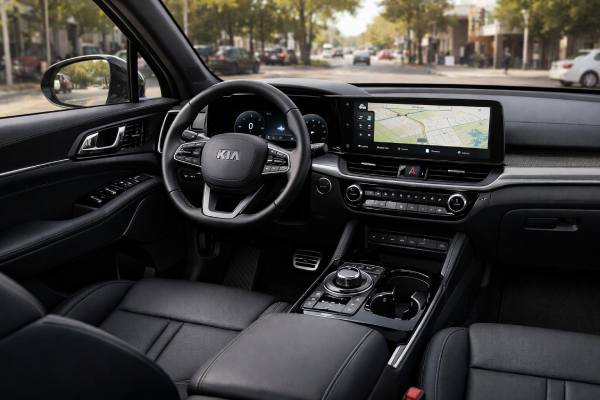

The facelifted 2024–present Kia Sorento (MQ4) with the Smartstream 2.2 diesel is aimed at owners who want long-distance efficiency without giving up three-row practicality. This engine’s defining trait is its strong mid-range torque, which suits motorway cruising, towing, and full-family loads better than many small-capacity turbo petrol units. In daily use, the diesel Sorento feels “relaxed”: it builds speed with fewer downshifts, and it tends to deliver consistent consumption on steady-speed runs—especially at European highway limits.
The trade-off is modern diesel complexity. The Sorento’s aftertreatment hardware (DPF and SCR/AdBlue) rewards the right usage pattern and maintenance habits, and it can punish repeated short trips. If you understand that relationship—and plan your servicing around the vehicle’s real duty cycle—the 2.2 diesel Sorento can be one of the most sensible choices in the MQ4 range for high-mileage drivers.
Owner Snapshot
- Strong torque delivery makes towing and loaded driving feel easy and stable.
- Efficient at steady speeds; best results come from longer runs and warm operating temps.
- Practical 7-seat packaging with a genuinely usable cargo area in 5-seat mode.
- Diesel aftertreatment (DPF and SCR/AdBlue) needs the right driving pattern to stay trouble-free.
- Typical service cadence is 12 months / up to 32,000 km (20,000 miles), depending on market and service plan.
Navigate this guide
- Kia Sorento MQ4 diesel facelift focus
- Kia Sorento MQ4 2.2 diesel specs and measurements
- Kia Sorento MQ4 diesel trims, safety, and ADAS
- Reliability issues and service campaigns
- Maintenance plan and buyer advice
- Real-world driving and economy
- Diesel Sorento versus key rivals
Kia Sorento MQ4 diesel facelift focus
The 2024 facelift keeps the MQ4 Sorento’s core strengths—space, comfort, and a well-judged chassis—while updating the look and technology to feel current. In diesel form, the Sorento is best understood as a “torque-first” family SUV. You do not buy it for sporty sound or high-rev response. You buy it because it stays composed with passengers, luggage, and a trailer, and because it can cover long distances with fewer fuel stops than many petrol alternatives.
From an engineering standpoint, the Smartstream D2.2 is designed around emissions compliance and efficiency. It uses high-pressure common-rail injection and a turbocharger, plus modern exhaust aftertreatment: a diesel particulate filter (DPF) to trap soot and selective catalytic reduction (SCR) using AdBlue/DEF to reduce NOx. That system works extremely well when the engine reaches full operating temperature and sees consistent load. It works less well when the car is used like a city supermini—short trips, cold starts, and long idling.
On the road, the diesel’s biggest advantage is how it manages effort. Instead of chasing power at high rpm, it delivers its useful shove in the mid-range. That makes it feel smoother in normal traffic and more confident on hills. It also pairs nicely with the Sorento’s family mission: you can maintain speed without constant kickdown, which tends to reduce noise and driver fatigue.
Ownership-wise, the diesel Sorento rewards a simple mindset: treat it like a long-distance tool and it will usually behave like one. If your routine is mostly urban, the hybrid powertrains can be a better match because they avoid many diesel-specific wear patterns. But for frequent motorway work, rural commutes, and towing, the 2.2 diesel can be the “set it and forget it” option—provided you keep the aftertreatment and fluids in mind.
Kia Sorento MQ4 2.2 diesel specs and measurements
Below is a market-realistic technical snapshot for the facelift-era MQ4 Sorento with the Smartstream 2.2 diesel. Exact numbers can vary by trim, wheel size, seating configuration (5/7), and whether the vehicle is front-wheel drive or all-wheel drive in your region.
Powertrain and efficiency
| Item | Specification |
|---|---|
| Code | Smartstream D2.2 (commonly listed as D4HE in some catalogs) |
| Engine layout and cylinders | Inline-4, transverse; DOHC; 4 valves/cyl |
| Bore × stroke | 83.0 × 99.4 mm (3.27 × 3.91 in) |
| Displacement | 2.2 L (2,151 cc) |
| Induction | Turbocharged (variable-geometry type in many applications) with intercooler |
| Fuel system | Common-rail direct injection (diesel) |
| Compression ratio | 16.0:1 (typical for this engine family) |
| Max power | Up to ~202 hp (150 kW) @ ~3,800 rpm (market-rated outputs vary; some regions quote ~190 bhp) |
| Max torque | 440 Nm (325 lb-ft) @ ~2,750 rpm (typical published value) |
| Timing drive | Often reported as a timing belt on Smartstream D2.2 variants; verify by VIN/service data |
| Rated efficiency | WLTP varies by trim/wheels; commonly around ~6.5 L/100 km combined (see market sheets) |
| Real-world highway @ 120 km/h | Expect roughly ~6.5–7.5 L/100 km depending on tyres, load, wind, and temperature |
Transmission and driveline
| Item | Specification |
|---|---|
| Transmission | 8-speed automatic dual-clutch (often described as 8DCT in many markets) |
| Drive type | FWD or AWD depending on market/trim; many “diesel flagship” specs pair diesel with AWD |
| Differential | Open differentials with brake-based traction control; no traditional locking diff |
Chassis and dimensions
The MQ4 platform is tuned for stability and comfort. Even on larger wheels, the Sorento typically prioritizes ride compliance over sharp turn-in.
| Item | Specification |
|---|---|
| Suspension (front/rear) | MacPherson strut / multi-link |
| Steering | Electric power steering (ratio varies by rack calibration) |
| Brakes | 4-wheel discs (diameters vary by trim/market) |
| Wheels/tyres (popular sizes) | Commonly 235/55 R19; some trims use 235/65 R17 or 255/45 R20 |
| Ground clearance | Market-dependent; typically around the “family SUV” norm rather than off-road-focused |
| Length / width / height | Varies by market equipment; MQ4 is roughly ~4.8 m class |
| Wheelbase | Roughly ~2.8 m class |
| Turning circle | Typically around ~11.6–12.0 m kerb-to-kerb depending on wheels/tyres |
| Kerb weight | Often ~1,900–2,100 kg depending on AWD and seating |
| Fuel tank | Often ~67 L (17.7 US gal / 14.7 UK gal) |
| SCR/AdBlue tank | Often ~14 L on diesel configurations |
| Cargo volume | Highly configuration-dependent (5 vs 7 seat); best compared using the same measurement method (VDA/SAE) |
Performance and capability
| Item | Specification |
|---|---|
| Acceleration | Commonly 0–100 km/h ~9–10 s (0–62 mph similar), trim dependent |
| Top speed | Often quoted around ~200 km/h (124 mph) |
| Braking distance | Tyre-dependent; larger wheels with performance tyres can shorten stops |
| Towing capacity | Frequently up to ~2,500 kg braked (5,512 lb) in many European specs; verify per VIN plate |
| Payload | Varies widely by trim and seating; check the door-jamb label |
Fluids and service capacities (typical decision-grade info)
These figures are best treated as planning guidance. Always confirm the exact specification in the owner’s/service literature for your VIN.
| Item | Typical guidance |
|---|---|
| Engine oil | Low-SAPS oil meeting OEM requirements (often ACEA C2/C3 class); viscosity commonly 0W-30 or 5W-30 depending on climate/market |
| Engine oil capacity | Often around ~5.6 L including filter (varies by sump/filter) |
| Coolant | OEM long-life coolant; usually 50/50 premix unless specified otherwise |
| Transmission fluid | OEM-specified DCT fluid only; service practice varies by market and usage (towing/heat) |
| Differential/transfer case (AWD) | OEM gear oil; service interval depends on duty cycle |
| A/C refrigerant | Market-specific; label under bonnet lists exact type and charge amount |
Key torque specs (common, verify for VIN):
- Wheel nuts: often ~110–130 Nm (81–96 lb-ft) depending on wheel/hub design
- Engine oil drain plug: often ~25–40 Nm (18–30 lb-ft) depending on pan design
- Brake caliper bracket bolts: commonly higher torque than slider bolts (always use service manual values)
Kia Sorento MQ4 diesel trims, safety, and ADAS
Diesel availability can be trim-linked. In some regions, the 2.2 diesel is positioned as the torque-and-towing choice and may be bundled with higher equipment grades (larger wheels, richer interior, more driver assistance). In others, it can be ordered more broadly. Because the facelift spans multiple markets, the smartest way to shop is by “functional needs” first, trim badge second.
Trims and options that matter mechanically
Look for these factors because they change ownership costs or capability more than cosmetic items:
- AWD versus FWD: AWD helps with wet grass slip, snowy driveways, and stability when launching a trailer, but it adds weight and introduces extra fluids (rear diff/transfer case) that need periodic attention.
- Wheel and tyre packages: 20-inch wheels can look excellent but may cost more in tyres, ride firmer over potholes, and sometimes reduce real-world economy. For mixed roads, 17–19 inch packages usually make the most sense.
- Towing equipment: A factory tow package (or equivalent) typically integrates cooling strategy, stability programming, and trailer wiring more cleanly than aftermarket solutions.
- Seating configuration: A 7-seat setup is a practical win, but it can affect kerb weight and, in some markets, towing/payload ratings.
Quick identifiers while shopping:
- Diesel models often advertise SCR/AdBlue in the technical sheet or have an AdBlue filler under the fuel flap or nearby.
- Many diesel-focused builds come with AWD and the 8-speed DCT as standard in certain markets.
- Under-bonnet labels and the vehicle data sticker (or dealer printout by VIN) are more reliable than exterior badges.
Safety ratings and what they mean for the facelift
The Sorento generation’s core structure and restraint strategy underpin its crash performance. Safety ratings are issued for a specific test year and equipment list, so treat the score as “platform capability,” then verify that your specific trim includes the safety kit that matches the tested configuration (for example, certain ADAS items can be standard in one country and optional in another).
For European buyers, the most relevant rating body is Euro NCAP. The Sorento achieved a top-tier star rating under the protocols used at the time of its test, with strong adult and child occupant scores and a robust safety-assist result.
ADAS (driver assistance) to understand before you buy
Most modern Sorento trims include a broad safety suite, but the details matter:
- AEB (Autonomous Emergency Braking): Typically includes car-to-car; higher specs may add pedestrian and cyclist detection and junction support.
- ACC (Adaptive Cruise Control): Useful for motorway driving; some versions integrate navigation-based speed adjustment.
- Lane keeping and lane centering: These systems depend on camera calibration and clear lane markings. After a windscreen replacement or front-end repair, calibration quality matters.
- Blind-spot monitoring and rear cross-traffic alert: High-value real-world features in car parks and during lane changes.
- Traffic sign recognition: Helpful, but do not treat it as “always correct” in poor weather or temporary roadworks.
Service note: If a Sorento has had bodywork, suspension work, or windscreen replacement, ask for documentation showing ADAS calibration was completed correctly. It can prevent nuisance warnings and ensure systems respond as designed.
Reliability issues and service campaigns
The facelift-era diesel Sorento is still “new enough” that long-run patterns will keep evolving. That said, modern diesel SUVs tend to cluster around predictable themes: aftertreatment management, sensor health, and heat-related drivetrain maintenance. Below is a practical map of what owners commonly face, organized by prevalence and cost tier.
Common (low to medium cost)
- DPF loading from short trips
- Symptoms: Rising fuel consumption, fans running after shutdown, warning lights, reduced power, frequent regeneration.
- Likely cause: Repeated cold starts and low-load driving prevent complete regens.
- Remedy: Ensure regular long runs (warm engine), correct oil spec (low-SAPS), and address any underlying EGR or boost leaks that increase soot.
- AdBlue/SCR warnings
- Symptoms: AdBlue range countdown, “no restart in X km” messaging, NOx sensor faults.
- Likely cause: Low fluid, crystallization at the filler/lines, sensor aging, or poor-quality fluid.
- Remedy: Use fresh, correct-spec AdBlue; avoid chronic top-ups of tiny amounts; have faults diagnosed early to avoid forced-limp strategies.
- EGR and intake contamination
- Symptoms: Hesitation, uneven idle, smoke under load, fault codes related to EGR flow.
- Likely cause: Soot and oily vapour buildup over time, especially with low-load driving.
- Remedy: Diagnose boost leaks and sticking EGR; cleaning can help, but replacement is sometimes the durable fix.
Occasional (medium to high cost)
- Turbo control and boost leaks
- Symptoms: Underboost codes, sluggish acceleration, hissing noise, oil mist around charge pipes.
- Likely cause: Hose seepage, loose clamps, intercooler leaks, turbo actuator control issues.
- Remedy: Pressure-test intake tract; replace weak hoses/clips; confirm actuator movement and vacuum/electronic control.
- Fuel system sensitivity
- Symptoms: Hard starting, rough running, injector balance faults, rail pressure codes.
- Likely cause: Contaminated fuel, water in fuel, filter neglect, or component wear.
- Remedy: Keep to fuel-filter intervals; buy fuel from reputable stations; investigate promptly because diesel injection repairs can escalate in cost.
Rare but expensive (high cost)
- Aftertreatment hardware replacement (DPF, SCR catalyst, dosing modules)
- Symptoms: Persistent warnings despite correct driving pattern and fluid level; repeated fault codes returning after resets.
- Cause: Internal failure, poisoning, or thermal damage—sometimes secondary to unresolved engine faults.
- Remedy: Proper diagnostics first; avoid “parts darts.” Confirm root cause (exhaust leaks, sensors, fueling issues).
- Transmission heat and service neglect (especially with towing)
- Symptoms: Shudder, abnormal shift behaviour, overheating warnings, fluid smell.
- Cause: High load without adequate fluid health; towing can significantly increase thermal stress.
- Remedy: Follow severe-duty fluid service guidance; ensure software updates are applied where applicable.
Software, calibrations, and service actions
Modern Sorentos rely heavily on control software (engine, transmission, and ADAS). Updates may address:
- Shift quality or low-speed creep behaviour
- Regeneration strategy and warning thresholds
- Sensor diagnostics that reduce false warnings
- Camera/radar logic refinements
Recalls and campaigns: Rather than relying on model-year “internet lists,” verify by VIN through official recall portals and your dealer’s completion history. This is especially important for vehicles that have crossed borders or changed owners.
Maintenance plan and buyer advice
A good maintenance plan for the 2.2 diesel Sorento is less about over-servicing and more about servicing the right items at the right time, based on how the vehicle is used.
Practical maintenance schedule (distance/time)
Use this as a strong baseline, then adjust for severe duty (short trips, heavy city use, dusty roads, towing).
- Engine oil and filter: Every 12 months / 15,000–20,000 km (or per market schedule). If you do frequent short trips or tow often, shorten the interval. Use the correct low-SAPS oil spec to protect DPF and turbo health.
- Cabin air filter: Typically every 12–24 months; sooner in dusty areas.
- Engine air filter: Inspect annually; replace around 30,000–60,000 km depending on environment.
- Fuel filter (diesel): Commonly every 30,000–60,000 km (market-dependent). This is a high-value item for injector and pump longevity.
- Coolant: Follow the long-life coolant interval in official documentation; often several years. Do not mix incompatible coolants.
- Brake fluid: Typically every 2 years, regardless of mileage.
- Brake pads/rotors: Inspect at every service; replace based on wear and corrosion, not just mileage.
- Tyre rotation and alignment: Rotate roughly every 10,000–12,000 km; align if you see uneven wear or after suspension impacts.
- Transmission (8DCT): If the manual specifies a service interval, follow it. If not, consider a severe-duty fluid service strategy when towing regularly or driving in hot conditions.
- AWD fluids (if equipped): Rear differential and transfer case fluid changes are often skipped; do not skip them if you plan to keep the car long-term.
- AdBlue/SCR: Top up as needed; avoid letting the tank run very low, and keep the filler area clean to reduce crystallization.
- DPF health: Not a “service item,” but a usage habit: plan periodic longer drives that allow complete regeneration.
Timing components: treat as VIN-specific
Some Smartstream diesel variants are widely reported to use a timing belt rather than a chain. The key takeaway is not the internet argument of belt vs chain—it is that you should verify the installed system and its inspection/replacement guidance for your exact VIN and market. If it is a belt-driven setup, plan for inspection and eventual replacement on the manufacturer’s schedule or earlier under severe use.
Buyer’s guide checklist (used or nearly-new)
Bring this list to a viewing or pre-purchase inspection:
- Usage pattern match: Ask how the car was used. Frequent short trips are a risk factor for DPF/SCR issues.
- Service documentation: Confirm correct oil spec and interval history. A “cheap oil” pattern is a turbo and DPF risk.
- AdBlue history: Any repeated warnings? Any “no restart” countdown events? Those merit deeper diagnostics.
- Test drive: Look for smooth low-speed behaviour, clean boost delivery, and no drivetrain vibrations under load.
- Electronics and ADAS: Ensure no warning lights; check camera/radar operation; confirm calibrations after any windscreen/body repair.
- Tyres and brakes: Uneven tyre wear can hint at alignment or bushing issues; brake judder can indicate corrosion or rotor thickness variation.
- Towing evidence: Tow bar fitted? Ask about trailer weights, frequency, and whether transmission/AWD fluids were serviced accordingly.
- Recall status by VIN: Verify completion in official systems and dealer records.
Long-term durability outlook
For high-mileage owners, the 2.2 diesel Sorento can age well if:
- It sees regular long runs
- It gets correct low-SAPS oil and timely filter service
- Fuel filtration is taken seriously
- AWD and transmission fluids are not neglected under towing or heavy use
Neglect in any of those areas does not always fail immediately—but it tends to surface as expensive “stacked problems” later (sensors, aftertreatment, turbo, then driveline wear).
Real-world driving and economy
The diesel Sorento’s personality is built around calm capability. You feel the engine’s intent most when the vehicle is loaded or when you are climbing grades at motorway speeds. Instead of a dramatic surge, it delivers steady thrust that feels “elastic,” which is exactly what most family-SUV drivers want.
Ride, handling, and NVH
- Ride comfort: The Sorento is generally tuned for comfort and stability. On 17–19 inch wheels, it typically deals well with broken pavement. On 20s, impacts can feel sharper and tyre cost rises.
- Handling balance: Expect secure, predictable cornering rather than sporty rotation. Body control is usually well managed for the class, but physics still applies: it is a large, tall SUV.
- Steering: Light-to-moderate weight with an easy self-centering feel. It is designed to reduce fatigue more than to deliver “sports feedback.”
- Cabin noise: At steady speed, diesel torque can mean lower rpm and fewer downshifts, which often reduces drivetrain noise. Under hard acceleration, you will hear the diesel character more clearly.
Powertrain behaviour
- Throttle response: Strong once boost is established; there can be a small pause at very low rpm, especially if you ask for sudden acceleration in a high gear.
- Transmission logic: The 8-speed DCT is typically quick and efficient when calibrated well, but it can feel different from a conventional torque-converter automatic at parking-lot speeds. Smoothness depends on software version, driving mode, and driver inputs.
- Drive modes: Eco modes usually soften throttle mapping and encourage earlier upshifts; Sport modes hold gears longer and sharpen response, often at the cost of consumption.
Real-world efficiency (what to expect)
Actual consumption depends heavily on speed, temperature, and tyres:
- City (short trips): Higher consumption than you might expect from a diesel because the engine spends time cold and the aftertreatment works harder.
- Mixed use: Many drivers see a stable middle ground when trips are long enough to fully warm the engine.
- Highway 100–120 km/h: This is where the diesel typically shines, especially when traffic allows steady throttle.
Cold weather effect: Diesel aftertreatment and cabin heating demands can raise consumption in winter. Also expect more frequent regeneration behaviour if your driving pattern becomes more stop-start.
Traction, control, and towing feel
- AWD advantage (where fitted): Better traction in poor conditions, more confident launches with a trailer, and a little extra composure on wet roads.
- Tyres matter: A premium all-season or winter tyre can change the Sorento’s behaviour more than most owners expect—especially under braking and in slush.
- Towing: The diesel’s torque and gearing often make towing feel less strained. Still, towing increases heat load, so a conservative maintenance approach (fluids and cooling health) pays off.
If your use case includes regular towing or fully loaded motorway trips, the diesel Sorento is often easier to live with than smaller turbo petrol options because it does not need to “work as hard” to maintain speed.
Diesel Sorento versus key rivals
The diesel three-row SUV market in Europe is smaller than it used to be, which makes the 2.2 diesel Sorento more distinctive. Its real competition often comes from a mix of diesel and non-diesel alternatives that try to solve the same problem—moving people and gear efficiently.
Where the diesel Sorento tends to win
- Effortless long-distance pace: Strong mid-range torque suits real motorway use, especially when loaded.
- Towing-friendly character: High torque at usable rpm makes towing feel less frantic.
- Equipment packaging: In many markets, diesel trims are well equipped and aimed at family touring.
Where rivals can be stronger
- Lower running complexity (hybrids/petrol): If your driving is mostly city-based, a hybrid rival can reduce the risk of DPF/SCR-related headaches.
- Sharper handling: Some rivals prioritize lighter steering feel and sportier chassis tuning.
- Price and tyre costs: Depending on trim, some competitors can undercut the Sorento or offer smaller wheel packages as standard.
Practical rival set to cross-shop
- Skoda Kodiaq (2.0 TDI): Often a value leader for space and long-distance use; check towing ratings and equipment packaging by trim.
- Peugeot 5008 (BlueHDi where available): Efficient and family-friendly, though powertrain availability varies by market and year.
- Hyundai Santa Fe (diesel in some markets): Closely related in engineering philosophy; compare pricing, interior packaging, and trim equipment.
- Non-diesel alternatives (hybrids): If your routine is urban-heavy, hybrid 7-seat SUVs can outperform diesel on running smoothness and low-speed efficiency.
Choosing the right one for your use
Pick the diesel Sorento if:
- You regularly drive long motorway distances,
- You tow or carry heavy loads,
- You can maintain a driving pattern that keeps DPF/SCR happy.
Consider a hybrid alternative if:
- Most trips are short and urban,
- You want maximum stop-start smoothness,
- You prefer reduced diesel aftertreatment complexity.
Done right, the diesel Sorento is a highly functional “family logistics” vehicle—quietly competent, stable at speed, and easy to live with for the drivers who match its strengths to their real routine.
References
- Sorento specifications | Kia UK 2026 (Technical Specifications)
- The Sorento 7-Seater SUV | Kia UK 2026 (Model Overview)
- Official Kia Sorento 2020 safety rating 2020 (Safety Rating)
- Kia Recalls | Kia Europe 2026 (Recall Checker)
- Check if a vehicle, part or accessory has been recalled – GOV.UK 2026 (Recall Database)
Disclaimer
This article is for informational purposes only and is not a substitute for professional inspection, diagnosis, or repair. Specifications, torque values, service intervals, and procedures can vary by VIN, market, model year, drivetrain, and equipment. Always confirm details using your vehicle’s official owner and service documentation and follow qualified technician guidance for repairs.
If this guide helped you, please consider sharing it on Facebook, X (Twitter), or your favourite forum to support our work.