


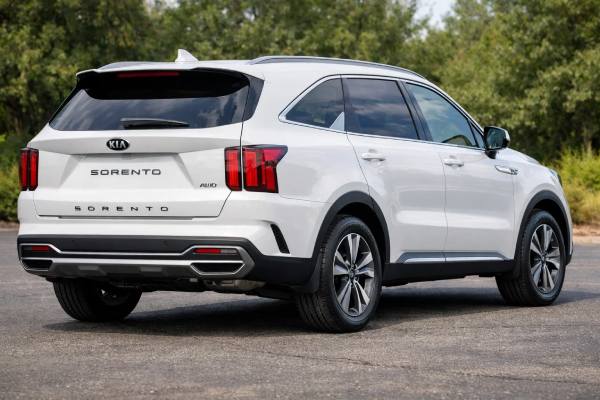
The 2021–2023 Kia Sorento Hybrid AWD (MQ4) is the “do-it-all” Sorento when you want three-row versatility but you do not want three-row fuel bills. Its hybrid system pairs a small turbocharged 1.6-liter gasoline engine with an electric motor and a compact high-voltage battery, then sends power through a conventional 6-speed automatic. That last detail matters: the driving feel is familiar, and long-term servicing is straightforward compared with many eCVT-style hybrids.
The AWD version adds traction and confidence for wet weather, mild snow, and gravel driveways, with a modest efficiency penalty versus the front-wheel-drive hybrid. For owners, the big wins are low-speed smoothness, reduced brake wear from regenerative braking, and quiet cruising. The tradeoffs are a more complex cooling and electrical system, plus tighter packaging under the hood that rewards proactive maintenance.
Owner Snapshot
- Strong real-world efficiency for a midsize AWD SUV, especially in mixed city use.
- Conventional 6-speed automatic feel with smooth hybrid torque fill at low rpm.
- AWD traction improves stability on slick roads without needing a plug.
- Plan for extra cooling-system attention (multiple loops and electric pumps).
- Change engine oil every 8,000–10,000 km (5,000–6,000 miles) or 6–12 months, depending on driving severity.
Jump to sections
- Kia Sorento Hybrid AWD profile
- Kia Sorento Hybrid AWD specs
- Kia Sorento Hybrid AWD trims and safety
- Hybrid reliability and common issues
- Maintenance plan and buying tips
- Real-world driving and efficiency
- How it compares to rivals
Kia Sorento Hybrid AWD profile
The MQ4-generation Sorento Hybrid uses a “parallel hybrid” layout: a turbocharged 1.6-liter direct-injection engine provides the baseline power, and an electric motor fills in torque during launches, low-speed acceleration, and gear changes. In practice, that means the Sorento can feel bigger than its displacement suggests—especially pulling away from a stop, climbing short grades, or merging into traffic where the electric motor helps cover turbo spool time.
A key ownership advantage is the conventional 6-speed automatic transmission. Instead of the high-rev “rubber band” sensation some drivers associate with eCVTs, the Sorento Hybrid steps through gears in a familiar way. It also tends to behave predictably when towing light loads or running at steady highway speeds, where the turbo engine can sit in an efficient band while the hybrid system trims small speed changes.
AWD adds a prop shaft and rear drive unit to distribute torque to the back axle when traction demands it. For daily use, you notice it most in rain-soaked roundabouts, winter slush, or uneven gravel driveways where a front-drive hybrid might scrabble. The penalty is extra mass and driveline drag, so the AWD hybrid typically trails the FWD hybrid in highway consumption.
From a packaging standpoint, the high-voltage battery is small compared with a plug-in hybrid. That keeps weight reasonable and preserves cargo usability, but it also means the system is designed for frequent charge and discharge rather than long EV-only driving. The hybrid shines in stop-and-go traffic and rolling suburban roads where it can recapture energy under braking and reuse it at the next launch.
For buyers, the Sorento Hybrid AWD makes the most sense when you want:
- Three-row flexibility with better fuel economy than a conventional 2.5-liter or V6 midsize SUV
- Confident all-season traction without the cost and charging routine of a plug-in
- A powertrain that feels “normal” while still delivering hybrid efficiency benefits
Kia Sorento Hybrid AWD specs
Below is a practical spec sheet for the 2021–2023 Sorento Hybrid AWD configuration. Exact values can vary by market, trim, wheel size, and certification method, so treat this as a decision-grade reference and verify by VIN for service-critical numbers.
Powertrain and efficiency
| Item | Specification |
|---|---|
| Powertrain code | Smartstream 1.6 T-GDi Hybrid (GDI turbo) |
| Engine layout | Inline-4, turbocharged, DOHC |
| Displacement | 1.6 L (1,598 cc) |
| Bore × stroke | 75.6 × 89.0 mm (2.98 × 3.50 in) |
| Compression ratio | 10.5:1 |
| Fuel system | Gasoline Direct Injection (GDI) |
| Induction | Turbocharged |
| Max system power | 227 hp (169 kW) (combined system) |
| Max system torque | 350 Nm (258 lb-ft) (combined system) |
| Hybrid motor | 1 motor, integrated with transmission (front) |
| Battery chemistry | Lithium-ion polymer |
| Battery energy | ~1.5 kWh |
| System voltage | ~270 V |
| Rated efficiency (typical) | ~6.9–7.5 L/100 km combined (34–37 mpg US combined), market dependent |
| Real-world highway @ 120 km/h | Commonly ~7.5–8.5 L/100 km (28–31 mpg US), depending on tyres, wind, temperature |
Transmission and driveline
| Item | Specification |
|---|---|
| Transmission | 6-speed automatic (hybrid-compatible) |
| Drive type | AWD (on-demand, multi-plate coupling) |
| Differentials | Open front and rear (traction managed by brake-based systems) |
Chassis and dimensions
| Item | Specification (typical MQ4 Sorento) |
|---|---|
| Front suspension | MacPherson strut |
| Rear suspension | Multi-link |
| Steering | Electric power steering |
| Brakes | 4-wheel disc (sizes vary by trim) |
| Common tyre size | 235/55 R19 or 235/60 R18 (varies by trim/market) |
| Ground clearance | ~176 mm (~6.9 in), trim dependent |
| Length / width / height | ~4,810 / 1,900 / 1,695 mm (~189.4 / 74.8 / 66.7 in) |
| Wheelbase | ~2,815 mm (~110.8 in) |
| Turning circle | ~11.6–11.8 m (38–39 ft), tyre dependent |
| Kerb weight | Typically ~1,850–1,950 kg (4,080–4,300 lb), trim dependent |
| Fuel tank | ~67 L (~17.7 US gal / 14.7 UK gal), market dependent |
Performance and capability
| Item | Typical result |
|---|---|
| 0–100 km/h (0–62 mph) | ~8.0–9.0 s (tyres/trim/altitude matter) |
| Top speed | ~185–195 km/h (~115–121 mph), market dependent |
| Towing capacity (braked) | Often up to ~750 kg (~1,650 lb) for the hybrid; verify by market and cooling package |
| Payload | Highly trim- and market-dependent; check the door-jamb label |
Fluids and service capacities (decision-grade)
Hybrid vehicles often use multiple coolant circuits and electric pumps. Always confirm the correct fluid spec and bleed procedure for your exact VIN.
| System | Typical spec guidance |
|---|---|
| Engine oil | Full-synthetic, commonly 0W-20 or 5W-30 depending on market/climate; capacity varies by pan and filter |
| Engine coolant | Long-life coolant; correct mix ratio per manual |
| Transmission fluid | Manufacturer-specified ATF for the hybrid 6AT |
| Rear differential / AWD coupling | Gear oil spec by market; service interval depends on use (towing, mountains, short trips) |
| A/C refrigerant | R-1234yf on many modern markets; charge is label-specific |
Safety and driver assistance (high level)
| Category | What to expect (varies by trim/market) |
|---|---|
| Crash structure | MQ4 platform with modern occupant cell and multiple airbags |
| Core ADAS | Forward collision avoidance, lane support, blind-spot monitoring, rear cross-traffic alert (availability varies) |
| Headlights | Trim- and option-dependent; headlight performance can materially change safety outcomes |
Kia Sorento Hybrid AWD trims and safety
Hybrid AWD availability and naming can differ by region, but the common pattern is a two-trim ladder: a well-equipped mainstream trim and a higher-spec technology/luxury trim. When shopping used, do not rely on a badge alone—confirm the hybrid system and AWD hardware from the VIN build data and the underbody layout (rear differential and prop shaft are the quick visual tells).
Trims and options that matter mechanically
Even when power output stays the same, trims can change how the vehicle drives and what it costs to maintain:
- Wheel and tyre packages: 19-inch wheels often look great but can increase tyre cost and road noise. They can also reduce ride compliance on broken pavement. If your priority is comfort and efficiency, the smaller wheel package is often the smarter long-term choice.
- Brake hardware: Disc sizes can vary by trim. Larger brakes can feel more confident on long descents, but pads and rotors may cost more.
- Cooling and towing equipment: Some markets bundle additional cooling capacity or software calibrations with tow packages. For a hybrid, that can be especially valuable because both the engine and the electric components generate heat under sustained load.
- Driver-assistance sensor suite: Higher trims may include additional radar/camera features, surround view cameras, or more advanced junction and turning collision functions. These add convenience and safety, but they also add calibration steps after a windshield replacement, front-end repair, or alignment.
Quick identifiers when inspecting a used example
- Hybrid confirmation: “HEV” badging and a hybrid instrument cluster with power/charge flow screens are typical, but VIN decoding is best.
- AWD confirmation: Look underneath for a prop shaft to the rear and a rear differential housing. In the cabin, many AWD variants also include drive-mode settings that reference terrain or traction.
- ADAS confirmation: Check the windshield area for the camera module and the front grille/bumper area for radar. Then verify the feature list in the vehicle settings menu—some systems are present but not enabled without specific packages.
Safety ratings and what they mean for owners
Safety ratings can apply to the Sorento line overall rather than the hybrid specifically, because the body structure is shared. Still, pay attention to two details that often change the real-world outcome:
- Headlight performance: Ratings frequently vary by trim and optional lighting packages. If you drive rural roads at night, headlight quality is not a “nice to have”—it is safety equipment.
- AEB and lane support calibration: Camera alignment, windshield replacement quality, tyre size, and suspension condition can all affect how driver assistance performs. After repairs, insist on proper calibration where required.
Finally, remember that child-seat usability is about more than anchors. Bring your actual child seat, verify access to the lower anchors, and check that the belt path works cleanly without awkward twists.
Hybrid reliability and common issues
Overall, the Sorento Hybrid system is designed for high cycling—small battery, frequent charge/discharge, and a lot of low-speed electric assistance. That is a durable approach when cooling is healthy and fluid services are kept up. The problems owners encounter tend to fall into a few predictable categories.
Common (higher prevalence)
- Coolant level changes or slow leaks
Symptoms: Sweet smell, damp residue around hoses, low level over weeks, intermittent heater performance.
Likely causes: Hose clamp seepage, reservoir cap issues, or a minor leak at a connector in one of the cooling circuits.
Remedy: Pressure test, inspect all circuits (engine and hybrid electronics), replace suspect clamps/hoses, and follow correct bleeding procedure. - 12 V battery weakness (especially with short trips)
Symptoms: Slow start, weird warning lights, infotainment resets, intermittent “no ready” events.
Likely causes: Frequent short trips, accessory loads, aging battery. Hybrids can be sensitive to low 12 V voltage because it powers control modules and contactors.
Remedy: Battery test with conductance tool, clean grounds, replace proactively if marginal. - GDI intake valve carbon buildup (long-term pattern)
Symptoms: Rough idle, hesitation, reduced efficiency, misfire codes at higher mileage.
Likely causes: Direct injection does not wash intake valves with fuel; deposits can accumulate.
Remedy: Use quality fuel, keep PCV system healthy, consider intake cleaning if symptoms appear.
Occasional (moderate prevalence)
- Turbo-related noises or boost control issues
Symptoms: Rattle on spool, inconsistent power, underboost codes.
Likely causes: Wastegate actuator wear, boost leaks at hoses, sensor drift.
Remedy: Smoke test intake system, inspect actuator operation, update software if applicable. - Transmission shift quality complaints
Symptoms: Harsh 2–3 shift, hesitation on kickdown, occasional shudder.
Likely causes: Fluid aging, adaptation values, or calibration differences after battery disconnect.
Remedy: Correct fluid service, adaptation relearn procedure, and check for updates.
Rare but high impact
- Hybrid system warning and reduced power mode
Symptoms: “Check hybrid system,” reduced acceleration, overheating warnings.
Likely causes: Cooling issue affecting inverter/motor, sensor faults, or electrical connector problems.
Remedy: Diagnose with hybrid-capable scan tool, verify cooling pump operation, inspect wiring connectors for corrosion or pin fitment, and apply software updates where the manufacturer specifies a reflash.
Recalls, TSBs, and updates: how to approach them
For this generation, the best practice is procedural rather than speculative:
- Run an official VIN recall check and keep a printed record.
- Ask a dealer to confirm completion history, not just “open campaigns.”
- If you experience drivability quirks, request that the shop checks for ECU/TCU/hybrid control updates before replacing parts. Hybrids are software-managed systems; calibrations matter.
Pre-purchase checks that pay off
- Confirm all recalls completed and that the hybrid system has no stored warning history.
- Inspect coolant levels and look for signs of recent top-ups without documentation.
- Test drive from cold: listen for belt/tensioner noises, check smooth engagement, and confirm the vehicle enters “ready” state consistently.
- On a mixed route, watch for stable temperature behavior and consistent power delivery under moderate load.
Maintenance plan and buying tips
A hybrid AWD Sorento rewards a conservative service plan. The engine may run fewer hours than a non-hybrid in city use, but it often runs under higher load when it does run, and the cooling system has more components that must stay healthy.
Practical maintenance schedule (distance or time, whichever comes first)
Use this as a robust baseline; adjust if your market’s official schedule differs.
- Engine oil and filter: every 8,000–10,000 km (5,000–6,000 miles) or 6–12 months.
Short trips, cold winters, towing, or lots of idling justify the shorter interval. - Engine air filter: inspect every 15,000 km (10,000 miles); replace 30,000–45,000 km (20,000–30,000 miles) depending on dust.
- Cabin air filter: every 15,000–20,000 km (10,000–12,000 miles) or annually.
- Coolant (engine and hybrid circuits): inspect level at every service; replace per official interval, and always use correct bleeding procedure.
- Spark plugs: typically 160,000 km (100,000 miles) for iridium-style plugs, but inspect earlier if you see misfire codes or roughness.
- Brake fluid: every 2 years regardless of mileage.
- Tyre rotation and alignment: rotate every 10,000–12,000 km (6,000–7,500 miles); check alignment annually or when tyre wear is uneven.
- Transmission fluid (6AT): inspect for leaks at every service; consider a fluid change around 60,000–90,000 km (40,000–60,000 miles) if you tow, drive mountains, or do heavy city use.
- Rear differential and AWD coupling fluid: consider service around 60,000–90,000 km (40,000–60,000 miles) for severe use; always follow the correct fluid spec.
- 12 V battery: test annually after year 3; many owners replace preventively around 4–6 years depending on climate.
- Hybrid cooling checks: ensure radiator fins stay clean, coolant levels are stable, and electric pumps run correctly.
Fluid specs and torque values (useful checkpoints)
Because VIN and market can change details, use these as “sanity checks,” not absolute instructions:
- Wheel lug nuts: commonly around 100–110 Nm (74–81 lb-ft)
- Engine oil drain plug: commonly around 30–40 Nm (22–30 lb-ft)
- Spark plugs (small turbo engines): commonly around 15–25 Nm (11–18 lb-ft)
If you or your shop cannot confirm the exact torque spec for your VIN, stop and verify—over-torquing aluminum threads is an expensive mistake.
Buyer’s guide: what to seek or avoid
Seek:
- Full service history with consistent oil changes
- Evidence of recall completion and software updates
- Clean coolant reservoirs with stable level marks over time
- Tyre sets that match in brand, size, and wear (AWD drivetrains dislike mismatched rolling diameter)
Be cautious with:
- Vehicles with repeated 12 V battery replacements without explanation
- Signs of chronic overheating, repeated coolant top-ups, or oily residue near coolant junctions
- Harsh shifting that persists after a long, fully warmed test drive
Long-term durability outlook
When serviced proactively, the Sorento Hybrid AWD can be a durable family SUV. The most important “hybrid habit” is not exotic maintenance—it is simple consistency: keep fluids fresh, keep cooling healthy, and do not ignore early warning lights or minor leaks.
Real-world driving and efficiency
The Sorento Hybrid AWD’s defining trait is how it smooths everyday driving. At parking-lot speeds and in stop-and-go traffic, the electric motor supplies immediate torque, so the SUV steps off cleanly without needing high revs. That makes it feel refined even when the engine is cold or when you are creeping in traffic.
Ride, handling, and NVH
- Ride comfort: The Sorento tends to prioritize comfort over sharpness. Smaller wheels usually ride better; larger wheels can add thump over potholes.
- Steering feel: Electric steering is predictable, light-to-medium in effort, and tuned more for stability than feedback.
- Braking feel: Regenerative braking reduces pad wear, but brake feel can be slightly “two-stage” if you switch from light regen braking to heavier pedal input. A healthy system should still be smooth and easy to modulate.
- Cabin noise: At city speeds, the hybrid can be notably quiet. At highway speeds, wind and tyre noise dominate, and tyre choice can make a surprising difference.
Powertrain character and transmission behavior
The 1.6 turbo engine provides strong midrange, while the electric motor covers gaps:
- Low rpm response: Strong, thanks to electric assist.
- Passing performance: Usually adequate without drama, though kickdown can involve one or two downshifts from the 6AT.
- Drive modes: If your market includes ECO/SMART/SPORT logic, expect ECO to soften throttle response and favor earlier upshifts, while SPORT holds gears longer and uses electric assist more aggressively.
Efficiency in the real world
Hybrid results depend heavily on speed and temperature:
- City driving: Often the best-case scenario because regen recovers energy and the engine can shut off more often.
- Highway at 100–120 km/h (60–75 mph): Efficiency typically drops because aero drag dominates and the engine runs more steadily.
- Cold weather: Expect a noticeable hit. The engine must run more to provide cabin heat, and the battery is less efficient when cold.
A realistic expectation for many owners is that the AWD hybrid’s combined consumption is still closer to a compact SUV than a traditional three-row midsize SUV. If you spend most of your time on fast motorways, you will see a smaller advantage—but it rarely disappears.
Load and towing notes
This hybrid is best treated as a light-duty tow vehicle. With a small trailer, it can feel stable and confident, but keep these priorities:
- Use the correct tow rating for your exact VIN and market.
- Keep speeds moderate on long grades, watch temperatures, and do not push into sustained full-load conditions.
- Maintain shorter fluid intervals if you tow regularly—heat is the enemy of long-term drivetrain health.
How it compares to rivals
The Sorento Hybrid AWD sits in a competitive space: midsize crossovers that need to do family duty, handle bad weather, and still deliver respectable fuel economy. Its strengths are not only efficiency, but also how “normal” it feels compared with some hybrids.
Against hybrid-focused rivals
- Toyota Highlander Hybrid AWD (and similar): Often the benchmark for hybrid efficiency and long-term hybrid reputation. The Sorento counters with a more conventional stepped-gear feel and, depending on market, strong feature value. If maximum mpg is your only goal, Toyota often wins; if you prefer a more traditional power delivery and a modern cabin layout, Sorento can feel more familiar.
- Ford Explorer Hybrid (where available): Typically more power and a larger feel, but often higher running costs and less consistent efficiency. Sorento Hybrid focuses on balanced consumption and everyday smoothness.
Against non-hybrid AWD midsize SUVs
- Turbo 4-cylinder AWD gas models: These can feel quick, but they usually consume more fuel in city use and wear brakes faster because they cannot recapture energy. Sorento Hybrid tends to win on mixed driving economy and calmness in stop-and-go.
- V6 AWD models: Often smoother under heavy load and sometimes better for frequent towing. The hybrid’s advantage is day-to-day efficiency, especially if you mostly drive without heavy loads.
The deciding questions
Choose the Sorento Hybrid AWD if:
- You drive a lot of mixed city/suburban routes and want efficiency without changing your routine.
- You value a conventional automatic transmission feel.
- You need AWD for weather confidence but do not need serious off-road capability.
Consider a different option if:
- You tow frequently or tow heavy—look for higher tow ratings and larger cooling reserves.
- You spend most of your time at high motorway speeds where hybrid gains shrink.
- You want meaningful EV-only driving—then a plug-in hybrid may fit better, if you can charge consistently.
References
- 2023 Kia Sorento HEV Specifications 2023
- 2021 Kia Sorento HEV Specifications 2021
- Gas Mileage of 2023 Kia Sorento 2023 (Fuel Economy Database)
- 2023 Kia Sorento 4-door SUV 2023 (Safety Rating)
- Official Kia Sorento 2020 safety rating 2020 (Safety Rating)
Disclaimer
This article is for informational purposes only and is not a substitute for professional diagnosis, inspection, or repair. Specifications, fluid capacities, torque values, service intervals, and procedures can vary by VIN, market, model year, and equipment. Always verify details using your vehicle’s official owner’s manual and service documentation, and follow manufacturer procedures—especially for hybrid high-voltage systems.
If this guide helped, please consider sharing it on Facebook, X (Twitter), or your favorite forum to support our work.