

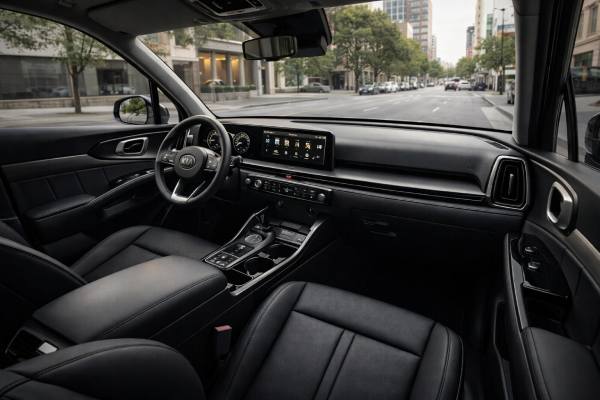

The facelifted 2024–present Kia Sorento Plug-in Hybrid (PHEV) AWD is a very specific kind of family SUV: it blends short-trip EV driving with long-distance gasoline flexibility, without moving up to a full-size platform. Its powertrain combines a 1.6-liter turbocharged direct-injection engine with a traction motor and a high-voltage battery, feeding a conventional 6-speed automatic and an on-demand AWD system. In day-to-day use, the “win” is how easily the Sorento can cover commuting and school runs on electricity while still towing light loads or doing highway days with no charging anxiety.
Ownership success comes down to two habits: charging consistently (to actually earn the fuel savings) and maintaining the hybrid-specific cooling and drivetrain fluids on time. Get those right, and the Sorento PHEV tends to feel like a normal, quiet midsize SUV that just happens to visit gas stations far less often.
Owner Snapshot
- Strong blend of EV commuting and gasoline road-trip range in one AWD package.
- Smooth, low-noise urban driving when the battery is charged and EV mode is available.
- Heavier curb weight means tires and brakes can wear faster if driven hard.
- Plan on a brake-fluid refresh about every 2 years (typical interval for many markets).
- Charge from a 240 V Level 2 source in roughly 3.4 hours (typical for this model).
Section overview
- Sorento MQ4 PHEV AWD profile
- Sorento MQ4 PHEV AWD specs
- Sorento PHEV trim and ADAS
- Reliability and common fixes
- Maintenance schedule and buying
- Charging, efficiency, and drive
- Rivals and best alternatives
Sorento MQ4 PHEV AWD profile
The Sorento PHEV AWD sits in a niche that’s still surprisingly small: a three-row-capable crossover with plug-in capability and standard traction for mixed weather. The facelifted 2024–present version keeps the same core engineering approach—an electrified front power unit with an on-demand AWD system—while updating the design and cabin tech to match newer Kia interiors.
From an engineering perspective, the key is how Kia chose “conventional” components around the hybrid hardware. You get a familiar automatic transmission rather than an eCVT-only feel, and AWD behavior that’s closer to a normal crossover than to a dedicated off-road system. That makes the Sorento easy to understand: it drives like a typical midsize SUV, just with an EV layer on top.
Where the Sorento PHEV excels:
- Short trips: A charged battery can cover many commutes and errands without the engine starting, especially in moderate temperatures and city speeds.
- Mixed driving: Once the battery depletes, the vehicle behaves like a regular hybrid, using regenerative braking and engine management to reduce fuel burn.
- Year-round usability: Standard AWD and a higher mass over the axles help stability in rain and light snow—though tires still matter more than drivetrain for braking and cornering.
Trade-offs to understand before buying:
- Weight: The battery and hybrid hardware push curb weight well above non-electrified Sorento trims. That typically means faster tire wear, more sensitivity to alignment, and a slightly “heavier” feel on quick transitions.
- Third row reality: The Sorento is a practical “occasional” third-row SUV. Adults fit for short trips, but it’s more comfortable as a 5-seater with cargo space.
- Charging dependency: The efficiency promise only shows up if you charge regularly. If you never plug in, you carry battery weight for smaller gains.
The ownership mindset that works best is simple: treat it like an EV for the first part of your day and a hybrid for the rest. If you can charge at home or work, the Sorento PHEV is one of the more seamless ways to reduce fuel use without changing how you plan long trips.
Sorento MQ4 PHEV AWD specs
Specs can vary by market, but the 2024+ Sorento PHEV AWD is typically sold in a narrow configuration (often one main trim), which keeps the data easier to interpret. The tables below focus on the facelift-era AWD PHEV setup and omit non-applicable items.
Powertrain and efficiency
| Item | Specification |
|---|---|
| Code | Smartstream G1.6 T-GDi HEV/PHEV (turbo DI) |
| Engine layout and cylinders | I-4, turbocharged, direct injection |
| Bore × stroke | 75.6 × 89.0 mm (2.98 × 3.50 in) |
| Displacement | 1.6 L (1,598 cc) |
| Compression ratio | 10.5:1 |
| Max power (engine) | 177.2 hp @ 5,500 rpm |
| Max torque (engine) | 195.4 lb-ft @ 1,500–4,500 rpm |
| Traction motor | PMSM (Permanent Magnet Synchronous Motor) |
| Motor output | ~66.9 kW (about 89.8 hp), 224.2 lb-ft |
| System output | 261 hp (system) |
| System torque | 258 lb-ft (system) |
| HV battery | Lithium-ion polymer, ~360 V |
| Battery energy | ~14 kWh (gross; usable can be lower) |
| Rated efficiency (typical) | ~79 MPGe combined (electricity+gas) and ~34 mpg combined (gas-only) |
| Real-world highway @ 120 km/h | Commonly higher fuel use than rating once EV range is used; expect hybrid-mode economy to drop with speed, weather, and load |
Transmission and driveline
| Item | Specification |
|---|---|
| Transmission | 6-speed automatic |
| Drive type | AWD (active on-demand) |
| Differential | Open (typical crossover layout) |
Chassis and dimensions
| Item | Specification |
|---|---|
| Suspension (front / rear) | MacPherson strut / multi-link |
| Steering | Rack-mounted motor-driven power steering |
| Steering ratio | 13.27:1 |
| Brakes (front / rear) | Ventilated disc / ventilated disc |
| Brake diameter | 12.8 in / 12.8 in (325 mm / 325 mm) |
| Wheels and tires (common) | 235/55 R19 on 19 in alloy wheels |
| Ground clearance | 6.93 in (176 mm) |
| Angles | Approach 16.8° / Departure 21.3° / Breakover 15.6° |
| Length / Width / Height | 189.4 / 74.8 / 66.7 in (4,811 / 1,900 / 1,694 mm) |
| Wheelbase | 110.8 in (2,815 mm) |
| Turning circle (curb-to-curb) | 18.96 ft (5.78 m) |
| Curb weight | ~4,502–4,537 lb (2,042–2,058 kg) |
| GVWR | ~5,953 lb (2,700 kg) |
| Fuel tank | 12.4 US gal (47 L) |
| Cargo volume (SAE) | 12.6 ft³ (behind 3rd) / 38.5–45.0 ft³ (behind 2nd) / 75.5 ft³ (behind 1st) |
Performance and capability
| Item | Specification |
|---|---|
| 0–100 km/h (0–62 mph) | ~8.7 s |
| Top speed | ~120 mph (193 km/h) |
| EV-only max speed | ~74.6 mph (120 km/h) |
| Braking (60–0 mph) | ~126 ft (38.4 m) |
| Towing capacity | Unbraked ~1,654 lb (750 kg) (market-dependent) |
Fluids and service capacities (high-level)
| System | Typical specification |
|---|---|
| Engine oil | Full synthetic 0W-20 (API SP / ILSAC GF-6 typical) |
| Oil capacity | ~4.8 L (with filter) |
| ATF | Kia-spec SP4-type fluid (market naming varies) |
| Engine coolant | Ethylene glycol-based for aluminum radiator |
| Inverter coolant | Hybrid/PHEV-specific; capacity differs from HEV |
If you’re comparing this Sorento to non-plug-in hybrids, the biggest “spec story” is battery energy and charge time: it’s enough to change daily fueling behavior, but small enough that charging remains simple and quick on Level 2.
Sorento PHEV trim and ADAS
In many markets, the facelift-era Sorento PHEV AWD is sold in a limited trim walk—often a single high-spec grade—because the plug-in hardware already pushes cost and weight up. That’s good news for buyers: fewer “gotchas” where a key feature is missing.
Trims and options that matter
Common patterns you’ll see:
- Single main PHEV trim: Typically bundled with premium interior, larger wheels, and a higher level of driver assistance.
- Seating layout: Many PHEV configurations prioritize second-row comfort (often captain’s chairs) over maximum passenger count. If you need a true 7-seat layout, verify the exact seat hardware for your market.
- Wheel and tire package: The 19-inch setup is common. It looks right, but it also means replacement tires cost more, and winter tire selection can be narrower than 17–18-inch setups.
- Tow equipment: Some markets offer tow prep or wiring as an option. Because PHEV cooling loads can rise while towing, use factory-rated equipment and confirm whether an auxiliary transmission cooler or specific package is required.
Quick identifiers when shopping used:
- Charge door: Obvious, but confirm it functions smoothly and the latch seals well.
- Badging: “PHEV” or “Plug-in Hybrid” typically appears on tailgate/trim identifiers.
- Cable kit: Make sure the portable charging cable (if supplied originally) is present and undamaged.
Safety ratings and what they mean
Safety ratings can be confusing because the rating body, test year, and exact vehicle variant may differ. For the Sorento MQ4 platform:
- Euro NCAP awarded the Sorento a 5-star rating under the protocol used at the time, with strong adult and child occupant protection and strong Safety Assist scoring. This is a platform-level signal, but facelift updates and equipment differences can affect active-safety scoring.
- IIHS recognition for the Sorento in recent model years has depended heavily on headlight performance and front crash prevention results. That means trim and lighting package can change the outcome even when the structure is similar.
Driver assistance and calibration realities
Typical ADAS coverage includes:
- Automatic emergency braking (vehicle, pedestrian, cyclist detection, depending on market)
- Adaptive cruise control with lane centering/lane following support
- Blind-spot monitoring and rear cross-traffic alerts (sometimes with active intervention)
- Parking sensors and surround-view camera on higher trims
Two ownership notes that help avoid headaches:
- After windshield replacement or front-end repairs, assume radar/camera calibration may be required. Skipping calibration can cause warning lights or reduced system performance.
- Keep sensors clean in winter. Slush buildup on radar covers and cameras can temporarily disable features, which is normal but surprises new owners.
If you value modern safety tech, the PHEV’s typical “high trim by default” approach is a real advantage—just verify lighting and ADAS package details by VIN.
Reliability and common fixes
The Sorento PHEV combines three systems that each bring their own maintenance logic: a turbocharged gasoline engine, high-voltage hybrid components, and an AWD driveline. Reliability is usually good when service is consistent, but problems can be more expensive when neglected.
Below is a practical way to think about issues by prevalence and cost tier. Exact rates vary by climate, driving pattern, and build period.
Common (low to medium cost)
- 12 V battery sensitivity
Symptoms: Slow crank/boot, intermittent warning lights, odd infotainment resets.
Likely cause: Short-trip use, age, or repeated accessory use while parked. PHEVs can still be hard on the 12 V system because many modules stay awake.
Remedy: Test battery health, check charging behavior, replace with correct capacity AGM if specified, and update software if available. - Brake corrosion and uneven feel (PHEV/HEV trait)
Symptoms: Pulsation, noise after rain, or a “grabby” first stop.
Likely cause: Regen braking reduces friction brake use, letting rotors develop surface corrosion.
Remedy: Periodic firm stops to clean rotors, brake service/cleaning at tire rotations, rotor replacement if thickness/runout is out of spec. - Tire wear and alignment drift
Symptoms: Inside-edge wear, steering pull, road noise that grows quickly.
Likely cause: Added weight plus large wheels; alignment slightly out; underinflation.
Remedy: Align annually or when tires show uneven wear; rotate on schedule; keep pressures correct.
Occasional (medium to high cost)
- Cooling system attention (engine + inverter loops)
Symptoms: Overheat warnings, reduced EV power, cabin heat issues.
Likely cause: Incorrect coolant type, air pockets after service, or leaks from hose connections.
Remedy: Use the correct coolant spec, bleed procedures, and pressure tests. Hybrid systems often require stricter procedures than non-hybrid cars. - Turbocharged DI housekeeping
Symptoms: Rough idle, reduced efficiency, or hesitation after long periods of short trips.
Likely cause: Direct injection can lead to intake valve deposits over time, especially with short-trip operation and limited high-load use.
Remedy: Keep oil changes timely, use quality fuel, and periodically drive long enough to fully warm the engine. If needed, professional intake cleaning may help.
Rare (higher cost, but important)
- High-voltage component faults (contactors, sensors, DC–DC behavior)
Symptoms: “Check hybrid system,” reduced power, inability to charge, or warning lights that return.
Likely cause: Component failure or software logic that needs updates.
Remedy: Dealer-level diagnostics; software updates may be the official fix, but hardware replacement is sometimes required.
Recalls, service actions, and software updates
Because the facelift era is still relatively new, the most important “service action” category is often software:
- Powertrain calibration updates to improve driveability (shift feel, engine start/stop smoothness)
- Charging logic updates (charge session reliability, temperature behavior)
- ADAS updates that reduce false warnings or improve lane support behavior
How to protect yourself on a used purchase:
- Run the VIN through the official recall lookup in your region and ask a dealer to confirm completion records.
- Ask for proof of software update history when possible, especially if the car had repeated warning lights.
The good news: many PHEV “problems” aren’t mechanical breakages—they’re maintenance or calibration issues. The bad news: skipping correct procedures can make small issues expensive.
Maintenance schedule and buying
A plug-in hybrid rewards structure. If you follow a consistent schedule and use correct fluids, the Sorento PHEV is typically straightforward to maintain—just more systems to track.
Practical maintenance schedule (distance or time, whichever comes first)
Every 8,000–12,000 km (5,000–7,500 mi) or 6–12 months
- Engine oil and filter (turbo + DI engines like clean oil)
- Tire rotation; inspect brakes (pads, slider pins, rotor corrosion)
- Check coolant levels (engine and inverter loops)
- Inspect charge port seal, door alignment, and cable condition
Every 15,000–20,000 km (9,000–12,000 mi) or 12 months
- Cabin air filter
- Alignment check (especially with 19-inch tires)
- Inspect suspension bushings and front/rear axle boots
Every 30,000–40,000 km (20,000–25,000 mi)
- Engine air filter
- Brake service clean/lube (highly recommended for regen-heavy use)
- AWD fluids inspection (rear differential and transfer case); replace earlier if you tow or drive mountains often
Every 2 years (regardless of mileage)
- Brake fluid replacement (moisture control matters for ABS/ESC/ADAS braking stability)
Every 60,000–100,000 km (40,000–60,000 mi)
- ATF service (interval varies by market; towing and heat argue for earlier service)
- Spark plugs (turbo DI engines are sensitive to plug condition; confirm exact interval for your region)
Timing components
- The 1.6T uses a timing chain. There is usually no fixed replacement interval, but you should inspect if you hear cold-start rattle, see timing correlation faults, or have persistent misfire/roughness that isn’t solved by plugs/coils.
Fluid specifications and capacities (decision-useful snapshot)
Typical values (verify by VIN/market):
- Engine oil: 0W-20 full synthetic; about 4.8 L with filter
- ATF: Kia-spec SP4-type fluid family (exact label varies)
- Rear differential and transfer case (AWD): gear oil meeting API GL-5 (often 75W-85); capacities are small, so clean service matters
- Fuel tank: about 47 L (12.4 US gal)
Buyer’s guide: what to inspect
Charging and HV health
- Confirm the car charges reliably on Level 1 and Level 2.
- Check for warning messages after a full charge and after a short drive.
- Look for consistent EV range behavior relative to temperature and tire setup.
Cooling systems
- Inspect for dried coolant residue around hoses and junctions.
- Confirm cabin heat works normally (heat complaints can indicate coolant issues).
Driveline
- Listen for clunks on takeoff or during tight parking-lot turns (can indicate mount wear or driveline slack).
- Ensure AWD engagement feels smooth on wet pavement; no binding sensations.
Reconditioning costs to anticipate
- Premium tires (19-inch) are a common early spend.
- Brake rotor cleanup or replacement if the vehicle sat unused.
- Alignment (worth doing immediately on a used, heavy PHEV).
Long-term outlook: if you can charge consistently and you keep fluids fresh—especially in the AWD and cooling systems—the Sorento PHEV tends to age like a well-kept turbo crossover, with the added benefit of reduced fuel use.
Charging, efficiency, and drive
The Sorento PHEV’s driving experience depends heavily on whether you start the day with charge. With a full battery, the SUV feels calmer and more refined in stop-and-go traffic because the electric motor can handle launch and low-speed creep with minimal engine involvement. Once depleted, the powertrain transitions to hybrid operation and behaves more like a conventional Sorento Hybrid AWD.
Ride, handling, and NVH
- Ride: The added mass tends to smooth small bumps but can feel firmer over sharp edges, especially on 19-inch tires.
- Handling: It’s stable and predictable rather than sporty. The battery weight is usually low in the chassis, which helps body control, but the vehicle still carries momentum in quick direction changes.
- Noise: EV-mode operation is noticeably quieter around town. On the highway, wind and tire noise become the dominant sounds, and the turbo engine may run under load depending on terrain and battery state.
Powertrain character
- Throttle response: Immediate at low speeds thanks to the electric motor.
- Engine start/stop: Generally smooth, but can feel more noticeable in cold weather or when the engine needs to run for heating or battery management.
- Transmission behavior: The 6-speed automatic feels familiar. Under light throttle it can stay relaxed, but in hilly terrain you may notice it holding gears to keep the engine in an efficient band.
Real-world efficiency (what owners usually see)
A useful mental model:
- Best case: You charge daily, drive mostly within EV range, and use hybrid mode mainly on longer trips. Fuel use can drop dramatically because many miles are electric.
- Average case: Mixed charging habits and mixed driving. You’ll still benefit, but less than the headline numbers.
- Worst case: You rarely charge. Then you’re essentially carrying battery weight, and economy trends closer to a standard hybrid.
For highway travel at 100–120 km/h (60–75 mph):
- Expect EV range to shrink more quickly than in city driving.
- In hybrid mode, consumption rises with speed, cold temperatures, roof boxes, and heavy cargo.
Charging performance and planning
- Level 2 (240 V): Typical full charge time is about 3.4 hours.
- Level 1 (120 V): Slow but workable for overnight top-ups if you have enough time.
Practical tips:
- Use scheduled charging if your electricity pricing rewards off-peak rates.
- In winter, preheat while plugged in when possible; it preserves EV range and reduces engine start events.
- If you tow or climb long grades, expect the engine to run more often even with charge available—thermal management and sustained power needs can override EV preference.
Traction and control
The on-demand AWD system is tuned for confident road traction. It’s effective for rain, slush, and moderate snow with the right tires, but it’s not a low-range 4×4. Ground clearance and approach/departure angles are adequate for rough driveways and mild trails, not rock crawling.
Net: the Sorento PHEV is at its best as a quiet daily driver that occasionally becomes a long-range family SUV—without asking you to change your trip planning habits.
Rivals and best alternatives
The Sorento PHEV AWD competes on a mix of attributes that rarely appear together: plug-in capability, usable cabin space, and all-weather traction. Most rivals win on one or two points, but not all.
If you want a similar “family PHEV” mission
Hyundai Santa Fe Plug-in Hybrid (where available)
Often comparable in concept (shared corporate engineering roots in many markets), with strong packaging and good efficiency. Depending on model year, it may offer a different cabin layout philosophy and a different value balance. If you prioritize second-row comfort and a slightly different ride/tech feel, it’s worth cross-shopping.
Mitsubishi Outlander PHEV
A common alternative for shoppers who want plug-in capability with available AWD and three-row branding. It tends to emphasize electric driving more strongly in feel, but its third row is typically tighter, and performance character differs. It can be a strong pick if you value EV-style behavior and don’t rely on the third row.
If towing and power matter more than plugging in
Jeep Grand Cherokee 4xe
A compelling PHEV option if you want stronger off-road branding and a more rugged footprint. Trade-offs usually include higher purchase cost and potentially higher running costs. It’s the “capability-first” choice rather than the “efficient family tool” choice.
If you just want efficiency with fewer systems
Non-plug-in Sorento Hybrid AWD
If you can’t reliably charge, the conventional hybrid is often the smarter ownership play. It avoids the plug-in hardware complexity and still delivers strong fuel economy for an AWD midsize SUV. Many buyers who live in apartments or rely on public charging end up happier here.
Where the Sorento PHEV wins
- Daily flexibility: You can treat it like an EV for errands and like a hybrid for trips.
- Simple charging: Battery size keeps charge times short and infrastructure demands low.
- Trim simplicity (often): A narrow trim range means fewer feature compromises.
Where it can lose
- Price premium vs hybrid: You need consistent charging and meaningful EV miles to justify the added cost.
- Weight-related wear: Tires, brakes, and alignment can cost more over time than on lighter trims.
- Cargo and third-row constraints: If you regularly use all three rows and haul luggage, a larger three-row SUV may be more comfortable.
If your household can plug in most days, the Sorento PHEV AWD is often one of the most painless ways to reduce fuel use without sacrificing road-trip freedom. If you can’t charge consistently, the regular Sorento Hybrid AWD is frequently the better “set and forget” alternative.
References
- 2024 Kia Sorento PHEV Specifications 2024 (Specifications)
- 2024 Kia Sorento Plug-in Hybrid 2024 (Fuel Economy and Range)
- Recommended lubricants and capacities 2024 (Owner’s Manual)
- 2024 TOP SAFETY PICKs 2024 (Safety Rating)
- Official Kia Sorento 2020 safety rating 2020 (Safety Rating)
Disclaimer
This article is for informational purposes only and is not a substitute for professional diagnosis, inspection, or repair. Specifications, torque values, service intervals, and procedures can vary by VIN, market, model year, and equipment. Always verify details using the official owner’s manual and service documentation for your specific vehicle.
If this guide helped, please consider sharing it on Facebook, X (Twitter), or your favorite forum to support our work.