

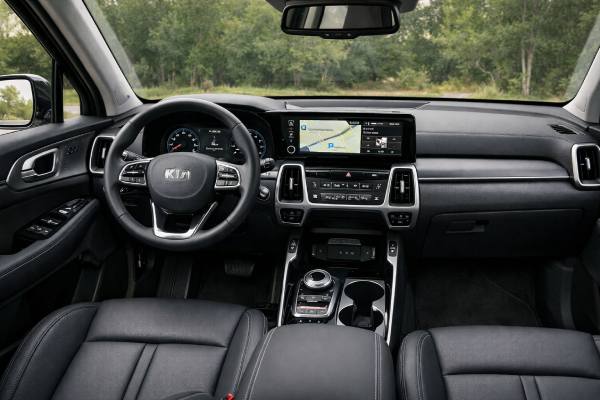

The 2021–2023 Kia Sorento Plug-in Hybrid AWD (MQ4) is built for drivers who want a real electric commute without giving up three-row flexibility. Its recipe is a turbocharged 1.6-liter gasoline engine paired with a stronger electric motor and a much larger high-voltage battery than the regular hybrid. When you keep it charged, many day-to-day trips can be done in EV mode, while the engine steps in seamlessly for longer drives.
Unlike many plug-ins that use an eCVT, this Sorento PHEV uses a conventional 6-speed automatic, so the throttle and shifting feel familiar. The tradeoff is complexity: you now have charging hardware, additional cooling loops, and more software control layers. Owners who treat it like a “battery car plus engine” and keep up with fluids and cooling checks tend to have the best long-term experience.
Fast Facts
- EV mode can cover short commutes and school runs when charging is consistent.
- AWD traction adds confidence in rain and snow with no change in daily driving habits.
- Conventional 6-speed automatic gives a familiar, predictable feel for a plug-in.
- Expect more maintenance touchpoints: charge port, cooling loops, and high-voltage safety checks.
- Charge at home regularly; a typical full charge on a 3.3 kW AC onboard charger is about 4–5 hours (equipment dependent).
What’s inside
- Sorento PHEV AWD deep dive
- Sorento PHEV AWD specs and dimensions
- Sorento PHEV AWD trims and ADAS
- Reliability, issues, and service actions
- Maintenance schedule and buyer checks
- Driving, EV range, and charging
- Plug-in rivals and alternatives
Sorento PHEV AWD deep dive
The MQ4 Sorento Plug-in Hybrid is best understood as an EV-capable family SUV that carries its own backup generator. In daily use, the larger battery lets the car behave like a battery electric vehicle on short trips: quiet pull-away, strong low-speed response, and minimal engine runtime if you keep the battery topped up. When the battery is depleted, it transitions into a conventional hybrid strategy, using the engine for steady power while the electric motor fills torque gaps and recovers energy during braking.
This PHEV layout uses a parallel hybrid design with a traditional 6-speed automatic transmission. That choice changes the driving character in two important ways. First, power delivery feels more “mechanical” and predictable than many eCVT plug-ins—especially during passing maneuvers, where the gearbox can downshift instead of relying only on motor speed changes. Second, the vehicle’s efficiency depends more on gear selection and speed discipline on the highway. In other words, the Sorento PHEV rewards calm driving and regular charging more than it rewards “set-and-forget” high-speed cruising.
The AWD system is a practical, on-demand type designed for road traction and light off-pavement use. It helps in wet roundabouts, slushy inclines, and uneven gravel. It is not intended to be a rock-crawling system, and the factory tire choice often becomes the limiting factor before the drivetrain does.
From an ownership perspective, the PHEV version adds new systems that deserve respect:
- High-voltage battery, contactors, and a battery management system (BMS)
- Onboard AC charger (OBC), charge port, and locking actuator
- DC–DC converter that keeps the 12 V system healthy
- Additional coolant loops and electric pumps for battery and power electronics
If you are deciding between the regular hybrid and the plug-in hybrid, the single biggest question is behavioral: will you reliably charge it? If the answer is yes, the PHEV can deliver a noticeably lower fuel bill and a calmer daily drive. If the answer is no, you will carry extra battery weight and complexity without capturing the full value.
Sorento PHEV AWD specs and dimensions
Specifications vary by market and certification method. Use the tables below as a practical snapshot for the 2021–2023 Sorento PHEV AWD, then confirm service-critical numbers by VIN and under-hood labels.
Powertrain and efficiency
| Item | Specification (typical) |
|---|---|
| Powertrain code | Smartstream 1.6 T-GDi Plug-in Hybrid |
| Engine layout and cylinders | Inline-4, turbocharged, DOHC |
| Valvetrain | DOHC, 4 valves/cyl |
| Bore × stroke | 75.6 × 89.0 mm (2.98 × 3.50 in) |
| Displacement | 1.6 L (1,598 cc) |
| Induction | Turbocharged |
| Fuel system | Gasoline Direct Injection (GDI) |
| Compression ratio | 10.5:1 |
| Max system power | 261 hp (195 kW) |
| Max system torque | ~350 Nm (~258 lb-ft) (system figure) |
| Traction motor | 1 motor (front), integrated with transmission |
| Battery chemistry | Lithium-ion polymer |
| Battery capacity | ~13.8 kWh (gross, market dependent) |
| System voltage | ~300–400 V class (pack dependent) |
Transmission and driveline
| Item | Specification |
|---|---|
| Transmission | 6-speed automatic (PHEV-compatible) |
| Drive type | AWD (on-demand coupling) |
| Differential type | Open (traction managed by brake-based systems) |
Chassis and dimensions
| Item | Typical MQ4 Sorento PHEV range |
|---|---|
| Suspension (front/rear) | MacPherson strut / Multi-link |
| Steering | Electric power steering |
| Brakes | 4-wheel disc |
| Wheels and tyres (common) | 235/55 R19 or 235/60 R18 (market/trim dependent) |
| Ground clearance | ~170–180 mm (~6.7–7.1 in) |
| Length / width / height | ~4,810 / 1,900 / 1,695 mm (~189 / 74.8 / 66.7 in) |
| Wheelbase | ~2,815 mm (~110.8 in) |
| Turning circle | ~11.6–11.8 m (~38–39 ft) |
| Kerb weight | Typically ~2,000–2,100 kg (~4,400–4,630 lb) |
| GVWR | Door-jamb label dependent |
| Fuel tank | Market dependent (often smaller than non-hybrid variants) |
| Cargo volume | Depends on seat layout; PHEV packaging can slightly reduce underfloor space |
Performance and capability
| Item | Typical result |
|---|---|
| 0–100 km/h (0–62 mph) | ~8.0–8.7 s (conditions and tyres matter) |
| Top speed | ~185–195 km/h (~115–121 mph) |
| Towing capacity | Commonly modest for PHEV; verify exact rating by VIN/market |
| Payload | Highly trim-dependent; verify on label |
Fluids and service capacities (decision-grade)
| System | Notes |
|---|---|
| Engine oil | Full-synthetic; common grades include 0W-20 or 5W-30 by market |
| Coolant | Multiple circuits; correct fluid and bleeding procedure are essential |
| Transmission fluid | Manufacturer-specified ATF for the 6AT |
| AWD/rear drive fluid | Spec and interval depend on market and use |
| A/C refrigerant | Typically R-1234yf on many markets; verify under-hood label |
Safety and driver assistance overview
| Category | Notes |
|---|---|
| Crash ratings | Often shared across the Sorento body structure; year/test version matters |
| ADAS | AEB, lane support, ACC, blind-spot and cross-traffic systems vary by trim |
| Headlight performance | Can change by trim and optional lighting packages |
Sorento PHEV AWD trims and ADAS
Trims for the Sorento PHEV AWD typically cluster around “well-equipped” and “fully loaded,” and the differences are not only cosmetic. When buying used, the most important task is separating appearance upgrades from functional upgrades that affect long-term satisfaction and repair cost.
Trims and options that change the experience
- Wheel size and tyre type: Larger wheels often look premium but can make the ride firmer and tyres more expensive. On a heavier PHEV, tyre quality matters for braking feel and cabin noise. If comfort and efficiency are your goals, the smaller wheel option is often the sweet spot.
- Headlights: Lighting is a real safety feature. Some trims move from basic LED units to higher-performance projector systems, sometimes with better high-beam behavior. This is one of the few “luxury” options that can change night driving confidence dramatically.
- Seating and climate packages: Ventilated seats and upgraded HVAC can affect EV range because cabin heating and cooling draw energy. A vehicle with efficient climate management (and a driver who uses seat heating smartly) can preserve EV miles in shoulder seasons.
- Infotainment and connected services: PHEVs depend on software for charging schedules, preconditioning, and efficiency displays. Higher trims may add features that make it easier to charge on a routine.
Safety ratings in plain language
Safety scores depend on the testing body, the year of test, and sometimes the exact equipment fitted. Treat ratings as a structured comparison tool rather than a guarantee. Two real-world factors often matter more than people expect:
- Headlight and AEB combination: Even strong crashworthiness can be undermined by weak night visibility or poorly equipped forward collision systems on lower trims.
- Tyre choice: A premium safety suite cannot out-brake budget tyres on wet roads. For a heavy PHEV, tyres are part of the safety system.
ADAS and what owners should know
Most Sorento PHEVs offer a familiar set of driver assists, though availability can be trim- or package-dependent:
- AEB (automatic emergency braking): May detect vehicles and sometimes pedestrians/cyclists depending on version.
- ACC (adaptive cruise control): Excellent for long trips, but sensor condition matters.
- Lane support: Lane keeping assist (LKA) and lane following/centering features vary by market.
- Blind-spot and rear cross-traffic alert: Particularly useful with a long vehicle and tall beltline.
Service implications are straightforward but important: windshield replacement, front bumper repairs, and even some alignments can require camera/radar calibration. If a shop returns the car without verifying calibration where required, ADAS performance can degrade quietly. When you are buying used, scan the vehicle settings menus and ensure the systems are present and functioning, not simply displayed as “available.”
Reliability, issues, and service actions
The Sorento PHEV’s reliability story is usually less about catastrophic failures and more about system health: cooling, charging hardware, sensors, and software updates. Because plug-in hybrids blend EV and ICE subsystems, small issues can show up as warnings, reduced power modes, or inconsistent charging behavior.
Common (higher prevalence) concerns
- Charge-port door and lock actuator quirks
Symptoms: Port won’t unlock, flap sticks, charging handle feels trapped.
Likely causes: Lock actuator wear, alignment issues, winter ice.
Remedy: Keep the port clean, avoid forcing connectors, address early before the actuator fails fully. - 12 V battery sensitivity
Symptoms: “No ready,” random alerts, infotainment resets, slow module boot-up.
Likely causes: Aging battery, frequent short trips, accessory draw. PHEVs still depend heavily on a healthy 12 V supply.
Remedy: Annual battery testing after year 3; replace proactively if marginal. - Cooling-system level changes
Symptoms: Low coolant warnings, inconsistent cabin heat, mild sweet smell.
Likely causes: Small seepage at clamps/connectors across multiple loops.
Remedy: Pressure test and correct bleeding procedure. Do not “top up and forget” on a PHEV.
Occasional issues (moderate prevalence)
- Onboard charger (OBC) or charging communication faults
Symptoms: Intermittent charging, charger clicking off early, fault messages on EVSE.
Likely causes: Loose charge inlet pins, temperature-related derating, software mismatch with certain EVSEs.
Remedy: Inspect inlet, try a known-good charger, check for updates, and confirm proper grounding at the outlet. - GDI-related deposits over time
Symptoms: Rough idle after long EV-heavy usage, hesitation when engine starts.
Likely causes: Direct injection intake valve deposits; engine may run less frequently but still sees cold starts.
Remedy: Use quality fuel, keep oil change intervals sensible, address PCV system health.
Rare but high-cost categories
- High-voltage isolation or contactor faults
Symptoms: Hybrid warning, reduced power, inability to engage EV mode.
Likely causes: Sensor faults, moisture intrusion, wiring issues, or internal component failure.
Remedy: High-voltage diagnostic procedure with a qualified technician; avoid guesswork.
Recalls, TSBs, and software updates
For modern electrified vehicles, software can be the official fix for drivability, charging behavior, and false warnings. The practical owner approach is:
- Run an official VIN recall check and document the results.
- Request proof of completion for campaigns and updates.
- If a warning appears intermittently, capture photos and conditions (temperature, charger type, battery state-of-charge). Good data speeds diagnosis.
Battery health and degradation patterns
Most Sorento PHEVs use conservative battery management to protect the pack. Real-world degradation is typically gradual, and many owners notice it first as reduced EV range in winter rather than a sudden drop. A strong pre-purchase practice is to test EV mode on a fully charged battery, confirm stable charging, and observe that the system transitions between EV and hybrid modes smoothly.
Maintenance schedule and buyer checks
A Sorento PHEV is easiest to live with when you maintain it like two vehicles in one: a turbocharged GDI engine and an EV charging system. The good news is that most tasks are familiar; the key is consistency and correct fluids.
Practical maintenance schedule (distance or time)
Adjust to your official market schedule, but this baseline suits many owners:
- Engine oil and filter: every 8,000–10,000 km (5,000–6,000 miles) or 6–12 months.
Choose the shorter interval for short trips, cold weather, heavy traffic, or frequent engine cold starts. - Engine air filter: inspect every 15,000 km (10,000 miles); replace 30,000–45,000 km (20,000–30,000 miles).
- Cabin air filter: every 15,000–20,000 km (10,000–12,000 miles) or annually.
- Coolant circuits (engine and electrified): inspect levels at every service; replace per official interval and use the correct bleed procedure.
- Spark plugs: often around 160,000 km (100,000 miles) for long-life plugs, but inspect earlier if misfires appear.
- Brake fluid: every 2 years, regardless of mileage.
- Tyre rotation and alignment: rotate every 10,000–12,000 km (6,000–7,500 miles); align if wear is uneven.
- Transmission fluid (6AT): inspect regularly; consider 60,000–90,000 km (40,000–60,000 miles) for severe use.
- Rear differential/AWD coupling fluid: consider a similar 60,000–90,000 km interval in harsh conditions or frequent towing.
- HV system inspection: follow the manufacturer’s procedure for periodic checks of high-voltage cables, coolant lines, and charge port condition.
- 12 V battery: test yearly after year 3; replace proactively if weak.
Key fluids and decision-grade torque values
Because VIN and market differences are real, treat these as checkpoints:
- Wheel lug nuts: commonly ~100–110 Nm (74–81 lb-ft)
- Engine oil drain plug: commonly ~30–40 Nm (22–30 lb-ft)
If you cannot confirm a torque value for your VIN, do not guess—aluminum threads and plastic undertrays do not forgive improvisation.
Buyer’s checklist for used Sorento PHEVs
Paperwork to request
- Service records showing consistent oil changes and coolant attention
- Recall and campaign completion proof
- Evidence of correct charging equipment use (no melted plugs, no “DIY outlet” issues)
Physical checks that matter
- Charge port condition: clean pins, smooth lock/unlock behavior
- Coolant reservoirs: correct level and clean fluid appearance
- Tyres: matched brand/size and even wear (important for AWD)
- Brake feel: smooth transition between regen and friction braking
Test drive routine
- Start cold and confirm the vehicle enters “ready” state consistently.
- Drive in EV mode at low speed and listen for abnormal clunks or repeated relay chatter.
- Trigger a blended acceleration event (moderate throttle) and ensure the engine start is smooth.
- If possible, perform a short AC charging session to confirm stable charging behavior.
A well-kept PHEV feels “quietly competent.” If it feels glitchy, inconsistent, or warning-prone during a short test, assume it will be worse when you own it.
Driving, EV range, and charging
The Sorento PHEV’s personality changes depending on whether you are running on battery or in hybrid mode. In EV driving, it feels refined and surprisingly strong at city speeds because the electric motor delivers immediate torque. In hybrid mode (battery depleted), it behaves more like a smooth turbo crossover with an assist motor that fills gaps and reduces fuel use in stop-start traffic.
Ride, handling, and NVH
- Ride: The extra PHEV weight can actually help it feel settled over gentle undulations, but sharp potholes still depend on wheel size and tyre sidewall. Smaller wheels generally improve comfort.
- Handling: Predictable and stable, tuned for family use rather than sportiness. AWD helps put power down cleanly on wet surfaces.
- Noise: EV mode is quiet. In hybrid mode, the engine may be more noticeable under sustained load, but the 6-speed keeps revs more natural than some eCVT plug-ins.
EV range in real life
Real EV distance varies enormously with speed, temperature, and heating use:
- City and suburban: Typically best-case because speeds are moderate and regen is effective.
- Highway: EV range drops quickly at 110–130 km/h due to aerodynamic drag.
- Cold weather: Expect a meaningful reduction. Cabin heat can be a large energy draw, and cold batteries are less efficient.
A good ownership habit is using seat heating (where equipped) and preconditioning while plugged in. Those small behaviors protect EV miles and reduce engine start events.
Charging performance
This Sorento PHEV is designed around AC charging (home and workplace), not fast DC charging.
- Onboard AC charging rate: commonly ~3.3 kW (market dependent)
- Typical 0–100% time: roughly 4–5 hours on a 240 V Level 2 setup with adequate current
- Level 1 (120 V) charging: often overnight-plus; best as a backup rather than a daily plan
Because there is no DC fast charging, your best “performance upgrade” is a reliable home charging routine. If your household electrical setup is marginal, fix that first—many charging complaints trace back to poor outlets, weak grounding, or underrated extension cords.
Performance metrics that matter
- 0–100 km/h: commonly in the high-8-second range, with strong midrange response
- Passing power: feels confident at moderate speeds because the motor can assist during downshifts
- Braking consistency: generally good, but the feel can change slightly between regen and friction braking—normal for many electrified vehicles
Towing and load behavior
Treat towing as occasional and moderate. Plug-in hybrids generate and manage heat across more systems, and the extra vehicle mass means brakes and tyres work harder. If you tow even a few times per year, shorten fluid intervals and pay extra attention to tyre condition and brake fluid age.
Plug-in rivals and alternatives
The Sorento PHEV AWD competes with plug-in crossovers that aim to replace a large share of gasoline miles with electricity. Your best alternative depends on what you value most: EV range, third-row packaging, charging flexibility, or long-term simplicity.
If you want maximum EV capability
- Toyota RAV4 Prime: Often a benchmark for brisk performance and strong EV usability, but it is a two-row format in most markets. If you do not need a third row, it can be a compelling “EV-first” plug-in.
- Mitsubishi Outlander PHEV: Frequently emphasizes EV driving feel and SUV practicality, sometimes with different AWD behavior and charging features by year. It can be a smart pick if you prioritize EV-mode refinement and a plug-in lifestyle.
If you want a similar family layout
- Hyundai Santa Fe PHEV: Shares similar corporate engineering themes and can feel close in mission, often with different interior packaging priorities. Compare second-row comfort, cargo floor height, and trim availability in your market.
- Volvo XC90 Recharge (used): A different price and performance class, but worth mentioning if you are cross-shopping used. It can offer strong torque and premium features, with higher service costs and more complex systems.
If you are unsure about charging discipline
If you will not charge most days, a regular hybrid can be the better ownership experience. Carrying a larger battery without using it can reduce efficiency and add complexity without payoff. In that scenario, a conventional hybrid AWD variant often delivers a simpler “always-on” benefit without changing your routine.
The quick decision filter
Choose the Sorento PHEV AWD if:
- You can charge at home or work consistently
- You want three-row flexibility and EV-capable daily driving
- You prefer a conventional automatic feel in a plug-in
Consider a different option if:
- You need DC fast charging for road-trip charging stops
- You tow frequently or heavy
- Your driving is mostly high-speed motorway, where EV miles disappear quickly
In the right household, the Sorento PHEV can meaningfully reduce gasoline use while still behaving like a normal family SUV on long trips. Its advantage is not just numbers—it is that it lets you drive electric often without committing to a full EV.
References
- 2023 Kia Sorento PHEV Specifications 2023
- 2021 Kia Sorento PHEV Specifications 2021
- Gas Mileage of 2023 Kia Sorento 2023 (Fuel Economy Database)
- Check for Recalls: Vehicle, Car Seat, Tire, Equipment 2026 (Recall Database)
- 2023 Kia Sorento 4-door SUV 2023 (Safety Rating)
Disclaimer
This article is for informational purposes only and is not a substitute for professional diagnosis, inspection, or repair. Specifications, torque values, intervals, and procedures vary by VIN, market, model year, and equipment. Always verify details using the official owner’s manual and service documentation for your exact vehicle, and follow high-voltage safety procedures when working on plug-in hybrid systems.
If you found this guide useful, please consider sharing it on Facebook, X (Twitter), or your preferred community to support our work.