

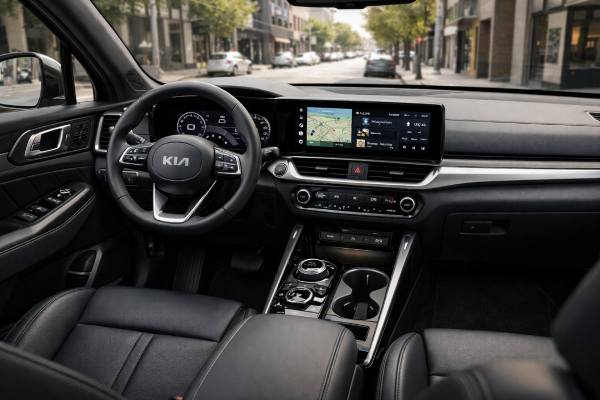

The facelifted Kia Sorento AWD (MQ4) with the Smartstream 2.5T is built for owners who want three-row flexibility without giving up strong midrange power. The 281 hp turbo four pairs direct injection with supplemental port injection, which helps drivability and can reduce intake-valve deposits compared with DI-only engines. In AWD form, it’s tuned as an on-road family SUV first, but it still brings useful geometry and traction logic for snow, wet roads, and light unpaved travel.
The key ownership story is balance: a punchy engine, a modern cabin and driver assistance suite, and a chassis that’s easy to live with day to day. The tradeoffs tend to center on heat and fluid management under heavy loads (towing, mountains, hot climates) and staying current on software updates that can affect lighting, safety systems, and powertrain behavior.
Quick Specs and Notes
- Strong passing power for a midsize SUV, with turbo torque that feels relaxed at highway speeds.
- AWD traction logic is confidence-inspiring in rain and snow, especially with the right tires.
- Family-friendly packaging: usable third row for kids and a wide cargo range with seats folded.
- Ownership caveat: the turbo + DCT pairing rewards correct fluids, gentle low-speed creeping habits, and timely updates.
- Plan on engine oil and filter service about every 12 months or 12,000 km (7,500 mi) (sooner in severe use).
Guide contents
- Kia Sorento MQ4 AWD basics
- Kia Sorento MQ4 2.5T key specs
- Kia Sorento MQ4 trims, safety, and ADAS
- Reliability, issues, and service actions
- Maintenance plan and buyer’s checklist
- Driving feel and real-world performance
- How it stacks up against rivals
Kia Sorento MQ4 AWD basics
The 2024–present facelift Sorento (MQ4) keeps the same core strengths that made the fourth generation popular—three-row versatility, a calm ride, and a tech-forward interior—but the AWD 2.5T variant is the one that changes the personality most. With 281 hp on tap, it feels less like a “family appliance” and more like a confident all-rounder that can merge, pass, and climb grades without strain.
What “AWD” means on this Sorento. This is an on-demand system designed to send torque rearward when traction or load demands it. Under steady cruising, it may behave mostly like a front-driven vehicle for efficiency. When it detects slip, brisk throttle, or certain drive-mode requests, it can preemptively engage the rear drive. That matters for:
- Wet roundabouts and highway on-ramps: less front tire overload, smoother exit traction.
- Snow starts and slushy climbs: fewer one-wheel scrabbles and less stability-control intervention.
- Towing stability: better composure when a trailer adds rear-axle load changes.
Why the 2.5T is the “engineering pick.” The Smartstream 2.5T combines modern combustion control with torque that arrives early enough to keep revs modest in daily use. In practice, that means fewer downshifts on hills and less “busy” sound under moderate throttle compared with smaller turbo engines working harder. It also pairs well with the Sorento’s size: the vehicle doesn’t feel underpowered when loaded with passengers and luggage.
Facelift-era ownership traits to know.
- Software is part of the vehicle now. Updates can affect infotainment stability, driver-assist calibration, lighting behavior, and occasionally shift logic. Treat dealer campaigns and updates as normal maintenance, not an annoyance.
- Tires define the AWD experience. The system can only use what the tires can provide. If you live in a true winter climate, a dedicated winter tire set often transforms braking and steering more than AWD alone.
- Heat management is the hidden limiter. Turbo engines and dual-clutch transmissions can generate heat under repeated hard pulls, steep climbs, or towing. The Sorento is capable, but it’s happiest when fluids are fresh and the cooling system is healthy.
Advantages that show up over years, not days. The Sorento’s wide cargo envelope, usable second row, and straightforward road manners are what make it a long-term “keeper.” The 2.5T AWD version simply delivers those strengths with less compromise when conditions get demanding.
Kia Sorento MQ4 2.5T key specs
Below are the most relevant specifications for the Sorento MQ4 AWD with the 2.5T (281 hp). Note: exact equipment, curb weight, and ratings can vary by trim and market, but the figures shown reflect widely published OEM specifications for the 2024 Sorento lineup.
Powertrain and efficiency (2.5T AWD)
| Item | Spec |
|---|---|
| Engine family | Smartstream G2.5T (2.5L turbo GDI) |
| Layout | Inline-4, DOHC, 4 valves/cyl (16-valve) |
| Bore × stroke | 88.5 × 101.5 mm (3.48 × 4.00 in) |
| Displacement | 2.5 L (2,497 cc) |
| Induction | Turbocharged |
| Fuel system | GDI + MPI (dual injection) |
| Compression ratio | 10.5:1 |
| Max power | 281 hp (209 kW) @ 5,800 rpm |
| Max torque | 311.6 lb-ft (≈422 Nm) |
| Timing drive | Chain (verify by VIN/market service data) |
| Rated economy (AWD, OEM estimate) | 20 city / 27 highway / 23 combined mpg (US) |
| Real-world highway @ 120 km/h (75 mph) | Often ~9.0–10.5 L/100 km (26–31 mpg US), weather and tires dependent |
Transmission and driveline
| Item | Spec |
|---|---|
| Transmission | 8-speed wet dual-clutch (DCT) on 2.5T trims |
| Drive type | AWD (active on-demand) |
| Differential | Open (traction managed by brake-based vectoring) |
| Notable behavior | Low-speed creep feel depends on clutch control and heat; software updates matter |
Chassis and dimensions
| Item | Spec |
|---|---|
| Suspension (front/rear) | MacPherson strut / multi-link |
| Steering | Column-mounted motor-driven power steering (C-MDPS) |
| Steering ratio | 13.72:1 |
| Brakes (front/rear) | Ventilated discs / ventilated discs |
| Brake size | 325 mm / 305 mm (12.8 in / 12.0 in) |
| Typical tire size (popular) | 255/45 R20 (20 in rim) on upper 2.5T trims |
| Ground clearance (AWD) | 175 mm (6.9 in) |
| Approach / departure / breakover | 16.8° / 22.1° / 17.0° |
| Length / width / height | 4,816 / 1,900 / 1,694 mm (189.6 / 74.8 / 66.7 in) |
| Wheelbase | 2,814 mm (110.8 in) |
| Turning circle (curb-to-curb) | 11.6 m (38.0 ft) |
| Curb weight (AWD, range by trim) | ~1,834–1,928 kg (4,045–4,250 lb) |
Performance and capability
| Item | Spec |
|---|---|
| 0–100 km/h (0–62 mph) | ~7.5 s (AWD, OEM figure) |
| 80–120 km/h passing | ~4.6 s (AWD, OEM figure) |
| Top speed | ~211 km/h (131 mph) |
| Braking distance (100–0 km/h) | ~40 m (132 ft), surface dependent |
| Towing capacity (with tow package where offered) | Up to 1,588 kg (3,500 lb) braked |
| Fuel tank | 67.0 L (17.7 US gal / 14.7 UK gal) |
Fluids and service capacities (decision-useful)
Because public spec sheets don’t always publish every fluid type and capacity, the safest approach is: use the figures below for planning, and confirm the rest by VIN in the official service documentation.
| Fluid | Specification (typical) | Capacity |
|---|---|---|
| Engine oil | API SP / ILSAC GF-6; commonly 0W-30 or 5W-30 by climate (verify) | 6.8 L (7.2 US qt) |
| Engine coolant | Long-life ethylene glycol (OEM type), usually 50/50 mix (verify) | 3.3 L (3.5 US qt) listed in OEM spec sheet |
| DCT fluid | OEM wet-DCT fluid (verify exact part spec) | Not consistently published publicly—verify by VIN/service manual |
| Rear diff / transfer case | OEM gear oil spec (verify) | Verify by VIN/service manual |
| A/C refrigerant and oil | Refrigerant type and charge vary by market (verify) | Verify by under-hood label/service manual |
Safety and driver assistance (headline)
- IIHS: 2024 Sorento is listed as a Top Safety Pick, with strong crashworthiness and standard front crash prevention noted; headlight ratings can vary by trim/headlamp type.
- Euro NCAP: Sorento was tested in 2020 with a 5-star result; facelift models are not always re-tested, so treat that as the closest published baseline for the MQ4 platform in Europe.
- NHTSA: Use the official vehicle page and VIN lookup for the latest star ratings, recalls, and complaints data for your exact variant.
Kia Sorento MQ4 trims, safety, and ADAS
Trim structure varies by region, but the 2.5T AWD Sorento generally sits in the upper-middle to upper end of the lineup. The easiest way to think about it is powertrain first, then equipment.
Trims and options that change how it drives
On many markets, the 2.5T is paired with a more performance-oriented drivetrain package (notably the wet DCT) and larger wheel options. The meaningful mechanical differences you’ll see across trims are:
- Wheel and tire packages: Moving from 18-inch to 20-inch wheels tends to sharpen initial steering response, but it can add impact harshness over broken pavement and increases replacement tire cost. If comfort matters most, an 18-inch package is usually the sweet spot.
- Tow package availability: Some trims can be optioned to reach higher braked towing ratings. If towing is on your list, confirm you have the factory tow prep (cooling, hitch rating, and any required software).
- Seating configuration: Some higher trims swap a second-row bench for captain’s chairs (often 6-passenger). That’s a lifestyle choice, but it also affects cargo flexibility and how you load child seats.
Quick identifiers when shopping used (practical tells):
- Turbo trims often carry “2.5T” badging or are linked to higher-grade exterior pieces (larger wheels, upgraded lighting signatures).
- A rotary shift dial vs. a lever can indicate a higher equipment tier in some regions.
- If equipped, surround-view camera and advanced parking features usually signal higher trims that bundle more ADAS.
Safety ratings: how to interpret them correctly
Safety scores can be confusing because rating bodies test different things and update protocols over time.
- IIHS focuses on crashworthiness (small overlap, side tests) plus crash avoidance (AEB performance, headlight evaluations). The Sorento’s ratings apply across multiple model years, and the side test information for newer years notes structural and restraint updates on later builds.
- Euro NCAP publishes category percentages (Adult, Child, Vulnerable Road Users, Safety Assist) alongside star ratings. If the facelift hasn’t been re-tested, the older MQ4 result is still useful for platform context, but it’s not a guarantee that every facelift variant scores identically under the latest protocol.
- NHTSA star ratings are variant-dependent. Always confirm your exact powertrain and drivetrain on the official page because a “Sorento” label can include multiple engines.
ADAS suite: what’s typically included and what changes by trim
Most 2024–present Sorento trims include a core set of driver aids:
- Automatic emergency braking (AEB) with vehicle and pedestrian detection (feature names vary by market).
- Lane departure warning and lane keeping assist / lane following support.
- Blind-spot monitoring and rear cross-traffic alert on many mid-to-upper trims.
- Adaptive cruise control (ACC) on many trims; higher tiers may add navigation-linked behavior.
Higher trims usually add the features that owners notice daily:
- Highway assist functions (lane centering that feels more confident on long drives).
- Enhanced blind-spot visualization (camera view in the cluster in some markets).
- Parking collision avoidance and more capable parking camera systems.
Service implication: any windshield replacement, bumper repair, wheel alignment change, or suspension work can require ADAS calibration. Budget time and money for this if you plan modifications (lift kits, non-standard wheel offsets) or if you buy a repaired vehicle.
Reliability, issues, and service actions
Overall, the MQ4 Sorento platform has a solid reputation, and the 2.5T’s dual-injection strategy is a real engineering advantage. Still, “reliable” in modern vehicles often means predictable maintenance plus software discipline. Below are the issues to watch, grouped by prevalence and typical cost tier.
Common (watch closely)
- Low-speed DCT shudder or hesitation (medium cost if ignored):
Symptoms: vibration during gentle takeoff, odd creep behavior in stop-and-go, or a “busy” feeling when inching forward.
Likely root causes: wet clutch control strategy, heat buildup from repeated creeping, or outdated transmission software.
Remedy: ensure updates are current; avoid long creep sessions (use a little more decisive throttle, or leave space and roll); verify correct DCT fluid service if mileage is higher. - Brake wear variability (low–medium):
Symptoms: faster-than-expected front pad wear, occasional squeal, or uneven wear if alignment is off.
Root causes: vehicle mass + city driving, frequent ADAS braking interventions, and aggressive tire packages.
Remedy: annual brake inspections, clean and lubricate slide pins, and address alignment early. - 12V battery sensitivity (low–medium):
Symptoms: intermittent warnings, slow cranking, electronics behaving strangely after short trips.
Root causes: frequent short trips, accessory load, and battery aging.
Remedy: proactive battery testing before winter; replace preventively when weak.
Occasional (depends on use and climate)
- Turbo heat and oil stress (medium):
Symptoms: oil darkening quickly, increased consumption, or roughness after hard use.
Root causes: repeated high-load driving, towing, and short oil intervals.
Remedy: shorter oil change intervals under severe use; allow gentle cool-down after long climbs; ensure correct oil spec. - Cooling system aging (medium):
Symptoms: coolant smell, slow loss, or temperature creep under load.
Root causes: hose clamps, plastic fittings, or radiator/condenser debris.
Remedy: keep the cooling stack clean; pressure test if level drops; refresh coolant on schedule.
Rare but important (high attention)
- Lighting-related recall/service campaign (high priority, usually low cost to fix):
Kia America issued a safety recall submission describing a Body Domain Control Unit (BDC) software logic error that can cause momentary loss of low-beam headlamp and tail lamp illumination while driving on certain 2024–2025 Sorento vehicles. The remedy is an updated BDC software calibration.
What you do: run a VIN check and confirm completion, especially if you drive in dark rural areas or winter conditions.
Software and calibrations: the modern “maintenance item”
Today’s ownership reality is that many “issues” are calibration problems, not hardware failures. Practical best practices:
- Ask the dealer for a printout showing all open campaigns and the current software status at purchase.
- After any collision repair, confirm ADAS calibration and that no warning lights are stored.
- If you feel a driveline behavior change after an update, give it a few drive cycles—many systems re-learn.
Pre-purchase checks to request (especially for used)
- Full service history with oil change intervals clearly documented (short trips and towing should show more frequent oil service).
- Proof of recall completion by VIN.
- A test drive that includes parking-lot crawling, stop-and-go, and a warm highway pull (to sense DCT behavior under different heat states).
- Underside inspection for impact damage and seepage, especially if the vehicle lived on rough roads.
Maintenance plan and buyer’s checklist
A practical maintenance plan for the Sorento 2.5T AWD is about protecting three systems: the turbo engine, the wet DCT, and the AWD driveline. The schedule below is conservative enough for real-world use while staying easy to follow.
Core maintenance schedule (distance/time)
Use the shorter interval if you do frequent short trips, idle a lot, tow, drive in dust, or see extreme temperatures.
- Engine oil and filter: every 12 months or 12,000 km (7,500 mi); severe use often benefits from 8,000 km (5,000 mi) intervals.
- Engine air filter: inspect every 12 months, replace about 24,000–48,000 km (15k–30k mi) depending on dust.
- Cabin air filter: every 12 months (or sooner if you notice reduced airflow or odors).
- Brake fluid: every 2–3 years (humidity-driven; earlier in wet climates).
- Coolant: typically 5 years / 100,000 km (60k mi) initial, then shorter thereafter (verify official schedule for your market).
- Spark plugs (turbo engines): commonly 60,000–100,000 km (40k–60k mi) depending on plug type and fuel quality (verify).
- Tire rotation: every 8,000–12,000 km (5k–7.5k mi); maintain matching tread depth on all four tires for AWD.
- Wheel alignment: check annually or whenever tires show uneven wear.
- 12V battery test: annually after year 3; replace proactively if weak before winter.
AWD and DCT-specific care (the part owners skip)
- DCT fluid service: confirm the official interval for your market; if you tow or drive mountains often, consider earlier fluid service than a commuter would. Use only the correct OEM wet-DCT fluid.
- Rear differential / transfer case fluids: if your manual specifies intervals, follow them; if not, a preventive service around 60,000–100,000 km (40k–60k mi) is a reasonable “longevity play” for heavy-duty use (towing, snow, long mountain climbs).
- Tire matching: avoid running one tire significantly more worn than the others; that can stress the coupling and cause driveline vibrations.
Fluids, specs, and capacities (quick planning sheet)
- Engine oil: API SP / ILSAC GF-6; viscosity commonly 0W-30 or 5W-30 depending on climate; capacity ~6.8 L (7.2 US qt).
- Coolant: OEM long-life coolant, typically 50/50 mix; capacity references vary by documentation—confirm at service time.
- Fuel: use the recommended octane for your market; higher octane can improve knock resistance under load, but follow the owner’s manual for required vs recommended.
Essential torque values (verify by VIN/service manual)
These are the fasteners owners most often ask about. Because torque specs can vary by wheel size, brake package, and market, treat these as typical planning ranges and confirm before final tightening:
- Wheel lug nuts: typically ~100–120 Nm (74–89 lb-ft).
- Engine oil drain plug: typically ~25–35 Nm (18–26 lb-ft).
- Brake caliper bracket bolts: commonly ~100–140 Nm (74–103 lb-ft).
Buyer’s guide: what to seek, what to avoid
Seek if you want the best long-term experience:
- A trim with 18-inch wheels if ride comfort and tire cost matter.
- Evidence of consistent oil service (not just “when the reminder pops up”).
- A vehicle that has had all campaigns completed and has no persistent driver-assist warnings.
Be cautious if you see:
- Repaired collision history with missing ADAS calibration paperwork.
- Noticeable takeoff shudder or inconsistent creep behavior when fully warmed up.
- Mismatched tires (brand/model/tread depth) on an AWD vehicle.
Long-term durability outlook: with disciplined oil changes, correct DCT and driveline servicing, and up-to-date software, the Sorento 2.5T AWD can be a durable family SUV. The biggest “mistakes” tend to be skipped fluids, ignored recall actions, and running mismatched tires.
Driving feel and real-world performance
The 2.5T AWD Sorento’s driving character is defined by effortless midrange and a chassis tuned for stability over drama. It’s not a sporty crossover in the enthusiast sense, but it is confidently quick for its class.
Ride, handling, and NVH (noise and vibration)
- Ride quality: Generally composed on highways and smooth roads, with impacts becoming sharper on larger wheel/tire packages. If your roads are rough, smaller wheels with taller tire sidewalls noticeably improve comfort.
- Straight-line stability: A strong point—useful on windy highways and when the vehicle is loaded. The steering is quick enough to feel modern but is tuned more for ease than feedback.
- Cabin noise: The engine is quiet at steady speed, but under hard acceleration you’ll hear a purposeful turbo four-cylinder tone. Tire choice affects highway noise more than many owners expect.
Powertrain character: what it feels like daily
- Throttle response: Strong once the turbo is awake; most of the time it feels “ready” without needing big revs.
- Turbo behavior: You may notice a small ramp-in under very light throttle, but the torque curve is broad enough that it doesn’t feel laggy in normal driving.
- DCT logic: When driven smoothly, shifts are quick and clean. In tight stop-and-go, the feel can be more “mechanical” than a traditional torque-converter automatic because the clutches are managing engagement. This is normal—what you’re watching for is persistent shudder or harshness.
Real-world efficiency (and what changes it)
Official estimates for the AWD turbo setup are commonly around 20/27/23 mpg (US) in city/highway/combined use. In the real world:
- City: short trips and cold starts can push consumption up sharply (more time warming the engine and turbo system).
- Highway: steady cruising can be surprisingly reasonable, but speed is everything—120 km/h (75 mph) costs noticeably more fuel than 105–110 km/h.
- Winter: expect a meaningful drop with cold air density, winter tires, and longer warm-ups.
One useful rule: if you’re often carrying a full load of passengers, the 2.5T’s “efficiency” advantage isn’t only fuel—it’s that the powertrain doesn’t feel strained, so it tends to hunt gears less and feels calmer.
Traction, control, and tires
The AWD system works best when you support it with the right hardware:
- All-season tires are fine for mild winters, but true winter tires are the single biggest upgrade for snow-country safety.
- Keep all four tires close in tread depth. This protects the AWD coupling and improves stability-control behavior.
- If your Sorento has selectable drive modes, treat them as calibration profiles (throttle mapping, shift behavior, AWD engagement bias), not magic traction. Tires still do the braking.
Load and towing behavior
When properly equipped, the Sorento can tow up to 3,500 lb (1,588 kg) in some configurations. Under tow:
- Expect a fuel economy penalty that can easily reach +20–40% depending on trailer aerodynamics and terrain.
- Plan for more frequent oil and DCT/driveline fluid attention if towing is regular.
- Use a conservative approach to speed on grades; heat is the true enemy of long-term durability.
How it stacks up against rivals
The Sorento 2.5T AWD sits in a very competitive space: midsize crossovers that need to satisfy commuting, family duty, and occasional road trips. Here’s how it tends to compare in the areas that matter to buyers.
Powertrain and performance
Against key rivals like the Toyota Highlander and Honda Pilot (and its close cousin, the Hyundai Santa Fe in some markets), the Sorento 2.5T typically feels:
- Quicker in passing response than many naturally aspirated V6 competitors at midrange speeds, thanks to turbo torque.
- More “tech-managed” at low speed because of the DCT, whereas torque-converter automatics often feel more seamless when inching forward.
If you want a more performance-lux leaning alternative, the Mazda CX-90 can feel more premium and rear-drive-biased in character, but it often comes with higher purchase and tire costs depending on trim.
Space and daily usability
Sorento’s packaging advantage is flexibility:
- A usable third row for kids and short trips, with a wide range of cargo volume depending on seat configuration.
- The tradeoff is that some rivals offer a roomier third row or a larger “max cargo” footprint if you routinely carry adults in row three.
For maximum interior volume, large crossovers like the Volkswagen Atlas can feel bigger inside, but they may give up some efficiency or nimbleness.
Safety and driver assistance value
Because the Sorento has strong published results from IIHS testing and a robust ADAS suite on many trims, it competes well on safety-per-dollar. The caution is to:
- Confirm headlight performance by trim (a common differentiator in IIHS scoring).
- Make sure any used example has all campaigns and recalls completed, and that ADAS features work without intermittent warnings.
Long-term ownership and maintenance
This is where your priorities decide the winner:
- If you value a calm, traditional low-speed feel, some competitors with torque-converter automatics may feel more “effortless” in heavy traffic.
- If you value passing power, efficient highway performance for the size, and a modern cabin experience, the Sorento 2.5T AWD is a strong fit—provided you commit to correct fluids, tire matching, and software updates.
Bottom line: the Sorento 2.5T AWD is best for owners who want a near-premium driving feel without luxury pricing, and who are willing to treat modern software and drivetrain fluids as part of routine, responsible ownership.
References
- 2024 Kia Sorento Specifications 2024 (Technical Specifications)
- 2024 Kia Sorento 2024 (Safety Rating)
- Official Kia Sorento 2020 safety rating 2020 (Safety Rating)
- Part 573 Safety Recall Report 25V-006 2025 (Recall Database)
- Recalls 2026 (Recall Lookup)
Disclaimer
This article is for informational purposes only and is not a substitute for professional diagnosis, inspection, or repair. Specifications, torque values, service intervals, and procedures can vary by VIN, market, powertrain calibration, and installed equipment. Always verify details against the official owner’s manual and service documentation for your specific vehicle.
If you found this guide useful, please consider sharing it on Facebook, X/Twitter, or your favorite forum to help others find reliable ownership information.