


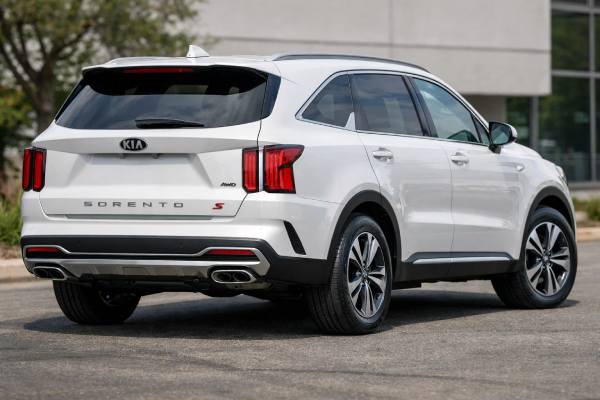
The 2021–2023 Kia Sorento AWD (MQ4) with the 2.5-liter Smartstream turbo is the “do-it-all” configuration in the lineup: strong mid-range torque for passing and towing, a modern 8-speed dual-clutch gearbox, and an on-demand all-wheel-drive system that adds traction without the constant fuel penalty of a full-time setup. It’s also a genuinely packaging-smart midsize SUV—usable third row for short trips, adult-friendly second row, and competitive cargo space for family duty.
Where owners should focus is not the headline 281 hp, but the systems that make this variant feel expensive (and stay reliable): the DCT’s shift behavior and software level, cooling and oil quality under heat and load, and AWD service basics. Get those right and the Sorento’s mix of quiet cruising, confident winter grip, and long-haul practicality makes a lot of sense.
Owner Snapshot
- Strong low-rpm torque makes highway merges and 80–120 km/h passing feel easy, even with passengers.
- AWD adds confidence on wet, snow, and gravel without making the Sorento feel heavy or slow.
- Big interior for the footprint: wide second row, workable third row for kids, and 75.5 ft³ max cargo.
- Ownership caveat: the 8-speed dual-clutch prefers clean fluid, correct software updates, and smooth driving when cold.
- Plan on oil service about every 8,000–10,000 km (5,000–6,000 mi) or 6–12 months depending on duty cycle.
Contents and shortcuts
- Kia Sorento MQ4 AWD 2.5T profile
- Kia Sorento AWD 2.5T specifications
- Kia Sorento 2021–2023 AWD trims and ADAS
- Common faults, recalls, and fixes
- Service schedule and used-buy checklist
- AWD’s driving feel and fuel economy
- Rivals: where the AWD Sorento fits
Kia Sorento MQ4 AWD 2.5T profile
Think of the 2.5T AWD Sorento as the “high-output, all-weather” interpretation of a three-row midsize SUV. The turbo engine’s job is not just peak horsepower—its real value is the torque plateau (311 lb-ft from roughly 1,700–4,000 rpm on this powertrain), which is where daily driving lives. In practice, that means fewer wide-open-throttle moments, less hunting for gears on grades, and better passing performance when the cabin is full.
The AWD system on these model years is an active, on-demand design. Under light load it behaves like a front-driver for efficiency; when slip is detected (or when you accelerate hard), it sends more drive rearward through a coupling and rear drive unit. On trims marketed for “rugged style,” you may also see a center-lock mode intended for low-speed traction (snowy inclines, muddy parking lots), not for rock crawling. The key point: it’s a confidence tool for real roads, not a substitute for a low-range transfer case.
The other defining system is the 8-speed dual-clutch transmission (DCT) paired with the 2.5T. A DCT uses clutches rather than a torque converter, which improves response and efficiency. The trade-off is that it can feel less “creamy” at parking-lot speeds, and it’s more sensitive to heat, fluid condition, and software calibration. If you test drive one, do it both cold and fully warm. You want smooth engagement, predictable creep, and no harsh shudder when inching forward.
Dimensionally, MQ4 Sorento stays impressively compact for a three-row: about 189 inches long with a 110.8-inch wheelbase, which helps maneuverability. Inside, the packaging is the story—wide doors, a low-ish load floor, and strong cargo volume for the segment. If you want one vehicle to handle commuting, winter weather, family duty, and occasional towing, this is the version most aligned with that mission.
Kia Sorento AWD 2.5T specifications
Below are the core specs for the 2021–2023 Sorento (MQ4) with the 2.5T and AWD. Values can vary slightly by trim, wheel package, and market. Use these as a practical reference, then confirm against your VIN-specific documentation when ordering parts or fluids.
Powertrain and efficiency
| Item | Spec (2.5T AWD) |
|---|---|
| Engine code / family | Smartstream G2.5T |
| Layout / cylinders | Inline-4, DOHC, 16-valve (4 valves/cyl) |
| Bore × stroke | 88.5 × 101.5 mm (3.48 × 4.00 in) |
| Displacement | 2.5 L (2,497 cc) |
| Induction | Turbocharged |
| Fuel system | GDI (gasoline direct injection) |
| Compression ratio | 10.5:1 |
| Max power | 281 hp (209 kW) @ 5,800 rpm |
| Max torque | 422 Nm (311 lb-ft) @ 1,700–4,000 rpm |
| Rated efficiency (AWD) | 9.8 / 8.4 / 9.8 L/100 km (23/28/24 mpg US city/hwy/comb) |
Real-world highway @ 120 km/h (75 mph): Expect roughly 8.8–10.2 L/100 km (23–27 mpg US) depending on temperature, tires, roof load, and traffic. The big swing factor is speed: this powertrain is strong enough that it’s easy to cruise faster than you think.
Transmission and driveline
| Item | Spec |
|---|---|
| Transmission | 8-speed dual-clutch (wet clutch) |
| Drive type | Active on-demand AWD |
| AWD behavior | Front-biased in steady cruise; adds rear drive under slip or load |
| Final drive (published) | 4.081:1 (AWD application) |
Chassis and dimensions
| Item | Spec |
|---|---|
| Suspension (front/rear) | Independent (segment-typical: strut front; multi-link rear) |
| Steering | C-MDPS (column-mounted motor-driven power steering) |
| Steering ratio | 13.72:1 |
| Brakes (front/rear) | Ventilated disc / ventilated disc; 325 × 305 mm (12.8 × 12.0 in) |
| Wheels/tires (popular) | 235/60R18; 255/45R20 common on higher trims |
| Ground clearance (AWD) | 175 mm (6.9 in) (some trims marketed for off-pavement style list higher clearance) |
| Length / width / height | 4,801 / 1,900 / 1,694 mm (189.0 / 74.8 / 66.7 in) |
| Wheelbase | 2,814 mm (110.8 in) |
| Turning circle (kerb-to-kerb) | ~11.6 m (~38 ft) |
| Curb weight (AWD) | ~1,749–1,869 kg (3,856–4,120 lb) depending on trim |
| GVWR (AWD) | 2,480 kg (5,468 lb) |
| Fuel tank | 67.0 L (17.7 US gal / 14.7 UK gal) |
| Cargo volume (SAE) | 2,138 L (75.5 ft³) behind 1st row (max) |
Performance and capability
| Metric | Typical published value (2.5T AWD) |
|---|---|
| 0–100 km/h (0–62 mph) | ~7.6 s |
| 80–120 km/h passing | ~4.6 s |
| Braking 100–0 km/h (62–0 mph) | ~40 m (132 ft) (published as 62–0 mph) |
| Towing capacity | 907 kg (2,000 lb) standard; up to 1,588 kg (3,500 lb) with towing package |
| Payload | Varies by trim; check door-jamb sticker |
Fluids and service capacities (practical guidance)
Some markets publish only partial capacities publicly. For ownership planning, these ranges are still useful:
| Item | What to use |
|---|---|
| Engine oil | Full synthetic meeting the correct API/ILSAC spec for your market; common viscosity 0W-30 or 5W-30; fill approx 6.7 L (7.1 US qt) |
| DCT fluid | Use the exact OEM-spec DCT fluid; service fill varies by method (drain/fill vs full exchange) |
| AWD rear drive unit | OEM-spec gear oil; service interval depends on towing/heat exposure |
| Brake fluid | DOT 4 (common in many markets) |
| Coolant | OEM long-life coolant; verify chemistry and concentration for your climate |
Key torque specs (critical fasteners): always verify for your VIN, but most owners should only rely on two: wheel lug torque (usually printed in service info) and oil drain plug torque (to avoid stripped threads). If you do your own maintenance, use a torque wrench and the correct crush washer where required.
Kia Sorento 2021–2023 AWD trims and ADAS
For the 2.5T AWD Sorento, trims matter because they change more than cosmetics. Wheel size affects ride and tire cost, certain packages change towing readiness (cooling, hitch wiring, drive modes), and driver-assistance hardware can differ by year and grade.
Trim and option strategy (how to identify what you’re looking at)
Common 2.5T AWD trims in many markets include EX/SX/SX Prestige equivalents, plus “X-Line” branded packages. In practice:
- EX-class 2.5T AWD: often the best value if you want the engine and AWD without paying for 20-inch wheels and every luxury feature. Typically easier on tires and ride quality.
- SX / SX Prestige-class 2.5T AWD: adds more tech (surround cameras on some versions, upgraded audio, larger displays), plus additional active-safety features depending on market.
- X-Line-themed AWD: usually bundles rugged appearance cues and may add an AWD lock mode and altered wheel/tire packages. Some versions also list a higher ride height, which can help in deep snow ruts but may raise step-in height.
Quick identifiers when shopping used
- Look at the tire size first: 18-inch packages (235/60R18) tend to ride more calmly and cost less to replace than 20s (255/45R20).
- Confirm tow equipment: a factory hitch and a proper 7-pin connector are better than an aftermarket bolt-on with unknown wiring.
- Check the driver-assistance menu in the infotainment: trims with additional camera/radar features usually show more settings (lane assist modes, following distance, junction functions).
Safety ratings (what the big test bodies say)
You’ll see ratings from different organizations depending on region and year:
- Euro NCAP: MQ4 Sorento earned a 5-star result in the 2020 test cycle, with strong adult and child occupant scores and solid Safety Assist performance.
- IIHS (U.S.): ratings can be trim-sensitive—especially headlights—and can vary by model year and test protocol. For many Sorento configurations, crashworthiness results are generally strong, while some advanced crash-prevention results depend on which front camera/radar system is installed.
Because test protocols and equipment bundles change, treat ratings as a “configuration outcome,” not a universal truth. When buying used, match the trim and model year to the test you’re referencing.
Driver assistance and calibration implications
Most 2.5T AWD Sorentos in this generation offer a modern ADAS stack, typically including:
- Automatic emergency braking (vehicle and pedestrian detection; some versions add cyclist/junction features)
- Adaptive cruise control (ACC)
- Lane keeping and lane centering assistance
- Blind-spot monitoring and rear cross-traffic alerts
Service reality: ADAS-equipped cars are only as good as their calibration. After windshield replacement, bumper work, alignment changes, or certain suspension repairs, you may need camera/radar calibration. When shopping used, scan for warning lights and ask for documentation if the vehicle has had front-end repairs.
Common faults, recalls, and fixes
The 2.5T AWD Sorento is not defined by one “fatal flaw,” but by a small set of patterns that are easier (and cheaper) to manage if you know what to look for. Below is a practical issue map using prevalence and cost tier, plus the “symptoms → likely cause → remedy” approach.
Common (low to medium cost)
- Parking-lot shudder or hesitation when cold → DCT clutch engagement strategy + cold fluid viscosity → Let the drivetrain warm up, drive smoothly for the first 5–10 minutes, and confirm all software updates are applied.
- Rough idle or intermittent misfire under load → spark plug wear, coil weakness, or fuel quality sensitivity in a turbo DI engine → Use correct plugs at the correct interval; avoid bargain fuel in hot weather or during towing.
- Brake feel changes / vibration → pad material transfer or rotor hot spots (often from repeated short trips) → Proper bed-in after brake service; inspect for sticking calipers and slide pins.
Occasional (medium cost)
- Boost feels inconsistent / whistle or whoosh → charge-air hose clamp leak or intercooler plumbing seep → Pressure test intake tract; re-seat clamps; check for oil mist at joints.
- Cooling fan running often / higher temps in traffic → debris in heat exchangers, aging coolant, or heavy thermal load (towing/AC use) → Clean radiator/intercooler fins carefully; service coolant per severe schedule if you tow or idle often.
- AWD feels “late” to engage → tire mismatch (circumference difference), low AWD fluid condition, or software/logic behavior → Keep all four tires matched closely; rotate regularly; service AWD fluids if used hard.
Rare but higher impact (medium to high cost)
- Loss of drive power warning / limp mode → known recall/field action patterns in some model years involving transmission-related components or logic → Verify recall completion by VIN; do not ignore warning messages; insist on dealer documentation of the remedy.
- Persistent oil consumption or smoke under load → turbo seals, PCV system issues, or ring-related problems (rare but expensive) → Document oil usage; perform compression/leak-down and PCV checks before assuming “normal.”
Recalls, TSBs, and “service actions” (how to handle correctly)
Recalls and service campaigns matter more than internet anecdotes because they dictate the official remedy and parts. Best practice:
- Run a VIN recall check and save a screenshot or printout.
- Ask the seller for dealer service history showing completion dates and mileage.
- If the vehicle has a DCT software update available, treat it as a reliability and drivability upgrade, not a “nice to have.”
Pre-purchase checks worth paying for
- Cold start + slow-speed crawl test: any harsh shudder or banging engagement should be investigated, not rationalized.
- Full scan with a capable tool: look for pending powertrain codes and ADAS calibration faults.
- Tire match verification: same brand/model/size and similar tread depth across all four tires to protect the AWD coupling.
- Underbody inspection: look for fluid dampness around the rear drive unit and signs of curb strikes on suspension arms.
Service schedule and used-buy checklist
A good maintenance plan for the 2.5T AWD Sorento is less about obsessing over tiny details and more about respecting heat, fluid condition, and tire consistency. Turbo engines and DCTs both reward “clean fluids on time.”
Practical maintenance schedule (baseline)
Use the conservative end of these intervals if you do short trips, tow, idle frequently, drive in mountains, or see extreme heat/cold.
- Engine oil and filter: every 8,000–10,000 km (5,000–6,000 mi) or 6–12 months.
- Tip: turbo engines like fresh oil. If you want long-term durability, err shorter rather than longer.
- Tire rotation: every 8,000–10,000 km (5,000–6,000 mi).
- Goal: keep tread depth even to reduce AWD stress.
- Engine air filter: inspect every 15,000 km (10,000 mi); replace 30,000–45,000 km (20,000–30,000 mi) depending on dust.
- Cabin air filter: every 15,000–20,000 km (10,000–12,000 mi) or annually.
- Brake fluid: every 2 years, regardless of mileage (moisture is the enemy).
- Coolant: commonly 5 years / 100,000 km then shorter intervals; confirm your market’s spec.
- Spark plugs (turbo): commonly 60,000–100,000 km (40,000–60,000 mi) depending on plug type and market schedule; replace earlier if you tow or tune.
- DCT fluid: inspect for seepage at every service; consider fluid service around 60,000–80,000 km (40,000–50,000 mi) if driven hard, in heat, or with towing.
- AWD rear drive unit fluid: consider 60,000–80,000 km (40,000–50,000 mi) under heavy use; otherwise follow the official schedule.
Fluid and parts habits that pay off
- Use OEM-spec fluids, especially for the DCT and AWD unit. “Close enough” can become shudder, noise, or early wear.
- Keep cooling airflow healthy: clean leaves and debris from the radiator stack and avoid blocking the grille in hot weather unless designed for it.
- If you tow, treat the vehicle like it’s in severe service: shorter oil intervals, more frequent inspections, and careful attention to brakes.
Used-buyer checklist (quick but effective)
Before you travel to see the car
- Ask for the VIN and run a recall check.
- Confirm it is truly a 2.5T AWD (281 hp models often have the DCT).
On-site inspection
- Verify matching tires and tread depth. Uneven tires are an AWD red flag.
- Check for smooth low-speed behavior (no bucking or harsh clutch take-up).
- Test all cameras and radar-based features (ACC, lane functions) and ensure no warnings.
After the test drive
- Look underneath for fresh fluid around the rear drive unit and transmission area.
- Smell for burnt oil after hard acceleration; it can hint at leaks onto hot surfaces.
Long-term durability outlook (realistic)
With timely oil service, matched tires, and recall/updates handled, many owners can expect a solid long-term experience. The biggest “budget shock” items tend to be: 20-inch tires, delayed fluid services on hard-driven vehicles, and ignoring early drivability symptoms that software updates or minor repairs could have addressed early.
AWD’s driving feel and fuel economy
The 2.5T AWD Sorento’s character is defined by torque and traction. It feels quicker than many “family three-rows” because the engine doesn’t need to rev hard to deliver usable shove. The turbo torque plateau gives it a confident, almost diesel-like surge from low rpm, especially in rolling acceleration (merging, overtaking, climbing).
Ride, handling, and NVH
With 18-inch wheels, the Sorento generally rides with a mature, controlled feel—firm enough to stay composed, not so stiff that broken pavement becomes tiring. 20-inch wheels sharpen steering response slightly but usually increase impact harshness and tire noise. Cabin noise at highway speed is competitive for the segment; the engine is rarely loud, but you’ll hear it when you ask for sustained boost on long grades.
Steering is light and easy, aimed at comfort rather than feedback. The chassis feels stable in a straight line, and the wheelbase helps it track well on the motorway. Braking performance is strong for the class, but pedal feel can vary with pad compound and heat—important if you tow.
Powertrain behavior (what’s normal vs concerning)
A dual-clutch transmission can behave differently than a traditional automatic:
- Normal: a slight “mechanical” feel at very low speed, especially when cold; quick, clean shifts once moving; strong mid-range pull in the 40–120 km/h band.
- Concerning: repeated shudder after warm-up, harsh banging into gear, delayed engagement into Drive/Reverse, or warning messages.
Drive modes can change the feel meaningfully. Sport typically holds gears longer and makes the throttle more immediate; Eco calms it down and can reduce boost-heavy driving habits.
Real-world efficiency
Published AWD estimates for this powertrain are around 9.8 L/100 km combined (24 mpg US) with ~11.2 L/100 km city (21 mpg US) and ~8.4 L/100 km highway (28 mpg US). In real ownership:
- City (heavy traffic, short trips): 10.5–13.5 L/100 km (17–22 mpg US)
- Highway (100–120 km/h): 8.8–10.2 L/100 km (23–27 mpg US)
- Mixed: 9.5–11.5 L/100 km (20–25 mpg US)
Cold weather can add a noticeable penalty because the engine runs richer during warm-up, and winter tires increase rolling resistance. Roof boxes and racks also cost efficiency at highway speed—often more than owners expect.
Towing and load notes
With the towing package, the 2.5T has the torque to pull confidently, but physics still applies:
- Expect a 15–35% fuel increase under moderate towing, more in hills or headwinds.
- Watch for heat management: use lower speeds on long grades, and don’t ignore temperature warnings.
- Trailer brakes and correct hitch setup matter more than raw tow rating for safety.
Rivals: where the AWD Sorento fits
The 2.5T AWD Sorento competes in a crowded space where buyers want three rows, AWD confidence, and decent efficiency. Its advantage is that it offers a genuinely strong powertrain without moving into “large SUV” fuel consumption—if you drive it with some restraint.
Where the Sorento 2.5T AWD wins
- Power-to-effort: The torque-rich turbo makes daily driving feel relaxed. Many rivals require higher revs or a larger engine to feel similarly strong.
- Packaging: For its external size, the Sorento uses space well—useful second row, workable third row for kids, and strong cargo volume.
- Trim flexibility: You can often find a configuration that matches your priorities (value-focused EX-type trims or feature-heavy prestige trims).
Where rivals may do better
- Transmission smoothness: Some competitors use traditional torque-converter automatics that feel smoother in parking-lot crawling and stop-and-go traffic.
- Fuel consistency: Hybrid rivals can deliver more stable mpg in city driving, especially in cold-warm cycles and short trips.
- Third-row comfort: If you regularly carry adults in the third row, a larger three-row SUV class may fit better.
Quick competitor-fit guidance
- Choose the Sorento 2.5T AWD if you want strong acceleration, confident AWD behavior, and a modern interior, and you’re willing to maintain it thoughtfully.
- Consider a hybrid alternative if your use case is mostly urban and you prioritize fuel cost above performance.
- Consider a larger three-row if you routinely carry six or seven adults and need a truly adult-sized third row.
In short: the 2.5T AWD Sorento is a smart pick for owners who value power and traction but still want midsize practicality. Buy the best-maintained example you can find, keep tires matched, stay current on updates, and it tends to reward you with an ownership experience that feels a class above its size.
References
- 2023 Kia Sorento Specifications 2023 (Manufacturer Specifications)
- Fuel Economy of 2021 Kia Sorento 2021 (Official Fuel Economy Data)
- 2022 Kia Sorento 2022 (Safety Rating)
- Official Kia Sorento 2020 safety rating 2020 (Safety Rating)
- Check for Recalls: Vehicle, Car Seat, Tire, Equipment | NHTSA 2026 (Recall Database)
Disclaimer
This article is for informational purposes only and is not a substitute for professional diagnosis, inspection, or repair. Specifications, torque values, service intervals, and procedures can vary by VIN, market, model year, and equipment; always verify details using official Kia service information for your specific vehicle and consult a qualified technician when needed.
If you found this guide useful, please consider sharing it on Facebook, X (Twitter), or your favorite forum/community to help others and support our work.