

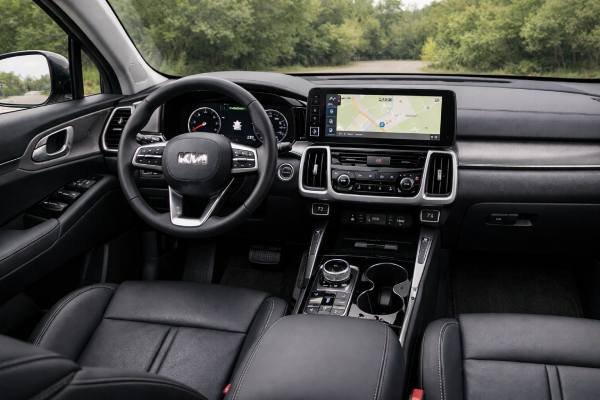
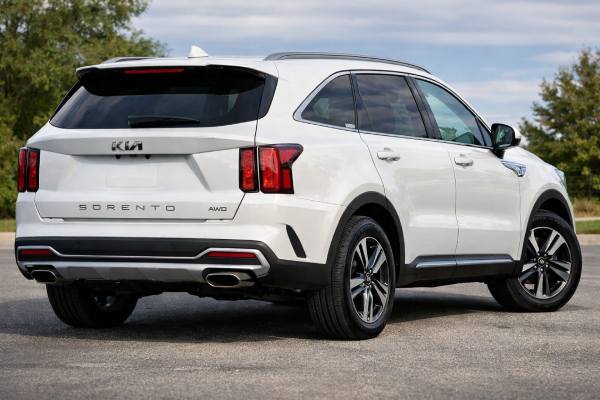
The 2021–2023 Sorento MQ4 with the Smartstream 3.5-liter V6 and AWD is the “all-weather, low-drama” choice in this generation. You get naturally aspirated response (no turbo heat management), a familiar automatic-transmission feel in most markets, and an on-demand AWD system that adds traction for wet roads, snow, and dirt tracks without turning the SUV into a full-time 4×4. For many owners, that combination feels easier to live with than smaller turbo engines or dual-clutch gearboxes—especially in stop-and-go driving and when the cabin is loaded.
The key to owning this variant well is understanding where the stress goes: the cooling system under sustained load, the AWD coupling and rear drive unit if tires are mismatched, and the “electronics layer” (ADAS sensors and 12 V battery health) that can make a modern SUV feel temperamental when it is actually just under-voltage or out of calibration.
Fast Facts
- Smooth V6 power delivery suits heavy loads and long motorway trips.
- AWD adds real traction margin in rain and snow, especially with good tires.
- Typically stronger towing confidence than smaller engines, depending on market rating.
- Ownership caveat: mismatched tire circumference can strain AWD hardware over time.
- Rotate tires about every 8,000–10,000 km (5,000–6,000 mi) to keep wear even.
Explore the sections
- Kia Sorento MQ4 AWD V6 ownership fit
- Kia Sorento AWD 3.5 V6 tech specs
- Kia Sorento 2021–2023 AWD V6 trims and safety
- Issues, recalls, and update priorities
- Maintenance plan for AWD V6 Sorento
- Driving impressions, efficiency, and towing
- Against rivals: where it makes sense
Kia Sorento MQ4 AWD V6 ownership fit
The Sorento MQ4 V6 AWD is best understood as a “balanced systems” SUV. The naturally aspirated 3.5-liter engine delivers predictable torque without relying on boost pressure, so it feels consistent whether you’re pulling away gently in traffic or climbing long grades with passengers. That consistency is a subtle advantage: the drivetrain is less sensitive to temperature swings than many turbo setups, and the throttle response is usually easier to meter on slick surfaces.
AWD is the other half of the appeal. In most Sorento MQ4 configurations, it’s an active on-demand system: the vehicle drives primarily through the front axle during steady cruising, then uses a coupling to send torque rearward when the front tires slip or when the control system predicts slip (hard acceleration, low-traction surfaces, some drive-mode settings). Owners feel this as confidence rather than drama: fewer traction-control interventions pulling into wet roundabouts, less wheelspin leaving snowy parking lots, and more stable launches on uneven gravel.
Where buyers should be honest with themselves is “what AWD is not.” It’s not a low-range, rock-crawling transfer case, and it can’t compensate for worn all-season tires in deep snow. The best AWD Sorento in winter is still the one on the right tires, with even tread depth on all four corners. Because the AWD system ties front and rear axle speeds together through the coupling, large differences in rolling circumference (mixing tire brands, uneven wear, one new tire with three half-worn tires) can create constant correction work and extra heat. That’s why tire rotation and matching tires matter more on AWD than FWD.
The MQ4 platform itself is also part of the value: a longer wheelbase helps straight-line stability and third-row packaging, while modern safety systems can reduce fatigue on long drives. The trade is complexity. Even with a “simple” V6, the vehicle depends on sensor calibration, clean electrical grounds, and a healthy 12 V battery. Many modern “mystery” issues—random warnings, camera faults, intermittent start/stop behavior—trace back to low voltage, a windshield replacement without camera recalibration, or water intrusion into a connector.
If your priorities are smooth power, all-weather traction, and predictable towing manners (within your market rating), this is often the most natural-feeling Sorento MQ4 variant to live with long term.
Kia Sorento AWD 3.5 V6 tech specs
Specifications for the Smartstream 3.5 V6 can vary by region (fuel quality, emissions equipment, and rating standard). The tables below focus on owner-relevant data points, presented with common ranges where markets differ. Always verify by VIN for parts ordering and fluid fills.
Powertrain and efficiency
| Item | Specification (typical for MQ4 3.5 V6) |
|---|---|
| Code / family | Smartstream G3.5 (V6) |
| Engine layout & cylinders | V6, 6 cylinders, DOHC, 4 valves/cyl |
| Bore × stroke | Varies by sub-variant; confirm in service data |
| Displacement | 3.5 L (≈ 3,470 cc) |
| Induction | Naturally aspirated |
| Fuel system | MPI or GDI (market-dependent) |
| Compression ratio | Typically ~11:1 to ~12:1 (variant dependent) |
| Max power | 290 hp (216 kW) @ rpm (market rating standard dependent) |
| Max torque | Commonly ~332–360 Nm (245–266 lb-ft) @ rpm (market dependent) |
| Timing drive | Chain |
| Rated efficiency | Often ~10.0–12.0 L/100 km combined (23–19 mpg US equivalent), test-cycle dependent |
| Real-world highway @ 120 km/h | Often ~9.0–12.0 L/100 km (26–20 mpg US), speed and wind sensitive |
Transmission and driveline
| Item | Specification |
|---|---|
| Transmission | 8-speed automatic (torque-converter type in many markets) |
| Drive type | AWD (on-demand coupling type) |
| Differential | Typically open; brake-based traction control manages wheel slip |
Chassis and dimensions
| Item | Specification (typical MQ4 body) |
|---|---|
| Suspension (front/rear) | Independent strut front / multi-link rear |
| Steering | Electric power steering; ratio varies by trim |
| Brakes | 4-wheel discs; diameters vary by trim and wheels |
| Wheels/Tyres (popular sizes) | 235/60 R18 or 255/45 R20 depending on trim |
| Ground clearance | Commonly ~175 mm (6.9 in); some trims may list slightly higher |
| Length / Width / Height | ~4,810 / 1,900 / 1,695 mm (189.0 / 74.8 / 66.7 in) approx. |
| Wheelbase | ~2,815 mm (110.8 in) |
| Turning circle (kerb-to-kerb) | ~11.6–11.8 m (38–39 ft) |
| Kerb (curb) weight | ~1,800–1,950 kg (3,970–4,300 lb), trim dependent |
| GVWR | ~2,480–2,550 kg (5,470–5,620 lb), market dependent |
| Fuel tank (ICE) | ~67 L (17.7 US gal / 14.7 UK gal) |
| Cargo volume | Up to ~2,138 L (75.5 ft³) seats down (SAE method common in North America) |
Performance and capability (what matters most)
| Metric | Typical range (depends on tires and market tune) |
|---|---|
| 0–100 km/h (0–62 mph) | ~7.5–8.5 s |
| Top speed | Often ~200–210 km/h (124–131 mph), market limited |
| Braking 100–0 km/h | ~39–42 m (128–138 ft), tire dependent |
| Towing capacity | Market-rated; often up to ~2,000–2,500 kg (4,400–5,500 lb) when properly equipped |
| Payload | Varies widely; verify on door-jamb label |
Fluids and service capacities (confirm before filling)
| Item | What to confirm (VIN-specific) |
|---|---|
| Engine oil | Specification and viscosity grade; typical fills are often ~6–7 L with filter |
| Coolant | OEM long-life coolant type and capacity; mix ratio usually 50/50 unless specified |
| Transmission/ATF | OEM ATF spec and service method; capacity depends on drain vs full exchange |
| Rear differential / coupling | OEM gear oil spec (often separate from ATF); service fill varies |
| A/C refrigerant | Type (R-1234yf or R-134a by market) and charge amount from under-hood label |
| Key torque specs | Wheel lugs and oil drain plug are the “must-torque” items for most owners |
If you only remember one rule: match fluids to the exact specification, especially for the transmission and AWD components. “Close enough” fluids are a common cause of drivability complaints and long-term wear.
Kia Sorento 2021–2023 AWD V6 trims and safety
Trim structure varies by country, but the logic is consistent: AWD and the V6 are usually paired with mid-to-upper trims that also bring more driver assistance features, stronger headlights, and higher-quality interior hardware. That bundling can be good value, but it makes shopping used a little more detail-driven: you need to confirm equipment, not just badges.
Trims and options: what changes mechanically
- Wheel and tire packages: 18-inch setups usually ride better and cost less to replace; 20-inch packages can look premium but raise tire costs and can increase road noise. On AWD, larger wheels also raise the importance of rotating tires regularly to keep wear even.
- Tow-related hardware: Some markets bundle hitch wiring, trailer stability logic, and cooling upgrades with a tow package. A hitch alone is not proof of full tow preparation. If towing matters, verify the factory equipment list.
- Drive modes and AWD control: Some trims add a center-lock function or additional terrain/snow modes. These help low-speed traction, but they are not substitutes for proper tires.
- Brake and lighting upgrades: Higher trims may include stronger headlight performance and, in some markets, larger brakes. Headlights are a “quiet safety feature” that matters more than most people think.
Year-to-year changes worth knowing
Between 2021 and 2023, many manufacturers make small but meaningful changes:
- ADAS software updates and sensor revisions
- Infotainment improvements and bug fixes
- Package reshuffles (a feature that was optional becomes standard, or vice versa)
When buying used, compare a 2021 and a 2023 carefully; you may find the newer one has a calmer driver-assist behavior or better lighting even if the powertrain feels the same.
Safety ratings: how to interpret them correctly
A Sorento’s crashworthiness is typically strong in modern tests, but results can be equipment-sensitive:
- Headlight ratings can vary by trim because different lamps project different patterns.
- Front crash prevention scores can vary depending on which camera/radar hardware is installed and the software level.
- Regional differences matter. A Euro NCAP test and an IIHS test evaluate different scenarios and scoring systems; both are useful, but neither replaces real-world tire grip and attentive driving.
Safety systems and ADAS: what to check on the actual car
Common systems on well-equipped MQ4 Sorentos include:
- AEB (automatic emergency braking) with vehicle and pedestrian detection, sometimes cyclist/junction features
- ACC (adaptive cruise control)
- Lane keeping and lane centering assistance
- Blind-spot monitoring and rear cross-traffic alert
- Multiple airbags and ISOFIX/LATCH anchors
Service implications: ADAS depends on correct calibration. Windshield replacement, bumper repairs, alignment changes, and some suspension work may require recalibration. If a used Sorento has had front-end bodywork, insist on documentation that camera/radar calibration was completed, and confirm there are no warning messages.
If you want the safest ownership experience, prioritize trims with strong headlights and complete active-safety features, then keep the sensors clean and the tires high quality.
Issues, recalls, and update priorities
The V6 AWD Sorento’s reliability profile is usually more about “systems health” than dramatic powertrain failures. Most real problems land in three buckets: (1) heat and fluids, (2) tire/AWD mismatch, and (3) software and sensor calibration.
Issue map by prevalence and cost tier
Common (low cost, high annoyance)
- Infotainment glitches (reboots, connectivity dropouts): often improved by updates.
- 12 V battery weakness causing odd warnings: a borderline battery can trigger sensor faults, camera errors, and inconsistent start behavior.
- Brake noise or low-speed grab: pad compound and driving style can play a big role.
Occasional (medium cost)
- Cooling system leaks or weak points: hoses, clamps, and radiator or water-pump seepage can appear with age and heat cycles. Symptoms include coolant smell, gradual coolant loss, or heater performance changes.
- Engine mount wear: a heavy V6 can reveal mount fatigue as vibration at idle in gear or a thump on shifts.
- Steering/suspension wear items: sway bar links and bushings can develop knocks on rough roads.
Rare (higher cost)
- Transmission drivability complaints (flare, harsh shifts): more likely if fluid is neglected, the vehicle tows frequently, or software is out of date.
- AWD coupling or rear drive unit stress due to tire mismatch: often preventable with rotation and tire discipline.
Symptoms → likely root cause → recommended remedy
- Shudder or binding on tight turns at low speed → uneven tire circumference or stressed coupling → measure tread depth, match tires, check AWD fluid condition.
- Temperature rises on long grades or in traffic → airflow restriction or coolant weakness → clean condenser/radiator stack, pressure test system, verify fan operation.
- Random ADAS warnings after glass/bodywork → camera/radar out of calibration → perform proper recalibration and verify alignment.
- Hesitation or misfire under load → worn plugs/coils or poor fuel quality → confirm plug interval, use correct plug type, inspect ignition components under load conditions.
Recalls, TSBs, and software: how to treat them
Treat official campaigns as part of the vehicle’s maintenance, not as optional paperwork:
- Verify open recalls by VIN using an official portal.
- Ask for proof of completion (dealer invoice or printout).
- Prioritize powertrain and safety updates first: engine management, transmission logic, and ADAS calibrations deliver the largest real-world benefits.
Pre-purchase checks that prevent expensive surprises
- Confirm all four tires match in brand/model/size and are within a few millimeters of tread depth.
- Do a test drive that includes tight turns, a low-speed crawl, and a longer highway pull to check temperature stability.
- Scan for stored or pending codes (powertrain and chassis modules), not just dashboard lights.
- Inspect for coolant residue and evidence of prior overheating (stained expansion tank, burnt smell near radiator area).
Most owners who keep this Sorento happy do not “fix problems”—they prevent them by keeping tires and fluids correct, and by staying current on updates.
Maintenance plan for AWD V6 Sorento
A good maintenance plan for the V6 AWD Sorento is built around three principles: clean oil, healthy cooling, and AWD protection through tire management. The schedule below is practical for owners who want long-term reliability rather than minimum-cost short-term servicing.
Service schedule (use whichever comes first)
| Item | Normal use | Severe use (short trips, towing, heat, dust) |
|---|---|---|
| Engine oil and filter | 12 months or 10,000–12,000 km | 6–9 months or 7,500–8,000 km |
| Tire rotation | 10,000–12,000 km | 8,000–10,000 km |
| Engine air filter | 30,000–45,000 km | 20,000–30,000 km |
| Cabin air filter | 15,000–20,000 km | 10,000–15,000 km |
| Brake fluid | Every 2 years | Every 2 years (consider yearly in high humidity) |
| Coolant | Follow OEM long-life interval | Inspect annually; shorten if towing/overheating history |
| Spark plugs | Often 100,000–160,000 km (variant dependent) | 80,000–120,000 km if towing or high-load use |
| ATF service | 80,000–120,000 km typical | 60,000–90,000 km (recommended for frequent towing) |
| AWD rear drive unit fluid | Follow OEM guidance | Consider 60,000–80,000 km if used hard |
| Alignment check | Yearly | Yearly + after impacts or tire changes |
| 12 V battery test | Yearly after year 3 | Yearly after year 2 |
Fluids and parts choices that matter most
- Oil: choose the correct spec and viscosity for your region and climate. On a V6 in a heavy SUV, oil quality is your “wear budget.”
- Coolant: use the correct OEM long-life coolant; do not mix chemistries. A small coolant leak can snowball into an overheating event, which is far more expensive than early repairs.
- ATF and AWD fluids: use OEM-specified fluids. Incorrect fluid can cause shift quality problems, noise, or early component wear.
- Tires: keep all four tires closely matched. On AWD, tires are a drivetrain component, not just a wear item.
Buyer’s guide: what to seek and what to avoid
Best used examples usually have
- Documented oil service history at sensible intervals
- Evidence of recall completion
- Even tire wear and matched tires
- No history of overheating, and a clean coolant system
Use caution with
- Vehicles showing tire mismatch (different brands or big tread differences)
- Signs of repeated towing with no ATF service history
- Persistent electronic warnings that sellers dismiss as “just a sensor”
Quick inspection checklist (15-minute version)
- Check coolant level and look for dried residue around hoses and radiator seams.
- Inspect tire brand and tread depth; confirm even wear across all four.
- Verify smooth shifts and no driveline binding on tight turns.
- Test all cameras and driver-assist functions; look for warning lights.
- Review service records for fluid changes, not just “oil changed.”
If you plan to keep this Sorento long term, the smartest “upgrade” you can make is not a part—it’s a maintenance mindset that treats fluids and tires as preventive insurance.
Driving impressions, efficiency, and towing
On the road, the V6 AWD Sorento tends to feel composed and predictable rather than sporty. The V6’s biggest advantage is how it handles real life: full passenger load, long hills, and steady motorway speed. You get linear throttle response without turbo lag, and the engine rarely feels strained unless you’re climbing steep grades at high speed.
Ride, handling, and NVH
With 18-inch wheels, the Sorento typically rides with a settled, “family premium” feel—good body control without being stiff. Larger wheels sharpen turn-in a little but can transmit sharper impacts and raise tire roar. At motorway speeds, wind noise is usually the dominant sound; the V6 hum is present under acceleration but not intrusive.
Handling is safe and front-led. AWD helps traction when you accelerate out of wet corners, but the vehicle still prefers smooth inputs. Steering is light and consistent, and braking confidence depends heavily on tire grip. If you want shorter stopping distances and better wet control, prioritize tires with strong wet-braking scores and keep brake fluid fresh.
Powertrain character
- Throttle response: immediate and easy to modulate—one of the main reasons owners like naturally aspirated engines.
- Kickdown behavior: generally smooth; it may downshift decisively for passing without the “boost surge” effect of turbo engines.
- Engine braking: helpful on descents when you select a lower gear or a sport mode.
Real-world efficiency (what most owners see)
Expect fuel use to vary more with speed than with small spec differences:
- City-heavy driving: often ~12–15 L/100 km (16–20 mpg US) depending on traffic and trip length.
- Highway at 100–120 km/h: commonly ~9–12 L/100 km (20–26 mpg US), with headwinds and roof loads making a big difference.
- Mixed: often ~10.5–13.0 L/100 km (18–22 mpg US).
Cold weather increases consumption because the engine spends more time warming up and AWD-related traction losses rise with winter tires.
Towing and load notes
Market tow ratings differ, but as a driving experience the V6 AWD setup is usually confidence-inspiring:
- It maintains speed on grades with fewer dramatic downshifts than smaller engines.
- AWD helps stability when pulling away on wet ramps or gravel surfaces.
- The main limitation is heat management: towing raises ATF temperatures and brake load. If you tow regularly, shorten ATF service intervals, use quality brake pads, and avoid sustained high-speed towing in extreme heat.
For many owners, this is the “easy” Sorento: smooth around town, confident in weather, and steady under load—provided you accept that fuel consumption is the trade for that refinement.
Against rivals: where it makes sense
The V6 AWD Sorento competes in a segment split between turbo fours, hybrids, and larger-displacement engines. The best comparison is not “which is best,” but “which matches your driving pattern and ownership style.”
Where the V6 AWD Sorento tends to win
- Predictable power delivery: The naturally aspirated V6 feels consistent across temperatures and elevations, and it’s easy to modulate on slick roads.
- All-weather confidence: On-demand AWD plus good tires provides real traction margin without the constant drag of full-time systems.
- Long-trip comfort: The platform’s stability and the V6’s relaxed cruising suit motorway miles.
Where rivals may be a better fit
- City fuel cost: Hybrids usually beat a V6 clearly in stop-and-go driving and short-trip use.
- Parking-lot smoothness vs complexity: Some rivals use very smooth traditional automatics even with turbo engines; others use eCVTs in hybrids that feel seamless in traffic.
- Third-row adult comfort: If you often carry adults in the third row, you may need a larger class of three-row SUV.
Buyer guidance by use case
- Mostly highway, mixed weather, occasional towing: V6 AWD makes sense because it feels calm and capable without relying on boost.
- Mostly city, short trips, cost-sensitive fueling: A hybrid alternative will usually pay you back faster.
- Frequent towing or heavy loads: Verify tow rating and cooling equipment for your market; then prioritize transmission fluid discipline and brake maintenance.
The practical verdict
Choose the 2021–2023 Sorento MQ4 V6 AWD if you want a three-row SUV that feels “easy” to drive: smooth throttle, confident traction, and steady grade performance. Maintain it like a load-bearing machine—keep fluids fresh, keep tires matched, and treat recalls and software updates as part of ownership—and it can be a durable, satisfying family vehicle.
References
- Smartstream G3.5 MPI Engine 2025 (Owner’s Manual)
- 2021 Kia Sorento 4-door SUV 2021 (Safety Rating)
- Official Kia Sorento 2020 safety rating 2020 (Safety Rating)
- Check for Recalls: Vehicle, Car Seat, Tire, Equipment 2026 (Recall Database)
- Recalls 2026 (Recall Lookup)
Disclaimer
This article is for informational purposes only and is not a substitute for professional diagnosis, inspection, or repair. Specifications, torque values, fluid types and capacities, service intervals, and procedures vary by VIN, market, model year, and equipment; always verify details using the official Kia owner’s manual and service documentation for your exact vehicle.
If this guide helped you, please consider sharing it on Facebook, X (Twitter), or your preferred community to support our work and help other owners find reliable information.