

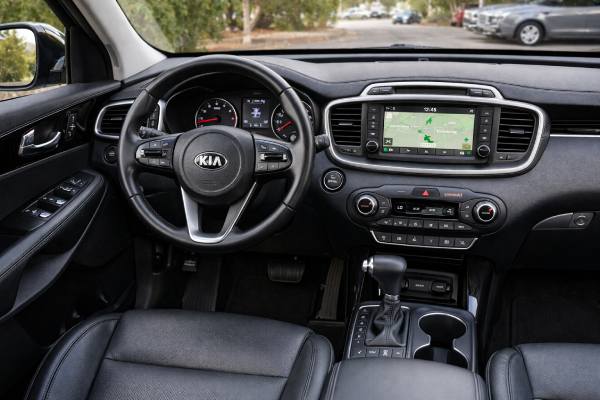
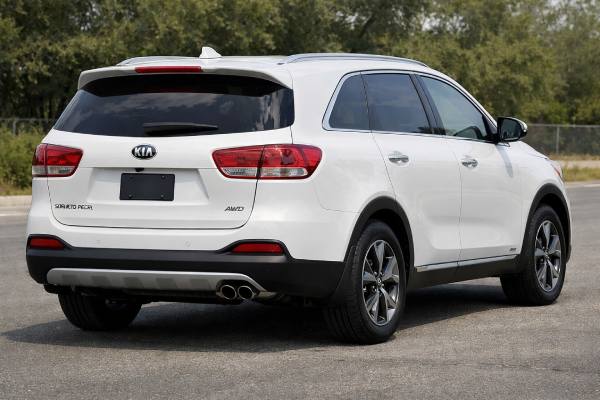
The 2016–2017 Kia Sorento UM with the 2.0-liter turbo (G4KH) is the “torque-first” Sorento: it delivers strong midrange pull for everyday merges and hills, while the on-demand AWD system adds year-round traction without the constant drag of a full-time setup. This powertrain is also more sensitive to maintenance quality than the base engines. Turbo heat, direct injection, and higher cylinder pressures reward owners who stay ahead on oil quality, spark plugs, and cooling-system health.
As a used buy, this Sorento makes the most sense for drivers who want a quiet, family-sized cabin and confident wet-road grip, but who also understand that “short-trip life” and skipped fluid services can shorten turbo and driveline life. Pick the right trim, verify campaigns by VIN, and it can be a satisfying long-haul SUV.
Top Highlights
- Strong low-to-mid rpm torque makes city driving and highway merging easier than the base engines.
- AWD improves traction on wet, snow, and gravel without a steep learning curve.
- Solid safety structure and available driver-assist features in higher trims.
- Budget for more frequent oil service if you do short trips or hot-climate driving (turbo heat load).
- Plan on tyre rotation about every 10,000–12,000 km (6,000–7,500 mi) to keep AWD-friendly tyre wear even.
Quick navigation
- Sorento UM AWD 2.0T at a glance
- Sorento UM G4KH specs and measurements
- Sorento UM trims, safety, and ADAS
- Reliability patterns and known faults
- Maintenance plan and buying tips
- Real-world driving and economy
- Rival comparisons in the class
Sorento UM AWD 2.0T at a glance
If you’re shopping the 2016–2017 Sorento UM range, the 2.0T AWD version sits in a sweet spot: noticeably stronger passing power than the base four-cylinder, usually less thirsty in real-world commuting than a larger V6 when driven gently, and more relaxed than the diesel options in markets where diesel emissions hardware adds complexity. The G4KH is a turbocharged, direct-injected inline-four that’s tuned for torque, not drama—meaning you feel it most between about 2,000 and 4,500 rpm where daily driving lives.
The AWD system on these Sorentos is typically an on-demand design. Most of the time it behaves like a front-drive SUV, then it sends torque rearward through an electronically controlled coupling when wheel slip, throttle demand, or stability-control logic calls for it. For owners, that translates into good traction in rain and snow, but also a reminder: tyres must be kept closely matched in tread depth and pressure. Uneven tyres can keep the coupling working harder than intended, heating the fluid and accelerating wear.
From an engineering point of view, the 2.0T’s “ownership personality” is shaped by three things:
- Heat management (turbocharger, intercooler plumbing, coolant and oil condition).
- Direct injection realities (potential intake-valve deposits over time, sensitivity to oil vapor control).
- Driveline servicing (rear differential and transfer case fluid changes are often forgotten because the SUV “feels fine”… until it doesn’t).
The Sorento UM platform itself is a family-first chassis: stable at speed, generally quiet for the class, and tuned for comfort over sharp cornering. That’s good news for long trips. The best examples are the ones with documented oil services, clean coolant history, and evidence that driveline fluids weren’t treated as “lifetime.”
Sorento UM G4KH specs and measurements
Specs vary by market, emissions package, wheel size, and tow equipment. The tables below reflect the most common 2016–2017 Sorento UM AWD configuration with the 2.0T/G4KH and 6-speed automatic, using typical ranges where equipment changes the numbers.
Powertrain and efficiency (typical)
| Item | Specification |
|---|---|
| Code | G4KH |
| Engine layout and cylinders | Inline-4 (I-4), DOHC, 4 valves/cyl |
| Displacement | 2.0 L (1,998 cc) |
| Induction | Turbocharged |
| Fuel system | Direct injection (GDI) |
| Compression ratio (ICE) | ~9.5:1 (market-dependent) |
| Max power | 240 hp (179 kW) @ ~6,000 rpm (typical) |
| Max torque | ~350 Nm (260 lb-ft) @ ~1,450–4,500 rpm (typical) |
| Timing drive | Chain |
| Rated efficiency | Commonly ~10.0–12.0 L/100 km combined (23–28 mpg US combined range by market/test cycle) |
| Real-world highway @ 120 km/h (75 mph) | ~9.0–11.0 L/100 km (21–26 mpg US), speed/wind/tyres dependent |
Transmission and driveline
| Item | Specification |
|---|---|
| Transmission | 6-speed automatic (market-dependent code) |
| Drive type | On-demand AWD |
| Differential | Open (front and rear), coupling-managed torque transfer |
Chassis and dimensions (common range)
| Item | Specification |
|---|---|
| Suspension (front/rear) | MacPherson strut / multi-link |
| Steering | Electric power steering (EPS) |
| Brakes | Disc/disc (diameter varies by trim; typically ~320–330 mm front, ~314–325 mm rear) |
| Wheels and tyres (popular size) | 235/60 R18 (18 in rim) |
| Ground clearance | ~185 mm (7.3 in) (varies with wheels/market) |
| Length / width / height | ~4,780 mm (188.2 in) / ~1,890 mm (74.4 in) / ~1,685–1,700 mm (66.3–66.9 in) |
| Wheelbase | ~2,780 mm (109.4 in) |
| Turning circle (kerb-to-kerb) | ~11.3–11.6 m (37–38 ft) |
| Kerb (curb) weight | ~1,750–1,900 kg (3,858–4,189 lb) depending on trim |
| GVWR | ~2,400–2,600 kg (5,291–5,732 lb) depending on market |
| Fuel tank | ~71 L (18.8 US gal / 15.6 UK gal) typical |
| Cargo volume | Market-method dependent; typically ~400–450 L seats up, ~1,500+ L seats down (VDA/SAE varies) |
Performance and capability (typical expectations)
| Item | Typical value |
|---|---|
| Acceleration 0–100 km/h (0–62 mph) | ~7.5–8.5 s (trim/tyres/altitude) |
| Top speed | ~195–205 km/h (121–127 mph) (market-limited) |
| Braking 100–0 km/h | ~37–41 m (121–135 ft) with quality tyres |
| Towing capacity | Market-dependent; commonly ~900–2,000 kg (2,000–4,409 lb) braked if equipped |
| Payload | Often ~500–650 kg (1,102–1,433 lb) depending on trim |
Fluids and service capacities (verify by VIN and drivetrain)
Capacities can vary by oil pan, cooler fitment, and AWD hardware revision. Use these as planning estimates, not final fill targets.
| System | Specification (typical) |
|---|---|
| Engine oil | Full-synthetic; common grades 5W-30 or 5W-40 (by climate/spec); ~4.8–5.6 L (5.1–5.9 US qt) with filter |
| Coolant | Ethylene glycol long-life (mix per spec); ~6.5–8.0 L (6.9–8.5 US qt) |
| Automatic transmission (ATF) | OEM-spec ATF (market-specific); total fill often ~7–9 L (7.4–9.5 US qt), service drain less |
| Transfer case | Gear oil per spec; often ~0.5–0.8 L |
| Rear differential | Gear oil per spec; often ~0.7–1.1 L |
| A/C refrigerant | R-134a on many markets; charge varies by system label |
| Key torque specs | Lug nuts often ~90–110 Nm (66–81 lb-ft); drain plugs and plugs vary—verify service documentation |
Safety and driver assistance (overview)
| Item | Notes |
|---|---|
| Crash ratings | Depends on market test body and exact year/equipment |
| Euro NCAP | Not always listed for every market configuration; verify your region’s published result |
| IIHS | Ratings vary by trim (headlights and front crash prevention affect outcomes) |
| ADAS | Forward collision warning/AEB, lane support, blind-spot features often trim- and year-dependent |
Sorento UM trims, safety, and ADAS
Trims for the 2016–2017 Sorento UM differ by market, but the 2.0T AWD is commonly positioned as an “upper-middle” choice—often paired with richer interiors, larger wheels, and optional safety tech. When you’re shopping used, treat “trim” as more than a comfort package: it changes tyres, headlight performance, brake feel, and sometimes towing equipment.
Trims and options: what changes in real life
Look for these functional differences as you move up the range:
- Wheel and tyre packages: Larger wheels can sharpen steering response but may worsen ride over broken pavement. They also change replacement tyre cost and can slightly affect braking consistency (tyre compound matters more than diameter).
- Headlights: Some trims use projector halogens; others offer HID or LED units (market-dependent). This matters because headlight performance is a frequent weak spot in safety scoring systems and a big owner satisfaction factor on dark roads.
- Cooling and towing equipment: A factory tow package may include wiring and sometimes upgraded cooling. For the 2.0T, that matters if you tow regularly or drive in hot climates—heat is the enemy of turbo longevity.
- Interior configurations: Two-row vs three-row seating, power tailgate, and upgraded audio are common differentiators. Three-row packaging can change cargo utility more than you expect, especially with the third row folded.
Quick identifiers when inspecting a used listing
Because badges can be misleading, use multiple cues:
- Engine confirmation: The 2.0T typically has “T-GDI” or “Turbo” labeling in some markets, but the surest method is the engine code on documentation or a VIN-based build sheet.
- AWD confirmation: Look for an AWD lock button or drive mode selector in markets that offer it, plus rear driveline hardware visible from under the vehicle (rear diff and axle stubs).
- ADAS hardware: Forward camera housing near the rear-view mirror and radar module placement (often behind the grille area) are clues that AEB/ACC is fitted.
Safety ratings: how to read them for this Sorento
Safety results depend on test body and equipment. Two practical rules help:
- One year’s rating doesn’t automatically equal another year’s rating. Test protocols and scoring can change.
- Trim equipment can change the outcome. Headlights and front crash prevention can move a vehicle from “good” to “average” in real-world safety confidence.
If you’re shopping in North America, pay special attention to:
- Small overlap front and side protection (structural performance).
- Headlight performance (visibility).
- Front crash prevention (AEB) availability and calibration status.
In Europe and many other markets, pay attention to:
- Adult and child occupant performance, plus vulnerable road user outcomes, which increasingly emphasize AEB behavior and hood/bumper design.
ADAS and service implications
Driver-assist systems only help if they’re working as designed. After windshield replacement, front bumper repair, wheel alignment changes, or suspension work, camera and radar calibration may be required. On a used Sorento, that means:
- Confirm no warning lights (AEB/ESC/ABS).
- Verify that the windshield is correct (camera-compatible glass where required).
- If the vehicle has a history of front-end damage, budget for calibration at a shop with the right tools.
A well-equipped 2016–2017 Sorento 2.0T AWD can feel surprisingly modern, but only if sensors, tyres, and alignment are kept in spec.
Reliability patterns and known faults
The 2016–2017 Sorento UM 2.0T can be dependable, but it’s not a “neglect-friendly” powertrain. Most issues fall into predictable buckets. Below is a practical map by prevalence and cost impact, followed by symptoms and fixes.
Issue map (what shows up most)
Common (low to medium cost, especially with age):
- Ignition coil and spark plug wear (misfires under load).
- PCV system and crankcase ventilation hoses aging (oil vapor control issues).
- Cooling system maintenance lapses (old coolant, tired radiator cap, weak thermostat).
- AWD tyre mismatch and alignment drift (vibration, coupling stress).
Occasional (medium cost):
- Carbon buildup on intake valves (direct injection characteristic), leading to rough idle or reduced response.
- Turbo-related leaks (charge pipes, clamps) causing boost loss or whistle.
- Automatic transmission shift quality issues when ATF is neglected (flare, harshness).
Rare but high impact (high cost):
- Turbocharger failure from oil starvation/contamination (often tied to long oil intervals).
- Engine bearing wear events (varies by market and campaign history).
- AWD coupling or rear differential noise if fluid is never serviced.
Symptoms → likely cause → practical remedy
- Hesitation, flashing check-engine light, misfire codes under acceleration → worn plugs/coils, sometimes poor fuel quality → replace plugs at the correct heat range and interval; replace coils as needed; confirm no boost leak.
- Rough idle that improves at higher rpm → intake-valve deposits or minor vacuum leak → inspect PCV and hoses; consider intake cleaning methods suitable for DI engines.
- Whistling, whooshing, or low boost feel → intercooler pipe leak, loose clamp, split hose → pressure test intake tract; replace worn couplers.
- Coolant smell, slow loss of coolant, or inconsistent cabin heat → small leaks, cap/thermostat aging, or air in system → pressure test, correct bleed procedure, replace weak components early.
- Vibration or binding sensation on tight turns (especially after tyre replacement) → tyre circumference mismatch stressing AWD coupling → replace tyres as a matched set (or shave to match), align, confirm correct pressures.
- Driveline hum or whine that changes with speed → wheel bearing or differential wear → isolate by load and direction changes; service driveline fluids; replace bearing if confirmed.
Software, campaigns, and “check by VIN”
Modern powertrains often use software as a reliability tool. Updates may address:
- knock detection sensitivity,
- shift logic refinements,
- sensor plausibility checks that prevent cascading faults.
Because campaigns can be region-specific, the correct approach is simple: run a VIN check, confirm completion in dealer records, and treat missing updates as a negotiation point.
The ownership takeaway
A healthy 2.0T Sorento typically feels smooth, pulls strongly without drama, and doesn’t consume noticeable oil between services. The problem examples usually have a story: long oil intervals, cheap oil, chronic short trips, or mismatched tyres. If you avoid those traps and service the driveline fluids, the reliability profile improves sharply.
Maintenance plan and buying tips
A maintenance plan for the Sorento UM 2.0T AWD should be built around turbo heat, direct injection, and AWD hardware. The schedule below is intentionally practical for used ownership. Always follow your official service literature when it differs.
Core maintenance schedule (distance/time)
Engine oil and filter
- Normal use: 10,000–12,000 km (6,000–7,500 mi) or 12 months
- Severe use (short trips, towing, high heat, dusty roads): 6,000–8,000 km (4,000–5,000 mi) or 6 months
Use a full-synthetic oil that meets the correct specification for your market. Turbo engines reward conservative intervals.
Air filters
- Engine air filter: inspect every 15,000 km (10,000 mi), replace as needed (often 30,000 km / 20,000 mi).
- Cabin filter: every 15,000–20,000 km (10,000–12,000 mi), sooner in dusty cities.
Spark plugs
- Turbo DI engines are harder on plugs. Plan every 40,000–60,000 km (25,000–37,000 mi) unless your exact spec says otherwise. Misfires under load are your “don’t wait” sign.
Coolant
- Replace by spec interval (commonly 5 years / 100,000 km first, then shorter). If history is unknown, treat coolant as a reset item after purchase.
Automatic transmission (ATF)
- If your service book claims “lifetime,” interpret that as “lifetime under ideal conditions.” For used AWD SUVs, a smart interval is 60,000–90,000 km (37,000–56,000 mi) depending on use. Drain-and-fill is often safer than aggressive flushing on high-mileage units.
AWD driveline fluids
- Transfer case and rear differential: every 50,000–80,000 km (31,000–50,000 mi), sooner if you tow or drive mountains. This is one of the most neglected services on used AWD vehicles.
Brake fluid
- Every 2 years, regardless of mileage.
Tyres, alignment, and AWD-friendly habits
- Rotate tyres every 10,000–12,000 km (6,000–7,500 mi).
- Keep tyre pressures even and correct.
- Avoid mixing brands/tread depths on AWD. If you must replace one or two, match circumference as closely as possible.
12 V battery
- Test annually after year 4; many batteries last 4–6 years depending on climate.
Essential checks when buying used
Bring this as a checklist:
- Cold start behavior: listen for abnormal knocking, loud timing chain rattle, or turbo whistle that persists.
- Acceleration test: smooth boost build, no misfire, no sudden limp mode.
- Cooling system: stable temperature, no sweet odor, heater works consistently.
- Transmission: consistent shifts, no flare, no shudder under gentle load.
- AWD behavior: no binding in tight turns, no driveline clunks, tyres match.
- Evidence of servicing: oil intervals, plug changes, and driveline fluid proof matter more than shiny paint.
- Scan for codes: even if the dash is clear, stored history can reveal intermittent misfires or sensor faults.
Best ownership strategy
If you buy one with unclear history, budget for a “baseline service” right away: oil, filters, plugs (if due), coolant condition check, ATF assessment, and AWD fluid service. It costs money up front, but it’s cheaper than turbo or coupling repairs later—and it makes the SUV feel like the strong, refined family hauler it was meant to be.
Real-world driving and economy
The Sorento UM 2.0T AWD’s driving character is defined by torque delivery and calm chassis tuning. It’s not a sport SUV, but it’s far from slow, and it’s often more satisfying than the base engine because you don’t have to “floor it” to make progress.
Ride, handling, and NVH
- Ride quality: generally composed over highway expansion joints and mild potholes, especially on the common 17–18 inch setups. Larger wheels can transmit sharper impacts.
- Straight-line stability: a strong point—this Sorento tracks confidently at motorway speeds and feels heavier than many compact crossovers.
- Steering feel: EPS tuning prioritizes ease and consistency over detailed feedback. You get predictable responses, not sports-car texture.
- Cabin noise: typically quiet for the segment, with some tyre roar depending on tyre model and age. Wind noise can rise if door seals are worn or if the vehicle has had repair work.
Powertrain behavior
The turbo engine’s best trait is how early it makes usable torque. In daily driving that means:
- less downshifting for hills,
- more relaxed passing,
- better “two-lane confidence” than the base four-cylinder.
The 6-speed automatic is usually tuned for smoothness. Expect:
- gentle, sometimes slightly delayed kickdown if you request sudden acceleration,
- more decisive behavior in sport mode (if equipped),
- occasional hunting on rolling terrain if tyres are oversized or if the transmission is overdue for service.
Real-world fuel economy (what owners actually feel)
Your results depend on speed and trip length more than almost anything else:
- City-heavy, short trips: turbo engines run richer when cold; expect 11–14 L/100 km (17–21 mpg US).
- Highway 100–110 km/h (62–68 mph): often 8.5–10.5 L/100 km (22–28 mpg US).
- Highway 120 km/h (75 mph): wind drag rises quickly; 9–11 L/100 km (21–26 mpg US) is a realistic band.
- Cold weather penalty: short winter trips can add 10–25% consumption due to warm-up time and denser air.
Traction and control
In rain and snow, the AWD system’s main advantage is confidence. You still need good tyres, but:
- launch traction improves,
- stability control has an easier job,
- the vehicle feels more planted on slick inclines.
If your trim offers selectable modes or an AWD lock function, treat it as a low-speed aid for slippery starts—not a substitute for winter tyres, and not something to run on dry pavement for long periods.
Load and towing notes
Towing capability varies widely by market rating and equipment. Even when rated, the smart approach for the 2.0T is:
- keep loads moderate,
- service ATF and driveline fluids more often,
- watch for coolant and oil temperature stress in summer climbs.
Driven within its comfort zone, the Sorento 2.0T AWD is a refined, confident daily SUV with enough punch to feel modern—especially when maintained as a turbo vehicle, not as an “any oil, any time” appliance.
Rival comparisons in the class
The 2016–2017 Sorento UM 2.0T AWD competes with mid-size crossovers that often split into two camps: naturally aspirated V6 models that feel effortless but drink more fuel, and smaller turbo fours that can feel quick but sometimes run out of breath when loaded. Here’s how the Sorento tends to stack up.
Versus Toyota Highlander (V6-era models)
- Sorento advantage: turbo torque comes on early, so it can feel lively around town. Often a strong value on the used market with generous features for the money.
- Highlander advantage: reputation for long-term durability with simpler powertrain behavior and fewer turbo-specific demands.
- Best fit: choose Sorento if you want features and torque per dollar; choose Highlander if you prioritize conservative engineering and resale.
Versus Honda Pilot (V6)
- Sorento advantage: easier to find with a premium feel at a lower price point; AWD traction is competitive for normal winter use.
- Pilot advantage: V6 smoothness under load, often strong family packaging and predictable performance with passengers.
- Best fit: Sorento for daily torque and value; Pilot if you frequently run fully loaded and want naturally aspirated simplicity.
Versus Ford Edge (2.0T/2.7T, depending on market)
- Sorento advantage: more family-friendly cabin layout and often better third-row/cargo flexibility depending on configuration.
- Edge advantage: can feel sharper in handling, and higher-output trims can be quicker.
- Best fit: Sorento for family practicality; Edge for a more “driver-forward” feel.
Versus Hyundai Santa Fe (closely related)
- Sorento advantage: trim packaging and seating options may suit families better; used pricing can differ in your favor depending on market.
- Santa Fe advantage: similar mechanicals but different tuning; some buyers prefer its ride/seat comfort and feature mixes.
- Best fit: shop both and pick the cleaner service history—these cousins reward condition over badge.
The Sorento 2.0T AWD verdict
This Sorento’s strongest argument is balance: meaningful torque, secure all-weather traction, and a calm cabin—without the constant thirst of a bigger engine when driven sensibly. The tradeoff is that you must treat it like a turbo AWD vehicle: frequent oil discipline, matched tyres, and driveline fluid services. If you do that, it competes well with the class leaders in the ways owners feel every day.
References
- 7.2 Kia Service Intervals V25.12.xlsx 2026 (Service Schedule)
- OWNER’S MANUAL QUICK REFERENCE GUIDE 2015 (Owner’s Manual)
- 2017 Kia Sorento 2017 (Safety Rating)
- Vehicle Detail Search – 2017 KIA SORENTO SUV AWD 2017 (Recall Database)
- 2016 Kia Sorento Specifications 2016 (Specifications)
Disclaimer
This article is for informational purposes only and is not a substitute for professional inspection, diagnosis, or repair. Specifications, torque values, service intervals, and procedures can vary by VIN, market, drivetrain hardware, and installed options—always confirm details using your official owner’s manual and service documentation for the exact vehicle you’re servicing or buying.
If you found this guide useful, consider sharing it on Facebook, X (Twitter), or your favorite forum to help others research and maintain their vehicles.