

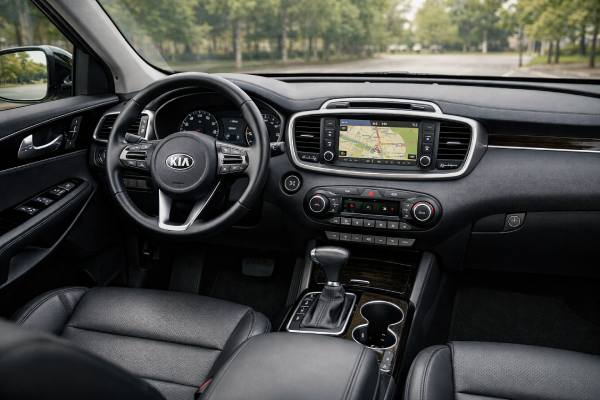
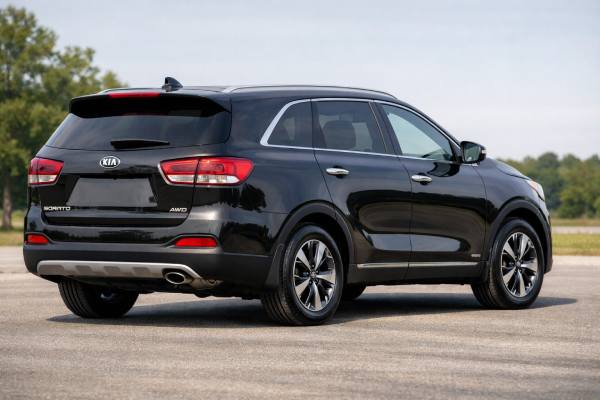
The 2016–2017 Kia Sorento UM with the 3.3-liter G6DH V6 and AWD is the “big-engine” version of this generation: smooth power, confident passing, and strong towing capability when properly equipped. It also has a very traditional mechanical layout—naturally aspirated V6, 6-speed automatic, on-demand AWD—which makes it easy for most shops to service and diagnose.
Ownership satisfaction tends to come down to priorities. If you value quiet highway cruising, simple power delivery (no turbo lag), and the ability to haul a family plus gear without feeling strained, this is the Sorento powertrain that fits. If you prioritize fuel economy, the V6’s extra consumption—especially around town—becomes the main trade-off. In the used market, condition and service history matter more than mileage alone, because deferred fluid service can turn into expensive driveline work later.
Top Highlights
- Strong real-world torque for merging and towing; feels less stressed than smaller engines under load.
- AWD traction and stability are genuinely helpful on wet roads and winter tires on snow.
- Cabin comfort and highway refinement are a standout for the class when suspension is healthy.
- Budget for AWD driveline fluid service (transfer case and rear diff) to avoid wear-related noise.
- Typical engine-oil interval: every 10,000–12,000 km (6,000–7,500 mi) or 12 months (short-trip use: sooner).
Quick navigation
- Sorento UM AWD V6 ownership picture
- Sorento UM 3.3 AWD specifications
- Sorento UM 2016–2017 trims and safety
- Reliability issues, recalls, and fixes
- Maintenance plan and buyer checklist
- Driving character and real-world economy
- Rivals and value comparison
Sorento UM AWD V6 ownership picture
Think of this Sorento as the “effortless” configuration in the UM lineup. The 3.3-liter V6 is naturally aspirated, so throttle response is predictable and linear: you press the pedal, it goes—no waiting for boost and no turbo plumbing to age. Pair that with a conventional 6-speed automatic and an on-demand AWD system, and you get a midsize family SUV that behaves consistently across weather and load changes.
Where owners usually notice the advantage is not at full throttle, but in everyday driving. With a full cabin and cargo, the V6 needs less downshifting to maintain speed, and it feels calmer climbing grades. That calmer workload can also help longevity when the vehicle is used for road trips or light towing, because the engine does not have to operate near its limits as often.
The main trade-off is operating cost. Fuel consumption rises most in short-trip city use, and AWD adds some parasitic drag and extra fluid services (rear differential and transfer case). Tires matter more than many people expect: mismatched tire wear can stress AWD couplings, and cheaper tires can noticeably increase stopping distance and road noise.
Buying used, this powertrain rewards a “condition-first” approach. A clean test drive (no driveline vibration, no clunks on throttle tip-in, no wheel-bearing hum) and evidence of regular fluid service usually predicts a better experience than low mileage with a thin history. If your priorities are smooth power, winter composure, and towing headroom, the V6 AWD is one of the most satisfying Sorento variants of these years.
Sorento UM 3.3 AWD specifications
Below are typical specifications for the 2016–2017 Sorento UM AWD with the G6DH 3.3 V6. Exact values can vary by market, trim, wheel and tire package, and optional equipment.
Powertrain and efficiency
| Item | Spec |
|---|---|
| Code | G6DH |
| Engine layout and cylinders | V6, 6 cylinders, DOHC, 4 valves/cyl |
| Bore × stroke | ~92.0 × 83.8 mm (3.62 × 3.30 in) |
| Displacement | 3.3 L (3,342 cc) |
| Induction | Naturally aspirated |
| Fuel system | Direct injection (GDI) |
| Compression ratio | ~11.5:1 (market dependent) |
| Max power | 290 hp (216 kW) @ ~6,400 rpm |
| Max torque | ~342 Nm (252 lb-ft) @ ~5,200 rpm |
| Timing drive | Chain |
| Rated efficiency (typical) | ~10.5–11.5 L/100 km (22–20 mpg US / 27–25 mpg UK) mixed, setup dependent |
| Real-world highway @ 120 km/h (75 mph) | ~9.5–11.0 L/100 km (25–21 mpg US / 30–26 mpg UK) |
Transmission and driveline
| Item | Spec |
|---|---|
| Transmission | 6-speed automatic (torque-converter) |
| Drive type | On-demand AWD (electronically controlled coupling) |
| Differential | Open front and rear (traction handled by brake-based stability system) |
Chassis and dimensions
| Item | Spec |
|---|---|
| Suspension (front/rear) | MacPherson strut / multi-link |
| Steering | Electric power steering (EPS), rack and pinion |
| Brakes | 4-wheel discs (vented front) |
| Wheels and tyres (common) | 235/55 R18 (rim 18 in) or 235/60 R17 (rim 17 in), package dependent |
| Ground clearance | ~185 mm (7.3 in) |
| Length / Width / Height | ~4,780 / 1,890 / 1,685–1,700 mm (188.2 / 74.4 / 66.3–66.9 in) |
| Wheelbase | ~2,780 mm (109.4 in) |
| Turning circle (kerb-to-kerb) | ~11.0–11.6 m (36–38 ft), trim dependent |
| Kerb (curb) weight | ~1,850–1,950 kg (4,080–4,300 lb), equipment dependent |
| GVWR | commonly ~2,400–2,550 kg (5,290–5,620 lb), market dependent |
| Fuel tank | ~71 L (18.8 US gal / 15.6 UK gal) |
| Cargo volume | typical ranges: ~430–450 L (15–16 ft³) seats up behind 3rd; ~1,050–1,120 L (37–40 ft³) behind 2nd; ~2,050–2,100 L (72–74 ft³) max (method varies SAE vs VDA) |
Performance and capability (typical)
| Item | Spec |
|---|---|
| 0–100 km/h (0–62 mph) | ~7.8–8.4 s (setup dependent) |
| Top speed | ~195–210 km/h (121–131 mph) |
| Braking 100–0 km/h | commonly ~38–42 m (tires and alignment matter) |
| Towing capacity | up to ~2,268 kg (5,000 lb) when properly equipped (market dependent) |
| Payload | often ~560–680 kg (1,235–1,500 lb), check door-jamb label |
Fluids and service capacities (typical)
| Item | Spec |
|---|---|
| Engine oil | API SN or later; commonly 5W-20 or 5W-30 (market dependent); ~5.7–6.1 L (6.0–6.4 US qt) with filter |
| Coolant | Ethylene glycol long-life coolant; 50/50 mix typical; ~9–10 L (9.5–10.6 US qt) |
| Automatic transmission fluid | Hyundai-Kia ATF SP-IV or approved equivalent; capacity varies by drain/fill vs dry |
| Transfer case | Spec varies; use OEM fluid or approved equivalent; capacity varies by unit |
| Rear differential | Hypoid gear oil (often 75W-90 class); capacity varies by unit |
| A/C refrigerant | R-134a (most markets for these years); charge varies by equipment |
| Key torque specs (critical fasteners only) | Always verify by VIN; typical examples: wheel lug nuts ~88–108 Nm (65–80 lb-ft), engine-oil drain plug commonly ~25–35 Nm (18–26 lb-ft) |
Safety and driver assistance (typical for these years)
| Item | Spec |
|---|---|
| Crash ratings | Euro NCAP: no published UM 2016–2017 rating in the standard database (region dependent). IIHS: model-year ratings vary by equipment; some trims qualify for awards when optional crash-prevention is fitted. |
| Headlight rating (IIHS context) | Often trim-dependent; some configurations rate poorly due to beam performance. |
| ADAS suite | AEB and ACC often optional by trim/package; lane warning/assist and blind-spot features typically trim dependent. |
Sorento UM 2016–2017 trims and safety
Trim naming changes by market, but the equipment pattern is consistent: the V6 AWD is usually positioned mid-to-upper range, where it can be paired with third-row seating, larger wheels, and upgraded comfort features. The important thing for buyers is not the badge on the liftgate, but which safety and towing equipment is installed.
Trims and options that matter mechanically
- Tow package (where offered): This is the difference between “can pull a small trailer occasionally” and “rated for the full 5,000 lb (2,268 kg).” Packages often include a hitch, wiring, and sometimes additional cooling capacity. If you plan to tow, confirm the presence of factory tow hardware and the vehicle’s tow rating label for your region.
- Wheel size: Larger wheels can sharpen steering response but can reduce ride compliance and may worsen real-world braking and wet traction if tire quality is poor. For all-season use, an 18-inch setup with a good tire is often the sweet spot.
- Third-row seating: Adds flexibility but can slightly change curb weight and rear suspension loading. Ensure the rear shocks and bushings are healthy; worn rear suspension can make the vehicle feel loose when loaded.
Quick identifiers when shopping used
- Look for ADAS hardware: AEB and adaptive cruise usually require a forward radar sensor and windshield camera arrangement. If the car has the steering-wheel cruise buttons but no distance-setting controls (varies by region), it may be conventional cruise only.
- Parking sensors and camera: Many V6 AWD trims include them, but not all. A working camera matters for daily usability; a cloudy or intermittent image can hint at wiring fatigue in the tailgate harness.
- Roof rails and hitch wiring: Presence suggests towing intent. Check for corrosion on aftermarket hitch installs and verify that trailer lights function correctly.
Safety ratings and what they mean here
For the UM Sorento in these years, safety performance is heavily influenced by option content. Some testing bodies evaluate a specific trim and configuration, then apply the result to a range of model years. That means you should read ratings as “this structure and restraint system performed like this,” and then confirm your target car is similarly equipped—especially with headlights and crash-prevention features.
Safety systems and ADAS notes
- Airbags and restraints: Most variants include front airbags, side torso airbags, and curtain airbags. Verify that the airbag warning light illuminates at key-on and then turns off—any persistent airbag fault should be treated as a no-buy until properly diagnosed.
- Child-seat provisions: ISOFIX/LATCH anchors are typically available on outboard rear seats. For three-across child seats, measure carefully; the cabin is midsize, not full-size.
- Calibration considerations: If the vehicle has forward camera and radar (AEB/ACC), windshield replacement, front-end collision repair, and even wheel alignment can require calibration. That is normal—just budget time and money to have it done correctly by a qualified shop.
Reliability issues, recalls, and fixes
Overall, the 3.3 V6 plus 6-speed automatic combination is straightforward and generally durable when fluids are kept fresh and cooling is healthy. The most expensive problems usually come from neglected driveline service, chronic overheating, or unresolved warning lights that owners “live with” until the repair multiplies.
Common issues (what you see, why it happens, what to do)
Common, medium cost
- AWD coupling or rear-diff noise
Symptoms: humming or growling that changes with speed; occasional shudder on tight turns; vibration under light throttle.
Likely cause: old or incorrect differential/transfer-case fluid, uneven tires, or bearing wear.
Remedy: confirm tire match and tread depth; service transfer case and rear diff with the correct fluid; if noise remains, inspect bearings and coupling operation before it damages hard parts. - Oil seepage from covers and seals
Symptoms: oil smell after driving, light drops on undertray, grime around valve covers.
Likely cause: aging gaskets and heat cycles.
Remedy: address early—minor leaks become messier and can soften bushings or contaminate rubber components.
Occasional, medium to high cost
- Cooling-system weak points
Symptoms: rising temperatures under load, coolant smell, heater performance changes, intermittent overheating in traffic.
Likely cause: aging radiator end tanks, hoses, thermostat issues, or a slow leak that leaves the system low.
Remedy: pressure test, fix leaks, replace thermostat if indicated, and use the correct long-life coolant. Avoid “stop leak” products; they can clog heater cores. - Direct-injection carbon buildup (GDI)
Symptoms: rough idle, stumble on cold start, reduced efficiency over time (often subtle).
Likely cause: fuel does not wash intake valves in GDI engines, so deposits can accumulate depending on driving style and oil vapor.
Remedy: periodic long highway runs help; a proper intake-valve cleaning is the fix when symptoms appear. Use correct oil and keep PCV system healthy.
Rare, but can be expensive
- Transmission shift quality issues
Symptoms: harsh 2–3 or 3–4 shifts, flare, delayed engagement into Drive, or shudder.
Likely cause: degraded ATF, adaptation issues, or internal wear.
Remedy: diagnose before flushing; many units respond best to a controlled drain-and-fill schedule and correct fluid, plus any available software updates.
Software and updates (what to pay attention to)
- Engine and transmission updates: If a vehicle has persistent drivability complaints but no mechanical fault found, dealers sometimes address it with ECU/TCU updates. When buying used, ask for service records showing update completion if the seller claims “it was fixed under warranty.”
- ADAS faults: Intermittent AEB or radar/camera warnings can be as simple as a dirty sensor area or as complex as a calibration issue after prior bodywork.
Recalls and service actions
Recalls vary by market and VIN range, and a single model year can have multiple campaigns. The most reliable approach is to verify by VIN using official databases and confirm completion with dealer records. During inspection, do not accept “it should be done” as proof—ask for paperwork or a dealer printout.
Maintenance plan and buyer checklist
A practical plan for the V6 AWD Sorento is about protecting three expensive systems: the engine, the 6-speed automatic, and the AWD driveline. None are exotic, but all dislike neglected fluids and chronic short-trip use.
Maintenance schedule (practical, ownership-focused)
Use this as a baseline; adjust for harsh conditions (short trips, dust, heat, towing, heavy city traffic).
- Engine oil and filter: every 10,000–12,000 km (6,000–7,500 mi) or 12 months. If most trips are under 10 km (6 mi), do 7,500–8,000 km (4,500–5,000 mi).
- Engine air filter: inspect every oil service; replace about 20,000–30,000 km (12,000–18,000 mi) in dusty use.
- Cabin filter: 12 months typical; sooner in urban pollution.
- Coolant: replace at the manufacturer interval; if history is unknown, plan a full exchange and correct bleeding procedure.
- Spark plugs: typically long-life iridium; replace around 160,000 km (100,000 mi) unless your market specifies earlier.
- PCV valve: inexpensive and worth replacing around 60,000–100,000 km (40,000–60,000 mi) if oil use or idle quality changes.
Driveline and chassis (the “AWD tax” that pays back)
- Automatic transmission fluid (ATF): if towing or heavy city use, a conservative approach is 50,000–80,000 km (30,000–50,000 mi) drain-and-fill intervals. For unknown history, avoid aggressive flushing; do staged drain-and-fills.
- Transfer case and rear differential: every 50,000–80,000 km (30,000–50,000 mi) is a sensible ownership interval; sooner if the car sees snow, water crossings, or towing.
- Brake fluid: every 2 years regardless of mileage.
- Brake pads and rotors: inspect every tire rotation; replace based on measured thickness, not feel alone.
- Tire rotation and alignment: rotate every 10,000–12,000 km (6,000–7,500 mi); align annually or after suspension work. AWD systems appreciate matched tires and even wear.
- 12 V battery testing: test before winter each year; many batteries age out around 4–6 years depending on climate.
Pre-purchase checklist (high signal items)
- Cold start: listen for abnormal ticking, belt noise, or rough idle beyond the first seconds.
- Transmission behavior: smooth engagement into Drive and Reverse; no flare on moderate acceleration.
- AWD check: slow tight turns in a parking lot should be smooth—no binding or hopping.
- Braking stability: straight stops from 80–100 km/h should be stable; steering shake suggests warped rotors or suspension play.
- Cooling integrity: verify stable temperature on a long drive; inspect for dried coolant residue and oil contamination.
- Electronics: confirm camera, parking sensors, and any ADAS warning lights function normally.
Long-term outlook
With documented fluid services and good tires, the V6 AWD Sorento can be a dependable long-distance family SUV. The “make or break” items are mostly maintenance-driven: ignoring driveline fluids, driving on mismatched tires, and postponing cooling-system repairs are the patterns that turn a solid vehicle into a costly one.
Driving character and real-world economy
The V6 AWD Sorento feels more relaxed than four-cylinder variants, especially when loaded. Around town, the engine’s smoothness is the first thing you notice: acceleration is quiet and progressive, and the transmission does not need to hunt as often. On the highway, it settles into a calm rhythm with good straight-line stability—assuming the suspension bushings and alignment are in good shape.
Ride, handling, and NVH
- Ride: generally composed over broken pavement, with a firm edge on larger wheels. Worn rear shocks can make it floaty with passengers or cargo.
- Handling: predictable, mildly front-heavy balance typical of the class. Good tires transform wet-road confidence.
- Steering: light to moderate effort; not sporty, but accurate enough for daily driving.
- Noise: wind and tire noise depend heavily on tire choice. A premium touring tire can make the cabin feel one class up.
Powertrain character
The naturally aspirated V6 delivers steady pull rather than a surge. That matters in real life: passing from 80–120 km/h (50–75 mph) is confident, and you can maintain speed on grades without feeling like you are wringing it out. The 6-speed automatic is tuned for smoothness; it can downshift decisively when you press harder, but it is not as quick-reacting as newer 8-speed units. If shifts feel abrupt or delayed, do not ignore it—check ATF condition and scan for stored codes.
Real-world efficiency expectations
Expect fuel economy to vary widely by use:
- City-heavy driving: often 12.0–14.0 L/100 km (19–17 mpg US / 24–20 mpg UK) depending on traffic and warm-up time.
- Highway cruising (100–120 km/h): typically 9.5–11.0 L/100 km (25–21 mpg US / 30–26 mpg UK).
- Mixed driving: commonly 10.5–11.5 L/100 km (22–20 mpg US / 27–25 mpg UK).
Cold weather and short trips can raise consumption noticeably because the engine spends more time warming up and the AWD system may see more active traction management.
Traction and control
On-demand AWD is most useful in rain, slush, and light snow—especially with proper winter tires. It improves launch stability and reduces wheelspin, but it is not a low-range off-road system. If you push it beyond its design (deep mud, steep rocky climbs), heat buildup and tire slip will limit progress. For typical winter commuting and ski trips, it is exactly the right tool.
Rivals and value comparison
In the 2016–2017 midsize crossover market, this Sorento competes with vehicles that often emphasize either driving feel, interior space, or long-term simplicity. The Sorento V6 AWD sits in the “balanced” zone: strong power and towing, comfortable road manners, and broad feature availability.
Where the Sorento V6 AWD stands out
- Smooth power delivery: Many rivals moved to turbo fours; the Sorento’s V6 feels more linear and less sensitive to load and heat.
- Towing capability: When properly equipped, the 5,000 lb (2,268 kg) rating is a meaningful advantage for owners with small campers or utility trailers.
- Comfort-per-dollar: In the used market, you often get leather, heated seats, and modern convenience features at a lower price point than some Japanese rivals.
Where rivals may do better
- Fuel economy: Turbocharged four-cylinder competitors can be more efficient, especially in mixed driving, if you do not tow.
- Third-row usability: Some competitors offer a slightly more usable third row or better cargo shape behind it.
- Driver-assistance consistency: Depending on trim, some rivals offered broader standard ADAS earlier, while the Sorento often made it optional.
Practical shopping guidance
If you want the best all-around used family SUV experience in this period, prioritize a Sorento V6 AWD with:
- documented ATF, rear differential, and transfer case service
- a matched set of quality tires with even tread
- a clean history of collision repairs (especially if equipped with AEB/ACC)
If you rarely carry heavy loads and you drive mostly in the city, a smaller engine variant may make more financial sense. But if you value relaxed highway performance and real towing headroom, the 3.3 AWD is the Sorento configuration that most consistently feels “right” for the vehicle’s size.
References
- 2017 Sorento Specifications 2017 (Manufacturer Specifications)
- 2016 Sorento Specifications 2016 (Manufacturer Specifications)
- 2016 Kia Sorento 4-door SUV 2016 (Safety Rating)
- Vehicle Detail Search – 2017 KIA SORENTO SUV AWD | NHTSA 2017 (Recall Database)
Disclaimer
This article is for informational purposes only and is not a substitute for professional inspection, diagnosis, or repair. Specifications, torque values, fluid types, capacities, service intervals, and procedures can vary by VIN, market, model year, and installed equipment. Always verify details using official service documentation for the exact vehicle you are working on.
If this guide helped, please consider sharing it on Facebook, X (Twitter), or your favorite forum to support our work.