

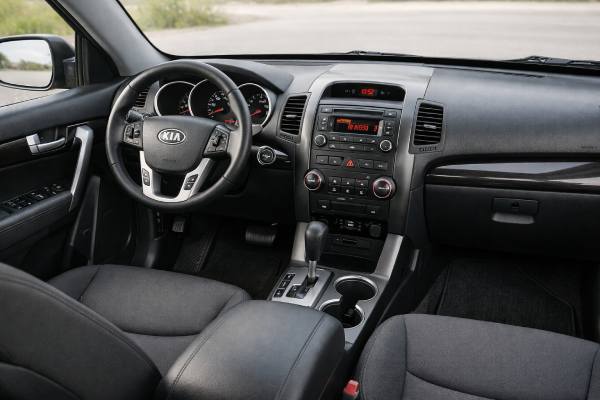
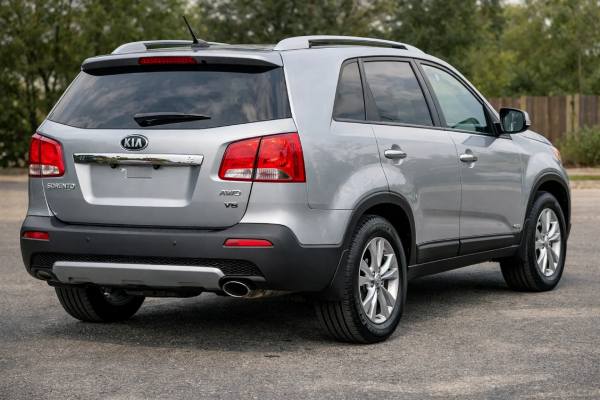
The 2011–2012 Kia Sorento XM with the 3.5-liter G6DC V6 and AWD is the “big-engine” version of this generation: strong mid-range pull, confident passing power, and a drivetrain that suits real family duty—wet weather, gravel driveways, and the occasional tow—better than the four-cylinder models. It also sits in a sweet spot of modern features without being overloaded with today’s sensor-heavy complexity. The trade-offs are clear, though: the V6 AWD combination adds weight and mechanical load, so suspension wear, brakes, and tires matter more, and fuel use is noticeably higher than the 2.4. If you maintain fluids on time, address cooling and ignition items before they become faults, and confirm recall work by VIN, the Sorento XM V6 can be a durable, capable two-row (or optional three-row) SUV for long ownership.
What to Know
- Strong V6 power makes highway merging and passing easy, especially with full passenger load.
- AWD improves traction in rain and snow and can reduce wheelspin on steep driveways.
- Cabin space is family-friendly, with a practical driving position and good outward visibility for the class.
- Plan for higher running costs: tires, brakes, and fuel usage are meaningfully higher than 4-cylinder models.
- Typical interval: change engine oil every 8,000–10,000 km (5,000–6,000 mi) or 6 months if used for short trips, towing, or heavy city driving.
Jump to sections
- Kia Sorento XM AWD V6 snapshot
- Kia Sorento XM G6DC AWD specs
- Kia Sorento XM AWD trims and safety
- Reliability patterns and recalls
- Maintenance plan and buying checks
- On-road performance and economy
- Rivals and best alternatives
Kia Sorento XM AWD V6 snapshot
The 2011–2012 Sorento XM AWD with the G6DC 3.5 V6 targets buyers who want midsize-SUV room with near-crossover manners. The V6 changes the character of the vehicle more than most people expect: instead of working hard near the top of the rev range, it delivers smooth torque early, so the six-speed automatic can stay in taller gears. That reduces noise under moderate load, and it makes the Sorento feel calmer in everyday traffic—especially when the cabin is full.
The AWD system is the practical kind rather than a hardcore off-road setup. In normal driving it behaves like a front-biased system, sending extra torque rearward when the front tires begin to slip. Some versions include an AWD lock mode for low-speed traction (useful for getting moving on snow, mud, or loose gravel), but it is not a substitute for low range or locking differentials. Think “all-weather confidence,” not rock crawling. The benefit for owners is simple: you get fewer traction-control interventions in bad weather and better pull-away stability on hills.
Chassis tuning on the XM generation leans toward comfort, with a compliant ride that suits rough pavement. The trade-off is that worn bushings and tired dampers become obvious: steering can feel loose on-center, the body can “float” over repeated bumps, and braking can feel less consistent if the suspension isn’t tight. That is why this V6 AWD variant rewards preventive maintenance more than the base models. With more power and more drivetrain mass, it is harder on tires, brakes, and engine mounts.
Ownership satisfaction usually comes down to three areas. First, keep the engine healthy with clean oil and attention to cooling—V6 heat management matters. Second, treat AWD and transmission fluids as real service items, not “lifetime.” Third, buy based on condition and history, not just mileage. A well-kept Sorento V6 AWD can feel strong and refined even at higher mileage, while a neglected one can rack up expensive catch-up work quickly.
Kia Sorento XM G6DC AWD specs
Below are practical specifications for the 2011–2012 Sorento XM AWD with the 3.5 V6. Exact figures can vary by market, trim, wheel size, and whether the vehicle has the third-row option. Use these as a strong baseline, then verify your VIN-specific data in official service information.
Powertrain and efficiency
| Item | Spec |
|---|---|
| Engine code | G6DC |
| Layout | V6, aluminum block and heads (typical) |
| Displacement | 3.5 L (3,497 cc) |
| Induction | Naturally aspirated |
| Fuel system | Multi-point injection (PFI/MPFI) (market-dependent) |
| Valvetrain | DOHC, 24 valves (4 valves/cyl) |
| Max power | 276 hp (206 kW) @ ~6,300 rpm |
| Max torque | ~335 Nm (248 lb-ft) @ ~5,000 rpm |
| Timing drive | Chain |
| Rated fuel use (typical) | ~11.0–12.5 L/100 km combined (21–18 mpg US) depending on market/testing cycle |
| Real-world highway @ 120 km/h | ~9.5–11.0 L/100 km (25–21 mpg US), wind and tire setup dependent |
Transmission and driveline
| Item | Spec |
|---|---|
| Transmission | 6-speed automatic (with manual mode on many trims) |
| Drive type | AWD (active on-demand coupling) |
| Differential | Typically open front and rear with traction-control braking assist |
| Tow rating (typical) | Up to ~1,588 kg (3,500 lb) when properly equipped; verify cooling package and hitch class |
Chassis and dimensions
| Item | Spec |
|---|---|
| Suspension (front / rear) | MacPherson strut / multi-link |
| Steering | Electric power assist (common on this generation) |
| Brakes | 4-wheel discs (vented front; rear solid or vented by trim/market) |
| Common tire size | 235/60 R18 or 235/55 R19 (varies by trim) |
| Ground clearance | ~184 mm (7.2 in) (varies with tires) |
| Length | ~4,685 mm (184.4 in) |
| Width | ~1,885 mm (74.2 in) |
| Height | ~1,710 mm (67.3 in) |
| Wheelbase | ~2,700 mm (106.3 in) |
| Turning circle | ~10.9–11.3 m (35.8–37.1 ft), spec varies |
| Curb weight | ~1,780–1,850 kg (3,924–4,079 lb), trim dependent |
| Fuel tank | ~68–70 L (18.0–18.5 US gal / 15.0–15.4 UK gal) |
Cargo volume (practical guidance)
Cargo numbers are the most market-dependent Sorento spec because measuring standards differ (VDA vs SAE), and the third-row option changes the “seats up” figure dramatically. A good way to think about it:
- With the third row fitted and in use: space is modest (enough for a few grocery bags).
- With the third row folded: you get a usable family cargo bay.
- With the second row folded: you get a long, flat load floor suitable for bulky items.
If cargo capacity is a key buying reason, measure the actual vehicle with your everyday items (stroller, luggage, sports bags) because published numbers can mislead.
Fluids and service capacities (typical)
Capacities and specs vary by market and drivetrain hardware; always verify for your VIN. Still, owners and DIY planners usually want a starting point:
| System | Typical spec to look for | Typical capacity range |
|---|---|---|
| Engine oil | API/ILSAC spec per market; common viscosities 5W-20 or 5W-30 | ~5.5–6.0 L (5.8–6.3 US qt) |
| Coolant | Long-life ethylene glycol, usually 50/50 mix | ~8–10 L (8.5–10.6 US qt) |
| Automatic transmission | ATF to Hyundai/Kia spec for 6AT | ~7–9 L (7.4–9.5 US qt) for service/refill varies |
| AWD coupling / rear drive unit | Gear oil spec per unit | often ~0.5–1.2 L per component |
Key torque specs (decision-level, typical)
These are common “critical fastener” categories owners ask about; exact values vary by engine/transmission variant:
- Wheel lug nuts: often ~88–108 Nm (65–80 lb-ft) depending on wheel/market
- Engine oil drain plug: often ~25–40 Nm (18–30 lb-ft) depending on pan design
- Brake caliper bracket bolts: typically higher torque than slide pins (confirm per VIN)
If you do your own work, the safest approach is to use the torque value from VIN-matched service documentation for each fastener you touch.
Kia Sorento XM AWD trims and safety
Trims vary widely by region, but the 3.5 V6 AWD typically appears on higher grades because the powertrain cost and towing positioning fit “family plus” and “touring” use cases. In North America you often see LX/EX/SX naming; in other markets you may see “Highline,” “Premium,” or equipment lines grouped by package codes. The useful way to shop is to focus on equipment that changes day-to-day ownership rather than badges.
Trims and options that matter most
1) Seating and cabin configuration
- Third-row seat: great for occasional use, but it changes cargo practicality and adds rear-seat mechanisms to maintain.
- Heated seats and dual-zone climate: comfort features that can also signal a higher-trim electrical architecture (more modules, more switches).
2) Wheels and brakes
- Larger wheels (19-inch) sharpen steering response but increase tire cost and can worsen ride on broken roads.
- If you drive in hilly areas or tow, prioritize the brake package and tire quality over cosmetic upgrades.
3) Towing readiness
A “tow rating” is not just engine power. Look for:
- Factory hitch wiring provisions (or a clean professional retrofit)
- Evidence of transmission cooling support (varies by market and package)
- A history of fluid servicing (ATF, AWD unit, rear drive unit)
Quick identifiers when shopping used
- VIN decode and build sheet: the most reliable way to confirm V6 AWD, third-row, and factory tow prep.
- AWD controls: many have a dash button for AWD lock; verify it functions and that warning lights are absent.
- Tire wear pattern: uneven inner shoulder wear often points to alignment or worn control-arm bushings.
Safety ratings and what they mean
For this generation, safety performance is often strong, but results depend on the test body and year-specific protocols:
- Euro NCAP: The Sorento in this era achieved a 5-star result under the then-current Euro NCAP system, with strong adult and child occupant scores and a lower pedestrian score typical of the time.
- IIHS (U.S.): The Sorento earned recognition as a Top Safety Pick in the early 2010s under IIHS criteria of that period (crashworthiness and stability control requirements).
These ratings are valuable, but don’t treat them as identical to modern 2020s testing. Newer test protocols add tougher crash scenarios and more emphasis on advanced crash prevention.
Driver assistance and safety tech reality for 2011–2012
On this model-year range, expect core safety systems rather than modern ADAS:
- ABS, stability control, traction control
- Front airbags plus side and curtain airbags (counts and coverage vary)
- Tire pressure monitoring (market-dependent)
You generally will not find factory AEB (automatic emergency braking) or adaptive cruise control as common equipment on 2011–2012 Sorento XM. That can actually simplify ownership: fewer cameras and radar modules to calibrate after windshield replacement or front-end repairs. The key is to ensure the fundamentals—tires, brakes, and suspension—are kept in good shape, because those are the real “active safety” systems on this generation.
Reliability patterns and recalls
Reliability on the Sorento XM V6 AWD is best understood as a mix of sturdy core hardware and predictable age-related wear. Many vehicles fail “by maintenance,” not by design—meaning the engine and transmission can be durable, but neglected fluids, worn mounts, and overdue ignition work create the problems owners associate with unreliability.
Common vs occasional vs rare issues
Common (expect to see on higher-mileage examples)
- Suspension bushings and links: clunks over bumps, vague steering, uneven tire wear.
- Remedy: replace worn control-arm bushings/ball joints, sway-bar links, and align properly.
- Engine mounts: vibration at idle in gear, thump on take-off.
- Remedy: mount replacement; check for oil contamination accelerating rubber failure.
- Brake wear and heat management: warped-feeling braking can be pad deposits or rotor wear, often worsened by cheap pads.
- Remedy: quality pads/rotors, caliper slide service, brake fluid refresh.
Occasional (depends on use and climate)
- Cooling system leaks: slow coolant loss, sweet smell, residue near hoses or radiator end tanks.
- Remedy: pressure test, replace weak components before overheating events.
- Ignition coils / spark plugs: misfires under load, check-engine light, rough running.
- Remedy: replace plugs at the correct interval; coils as needed (often one or two rather than all).
Rare (but costly if ignored)
- Timing chain system problems: rattle on cold start, correlation codes, poor running.
- Remedy: diagnose early; chain, guides, and tensioners are a bigger job than belt-driven engines, so don’t delay.
Driveline and AWD-specific watchpoints
AWD adds confidence, but it also adds service needs:
- Transfer/AWD coupling and rear drive unit fluids age from heat and shear. Old fluid can contribute to noise, shudder, or coupling stress.
- Tires must match closely in brand, model, and tread depth. A large rolling-diameter mismatch can force the AWD system to “work” constantly, increasing wear.
A practical rule: replace tires as a set when possible, and keep rotations consistent. If you must replace only two tires, measure tread depth and match as closely as you can.
Software and calibrations
This era is not dominated by over-the-air updates, but it can still have service updates that improve drivability. If you experience harsh shifts, delayed engagement, or odd throttle response, ask a dealer or a specialist shop to check for applicable ECU/TCU updates for your VIN and symptom set.
Recalls and service actions
Recalls vary by market and production batch. Because you’re shopping a 2011–2012 vehicle today, the most important step is not memorizing recall headlines—it’s confirming completion:
- Run the VIN through an official recall lookup for your region.
- Ask the seller for documentation showing recall remedies were performed.
- If uncertain, call a dealer with the VIN and request the campaign history.
When a recall exists, it usually matters because it addresses a safety or compliance risk. Even if the vehicle “seems fine,” completed recall work reduces the chance of an unexpected failure later—and it supports resale value.
Maintenance plan and buying checks
If you want this Sorento XM V6 AWD to last, treat maintenance as a schedule, not a reaction. The vehicle is forgiving in the short term, but long-term durability comes from fluid control, heat control, and keeping the chassis tight.
Practical maintenance schedule (distance or time)
Use the more frequent interval if you do short trips, tow, idle often, or drive in very hot/cold climates.
- Engine oil and filter: every 8,000–10,000 km (5,000–6,000 mi) or 6 months (severe use)
- Tire rotation and inspection: every 8,000–10,000 km (5,000–6,000 mi)
- Engine air filter: inspect every oil change; replace every 20,000–30,000 km (12,000–18,000 mi) in dusty areas
- Cabin air filter: every 15,000–20,000 km (9,000–12,000 mi) (or yearly)
- Brake fluid: every 2 years (moisture absorption affects pedal feel and corrosion)
- Coolant: commonly 5 years / 100,000–160,000 km depending on coolant type; verify for your market
- Spark plugs: often 100,000–160,000 km (60,000–100,000 mi) depending on plug type; verify by VIN
- Automatic transmission fluid (ATF): every 60,000–80,000 km (37,000–50,000 mi) if you want long transmission life (sooner if towing)
- AWD coupling / rear drive unit fluid: every 50,000–80,000 km (31,000–50,000 mi) depending on use
- Alignment: yearly, or immediately if tire wear appears or you hit a pothole hard
- 12 V battery: test yearly after year 4; many last 4–6 years depending on climate
Fluids, specs, and “what matters” choices
Owners often get stuck on brand names. The bigger durability factor is using a fluid that meets the correct specification and changing it before it’s degraded.
- For engine oil, choose the viscosity and rating specified for your market and climate; don’t “thicken” oil to mask wear.
- For ATF and AWD unit oils, prioritize the correct spec over universal fluids.
- For coolant, use the proper long-life coolant type and correct mix ratio—improper coolant can accelerate corrosion and seal wear.
Buyer’s guide: inspection checklist
Bring a flashlight and take your time. For this V6 AWD version, focus on items that can turn into expensive “catch-up” work:
Engine and cooling
- Coolant level stable, no oily film, no crusty residue at hose junctions
- Smooth idle in gear, no heavy vibration (mount condition)
- No misfire under load during a test drive (coils/plugs)
Transmission and AWD
- Smooth engagement into Drive/Reverse, no harsh slam
- No shudder on tight low-speed turns (tire mismatch or AWD stress)
- No driveline clunks when transitioning on/off throttle
Suspension, steering, brakes
- Even tire wear across tread; inner-shoulder wear suggests alignment or bushings
- No clunks over small bumps
- Braking is straight and consistent; no pulsing under light braking
Body and corrosion hotspots
- Check rear subframe area, suspension mounting points, and brake lines if the vehicle lived in a salt region
- Inspect the lower edges of doors and tailgate for bubbling paint
Which years and options to seek
For 2011–2012 specifically, prioritize:
- Clear maintenance history with documented fluid services
- Tires that match as a set and have even wear
- A trim level that fits your actual needs (third row, tow prep, comfort features)
Avoid:
- Vehicles with mismatched tires on AWD
- Signs of overheating history
- “No history, but it drives fine” examples unless priced to cover catch-up repairs
Long-term outlook: with disciplined fluids and a tight suspension, this Sorento can be a dependable long-haul SUV. Without that discipline, it becomes a cycle of tires, brakes, and driveline complaints.
On-road performance and economy
The G6DC V6 is the reason to choose this variant. In real driving it feels relaxed rather than sporty: torque arrives smoothly, the engine doesn’t sound strained, and the six-speed automatic usually makes sensible choices. If you’re coming from a four-cylinder midsize SUV, the difference shows up most on hills and during passing. You need less throttle to get the same speed change, which can actually make the cabin quieter even though fuel consumption rises overall.
Ride, handling, and NVH
For a midsize SUV of its era, the Sorento XM rides with a comfort bias:
- Ride: absorbs potholes and broken pavement well when dampers and bushings are healthy.
- Handling: stable and predictable, but not “sharp.” Body roll increases if the suspension is tired.
- Steering: light to medium effort; can feel vague on-center if front-end components are worn.
- Noise: tire noise becomes a bigger contributor than engine noise at highway speeds, especially with aggressive all-season tires.
A simple ownership tip: if the Sorento feels louder than expected at 100–120 km/h, look at tires first. Many SUVs get blamed for “wind noise” when it’s actually tread pattern roar.
Powertrain character
- Throttle response: generally smooth; response can feel soft if the transmission is protecting itself from heat or if the throttle body is dirty.
- Kickdown: strong; the V6 has the power to justify downshifts without drama.
- AWD behavior: mostly invisible in normal driving, which is what you want. In slippery conditions it reduces wheelspin and helps keep the vehicle tracking straight under gentle throttle.
Real-world efficiency
Expect fuel use to vary widely with speed and load. Typical owner expectations:
- City: around 12–14 L/100 km (19–17 mpg US) depending on traffic and warm-up time
- Highway (100–120 km/h): around 9.5–11.0 L/100 km (25–21 mpg US) depending on wind, roof racks, and tires
- Mixed: around 11–12.5 L/100 km (21–19 mpg US)
Cold weather can push these numbers up because warm-up takes longer and winter fuel blends reduce energy content. AWD also adds a small mechanical penalty versus 2WD.
Selective performance metrics that matter
On road tests, this V6 AWD Sorento typically lands in a “quick enough to feel confident” bracket:
- 0–100 km/h (0–62 mph): about 7.0–8.0 seconds depending on conditions and vehicle weight
- Passing power: strong for a family SUV of its time; it feels more effortless than the 2.4
- Braking: depends heavily on tire quality and brake condition; consistent braking is a sign the chassis is healthy
Towing and load behavior
With a proper hitch setup and well-maintained fluids, the Sorento can handle moderate towing. The keys are:
- Keep speeds sensible on grades
- Monitor for transmission heat behavior (hunting shifts, hot smell)
- Service ATF and AWD fluids more frequently if towing is routine
Expect fuel consumption to rise significantly when towing—often 20–40% depending on trailer size and speed.
Rivals and best alternatives
The 2011–2012 Sorento XM V6 AWD sits in a competitive slice of the used market: midsize crossovers with enough power for family travel and occasional towing. Your best alternative depends on what you value most—durability, interior space, fuel economy, or low repair risk.
If you want maximum long-term durability
Toyota Highlander V6 AWD (similar era)
Often praised for drivetrain longevity and a conservative engineering approach. Costs more up front, but it may return that value in fewer “catch-up” repairs. The trade-off is that some trims feel less feature-rich for the price.
Honda Pilot V6 AWD (similar era)
Strong space and family usability. When maintained properly it can run long, but some years require close attention to transmission service history and engine oil management. It’s a good choice if you need a more consistently usable third row.
If you care most about driving feel
Ford Edge V6 AWD (similar era)
Often feels stable and confident on highways. Availability and pricing can be attractive. The ownership experience depends heavily on prior maintenance and the specific powertrain configuration.
Mazda CX-9 (V6 AWD, similar era)
More engaging steering and handling, with a “lighter” driving feel than some rivals. It can be a smart buy if you prioritize road manners, but check suspension and brake condition closely—sportier tuning can mean faster wear when neglected.
If you want the best fuel economy in a similar size
A V6 AWD Sorento is not the fuel-economy choice. If fuel cost is your top priority, consider:
- A four-cylinder version of the Sorento (accepting slower performance)
- A smaller class SUV
- A hybrid option (depending on budget and local support)
Why the Sorento XM V6 AWD still makes sense
Choose this Sorento when your priority is usable power plus all-weather traction without stepping into heavier truck-based SUVs. It’s particularly appealing if you:
- Drive highways with full passenger load
- Live in mixed weather regions
- Want a vehicle that feels modern enough but not overloaded with advanced sensor systems
The best strategy is to compare not just model-to-model, but example-to-example. A well-maintained Sorento with documented fluid services and matching tires can be a better buy than a “reputation winner” with unknown history.
References
- Vehicle Detail Search – 2011 Kia Sorento SUV 4WD 2011 (Recall Database)
- Recalls 2026 (Recall Database)
- 2011 TOP SAFETY PICKs 2011 (Safety Rating)
- New Kia Sorento awarded 5-star Euro NCAP rating 2009 (Safety Rating)
Disclaimer
This article is for informational purposes only and is not a substitute for professional diagnosis, inspection, or repair. Specifications, torque values, service intervals, and procedures can vary by VIN, market, drivetrain hardware, and installed equipment. Always confirm details using official owner and service documentation for your exact vehicle.
If this guide helped you, please consider sharing it on Facebook, X (Twitter), or your favorite forum to support our work.