

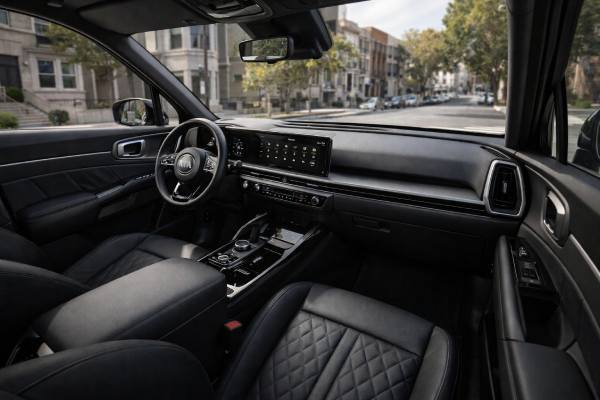

The facelifted 2024–present Kia Sorento (MQ4) with the 2.5-liter Smartstream gasoline engine is the “quietly sensible” choice in the lineup: it keeps the Sorento’s roomy three-row packaging and modern cabin tech, while avoiding the added heat and complexity of a turbocharger or hybrid hardware. In FWD form, the mechanical layout is straightforward—transverse four-cylinder, conventional torque-converter automatic, and fewer driveline components than AWD—which can pay off in long-term running costs if you maintain it well.
This version suits owners who want family practicality, predictable winter behavior on proper tires, and lower service risk than more highly stressed powertrains. The key to happy ownership is not heroic repairs—it’s consistent fluid service, keeping the direct-injection engine clean, and staying on top of software updates and recalls.
What to Know
- Smooth, low-stress powertrain that prioritizes durability over speed in daily driving.
- Strong interior space efficiency for a midsize SUV, especially with the third row folded.
- FWD reduces mechanical complexity and can lower maintenance costs versus AWD.
- Direct-injection engines reward high-quality fuel and timely oil changes to reduce deposits.
- Plan an oil service every 10,000–15,000 km (or 12 months), and shorten it for short trips or heavy city use.
Navigate this guide
- Sorento MQ4 facelift in context
- Sorento MQ4 2.5 key specifications
- Sorento MQ4 trims and safety tech
- Reliability patterns and service actions
- Maintenance plan and buyer’s checklist
- Real driving performance and efficiency
- Rivals worth cross-shopping
Sorento MQ4 facelift in context
The 2024 refresh keeps the Sorento’s core engineering recipe—transverse powertrain, optional three-row layout, and a chassis tuned for comfort—while modernizing the cabin technology and tightening the overall feel. In FWD 2.5 form, the Sorento sits in a sweet spot: it delivers the packaging and safety tech people expect from a contemporary family SUV, without the extra parts count of AWD or electrified variants.
From an ownership perspective, think of this model as “simple by modern standards.” The drivetrain is conventional: a naturally aspirated 2.5-liter four-cylinder paired with an automatic transmission. That matters because heat and torque spikes are major drivers of wear. Turbo engines and hybrid systems can be excellent, but they introduce additional components (boost control, charge-air cooling, high-voltage batteries, electric coolant pumps, power electronics). If you’re shopping for long-term predictability, the non-turbo 2.5 is easier to live with, especially outside dealer-heavy regions.
The Sorento’s body size and wheelbase are engineered around family use. In practice, you get:
- A second row that can genuinely fit adults without “knees in the dash” posture.
- A third row that works best for kids or shorter trips, but provides real flexibility.
- A cargo area that becomes properly useful when the third row is folded—ideal for strollers, weekly shopping, or sports gear.
The FWD configuration also changes the driving and cost profile. It’s typically lighter than AWD and has fewer fluid services (no rear differential, no transfer case). The trade-off is traction when you’re starting on steep, slick surfaces or towing on loose ground. For most road use, good tires do more than the badge on the tailgate.
Where owners should pay attention is not the headline horsepower—it’s the basics: direct-injection cleanliness, oil quality, and cooling system health. A modern DI (direct injection) engine can run beautifully for high mileage, but it’s less forgiving of extended oil intervals in harsh use (short trips, cold starts, heavy city traffic). The “facelift” years are also tech-forward, which means software matters. Small calibration updates can fix shifting behavior, sensor faults, and driver-assistance glitches that feel like hardware problems but aren’t.
If your goal is a comfortable, practical SUV that’s likely to age gracefully with routine care, the facelifted Sorento FWD 2.5 is designed to fit that role—provided you treat maintenance as a schedule, not a suggestion.
Sorento MQ4 2.5 key specifications
Below are practical, ownership-focused specifications for the facelift-era Sorento MQ4 with the 2.5-liter Smartstream gasoline engine in FWD form. Exact figures can vary slightly by market (emissions tuning, wheel and tire fitment, and trim equipment), so treat the numbers as a solid baseline and verify details by VIN when ordering parts or fluids.
Powertrain and efficiency (FWD 2.5 gasoline)
| Item | Specification |
|---|---|
| Code | Smartstream G2.5 (market-dependent engine code; commonly listed as 2.5 GDI) |
| Engine layout and cylinders | Inline-4, DOHC, 4 valves/cyl |
| Displacement | 2.5 L (2,497 cc) |
| Induction | Naturally aspirated |
| Fuel system | Direct injection (DI) |
| Max power | 191 hp (about 142 kW) |
| Max torque | ~245 Nm (about 181 lb-ft) (market-dependent) |
| Timing drive | Chain |
| Transmission | 8-speed automatic (torque converter) |
| Drive type | FWD |
| Rated efficiency | Typically around 9.0 L/100 km combined (about 26 mpg US combined) |
| Real-world highway at 120 km/h | Often ~8.0–9.0 L/100 km depending on load, tires, wind, and temperature |
Chassis and dimensions (typical MQ4 baseline)
| Item | Specification |
|---|---|
| Suspension (front/rear) | MacPherson strut / multi-link (common MQ4 configuration) |
| Steering | Electric power steering (EPS) |
| Brakes | 4-wheel discs (exact rotor sizes vary by trim/wheels) |
| Wheels and tires (common) | 235/55 R19 or 235/60 R18 (market and trim dependent) |
| Ground clearance | Around 175–180 mm (varies with wheels and underbody packaging) |
| Length / width / height | Around 4,810–4,820 mm / 1,900 mm / ~1,700 mm (equipment dependent) |
| Wheelbase | 2,815 mm |
| Turning circle | Around 11.6–11.8 m (typical for class) |
| Kerb (curb) weight | Commonly ~1,650–1,800 kg depending on seats and equipment |
| Fuel tank | Commonly around 65–67 L (market dependent) |
| Cargo volume | Strong “seats-down” practicality; exact liters vary by measurement standard and 2-row vs 3-row configuration |
Performance and capability (ownership-relevant)
| Item | Typical expectation |
|---|---|
| 0–100 km/h (0–62 mph) | About 9–10 seconds (trim and test conditions matter) |
| Top speed | Typically in the ~190–200 km/h range (market dependent) |
| Braking 100–0 km/h | Often mid-to-high 30 m range on good tires (test dependent) |
| Towing capacity | Frequently 900–1,000 kg braked for the non-turbo engine (market dependent) |
| Payload | Depends heavily on trim and seating; check the door-jamb label for your vehicle |
Fluids and service capacities (verify by VIN and service documentation)
Because capacities and approved fluids can differ by emissions package and cooling layout, the most responsible approach is to confirm via the official service information for your exact configuration. Still, these guidelines help you plan:
- Engine oil: Typically SAE 0W-20 or 5W-20 (market dependent) meeting the required API/ILSAC spec; capacity varies with filter and cooler setup.
- Coolant: Long-life ethylene glycol coolant, usually a 50/50 premix; capacity varies by radiator and heater circuit.
- Transmission fluid: Hyundai-Kia OEM ATF spec for the 8-speed automatic; service approach varies by market (sealed vs serviceable).
- Key torque specs: Use service manual values for wheel lug torque, drain plugs, and brake caliper brackets; do not guess on critical fasteners.
Safety and driver assistance (high-level)
| Item | Notes |
|---|---|
| Crash ratings | Vary by region and test year/version; many MQ4 Sorento variants are rated strongly in their class |
| ADAS suite | Commonly includes AEB, lane support, ACC, blind-spot monitoring, and rear cross-traffic alert (availability depends on trim and market) |
If you want one “numbers summary” to remember: this is a practical 191 hp family SUV with economy around the mid-9 L/100 km combined range, strong space utilization, and a drivetrain designed more for smooth daily use than sporty acceleration.
Sorento MQ4 trims and safety tech
Trim structures differ widely by country, but the facelift Sorento MQ4 range usually follows a familiar ladder: value-oriented trims with strong core safety, mid-trims that add comfort and convenience, and upper trims that bundle driver assistance, premium audio, larger screens, and upgraded lighting. The 2.5 FWD is often positioned as the rational entry point, and that influences what you’ll see on the used market: more cloth or durable synthetic upholstery, fewer complex chassis options, and simpler wheel packages.
Trims and options that matter mechanically
Even when the engine is the same, trims can alter ownership costs through wheel size, brake hardware, and equipment load.
- Wheel and tire packages: Larger wheels look great but cost more in tires and can raise road noise. If you value comfort and efficiency, the most “owner-friendly” setup is usually an 18-inch wheel with a taller sidewall tire.
- Seating configuration: Some markets sell the Sorento as a 2-row or 3-row. The 3-row adds flexibility, but also adds weight and can slightly reduce real-world economy.
- Lighting: LED headlights typically reduce bulb replacements and improve night visibility, but repairs can be expensive if a housing fails after warranty.
- Tow prep: If towing is part of your plan, seek a factory tow package when available. It often includes the right cooling strategy, wiring integration, and higher-rated hitch solutions.
Quick identifiers when shopping used
If listings are vague, you can still decode a lot during a walkaround:
- Badging and wheels often reveal whether it’s a base, mid, or upper trim, but don’t rely on badges alone—some markets de-badge.
- Driver assistance controls: steering wheel and dashboard buttons can hint at ACC and lane-centering availability.
- Cameras: a front camera or 360° system is a quick “upper trim tell.”
- Seat tracks: second-row captain’s chairs (where offered) indicate a specific package and can affect how the third row is accessed.
Safety ratings and what they mean in real life
Safety scores depend on:
- The test organization (which can use different protocols),
- The model year tested,
- And whether the tested car matches your exact equipment (headlights, optional safety packs).
As a buyer, focus on practical outcomes:
- Strong structure plus modern restraint systems (front, side, and curtain airbags) reduce injury risk.
- AEB (automatic emergency braking) is one of the most meaningful real-world safety technologies, especially if it includes pedestrian and cyclist detection.
- Lane support systems reduce fatigue, but they require correct calibration after windshield replacement or front-end repairs.
ADAS features and service implications
Facelift-era Sorentos typically offer a broad suite, but availability can be trim-locked:
- Forward collision avoidance (AEB): often standard, sometimes with junction-turn support on higher trims.
- Adaptive cruise control (ACC): not always standard on base trims.
- Lane keeping and lane following: lane keeping helps prevent drift; lane following can provide gentle centering on marked roads.
- Blind-spot and rear cross-traffic alerts: very useful in urban parking and driveway reversals.
Important ownership note: radar and camera systems are sensitive to alignment. After a windshield replacement, bumper removal, suspension work, or a collision repair, insist on proper calibration. “It seems fine” is not the same as “it’s calibrated to spec.”
Reliability patterns and service actions
The facelift Sorento FWD 2.5 is generally a low-drama configuration, but reliability depends on usage pattern. Short trips, cold starts, heavy city driving, and infrequent oil changes are the fastest path to modern DI engine complaints. Below are common issue patterns organized by prevalence and severity, along with what you can do about them.
Common, usually low-to-medium severity
1) Direct-injection deposits (intake valve and combustion chamber)
- Symptoms: rough idle, reduced response, occasional misfire codes, slightly higher fuel use.
- Likely cause: DI sprays fuel directly into the cylinder, so intake valves don’t get “washed” by fuel. Deposits build faster with short trips and cheap fuel.
- Remedy: consistent oil changes, quality fuel, and periodic induction cleaning if symptoms appear. On many DI engines, a preventative cleaning strategy is smarter than waiting for misfires.
2) Oil dilution and fuel smell in oil (usage-related)
- Symptoms: rising oil level, fuel smell on dipstick, harsh cold start behavior.
- Likely cause: repeated cold starts and short cycles where the engine never fully warms.
- Remedy: shorten oil intervals and add longer drives periodically to fully warm the oil.
3) Cooling system seepage (hoses, clamps, thermostat housing area)
- Symptoms: coolant smell, small drops after parking, low coolant warning.
- Likely cause: normal aging of seals, clamps, or plastic housings under heat cycling.
- Remedy: pressure test, replace the leaking component early. Overheating is what turns a small leak into a major repair.
Occasional, can be medium severity
4) Ignition coil or spark plug issues
- Symptoms: misfires under load, blinking check engine light, rough running.
- Likely cause: coil weakness, plug wear, or deposit-related misfire.
- Remedy: diagnose by cylinder, replace with correct parts, and keep to proper plug intervals.
5) Transmission shift quality complaints (often software-related)
- Symptoms: hesitation, busy shifting, clunk on engagement, or odd behavior in stop-and-go traffic.
- Likely cause: adaptation values, calibration updates, or fluid condition under severe use.
- Remedy: check for software updates first; if the vehicle is used hard (city, towing), consider a proactive ATF service where permitted by the maintenance plan.
Rare, higher-cost risks
6) High-pressure fuel system faults
- Symptoms: extended cranking, loss of power, fuel pressure codes.
- Likely cause: high-pressure pump or sensor issues (rare, but possible on DI engines).
- Remedy: proper scan data diagnosis; do not shotgun parts.
7) Electronics and sensor failures
- Symptoms: intermittent warning lights, camera faults, ADAS unavailable messages.
- Likely cause: connector issues, water intrusion, or module faults.
- Remedy: start with battery health and charging system checks; low voltage causes “ghost” faults.
Recalls, TSBs, and how to stay protected
Modern vehicles can have recall campaigns for items ranging from airbags to software logic. Do not rely on the seller’s memory. The best workflow:
- Run the VIN through the official recall lookup tools.
- Ask a dealer to confirm completion status in their system.
- Keep documentation with your service records.
A final reliability truth that’s easy to overlook: many “Sorento problems” are actually tire quality, alignment, or battery-voltage issues. A healthy 12 V battery and correct tires solve more complaints than most owners expect.
Maintenance plan and buyer’s checklist
If you want this Sorento to be a long-term keeper, treat maintenance as a system: fluids, filters, heat management, and small inspections that prevent expensive surprises. Below is a practical schedule that works well for the 2.5 FWD, with adjustments for harsh use.
Practical maintenance schedule (distance or time, whichever comes first)
Engine oil and filter
- Normal use: every 10,000–15,000 km or 12 months.
- Severe use (short trips, cold climate, heavy city, towing): every 7,500–10,000 km or 6–12 months.
Use the oil grade and specification required for your market. Modern engines depend on correct oil viscosity for timing components and variable valve control.
Engine air filter
- Inspect every 15,000 km; replace around 30,000–45,000 km (sooner in dust).
Cabin air filter
- Replace every 15,000–30,000 km, or yearly if you want consistently strong HVAC airflow.
Brake fluid
- Every 2 years is a safe, owner-friendly interval. Moisture in brake fluid reduces boiling point and can corrode internal components.
Coolant
- Often a long-life coolant interval (commonly 5 years then periodic changes). Verify the exact interval for your market and coolant type.
Spark plugs
- Many modern engines use long-life plugs (often 120,000–160,000 km). Replace on schedule—worn plugs stress coils and can trigger misfires under load.
Transmission (8-speed automatic)
- Some markets call it “filled for life,” but “life” often means warranty life. For long-term ownership:
- Consider an ATF service around 60,000–90,000 km if you drive hard, tow, or spend a lot of time in stop-and-go traffic (only using the correct fluid and procedure).
- If you drive gently on open roads, you can often extend that.
Tires, alignment, and brakes
- Rotate tires every 10,000–12,000 km.
- Check alignment yearly or anytime you see uneven wear.
- Inspect pads and rotors at every tire rotation.
12 V battery
- Test annually after year 3. Many modern vehicles become “electrically sensitive” when battery reserve declines.
Fluids, specs, and torque values (how to be accurate)
Because market specs differ, the best approach is to build a VIN-specific “service sheet” once and keep it:
- Confirm oil viscosity and specification,
- Confirm coolant type,
- Confirm ATF spec,
- Note wheel lug torque,
- Note jack points and lift procedure (important for avoiding underbody damage).
If you do DIY work, do not guess torque on drain plugs or suspension fasteners. Over-torquing causes stripped threads and leaks; under-torquing risks loosening.
Buyer’s guide: what to inspect before purchase
1) Service history and usage pattern
- Prefer cars with consistent oil records and longer-distance driving.
- Be cautious with vehicles that lived on short trips only.
2) Cold start behavior
- Listen for abnormal knocking beyond a brief normal DI tick.
- Check for rough idle, misfires, or warning lights.
3) Cooling system health
- Look for dried coolant residue around hoses and plastic housings.
- Confirm stable temperature under load.
4) Transmission feel
- Test stop-and-go behavior, parking maneuvers, and light throttle upshifts.
- “One odd shift” can be normal, but repeated hesitation deserves a scan and update check.
5) ADAS and camera function
- Confirm cameras, parking sensors, lane functions, and cruise work properly.
- After any windshield replacement, ask for calibration proof.
Long-term durability outlook
With timely oil service, clean air filtration, and attention to cooling and battery health, the Sorento FWD 2.5 is well-positioned to deliver strong long-term value. The owners who struggle are usually the ones who stretch oil intervals in severe use or ignore early signs of deposit-related drivability changes.
Real driving performance and efficiency
On the road, the 2.5 FWD Sorento drives like a modern family SUV should: calm, stable, and easy to place. It’s not tuned to feel sporty, and the naturally aspirated engine doesn’t have the punch of a turbo at low rpm. The payoff is predictable response and less thermal stress in everyday use.
Ride, handling, and NVH
Ride quality: The Sorento’s chassis generally prioritizes comfort. Over broken pavement, you’ll notice a controlled initial impact followed by a settled rebound—good damping is what keeps a three-row SUV from feeling floaty. Wheel size matters here: 18-inch setups usually ride more quietly and absorb sharp edges better than 19s or 20s.
Handling balance: For a family SUV, the Sorento typically feels secure in corners with mild understeer near the limit. FWD puts the workload (steering and drive) on the front tires, so tire quality and alignment have a big influence on confidence.
Cabin noise: Expect moderate road noise on coarse asphalt, especially on wider tires. Wind noise is usually well-managed at highway speed, but roof racks, worn door seals, or aggressive tire tread can change that quickly.
Powertrain character: what it feels like day to day
The 2.5’s strengths are smoothness and consistency:
- Throttle response: linear, with best response once the engine is into the midrange.
- Passing power: adequate for family duty, but you’ll feel the transmission kick down for quick overtakes—plan a half-second ahead and it’s fine.
- Transmission behavior: modern 8-speeds are tuned to chase economy; in gentle driving it will upshift early. If it feels indecisive, a software update and adaptation reset can help.
Drive modes (where offered) typically change throttle mapping and shift strategy. For city driving, a normal/comfort mode often feels smoother. For hills or overtakes, a sport mode can reduce “hunting” by holding gears longer.
Real-world efficiency
For the FWD 2.5, realistic consumption depends on speed and temperature:
- City-heavy driving: often around 10–11.5 L/100 km if traffic is dense and trips are short.
- Mixed use: commonly around 8.5–10.0 L/100 km.
- Highway (100–120 km/h): often around 8.0–9.0 L/100 km, with wind and load making a big difference.
Cold weather increases fuel use because:
- the engine runs richer during warm-up,
- the transmission and wheel bearings have higher friction,
- and cabin heating demands more energy.
Traction and control in FWD form
With good all-season or winter tires, FWD Sorentos handle typical rain and winter roads well. Where AWD pulls ahead is:
- steep, slick starts (ice or wet grass),
- towing on loose surfaces,
- and maintaining composure when one front tire is on a low-grip patch.
If you live in a snowy region and choose FWD, spend the budget on top-tier winter tires. That single decision improves braking, steering, and stability far more than drivetrain choice alone.
Towing and load behavior
The non-turbo 2.5 is better viewed as “occasional towing capable” rather than a heavy hauler. With moderate loads:
- expect more downshifts on grades,
- keep an eye on temperatures in hot weather,
- and accept a noticeable fuel-consumption penalty.
If towing is frequent, the turbo or hybrid variants (where available) often feel more relaxed—but they bring their own complexity. For most owners, the FWD 2.5 is the balanced daily driver that doesn’t demand attention when life gets busy.
Rivals worth cross-shopping
The Sorento competes in a crowded space where small differences in powertrain philosophy and packaging can matter more than brand reputation. If you’re considering a Sorento FWD 2.5, here are the rivals that most often make sense to compare—and what you should focus on.
Hyundai Santa Fe (same corporate family, different priorities)
The Santa Fe often shares platform DNA and technology philosophy. Depending on model year and market, it may:
- emphasize two-row comfort and interior design,
- offer similar driver assistance tech,
- and deliver comparable efficiency with equivalent engines.
What to compare:
- third-row need (Sorento often wins if you want occasional 7-seat flexibility),
- tire and suspension tuning (ride quality can differ noticeably),
- and pricing of options packages.
Toyota Highlander (or similar Toyota three-row SUVs)
Toyota’s main advantage is typically a long-running reputation for conservative engineering and strong resale value. The trade-offs can include:
- less “European-style” infotainment feel in some trims,
- higher purchase price,
- and different packaging priorities.
What to compare:
- real-world fuel use (Toyota hybrids can be compelling if you do a lot of city driving),
- comfort in the third row,
- and insurance/repair costs in your region.
Škoda Kodiaq / VW Tiguan Allspace (Europe-heavy cross-shops)
In markets where these are available, they often appeal to drivers who care about:
- road manners and steering feel,
- efficient turbo engines,
- and strong space efficiency.
What to compare:
- engine stress and long-term complexity (small turbo engines can be great but are sensitive to maintenance),
- DSG/dual-clutch behavior vs a conventional automatic,
- and parts/service pricing.
Nissan X-Trail (and similar two-row-plus options)
Many buyers cross-shop these if the third row is “nice to have” rather than essential. They can offer:
- good value,
- efficient powertrains,
- and comfortable cabins.
What to compare:
- luggage space with seats in use,
- long-term powertrain reputation in your specific engine/transmission pairing,
- and ADAS usability (some systems feel more natural than others).
What the Sorento FWD 2.5 does best in this group
- Balanced complexity: simpler than turbo/AWD/hybrid combinations while still feeling modern.
- Packaging flexibility: a practical family interior with optional occasional third-row use.
- Comfort-first tuning: stable and easy to live with on long trips.
When a rival may fit better
- You tow frequently or live on steep snowy roads: an AWD or higher-torque alternative may feel less strained.
- You do heavy city mileage: a hybrid rival can reduce fuel spend significantly.
- You prioritize “set-and-forget” resale: in some markets, Toyota-style depreciation curves can be hard to beat.
The smart way to decide is to test-drive with your real use case: car seats installed, a highway stretch at your typical speed, and a tight parking maneuver. For family vehicles, usability beats brochures every time.
References
- Check for Recalls: Vehicle, Car Seat, Tire, Equipment | NHTSA 2026 (Recall Database)
- 2024 Fuel Economy Guide 2024 (Official EPA Fuel Economy Guide)
- 2024 Fuel Economy Guide 2020 (Safety Rating)
Disclaimer
This article is for informational purposes only and is not a substitute for professional inspection, diagnosis, or repair. Specifications, torque values, fluid types and capacities, and service intervals can vary by VIN, market, and equipment. Always verify details against your official service documentation and the vehicle’s factory labels before servicing or ordering parts.
If you found this guide useful, please consider sharing it on Facebook, X (Twitter), or your favorite forum/community to help support our work.