

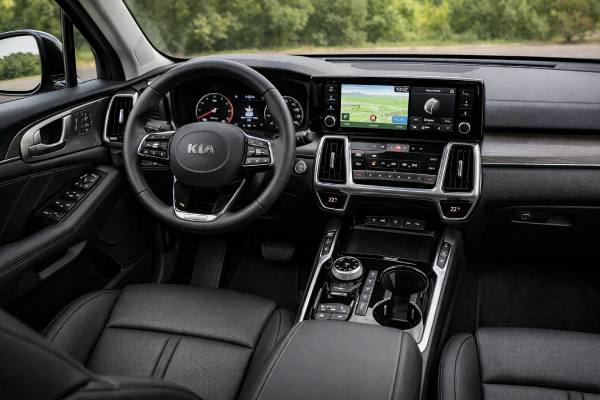

The 2021–2023 Kia Sorento MQ4 with the 2.5-liter Smartstream G2.5 and front-wheel drive is the “quietly smart” choice in the lineup: it’s the lightest mainstream Sorento powertrain, it avoids the complexity of turbo plumbing or hybrid hardware, and it still delivers three-row flexibility in a midsize footprint. In day-to-day ownership, this version stands out for predictable throttle response, a smooth 8-speed automatic, and generally sensible running costs—especially if you keep up with oil service and don’t ignore small early warning signs like a weak battery or noisy brakes.
This guide focuses on the 191 hp naturally aspirated 2.5 GDI FWD configuration across model years 2021, 2022, and 2023. You’ll find the key dimensions and capacities, a practical maintenance plan, what tends to go wrong (and when), and how to choose the right trim for your priorities.
Quick Specs and Notes
- Smooth, low-drama powertrain choice that typically costs less to maintain than turbo or hybrid variants over time.
- Strong packaging: adult-friendly first two rows with usable third-row “as needed” seating for families.
- Top Safety Pick recognition depends on getting the right headlight configuration for the year/trim.
- Watch for electrical and HVAC-related recall eligibility by VIN, plus early battery weakness in stop-and-go use.
- Plan on engine-oil service about every 12 months / 12,000 km (or sooner under severe use).
Explore the sections
- Sorento MQ4 FWD model focus
- Sorento MQ4 2.5 specs and measurements
- Sorento MQ4 trims and safety tech
- Reliability trends and known faults
- Maintenance routine and buyer checklist
- Real-world driving and efficiency
- Rivals you should cross-shop
Sorento MQ4 FWD model focus
This Sorento generation (MQ4) moved the model toward a more “platform-efficient” SUV: more usable cabin space, modern driver-assistance hardware, and a chassis tuned to feel stable at highway speeds without riding harshly. In the FWD 2.5 G2.5 configuration, the emphasis is balanced family transport rather than performance. That matters because it shapes what owners typically love—and what they should monitor.
What this specific configuration is best at
- Cost and simplicity: The naturally aspirated 2.5 avoids turbocharger heat management, extra plumbing, and higher boost-related stress. The drivetrain is straightforward: engine + 8-speed automatic + FWD.
- Everyday smoothness: You get linear torque delivery and predictable shift behavior. It’s easy to drive smoothly, which also helps fuel use.
- Practical packaging: Most trims can be found with a second-row bench; some offer captain’s chairs. Cargo flexibility is strong for a three-row crossover.
Where it’s not trying to compete
- Fast towing: FWD + 191 hp is not the “tow and mountain-pass” hero of the lineup. It can tow modest loads when equipped appropriately, but it’s best treated as an occasional-tow vehicle rather than a frequent heavy hauler.
- Sporty acceleration: Passing is adequate, not punchy. If you regularly drive at high altitude, carry full loads, or do frequent high-speed merges, turbo or V6-style rivals can feel more relaxed.
Engineering notes that matter for owners
- The Smartstream G2.5 in this application combines modern efficiency tuning with a practical emphasis on thermal control. That’s good for steady-state cruising and warm-weather operation, but it also means you should respect coolant condition and keep airflow paths clean (radiator/condenser debris buildup is common in any SUV).
- The 8-speed automatic’s behavior is sensitive to fluid condition and calibration. You don’t need to obsess over it, but you also shouldn’t treat it as “lifetime fluid” if you want the best long-term shift quality.
If you’re shopping used, this configuration is often the “sweet spot” because it’s typically less expensive than hybrid and turbo trims, while still offering the same body structure and most of the same safety architecture found across the range.
Sorento MQ4 2.5 specs and measurements
Below are the key specifications for the 2021–2023 Sorento MQ4 FWD with the Smartstream 2.5 GDI (191 hp). Exact figures can vary by market, trim, wheel/tire package, and equipment (sunroof, seat type, spare tire, etc.), so treat these as the “most common” spec baseline.
Powertrain and efficiency
| Item | Specification |
|---|---|
| Code | Smartstream G2.5 GDi (2.5 l) |
| Engine layout and cylinders | Inline-4, 4 cylinders, DOHC, 4 valves/cyl (16-valve) |
| Bore × stroke | 88.5 × 101.5 mm (3.48 × 4.00 in) |
| Displacement | 2.5 L (2,497 cc) |
| Induction | Naturally aspirated |
| Fuel system | GDI with supplemental port injection (market-dependent description) |
| Compression ratio | 13.0:1 |
| Max power | 191 hp (142 kW) @ 6,100 rpm |
| Max torque | 247 Nm (182 lb-ft) @ 4,000 rpm |
| Timing drive | Chain |
| Rated efficiency (typical FWD estimate) | 9.8 / 8.1 / 9.0 L/100 km (24 / 29 / 26 mpg US; 28.8 / 34.8 / 31.2 mpg UK) city / highway / combined |
| Real-world highway @ 120 km/h (75 mph) | Often ~8.5–9.5 L/100 km (25–28 mpg US), depending on wind, tires, and load |
Transmission and driveline
| Item | Specification |
|---|---|
| Transmission | 8-speed automatic |
| Drive type | FWD |
| Differential | Open (traction managed by brake-based stability/traction control) |
Chassis and dimensions
| Item | Specification |
|---|---|
| Suspension (front / rear) | MacPherson strut / multi-link |
| Steering | Motor-driven power steering (rack-mounted); ratio ~13.5:1 |
| Brakes | 325 mm (12.8 in) vented front discs; 305 mm (12.0 in) rear discs |
| Wheels/tyres (common) | 235/55 R19 (also common: 235/65 R17 or 235/60 R18 depending on trim) |
| Ground clearance | 175 mm (6.9 in) |
| Length / width / height | 4,801 / 1,900 / 1,694 mm (189.0 / 74.8 / 66.7 in) |
| Wheelbase | 2,814 mm (110.8 in) |
| Turning circle (kerb-to-kerb) | ~5.78 m (~19.0 ft) |
| Kerb weight (typical range) | 1,685–1,721 kg (3,715–3,794 lb) |
| GVWR (typical) | ~2,430 kg (~5,357 lb) |
| Fuel tank (market dependent) | Often ~60–67 L (15.9–17.7 US gal) |
Cargo volume and seating
Cargo figures vary depending on measurement method (VDA vs SAE) and whether a spare tire is fitted. A practical way to think about it:
- Seats up (3-row in use): enough for daily groceries and a few bags.
- Third row folded: the “family trip” sweet spot.
- Second and third rows folded: near-minivan-like floor length for bulky items.
Fluids and service capacities (common references)
| System | Specification | Capacity (typical) |
|---|---|---|
| Engine oil | Full synthetic SAE 0W-20; API SP / ILSAC GF-6 | 5.8 L (6.1 US qt) drain and refill |
| Coolant | Phosphate-based ethylene glycol coolant | ~9.1 L (9.6 US qt) for 2.5 GDi |
| Brake fluid | DOT 4 LV (market spec varies) | As required |
| A/C refrigerant | Market dependent (often R-1234yf on newer vehicles) | Refer to under-hood label |
| Key torque specs (common decision points) | Wheel lug nuts; drain plug; spark plugs | Verify by VIN/service manual before final tightening |
Safety and driver assistance snapshot
| Category | Typical status |
|---|---|
| Crash ratings | Strong results in major tests; award status varies by equipment |
| Headlight rating | Trim- and option-dependent |
| ADAS suite | AEB, lane support, and other systems vary by trim/year |
If you only remember one thing from the spec tables: this Sorento is a modern midsize family SUV engineered around stability, packaging, and comfort—so keeping it reliable is mostly about consistent fluids, healthy electrical basics, and staying current on recall/TSB actions.
Sorento MQ4 trims and safety tech
Trim naming varies by market, but for many buyers the practical decision is less about badges and more about three “layers”: (1) seating layout and convenience features, (2) wheel/tire size, and (3) driver-assistance content. For this 2.5 FWD, the most important functional differences usually come from headlights, tires, and ADAS availability—not from mechanical drivetrain changes.
Trims and options that change ownership experience
Value-oriented trims (often LX-style)
- Typically include the core safety structure, a basic infotainment setup, and smaller wheels.
- Often the best ride comfort, because taller tire sidewalls can reduce impact harshness.
- May have fewer standard ADAS functions or may package them into a technology option group.
Mid trims (often S or EX-style)
- Usually the “best balance” if you want upgraded lighting, better audio/infotainment, more cameras, and comfort features.
- Often where you find the strongest day-to-day usability upgrades: power liftgate, heated seats, parking sensors, or additional USB ports.
Higher trims (limited-style)
- You’ll often get more standard ADAS and premium cabin features.
- Watch wheel size: larger wheels can look great, but they tend to raise tire replacement cost and can make winter ride quality worse on rough roads.
Quick identifiers when shopping used
- Headlight design: Projector LED units usually look different than reflector housings. This matters because safety award status can depend on headlight performance.
- Second-row layout: Bench versus captain’s chairs changes family usability more than most people expect.
- Camera count: Surround-view systems require multiple cameras; a simple reverse camera is standard on most markets, but 360-degree view is not.
Safety ratings and what they mean here
On tests from major bodies like IIHS, this generation of Sorento can score very well structurally, with strong crashworthiness performance. However, award badges depend on equipment, especially headlights. If a trim uses weaker headlight units, the overall “headline” rating or award status can change even if the core body structure is the same.
For Euro NCAP, the Sorento’s large-SUV evaluation highlights strong overall occupant protection and a high Safety Assist score, but also notes the normal trade-offs: heavier SUVs do well in some crash modes while pedestrian/VRU performance depends heavily on AEB calibration and hood/front-end design.
ADAS features to understand (and maintain)
- AEB (automatic emergency braking): May be standard in basic form, with expanded pedestrian/cyclist performance depending on trim/year.
- Lane support: Lane keep assist (LKA) and lane following assist (LFA) are often bundled; the more advanced “lane centering” behavior can feel very different between early and later calibrations.
- Blind-spot and rear cross-traffic: Often optional on lower trims and standard higher up.
- Calibration after repairs: Windshield replacement, front radar alignment, or camera removal can require recalibration. The car may “work” without it, but performance can be degraded or fault codes may appear.
If your priority is safety-per-dollar, shop trims that combine good headlights with the full AEB and lane suite, even if you give up a luxury feature. It’s the most meaningful upgrade you can “feel” in real-world risk reduction.
Reliability trends and known faults
For the 2021–2023 Sorento MQ4 2.5 FWD, reliability is usually not about catastrophic engine failures. It is more often about electrical health, software behavior, and a few known component weak spots that show up in specific mileage or age windows. The good news: most issues have clear early symptoms and predictable remedies.
Common issues (high prevalence, usually moderate cost)
- 12 V battery weakness and low-voltage glitches (often 2–4 years):
Symptoms: slow cranking, random infotainment resets, warning lights after a cold night, or stop-start behaving oddly.
Likely cause: battery aging accelerated by short trips, accessory loads, and lots of idle time.
Remedy: battery test under load, check charging voltage, clean grounds, and replace the battery proactively if it tests marginal. - Infotainment and camera system instability (any age, software-related):
Symptoms: frozen screen, delayed camera image, Bluetooth dropouts, or navigation/audio reboot loops.
Likely cause: software bugs or low-voltage events.
Remedy: update infotainment firmware (dealer or official update path), confirm battery health, and check for water intrusion if the issue appears after heavy rain. - Brake vibration and rotor wear (10,000–40,000 km depending on use):
Symptoms: steering shimmy under braking, pulsation, or noisy braking.
Likely cause: pad material transfer from repeated short, hot stops; long downhill braking; or caliper slide pin friction.
Remedy: clean/lube slide pins, confirm caliper operation, and use quality pads/rotors. If towing or mountain driving, consider more frequent brake inspections.
Occasional issues (lower prevalence, can be annoying)
- Suspension noises over bumps:
Often linked to sway bar bushings, strut mounts, or rear suspension links. It’s typically a “noise/feel” problem, not a safety crisis, but it can worsen if ignored. - HVAC blower behavior or smell:
Symptoms: blower motor stops working, burning/melting smell, or smoke through vents in rare cases.
Remedy: treat this as urgent. Some vehicles are covered by a safety recall related to blower resistor/harness overheating. Verify by VIN and keep documentation. - Oil seepage around seals (later mileage):
Usually manageable if caught early. A clean engine bay and regular inspections make it easier to spot new leaks.
Rare but higher-severity risks (act quickly)
- Overheating events:
Not common, but when it happens it can be expensive. Watch for coolant smell, fluctuating gauge behavior, or fans running excessively. Keep the condenser/radiator stack clear of debris.
Recalls, updates, and how to verify
Safety actions and updates are best handled with official records. Use NHTSA VIN lookup (and your dealer’s service history) to confirm:
- Safety recall completion
- Any open campaigns or field service actions
- Software updates relevant to driveability or sensor faults
Pre-purchase checks that pay off
- Full service history: oil intervals, brake work, and any battery replacement.
- Scan for codes: even “pending” codes can reveal intermittent sensor or voltage problems.
- HVAC function test: run the fan at multiple speeds for several minutes and check for odor or heat discoloration near connectors (inspection by a technician is best).
- Road test at varied speeds: listen for suspension clunks and confirm smooth 8-speed shifts.
Overall, this powertrain’s long-term outcome is usually decided by consistency: good fluids, healthy voltage, and quick action on recalls.
Maintenance routine and buyer checklist
A practical maintenance plan for the Sorento MQ4 2.5 FWD is about controlling the “big three” wear systems: oil and filtration, cooling and fluids, and brakes/tires. Below is a realistic schedule that aligns with typical manufacturer logic while acknowledging real-world driving.
Core maintenance schedule (distance and time)
Every 10,000–12,000 km or 12 months (whichever comes first)
- Engine oil and filter (0W-20 full synthetic)
- Tire pressure check; rotate tires if wear pattern suggests it
- Inspect brakes (pad thickness, rotor condition, slide pins)
- Quick underbody inspection for leaks and torn boots
Every 20,000–24,000 km or 24 months
- Cabin air filter
- Engine air filter (sooner if dusty conditions)
- Brake fluid condition check; replace if dark/contaminated or per time-based schedule
Every 40,000–60,000 km
- Automatic transmission fluid: consider a drain-and-fill (especially in hot climates, heavy city traffic, or towing). It’s a “smoothness insurance” service.
- Alignment check (or sooner if tire wear shows edge wear or feathering)
Every 80,000–100,000 km
- Spark plugs (iridium plugs often last longer, but replacement here keeps ignition strong and protects catalytic converters)
- Coolant hoses inspection; replace any that are swelling or weeping
Coolant replacement
- Many modern coolants run long intervals. A common pattern is first replacement around 160,000–200,000 km or 10 years, then shorter thereafter. Confirm your exact interval by VIN/market documentation.
Battery
- Test annually after year 3. Many owners replace the 12 V battery around 3–5 years, earlier with frequent short trips.
Fluids, specs, and “decision” torque values
- Engine oil: SAE 0W-20 full synthetic (API SP / ILSAC GF-6 typical)
- Coolant: phosphate-based ethylene glycol coolant (do not mix random types)
- Brake fluid: DOT 4 low-viscosity type is common in many markets
- Wheel lug nuts: commonly ~100–110 Nm (74–81 lb-ft); confirm for your wheel type
- Drain plug and spark plug torque: always verify with VIN-specific documentation before final torque
Buyer’s guide checklist (printable logic)
Exterior and structure
- Look for uneven panel gaps, signs of repair, and windshield replacement history (important for camera calibration).
- Check tires: mismatched brands or uneven wear can hint at alignment or suspension issues.
Engine bay
- Inspect for coolant residue or oil seepage.
- Confirm the oil fill cap area is clean (heavy sludge indicates neglected service).
Interior and electronics
- Test every USB port, infotainment response, backup camera latency, and steering-wheel controls.
- Confirm ADAS warnings are not present; intermittent warning lights deserve a scan.
Road test
- Cold start: should be smooth and quiet; listen for abnormal rattles that persist.
- Braking: test from 80–30 km/h for vibration.
- Highway: confirm stable tracking and no steering vibration.
Best years and trims to target
- For many owners, later model years (2022–2023) can have small calibration and component refinements, even if the headline hardware is similar.
- Target trims with the lighting and ADAS package you want, because retrofitting headlights or safety sensors is rarely cost-effective.
Durability outlook is favorable if the car has consistent oil service and clean electrical history. Neglect, short-trip-only use, and unresolved recall actions are what usually turn “good cars” into frustrating ones.
Real-world driving and efficiency
The 2.5 FWD Sorento is tuned to feel composed and easy rather than sporty. That’s not a weakness—it’s the reason many families prefer it. Still, it helps to know what the car will and won’t do well before you commit.
Ride, handling, and NVH
- Ride quality: Generally compliant, especially on smaller wheels with taller sidewalls. On 19-inch tires, sharp impacts are more noticeable, but the chassis remains well controlled.
- Highway stability: A strong point. The wheelbase and suspension tuning make it feel planted at 110–130 km/h, and crosswind behavior is usually predictable.
- Steering feel: Light-to-moderate effort with limited feedback. It’s accurate enough for daily driving, but not “talkative.”
- Cabin noise: At steady highway speeds, wind and tire noise dominate. Tire choice matters more than many owners expect—some replacement tires can noticeably change cabin sound levels.
Powertrain character
- Throttle response: Linear and easy to modulate in parking lots and stop-and-go traffic.
- Passing and merging: Adequate. Expect the 8-speed to downshift decisively when you ask for power; it won’t feel “instant” like a turbo or EV.
- Transmission behavior: Smooth when healthy. If you feel frequent hunting between gears on gentle hills, it can be a sign of driving-mode choice, tire size changes, or fluid aging.
Real-world efficiency
Factory estimates often look excellent on paper. In practice, your results depend heavily on speed and load:
- City-heavy use: roughly 9.5–11.0 L/100 km (21–25 mpg US) is common for urban driving with lots of stops.
- Highway 100–120 km/h: often ~8.5–9.5 L/100 km (25–28 mpg US), with wind and roof boxes making a big dent.
- Cold weather: expect a noticeable penalty until the engine reaches full temperature; short trips can push consumption significantly higher.
Performance metrics that matter
- 0–100 km/h (0–62 mph): typically around 8.5–9.5 seconds depending on load, surface, and tires.
- 80–120 km/h passing: this is where you’ll feel the difference vs turbo rivals; plan passes with a little extra space.
- Braking confidence: pedal feel is usually consistent, but rotor vibration can creep in if brakes are overheated repeatedly (mountains, towing, aggressive city driving).
Load and towing reality
This Sorento can handle normal family loads easily, but its best life is passengers + luggage, not heavy towing. If towing is part of your plan:
- Use the correct hitch and wiring.
- Keep up with brake inspections and consider more frequent ATF service.
- Expect fuel consumption to rise sharply under load (often +20–40% depending on terrain).
If you want a calm daily driver that doesn’t demand attention, the 2.5 FWD delivers. It rewards smooth driving and consistent maintenance more than aggressive use.
Rivals you should cross-shop
Cross-shopping helps clarify what the Sorento 2.5 FWD is optimized for: value, space efficiency, and a modern safety-tech platform. Here’s how it generally compares to key alternatives.
Toyota Toyota Highlander
- Why consider it: Strong resale value, mature hybrid availability in many markets, and a reputation for long-term durability.
- Where the Sorento can win: Packaging flexibility and feature value for the money, especially if you want a strong tech set without paying top trim pricing.
- Decision point: If long-term resale and hybrid efficiency are the priority, Highlander often leads. If feature content and price-to-equipment matter more, Sorento is competitive.
Honda Honda Passport
- Why consider it: Strong V6 character (market-dependent), simple 2-row focus, and confident road manners.
- Where the Sorento can win: Third-row flexibility and generally newer-feeling infotainment/ADAS in comparable years.
- Decision point: If you never need a third row and want effortless passing power, Passport-style rivals feel stronger. If you want occasional third-row utility, Sorento fits better.
Subaru Subaru Ascent
- Why consider it: Standard AWD in many markets and strong foul-weather traction.
- Where the Sorento can win: FWD simplicity, often better fuel use in mild climates, and typically less drivetrain complexity for owners who don’t need AWD.
- Decision point: Choose Ascent if AWD is non-negotiable. Choose Sorento 2.5 FWD if your winters are mild and you prefer lower running complexity.
Hyundai Hyundai Santa Fe
- Why consider it: Similar engineering philosophy and often similar tech, sometimes with different styling and trim strategy.
- Where the Sorento can win: Third-row availability and a more “family-hauler” mission.
- Decision point: If you don’t need three rows, Santa Fe-type rivals can feel like a better size match. If you want maximum flexibility in a similar footprint, Sorento has the edge.
Ford Ford Edge
- Why consider it: Strong 2-row space and often confident highway manners.
- Where the Sorento can win: Newer safety and cabin tech (depending on year) and 3-row option.
- Decision point: If you want a spacious 2-row and don’t need the third row, Edge-style alternatives are compelling.
Bottom line: The Sorento 2.5 FWD is most attractive when you want modern safety tech and three-row flexibility without paying the complexity premium of turbo/hybrid powertrains. If your priorities are towing, high-altitude performance, or strong passing power, cross-shop turbo and V6-oriented rivals—and consider stepping up within the Sorento lineup.
References
- 2023 Kia Sorento Specifications 2023 (Manufacturer Specifications)
- Recommended lubricants and capacities 2021 (Owner’s Manual)
- 2022 Kia Sorento 4-door SUV 2022 (Safety Rating)
- Official Kia Sorento 2020 safety rating 2020 (Safety Rating)
- Part 573 Safety Recall Report 25V649 2025 (Recall Database)
Disclaimer
This article is for informational purposes only and is not a substitute for professional diagnosis, inspection, or repair. Specifications, torque values, service intervals, and procedures vary by VIN, market, and equipment, so always verify details using your official owner’s manual, service manual, and recall documentation for your exact vehicle.
If this guide helped you, please consider sharing it on Facebook, X (Twitter), or your favorite forum to support our work.