

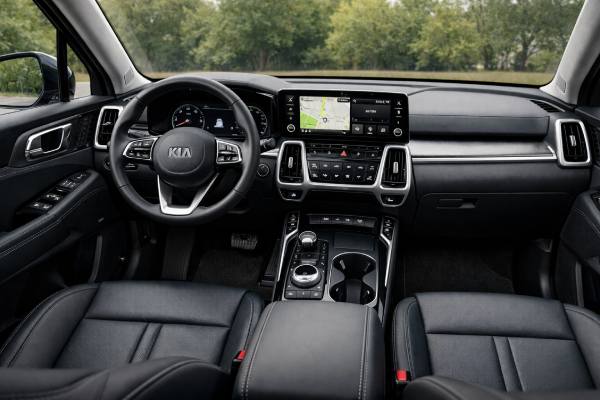

The 2021–2023 Kia Sorento (MQ4) with the Smartstream 2.2 diesel and front-wheel drive is a “torque-first” family SUV built for long-distance efficiency, relaxed towing manners, and low-effort daily use. Compared with the gasoline options, this drivetrain leans on a strong mid-range surge and tall gearing, so it feels calm at highway speeds and less busy in traffic. The trade-offs are diesel-specific ownership needs: it prefers full warm-up drives, clean low-ash oil, and attention to emissions hardware like the DPF (diesel particulate filter) and SCR/AdBlue system. In return, many owners see very steady highway consumption and good passing power without constant downshifts.
This guide focuses on what matters in real ownership: key specs and dimensions, what the FWD layout changes, known weak points, service intervals and fluids, safety ratings, and how this variant stacks up against the closest rivals.
What to Know
- Strong low-rpm torque suits highway cruising and towing, especially with the 8-speed dual-clutch’s tall top gear.
- FWD saves weight and running costs versus AWD, but winter traction depends heavily on tyres.
- Diesel ownership is happiest with longer trips; repeated short runs can load the DPF and raise service costs.
- Plan on routine oil services around 12 months / 16,000–20,000 km (10,000–12,000 mi) depending on market and duty cycle.
- Keep AdBlue/DEF in mind if equipped (SCR): low fluid or crystallization issues can trigger warnings and reduced power.
Contents and shortcuts
- Kia Sorento MQ4 diesel FWD overview
- Kia Sorento 2.2 CRDi specifications
- Kia Sorento diesel trims and safety
- Reliability and common diesel faults
- Maintenance schedule and buyer checks
- On-road performance and economy
- Rivals and value comparison
Kia Sorento MQ4 diesel FWD overview
Kia positioned the MQ4 Sorento as a true three-row-capable midsize SUV, and the 2.2 diesel is one of the most “work-ready” engines in the lineup. In most markets it pairs with an 8-speed wet dual-clutch transmission (DCT) and delivers its best work between roughly 1,500 and 3,000 rpm—exactly where you spend time when climbing grades, passing at highway speed, or towing. The biggest day-to-day advantage versus smaller turbo gasoline engines is how little throttle it needs to keep speed: the diesel’s torque does the heavy lifting with fewer high-rpm flare-ups.
Front-wheel drive changes the feel more than many buyers expect. With no rear drive unit, the steering tends to be lighter, the drivetrain a bit quieter, and the vehicle slightly more efficient. The flip side is traction. In rain, slush, or on steep gravel, the Sorento’s stability systems and modern tyres matter more than the badge on the tailgate. If you live where roads ice over, budget for proper winter tyres before you assume you “need” AWD.
The MQ4’s cabin and chassis tuning are oriented toward comfort: long wheelbase stability, compliant suspension travel, and a calm ride on broken pavement. With the diesel, the character becomes more “touring SUV” than “sporty crossover.” That’s good news for families and commuters, and it’s especially noticeable at 110–130 km/h (70–80 mph), where the engine can settle into a low-stress cruise.
Where owners can get caught out is using a diesel like a city-only runabout. Short, cold trips can prevent full DPF regeneration and increase soot dilution in oil. If your typical use is 5–10 minute errands, either plan occasional longer drives or pick a powertrain that tolerates that duty cycle better.
Who this variant fits best
- High-mileage commuters who want steady highway economy and low engine effort
- Families who tow moderate loads and prefer relaxed, low-rpm pull
- Buyers who don’t need AWD but want the Sorento’s space and towing ability
Who should think twice
- Mostly short-trip city use with infrequent longer drives
- Owners unwilling to stay strict on oil specification and diesel emissions upkeep
Kia Sorento 2.2 CRDi specifications
Below are the most useful “ownership-facing” specifications for the 2021–2023 Sorento MQ4 diesel FWD. Exact figures can vary by market (hp vs PS, emissions calibration, tow rating, tyre packages), so treat this as a decision guide and verify by VIN and local documentation.
Powertrain and efficiency
| Item | Spec (typical for 2021–2023 2.2 diesel) |
|---|---|
| Code | Smartstream D2.2 (market naming varies) |
| Engine layout and cylinders | Inline-4, DOHC, 4 valves/cyl (16-valve) |
| Displacement | 2.2 L (≈2,151 cc, market dependent) |
| Induction | Turbocharged (VGT in many applications) |
| Fuel system | Common-rail direct injection (diesel) |
| Compression ratio | ~16:1 (varies by calibration/market) |
| Max power | ~202 hp (≈149 kW) @ ~3,800 rpm (market-rated) |
| Max torque | commonly ~440 Nm (≈325 lb-ft) in many markets |
| Timing drive | Belt (verify by engine family/VIN) |
| Rated efficiency | Varies; diesel Sorento is typically strongest on highway runs |
| Real-world highway @ 120 km/h | Often lands in the mid-to-high 6s L/100 km range in favorable conditions (tyres, load, wind, temperature matter) |
Transmission and driveline
| Item | Spec |
|---|---|
| Transmission | 8-speed wet dual-clutch automatic (8DCT, market dependent) |
| Drive type | FWD |
| Differential | Open (traction managed by brake-based stability/traction systems) |
Chassis and dimensions
| Item | Spec (typical MQ4 range) |
|---|---|
| Suspension (front/rear) | MacPherson strut / multi-link |
| Steering | Electric power steering (EPS) |
| Brakes | 4-wheel discs (diameters vary by wheel package/market) |
| Wheels and tyres (popular sizes) | Common packages include 235/65 R17, 235/55 R19, 255/45 R20 (market dependent) |
| Ground clearance | Typically ~170–176 mm (verify by market) |
| Length / width / height | Approximately 4,810 / 1,900 / 1,695 mm (roofline and wheels can change height slightly) |
| Wheelbase | ~2,815 mm |
| Turning circle (kerb-to-kerb) | ~11.6 m (≈38 ft) |
| Kerb weight | Often ~1,850–1,980 kg depending on seating and equipment |
| Fuel tank | ~67 L (≈17.7 US gal / 14.7 UK gal) |
Performance and capability
| Item | Spec (typical) |
|---|---|
| 0–100 km/h (0–62 mph) | ~9.0–10.0 s depending on trim and test method |
| Top speed | ~195–205 km/h (≈121–127 mph), market dependent |
| Towing capacity (braked) | Up to ~2,500 kg (≈5,512 lb) in many markets |
| Payload | Commonly ~500–650 kg (trim dependent) |
Fluids and service capacities
Use the exact oil and capacity specified for your engine code and market. A practical “owner rule” is: correct low-ash oil spec matters more in modern diesels than the brand on the bottle.
| Fluid | Typical guidance (verify by VIN/market) |
|---|---|
| Engine oil | Use the specified diesel-approved oil; capacity varies by engine family and sump (check official chart/manual) |
| Coolant | Long-life coolant; premix ratio typically 50/50 unless stated otherwise |
| Transmission fluid | DCT-specific fluid; service interval depends on duty cycle (towing/heat) |
| A/C refrigerant | Varies by market and A/C system; confirm on under-hood label |
Key torque specs (decision-level)
- Wheel nuts: typically around 100–120 Nm (74–89 lb-ft) depending on wheel and market
- Engine undertray and plastic fasteners: follow manual to avoid broken clips and rattles
- Tow hitch fasteners: always use kit instructions and torque-to-spec, then re-check after initial towing miles
Kia Sorento diesel trims and safety
Trim naming varies heavily by region, so think of the Sorento diesel lineup in “equipment tiers” rather than a single global trim walk. Most markets offer a base tier focused on value, a mid-tier that adds comfort and tech, and a top tier with larger wheels, premium lighting, and the most complete driver-assistance suite. For diesel FWD specifically, pay attention to wheel size and seat layout: seven seats can change curb weight and cargo layout, and 19–20 inch wheels can sharpen steering response but raise tyre costs and reduce ride compliance on rough roads.
Trims and options that change ownership
- Wheel and tyre packages: The jump from 17 to 19/20-inch wheels typically increases replacement cost and can reduce winter traction unless you choose the right tyre compound and tread.
- Towing equipment: Some markets bundle cooling upgrades, wiring, and stability programming in tow packages. If you plan to tow near the limit, confirm you have the correct hitch hardware and any required cooling or software settings.
- Lighting: Headlight design can affect safety ratings and night driving confidence. In some rating systems, “Good” headlights are only achieved with specific LED projector units, while other trims score much lower.
- Seating configuration: If you use the third row often, check ventilation, charging ports, and whether rear HVAC is standard or optional.
Safety ratings overview
For the MQ4 Sorento generation, Euro NCAP awarded a five-star rating with sub-scores that reflect strong adult and child protection and solid active safety performance. In U.S.-focused testing, headlight performance and specific safety tech packaging can influence the overall evaluation, so confirm the lighting and ADAS set on the exact trim you’re considering.
Driver assistance and calibration notes
Common systems on this generation include forward collision avoidance (AEB), lane keeping/lane centering functions, adaptive cruise control, blind-spot monitoring, and rear cross-traffic alerts. Two practical ownership points:
- Sensor alignment after repairs: Windshield replacement, bumper repairs, and suspension geometry changes can require ADAS calibration. Budget time and money for a correct re-calibration rather than living with warning lights or degraded performance.
- Tyre matching: Mismatched tyre sizes or uneven wear can confuse stability systems and increase brake-based traction intervention, especially on FWD models in slippery conditions.
Reliability and common diesel faults
The Smartstream 2.2 diesel Sorento can be a durable high-mileage SUV when it is serviced on time, driven through full warm-up cycles regularly, and kept on the correct oil specification. Reliability outcomes tend to split into two groups: vehicles used for steady-distance driving (usually low drama) and vehicles used for repeated short trips in cold weather (more emissions-system complaints and regenerations).
Common issues (prevalence and cost)
Common (low to medium cost):
- DPF regeneration warnings or frequent regens (often on short-trip duty):
Symptoms: rising idle speed, cooling fans running after shutdown, fuel economy drop, DPF/engine light.
Likely causes: repeated cold starts, interrupted regens, incorrect oil spec, soot load accumulation.
Remedy: ensure regular longer drives; check for failed EGT sensors; confirm oil spec; dealer-level forced regen only after diagnosing root cause. - EGR and intake soot buildup over time:
Symptoms: sluggish response, fault codes, rough idle.
Likely causes: soot and oil vapor deposits common to modern EGR-equipped diesels.
Remedy: cleaning/parts replacement as needed; ensure crankcase ventilation is healthy.
Occasional (medium cost):
- SCR/AdBlue/DEF system warnings (if equipped):
Symptoms: countdown warnings, “refill” messages despite fluid, reduced power in some cases.
Likely causes: level/quality sensors, crystallization from poor handling, heater faults in cold climates.
Remedy: use fresh fluid, avoid contamination, follow correct refill technique, address sensor/heater faults early. - Dual-clutch drivability quirks in traffic:
Symptoms: low-speed shudder, hesitation, or “creep” inconsistency.
Likely causes: DCT heat management, clutch adaptation, driving style (stop-and-go on inclines).
Remedy: software updates, adaptation reset, and avoiding holding on the clutch with throttle on steep grades.
Rare (high cost):
- Turbocharger or high-pressure fuel system failures:
Symptoms: boost loss, limp mode, metallic noise, hard start, rail pressure codes.
Likely causes: contaminated fuel, neglected air filtration, oil starvation, or mechanical wear at high mileage.
Remedy: immediate diagnosis; do not continue driving underboost/overboost faults.
Software and service actions to watch
Modern Sorentos rely on updates for powertrain logic, emissions control, and ADAS behavior. If you feel unusual shifting, repeat warnings, or inconsistent driver-assist performance, ask a dealer to check for ECU/TCU updates as part of diagnosis. Software alone isn’t a cure-all, but when a manufacturer has revised calibrations for drivability or sensor plausibility, applying them early can prevent parts being replaced unnecessarily.
Operating conditions that increase risk
- Short trips, cold climates, and low-speed congestion (DPF and condensation issues)
- Frequent towing without allowing cool-down (heat load on turbo and DCT)
- Long oil intervals on the wrong spec oil (accelerates soot-related wear and aftertreatment stress)
Maintenance schedule and buyer checks
A diesel Sorento rewards disciplined maintenance. The goal is not “perfect service history for resale,” but preventing the predictable diesel pain points: soot loading, oil degradation, and emissions-system faults triggered by neglect or the wrong consumables.
Practical maintenance schedule
Use your market’s official schedule as the baseline; then adjust for how you drive.
- Engine oil and filter: every 12 months or 10,000–12,000 miles (16,000–20,000 km); shorten if you do frequent short trips, heavy towing, or lots of idle time. Use the exact specified oil grade and standard from the official chart/manual.
- Air filter: inspect at each service; replace typically every 30,000–45,000 km (20,000–28,000 mi), sooner in dusty areas.
- Cabin filter: every 12–24 months (odor or weak airflow is your cue).
- Fuel filter (diesel): commonly 40,000–60,000 km (25,000–37,000 mi); contaminated fuel can get expensive fast.
- Coolant: long-life coolant often 5 years / 100,000–160,000 km depending on market; verify.
- Brake fluid: every 2 years is a safe universal rule for moisture control.
- Transmission (8DCT): follow official guidance; if you tow regularly or drive in hot stop-and-go, consider earlier fluid service to protect clutches and mechatronics.
- Tyre rotation and alignment: rotate every 10,000–12,000 km (6,000–8,000 mi); align if you see shoulder wear (common on large SUVs).
- 12 V battery: test yearly after year 3; many batteries fade between 4–6 years depending on climate and accessory load.
Fluids, specs, and “must do” habits
- Buy oil by specification, not by marketing claims. Modern diesels can be sensitive to ash content and viscosity stability.
- Use fresh AdBlue/DEF from sealed containers if you top up yourself; store it cool and clean.
- Let the engine finish a regen when possible: if idle rises and fans run, avoid shutting down mid-cycle repeatedly.
Buyer’s guide checklist
When shopping used, focus on the items that predict expensive surprises:
- Service records: oil spec and interval consistency matter more than dealership stamps.
- DPF/SCR history: any repeated warning lights, forced regens, or AdBlue faults?
- Cold start behavior: excessive smoke, rough idle, or loud metallic ticking needs investigation.
- Transmission feel: smooth low-speed takeoff, no repeated shudder on gentle inclines, and no hesitation when selecting Drive/Reverse.
- Tyres and alignment: mismatched brands or uneven wear can hint at suspension wear or poor geometry.
- Recalls and campaigns: verify with official VIN checks and documented completion.
Long-term outlook: if your driving pattern includes weekly longer trips and you maintain it correctly, this diesel Sorento can be an efficient, capable family SUV. If your life is mostly short city hops, plan extra “health drives” or choose a powertrain better suited to that cycle.
On-road performance and economy
In real driving, the Sorento 2.2 diesel feels less about peak horsepower and more about controlled, usable torque. The engine typically delivers its best pull in the midrange, so it doesn’t need dramatic revs to merge or climb. That’s especially noticeable on highways: the Sorento settles into a quiet, low-rpm cruise where the cabin stays calm and the drivetrain feels underworked.
Ride, handling, and NVH
The MQ4 platform prioritizes stability and comfort. Straight-line tracking is confident, and the long wheelbase helps it feel planted over expansion joints. Steering is generally light-to-medium in effort, with limited feedback—normal for this class. Braking feel is usually consistent, but like many modern SUVs, pedal response depends on tyre choice and brake pad condition. Noise levels are often dominated by tyre roar more than engine note, especially on 19–20 inch wheels. Diesel clatter is most noticeable on cold starts, then fades into the background once warm.
Powertrain character and DCT behavior
The 8-speed DCT can be very smooth at speed, but its low-speed behavior depends on calibration and driving style. Unlike a traditional torque-converter automatic, a DCT uses clutches. That means:
- Gentle throttle and smooth inputs tend to produce the best creep behavior.
- Repeated stop-start on steep hills can create heat and occasional shudder.
- When towing, the transmission may downshift early to manage temperature and keep torque available.
Drive modes (if equipped) often change throttle mapping and shift timing more than they change raw performance. In daily use, the diesel’s torque lets you stay out of aggressive modes unless you want a sharper response.
Real-world economy
Diesel Sorento economy is strongly use-case dependent:
- Highway (100–120 km/h / 60–75 mph): typically the best case, often in the 6–8 L/100 km band with steady speed and moderate load.
- City and short trips: consumption rises quickly; regen activity and cold operation can push it toward 9–11 L/100 km in dense traffic.
- Cold weather: expect a noticeable penalty due to longer warm-up time and more frequent regen strategies.
Towing and load notes
With moderate towing, the Sorento’s stability is generally good, and the diesel’s midrange torque helps maintain speed without constant hunting. Expect a consumption increase under tow—often 20–40% depending on trailer shape, speed, and hills. For durability, the best habit is thermal management: avoid repeated full-throttle pulls from low speed, and allow a brief cool-down after hard climbing before shutting the engine off.
Rivals and value comparison
The diesel Sorento FWD sits in a very specific niche: a spacious three-row-capable SUV that prioritizes torque, long-distance efficiency, and towing confidence without the extra complexity of AWD. Its closest rivals depend on your market, but the comparison themes stay consistent: powertrain character, emissions-system complexity, cabin practicality, and running costs.
Compared with other diesel midsize SUVs
Against similar 2.0–2.2 diesels in the segment, the Sorento’s strengths are its refined highway demeanor, generous interior packaging, and strong towing figures for a family SUV. Where some rivals feel more “van-like” in ride quality or noisier at speed, the Sorento tends to feel more polished. The typical trade-off is that diesel emissions hardware is not optional: if you buy diesel, you accept DPF/SCR upkeep as part of ownership, regardless of badge.
Compared with gasoline turbo alternatives
A modern turbo gasoline SUV may feel lighter in the nose and respond more crisply at low speeds, especially in cold climates or short-trip city use. Gas models also avoid diesel aftertreatment complexity. However, for long highway runs or towing, many gasoline setups rely on higher revs and more frequent downshifts. If your driving includes steep grades with passengers and cargo, the diesel’s torque-first delivery can feel less stressed.
Compared with hybrid options
Hybrids usually win in urban efficiency and stop-and-go smoothness, and they often reduce brake wear thanks to regenerative braking. They can be an excellent match for city-heavy use where diesel struggles. The Sorento diesel counters with long-distance simplicity (no high-voltage battery management) and strong towing in many markets. Your decision should be driven by your weekly pattern: if you commute in traffic daily, a hybrid can be the easier long-term companion; if you do frequent highway miles, the diesel may be the more satisfying tool.
Value-focused buying advice
- Choose the best headlight configuration you can get if you drive at night often; it can affect both safety and fatigue.
- Prioritize service history quality over low mileage—diesels can be “worn by neglect” more than by distance.
- If you rarely see snow and your tyres are good, FWD is often enough—and cheaper to maintain than AWD.
References
- Sorento specifications | Kia UK 2025 (Manufacturer Specifications)
- Sorento Quick Reference Guide 2022 (Owner’s Guide)
- Official Kia Sorento 2020 safety rating 2020 (Safety Rating)
- 2021 Kia Sorento 4-door SUV 2021 (Safety Rating)
- Oil Grades and Capacities 2023 (Service Guide)
Disclaimer
This article is for informational purposes only and is not a substitute for professional inspection, diagnosis, or repair. Specifications, torque values, service intervals, and procedures can vary by VIN, market, model year, and equipment; always verify details using your official owner’s manual, service documentation, and dealer records for your exact vehicle.
If you found this guide useful, please consider sharing it on Facebook, X/Twitter, or your favorite forum to help others find reliable ownership information.