

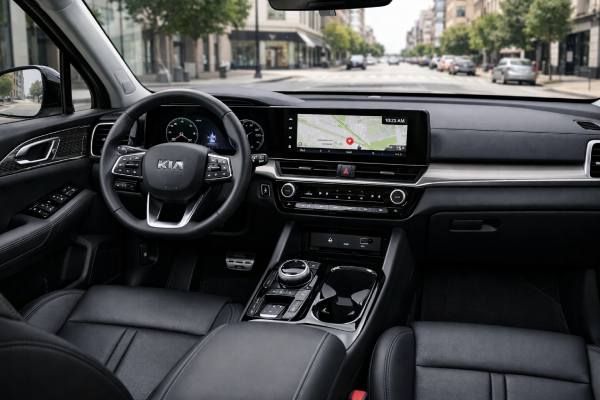
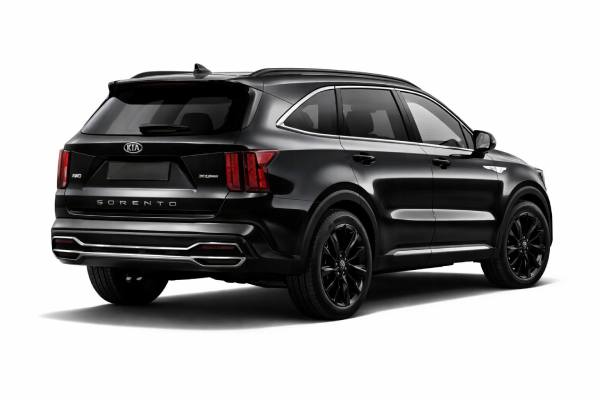
The facelifted 2024–present Kia Sorento MQ4 with the 2.5-liter turbo (Smartstream G2.5T) and front-wheel drive is the “torque-first” choice in the lineup. You get the strongest gas-engine output without the mass, friction losses, and added service items of AWD, so the car often feels more eager at everyday speeds than its curb weight suggests. The key engineering story is the pairing of a small-displacement turbo with an 8-speed dual-clutch transmission (DCT): it delivers quick, efficient power when you’re rolling, but it asks for a slightly different ownership mindset in slow, stop-and-go driving and when towing.
If you’re shopping this version, focus on three things: (1) how the DCT behaves at low speeds, (2) whether the vehicle’s tire and brake setup matches your use (family hauling vs frequent highway), and (3) a maintenance plan that treats oil quality and cooling health as non-negotiable.
Top Highlights
- Strong mid-range pull and confident passing power without the extra AWD weight and drag.
- DCT delivers crisp, efficient shifts at speed; best suited to drivers who spend more time rolling than creeping.
- Family-friendly packaging with three-row flexibility (trim-dependent) and modern cabin tech in the facelift.
- Ownership caveat: avoid prolonged “creep” slipping and heavy throttle at very low speeds to reduce DCT heat load.
- Typical interval: engine oil and filter every 10,000–12,000 km (6,000–7,500 mi) or 12 months (shorter under severe use).
Navigate this guide
- Kia Sorento FWD 2.5T in depth
- Kia Sorento FWD 2.5T technical specs
- Kia Sorento FWD trims, safety and ADAS
- Reliability hotspots and known fixes
- Maintenance plan and buyer tips
- Real driving performance and economy
- Sorento FWD 2.5T versus key rivals
Kia Sorento FWD 2.5T in depth
The 2024–present facelift Sorento MQ4 keeps the same core platform architecture, but it tightens the ownership proposition around cabin tech, driver-assistance refinement, and day-to-day smoothness. In FWD 2.5T form, it’s best understood as a “high-output family crossover” rather than a soft-roader. The front-drive layout saves weight and reduces mechanical complexity: no rear drive module, no transfer case, and fewer drivetrain fluids to monitor. That translates into slightly quicker responses, a bit more usable payload margin in some configurations, and typically lower running costs over the long term.
The Smartstream 2.5T is a turbocharged, direct-injected four-cylinder designed to make torque early. That matters because the Sorento is not a small vehicle, and this engine gives it the kind of midrange shove that makes merging and passing feel relaxed. The tradeoff is heat management: turbo engines run hotter than naturally aspirated ones, and the Sorento’s packaging means cooling and oil health are central to longevity. Short-trip driving can be harder on turbo engines because the oil spends more time contaminated with moisture and fuel vapor; regular, high-quality oil changes are the simplest way to keep the turbocharger and timing system happy.
The other big character piece is the 8-speed dual-clutch transmission (DCT). Unlike a conventional torque-converter automatic, a DCT uses clutches to connect engine power to the gearbox. At rolling speeds it can feel very direct and efficient—often “snappier” than a traditional automatic. In parking-lot creeping or long stop-and-go traffic, the clutches may slip more to meter movement, which generates heat. This isn’t a deal-breaker, but it rewards drivers who avoid riding the throttle at 3–8 km/h (2–5 mph) and who use gentle, deliberate inputs when maneuvering.
Who is this variant for? Drivers who want a three-row-capable crossover with strong acceleration and modern safety tech, and whose routine is mostly suburban/highway driving. If your daily life is dense city crawling, frequent trailer towing in summer heat, or steep hill creeping, consider whether an alternative powertrain (or at least an AWD setup with different gearing/tires) better matches your use.
Kia Sorento FWD 2.5T technical specs
Below is a practical spec set for the facelift-era Sorento MQ4 with the 2.5T and FWD. Exact numbers can vary by market, trim, wheels/tires, and test method, so treat this as the “what to expect” baseline and verify by VIN where required.
Powertrain and efficiency
| Item | Specification |
|---|---|
| Code | Smartstream G2.5T (2.5 T-GDi) |
| Engine layout and cylinders | Inline-4, DOHC, 4 cyl, 4 valves/cyl |
| Displacement | 2.5 L (≈2,497 cc) |
| Induction | Turbocharged |
| Fuel system | Direct injection (often paired with supplementary injection in some markets) |
| Compression ratio | ~10:1 (market-dependent) |
| Max power | 281 hp (≈209 kW) @ ~5,800 rpm (market-dependent) |
| Max torque | ~422 Nm (≈311 lb-ft) @ ~1,700–4,000 rpm (market-dependent) |
| Timing drive | Chain |
| Rated efficiency | Typically ~9.0–11.0 L/100 km combined (≈21–26 mpg US), trim/tires dependent |
| Real-world highway @ 120 km/h | Commonly ~8.5–10.5 L/100 km (≈22–28 mpg US), wind/tires/load dependent |
Transmission and driveline
| Item | Specification |
|---|---|
| Transmission | 8-speed dual-clutch automatic (wet DCT; code varies by market) |
| Drive type | FWD |
| Differential | Open (front) |
Chassis and dimensions
| Item | Specification |
|---|---|
| Suspension (front/rear) | MacPherson strut / multi-link |
| Steering | Electric power steering (EPS) |
| Brakes | 4-wheel discs (size varies by trim) |
| Wheels/tires (common) | 235/60 R18 or 235/55 R19 (trim-dependent) |
| Ground clearance | ~176 mm (≈6.9 in), trim-dependent |
| Length / Width / Height | ~4,810 mm / ~1,900 mm / ~1,695–1,700 mm |
| Wheelbase | ~2,815 mm (≈110.8 in) |
| Turning circle (kerb-to-kerb) | ~11.6–11.9 m (≈38–39 ft), market-dependent |
| Kerb weight | commonly ~1,750–1,950 kg (≈3,860–4,300 lb), trim-dependent |
| Fuel tank (ICE) | commonly ~67 L (≈17.7 US gal), market-dependent |
| Cargo volume | trim/seat dependent; third-row models vary widely by method (VDA/SAE) |
Performance and capability (typical)
| Item | Typical result |
|---|---|
| 0–100 km/h (0–62 mph) | ~6.8–7.6 s (tires, temperature, and load matter) |
| Top speed | ~200–210 km/h (≈124–130 mph), market-dependent |
| Braking 100–0 km/h | ~36–41 m (test/tires dependent) |
| Towing capacity | commonly up to ~1,588 kg (≈3,500 lb) braked (market/trim dependent) |
| Payload | varies widely; check door jamb label for your exact vehicle |
Fluids and service capacities (owner-facing)
These are the numbers owners most often need for planning and basic service decisions.
| Fluid | Specification (typical) | Capacity (typical) |
|---|---|---|
| Engine oil | Full synthetic, often SAE 0W-30 meeting modern API/ILSAC specs | ~6.4 L (≈6.8 US qt) drain/refill (some references list higher “total fill”) |
| Coolant | Ethylene glycol-based long-life coolant (aluminum-compatible) | ~8–10 L total system (market-dependent) |
| Transmission/ATF (DCT) | Manufacturer-specified fluid (often SP-IV-RR class) | capacity varies; service fill differs from dry fill |
| Brake fluid | DOT 4 / low-viscosity DOT 4 in many markets | ~0.4 L for exchange (system holds more) |
| A/C refrigerant | R-1234yf or R-134a (market-dependent) | charge varies by market and HVAC configuration |
Key torque specs (common “decision-making” values)
- Wheel lug nuts: typically ~117–127 Nm (86–94 lb-ft) depending on wheel and market
- Engine oil drain plug: commonly ~35–45 Nm (26–33 lb-ft) (verify for your pan/plug style)
Kia Sorento FWD trims, safety and ADAS
Trim names and equipment bundles vary by country, but the facelift Sorento generally follows a familiar ladder: an entry trim with the core infotainment and safety suite, mid-trims with comfort upgrades and larger wheels, and top trims that add premium lighting, audio, cameras, and a fuller driver-assistance stack. For a buyer, the important differences are less about “luxury feel” and more about functional hardware: wheel and tire size, headlight type, seat count (two-row vs three-row), and cooling/brake readiness for towing.
Trims and options: what changes that you can feel
- Wheel and tire package: 18-inch setups usually ride more comfortably and cost less to replace; 19–20-inch packages can sharpen steering response but often raise road noise and tire costs. If your roads are rough, prioritize sidewall.
- Headlights: projector LED vs higher-output LED systems matter for real night visibility. This also affects insurance and safety-test evaluations in some regions.
- Seating configuration: Some markets offer two-row versions with a larger cargo area; three-row variants offer flexibility, but the third row is best for kids or occasional use.
- Tow package and cooling: If you tow, look for factory tow wiring, hitch rating, and any upgraded cooling components or drive-mode calibrations that come with towing prep.
- Infotainment tier: Higher trims often add larger screens, better navigation integration, and surround-view cameras—these can reduce parking stress in a long vehicle.
Quick identifiers when viewing used listings:
- Bigger brake hardware and larger wheels often show through the spokes; a smaller rotor/caliper package typically pairs with 18-inch wheels.
- Higher trims usually add more exterior camera lenses (front grille, mirror undersides, tailgate area).
- Interior tells: upgraded trims frequently add ventilated seats, memory seat buttons, and a more premium dash/door trim finish.
Safety ratings: how to interpret them
Safety ratings for a model line can span multiple years and test protocols. Two key points help avoid confusion:
- A rating may apply broadly to the generation (MQ4), but specific awards can depend on headlights and standard crash-avoidance equipment.
- Test protocols evolve, so a “five-star” result from one year doesn’t always mean identical performance under a newer protocol—it means the vehicle met the requirements at the time and may have been reviewed later.
You’ll typically see results from Euro NCAP in Europe and IIHS in the U.S. The Sorento’s structural performance is generally strong in the MQ4 generation, and the facelift primarily focuses on tech and feature execution rather than a wholesale structural redesign.
Driver assistance (ADAS): what’s usually included and what varies
Most facelift Sorentos include a baseline set of:
- Automatic emergency braking (vehicle/pedestrian; cyclist support varies)
- Lane keeping and lane centering support (naming differs: LKA/LFA/LPA)
- Blind-spot monitoring and rear cross-traffic alert
- Adaptive cruise control on many trims (sometimes optional)
Higher trims may add:
- Highway-driving assist features that combine lane centering with adaptive cruise
- Blind-spot camera views in the cluster
- 360-degree camera and enhanced parking aids
Service note: After windshield replacement, bumper repairs, alignment work, or certain suspension changes, ADAS sensors may require calibration. Budget time and money for this, and insist on a post-repair scan and calibration confirmation.
Reliability hotspots and known fixes
The facelift Sorento 2.5T FWD can be a durable vehicle when it’s maintained with a “turbo + DCT” mindset. The most useful way to look at reliability is to separate what’s common and manageable from what’s rare but expensive.
Common (low to medium cost) patterns
- DCT low-speed behavior:
Symptoms: shudder during gentle takeoff, a “grabby” feel in stop-and-go, or warnings about transmission temperature.
Likely causes: normal clutch modulation under heavy creeping, driver input patterns, or early clutch wear if the vehicle lives in traffic.
Best remedy: change driving style first (avoid inching forward on throttle), confirm software updates, and ensure the correct transmission fluid is used if service is needed. - Turbo heat management and oil sensitivity:
Symptoms: oil level drop between changes, burnt-oil odor after hard runs, or occasional smoking after extended idling (rare).
Likely causes: turbocharger heat soaking, PCV flow characteristics, or extended intervals with short trips.
Best remedy: shorten oil intervals under severe use, use the correct oil spec, and let the engine idle briefly after sustained high-load driving before shutdown. - Direct-injection deposits (longer-term):
Symptoms: rough idle, reduced efficiency, or hesitation at low rpm after high mileage.
Likely causes: intake valve carbon buildup (a common DI trait).
Best remedy: periodic inspection; cleaning only if symptoms or misfire codes appear (avoid unnecessary “flushes”).
Occasional (medium cost) items to watch
- Cooling system weak points:
Symptoms: gradual coolant loss, sweet smell, or temperature creep in heavy load/hot weather.
Likely causes: hose clamps, radiator seams, thermostat housing seals, or water pump seepage over time.
Best remedy: pressure test at the first sign of loss; fix early to protect the turbo and head gasket. - Sensors and driveability faults:
Symptoms: intermittent check-engine light, reduced power, odd fuel economy swings.
Likely causes: boost control solenoid behavior, oxygen sensors, EVAP leaks, or wiring connector issues.
Best remedy: proper diagnostic scan; avoid parts-cannon repairs.
Rare (high cost) risks
- Hard DCT faults (mechatronics/actuation):
Symptoms: persistent gear engagement issues, limp mode, or repeated overheating warnings despite normal driving.
Likely causes: actuator/mechatronics faults, internal clutch pack issues, or control-unit problems.
Best remedy: dealer-level diagnosis; confirm whether a software update, fluid service, or component replacement is required. - Severe overheating events:
Turbo engines are less forgiving of overheating. One overheat can age hoses, seals, and turbo bearings. If you see temperature warnings, stop and diagnose—don’t “drive it home.”
Recalls, TSBs, extended coverage: how to stay ahead
Don’t guess. Use your VIN to check open campaigns through official channels and keep a record of completion. In the U.S., NHTSA listings are a fast way to confirm recall status; in other markets, your dealer network will provide similar lookup tools. When buying used, request:
- Full service history (not just stamps)
- Proof of campaign completion
- Documentation of any software updates for powertrain or safety systems
Maintenance plan and buyer tips
A good maintenance plan for the Sorento 2.5T FWD is simple: protect the turbo with clean oil, protect the DCT from heat abuse, and keep the cooling and brake systems fresh. Below is a practical schedule that fits most owners; adjust shorter if you drive in heavy traffic, extreme temperatures, short trips, dusty roads, or tow.
Practical maintenance schedule (distance or time, whichever comes first)
| Item | Normal use | Severe use (short trips, heavy traffic, towing, extreme heat/cold) |
|---|---|---|
| Engine oil and filter | 10,000–12,000 km (6,000–7,500 mi) / 12 months | 6,000–8,000 km (3,500–5,000 mi) / 6 months |
| Engine air filter | Inspect every 15,000 km; replace 30,000–45,000 km | Replace 20,000–30,000 km |
| Cabin air filter | 15,000–20,000 km / 12 months | 10,000–15,000 km |
| Spark plugs | 100,000–160,000 km (60,000–100,000 mi) depending on plug type and market | Tow/heat: lean toward the shorter end |
| Coolant | 5 years then every 3 years (typical long-life coolant practice) | Shorten if heat load is high |
| Brake fluid | Every 2 years | Every 2 years (do not stretch) |
| Brake pads/rotors | Inspect every tire rotation | Inspect every tire rotation |
| Tire rotation and alignment check | 10,000–12,000 km | 8,000–10,000 km |
| 12 V battery test | Annually after year 3 | Annually after year 2 |
| DCT fluid (if serviceable per market) | Follow official interval; consider inspection/service by 60,000–100,000 km | Consider earlier evaluation, especially if towing or frequent creeping |
Fluid specs and capacities (owner planning)
- Engine oil: full synthetic, commonly SAE 0W-30 meeting modern API/ILSAC requirements; typical drain/refill around ~6.4 L (confirm by VIN/market).
- Transmission fluid: use only the exact manufacturer specification (DCT units are sensitive to fluid choice).
- Brake fluid: typically DOT 4 (often low-viscosity DOT 4 LV).
Key “do this, not that” habits for longevity
- Do use smooth, decisive throttle in parking lots; don’t creep on the gas for minutes at a time.
- Do let the turbo cool after sustained high-load driving (brief easy driving before parking helps); don’t shut down immediately after a hard climb or high-speed run.
- Do fix small coolant losses early; don’t top-up repeatedly without diagnosing the leak.
Buyer’s guide: what to check before you commit
Walkaround and underside
- Uneven tire wear (alignment or suspension bushing wear)
- Brake rotor lip or steering wheel shake under braking
- Evidence of fluid leaks around the front of the engine and lower splash shields
Test drive
- From a stop, feel for consistent takeoff (no harsh shudder or repeated hesitation)
- In slow traffic, confirm the transmission doesn’t overheat or surge
- At 80–120 km/h (50–75 mph), ensure passing response is smooth and boost builds cleanly
Scan and records
- Ask for a diagnostic scan report (even if no warning lights)
- Confirm campaign and update history
- Check that the correct tires are fitted (mismatched sizes can confuse stability systems)
Long-term outlook: With on-time oil service, sensible low-speed driving habits, and cooling system vigilance, the 2.5T Sorento can age well. Most expensive outcomes tend to follow neglect (overheating, stretched intervals, or repeated DCT heat abuse), not normal use.
Real driving performance and economy
The Sorento 2.5T FWD feels strongest where families actually drive: merging, two-lane passing, and climbing grades with a load. The turbo’s torque arrives early, so you don’t need to rev it hard to make progress. That’s a big difference versus many naturally aspirated midsize crossovers that feel fine unloaded but get breathless with passengers and cargo.
Ride, handling, and NVH (noise and vibration)
- Ride quality: On 18-inch tires, the Sorento generally does a good job smoothing broken pavement. Larger wheel packages can add sharpness over potholes, so match the tire sidewall to your roads.
- Straight-line stability: The long wheelbase helps it track calmly on highways. In crosswinds, larger wheels and stiffer tires can feel more “busy.”
- Steering: Expect light-to-moderate effort with a modern EPS feel—accurate rather than talkative.
- Brakes: Pedal feel is typically consistent, but repeated hard stops (mountain descents, towing) make fluid freshness and pad quality matter more than usual.
Powertrain character: what it’s like day to day
- Throttle response: Strong once boost is building; the first half-second can feel softer if the transmission is choosing the best gear.
- DCT logic: At speed, shifts are quick and clean. In low-speed rolling, the transmission may feel different from a torque-converter automatic because it’s managing clutch engagement.
- Drive modes: Eco typically smooths throttle and upshifts earlier; Sport tends to hold gears longer and sharpen response. Use Sport for short merges and passing rather than mashing the pedal in Eco.
Real-world efficiency (what owners usually see)
Expect fuel use to be heavily influenced by wheels/tires, driving speed, and traffic pattern:
- City-heavy commuting: often ~10.5–13.0 L/100 km (≈18–22 mpg US) depending on congestion and cold starts
- Highway at 100–120 km/h: commonly ~8.5–10.5 L/100 km (≈22–28 mpg US)
- Mixed driving: often ~9.5–11.5 L/100 km (≈20–25 mpg US)
Cold weather can add a noticeable penalty because the engine spends more time warming up and enrichment strategies run longer—short trips exaggerate this.
Traction and control (FWD reality check)
FWD is perfectly adequate for wet roads and mild winters on proper tires. But tires are the real “traction system.” If you live where snow is regular:
- Prioritize quality winter tires over all-season compromises.
- Consider a narrower winter tire package if your market supports it.
- Expect stability control to intervene more on steep, slick climbs than an AWD version would.
Load and towing
The 2.5T has the torque to tow modestly, but towing is where heat management matters most. If you tow:
- Use the correct hitch rating and wiring, and keep trailer brakes adjusted.
- Watch coolant and oil condition; shorten oil intervals.
- Avoid prolonged low-speed climbs in hot weather if the vehicle is hunting gears—give it airflow and steady speed when possible.
Sorento FWD 2.5T versus key rivals
The Sorento 2.5T FWD sits in a competitive space: it offers near-premium torque and available three-row flexibility, but it competes against models that emphasize either long-term simplicity (traditional automatics, fewer moving parts) or hybrid efficiency.
Against mainstream two-row leaders (RAV4, CR-V class)
Compared to compact crossovers like the Toyota RAV4 or Honda CR-V, the Sorento’s advantages are power and space:
- Pros: stronger passing acceleration, often more cabin room, and available third-row utility.
- Cons: typically lower fuel economy and higher tire/brake costs due to size and power.
If you don’t need the extra space, a compact hybrid can be cheaper to run. If you do, the Sorento’s “right-size” interior is the reason to choose it.
Against midsize two-row/two-and-a-half-row SUVs (Passport, Santa Fe, Outback)
Here the Sorento’s 2.5T often wins on drivetrain punch-per-liter:
- Pros: turbo torque makes it feel energetic with passengers; modern cabin tech in the facelift.
- Cons: the DCT requires more consideration in heavy creeping than a conventional automatic.
If your driving is mostly open-road, the DCT’s efficiency and direct feel are assets. If you crawl in traffic daily, a rival with a torque-converter automatic may feel more relaxed.
Against three-row family staples (Highlander, Pilot, Telluride)
In the three-row conversation, the Sorento’s size is both a strength and a limitation:
- Pros: easier to park than the biggest three-row SUVs, strong power, flexible packaging.
- Cons: third-row space is more occasional-use than “adult-ready,” and towing ratings may trail some larger rivals.
Choose the Sorento if your third row is intermittent and you want a more maneuverable footprint. Choose a larger three-row if you routinely carry adults in row three or tow frequently at higher weights.
The bottom line
The Sorento 2.5T FWD makes the most sense when you want a modern, family-ready interior and confident turbo performance, and your routine is mostly rolling roads rather than constant crawling. If you can match the powertrain to your driving habits—and maintain it like a turbo vehicle—it’s one of the more satisfying “gas performance” picks in the segment.
References
- 2025 Kia Sorento Specifications 2025 (Specifications)
- Recommended lubricants and capacities 2024 (Owner’s Manual)
- 2024 Kia Sorento 2024 (Safety Rating)
- Official Kia Sorento 2020 safety rating 2020 (Safety Rating)
- Vehicle Detail Search – 2025 Kia SORENTO (2.5L) | NHTSA 2025 (Recall Database)
Disclaimer
This article is for informational purposes only and is not a substitute for professional inspection, diagnosis, or repair. Specifications, torque values, service intervals, and procedures can vary by VIN, market, trim, and equipment. Always verify details using official service information and the documentation for your specific vehicle.
If you found this guide useful, please consider sharing it on Facebook, X (Twitter), or your favorite forum to support our work.