

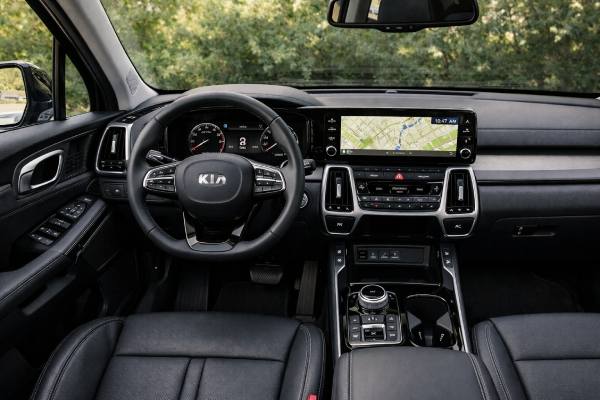
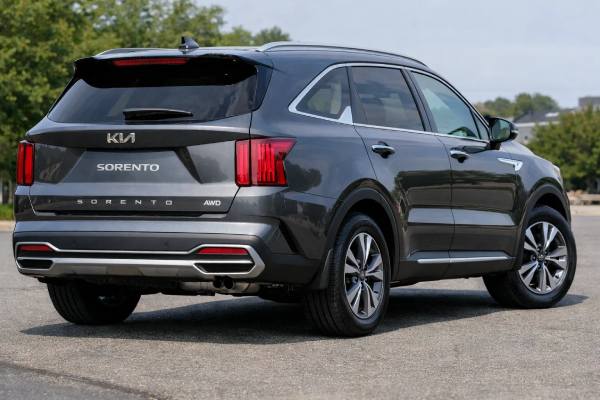
The 2021–2023 Sorento MQ4 with the 2.5-liter turbo (281 hp) and front-wheel drive is one of the more “engineering-forward” midsize three-row crossovers in its price class. The core story is its efficient packaging and powertrain strategy: a strong low-to-midrange turbo torque curve paired with an 8-speed wet dual-clutch transmission that aims for fast response without the fuel penalty of a larger V6. The MQ4 platform also brought a stiffer structure, longer wheelbase, and a more modern driver-assistance stack, which matters for both safety performance and daily fatigue.
Ownership, however, is about matching expectations to the hardware. The 2.5T’s performance is genuinely quick for a family crossover, but the DCT behaves differently than a conventional automatic, especially in stop-and-go traffic and when towing. If you maintain it with the right fluids, stay current on updates, and buy the right trim for your needs, it can be a very satisfying long-term SUV.
Owner Snapshot
- Strong passing power and confident highway merging for a three-row FWD SUV.
- Good cabin and cargo packaging for the footprint, especially seats-down volume.
- Advanced safety tech is widely available, but headlight and ADAS content varies by trim.
- Dual-clutch transmission feel can be “lurchy” in creeping traffic; software updates help.
- Plan on engine oil service about every 8,000–10,000 km (5,000–6,000 mi) if you do short trips or heavy city driving.
Navigate this guide
- Kia Sorento MQ4 2.5T what it is
- Kia Sorento FWD 2.5T core specs
- Kia Sorento 2021–2023 trims and safety features
- Reliability issues and service actions
- Maintenance plan and buying advice
- Roadmanners, power, and real fuel use
- How it stacks up against rivals
Kia Sorento MQ4 2.5T what it is
Think of this Sorento as a “right-sized turbo family SUV.” In FWD form, it’s designed primarily for paved-road use, commuter duty, and occasional towing rather than snow-belt traction or trail work. The MQ4 chassis moved the Sorento further into modern crossover territory: more structural rigidity than the prior generation, a longer wheelbase for better third-row packaging, and a calmer ride at highway speed. That platform foundation matters because it influences everything from squeak resistance to how well the suspension maintains alignment over time.
The Smartstream 2.5T’s character is the model’s biggest advantage. It doesn’t need to be revved hard to feel quick; it builds usable torque early, then holds it through the midrange. For real owners, that translates into two practical wins: (1) passing power with a full cabin and (2) less “hunting” between gears on rolling highways compared with smaller turbo engines that rely on frequent downshifts.
The tradeoff is the transmission choice. A wet dual-clutch (DCT) can be efficient and responsive, but it behaves more like an automated manual at parking-lot speeds. If you expect a classic torque-converter “creep” feel, you may need a short adjustment period. Smoothness depends on driver inputs (gentle throttle helps), temperature, and software calibration.
Finally, understand the trim logic: the 2.5T generally appears on mid-to-upper trims, where the Sorento’s best lighting, driver-assistance features, and towing hardware are most likely to be found. In other words, the best version of this powertrain is often bundled with the best equipment—great for value, but it means you should shop the exact build carefully.
Kia Sorento FWD 2.5T core specs
Below are practical, owner-relevant specifications for the 2021–2023 Sorento MQ4 FWD with the 2.5T (281 hp). Values vary slightly by trim, wheels/tires, and market. Use these as a decision guide, then verify your exact VIN configuration in official documentation.
Powertrain and efficiency
| Item | Specification |
|---|---|
| Engine code (family) | Smartstream G2.5T (2.5 T-GDi family) |
| Layout and valvetrain | Inline-4, DOHC, 4 valves/cyl (16V) |
| Bore × stroke | 88.5 × 101.5 mm (3.48 × 4.00 in) |
| Displacement | 2.5 L (2,497 cc) |
| Induction | Turbocharged |
| Fuel system | Direct injection (often with supplementary injection by application) |
| Compression ratio | ~10.0:1 (varies by application/market) |
| Max power | 281 hp (209 kW) @ ~5,800–6,000 rpm (market dependent) |
| Max torque | 422 Nm (311 lb-ft) @ ~1,700–4,000 rpm |
| Timing drive | Chain |
| Rated efficiency (typical) | ~10.5 L/100 km combined (about 25 mpg US) depending on trim and test cycle |
| Real-world highway @ 120 km/h | Commonly ~9.5–10.5 L/100 km (22–25 mpg US) at steady speed, weather and load dependent |
Transmission and driveline
| Item | Specification |
|---|---|
| Transmission | 8-speed wet dual-clutch (8DCT) |
| Drive type | FWD |
| Differential | Open (brake-based traction control manages slip) |
Chassis and dimensions
| Item | Specification |
|---|---|
| Front suspension | MacPherson strut |
| Rear suspension | Multi-link |
| Steering | Column-mounted motor-driven power steering (electric) |
| Steering ratio | ~13.7:1 (trim dependent) |
| Brakes | 4-wheel ventilated discs (sizes vary by trim) |
| Popular tire sizes | 235/65 R17, 235/60 R18, or 255/45 R20 depending on trim |
| Ground clearance | ~175 mm (6.9 in) typical (varies with wheels and market) |
| Length / width / height | ~4,810 / 1,900 / 1,695 mm (189.0 / 74.8 / 66.7 in) approx. |
| Wheelbase | ~2,815 mm (110.8 in) |
| Turning circle (kerb-to-kerb) | ~11.8 m (38.7 ft) typical |
Weight, capacity, cargo
| Item | Specification |
|---|---|
| Kerb (curb) weight (FWD) | ~1,685–1,814 kg (3,715–3,999 lb), trim dependent |
| GVWR (typical FWD) | ~2,430 kg (5,357 lb) |
| Fuel tank | ~67 L (17.7 US gal / 14.7 UK gal) |
| Cargo volume (SAE, typical) | ~357 L (12.6 ft³) seats up (behind 3rd) / ~1,090 L (38.5 ft³) behind 2nd / ~2,138 L (75.5 ft³) behind 1st |
Performance and capability
| Item | Specification |
|---|---|
| 0–100 km/h (0–62 mph) | ~7.4 s (trim and conditions dependent) |
| Top speed | ~211 km/h (131 mph) typical |
| Braking (100–0 km/h) | ~40 m (approx.) with OEM tires and good surface |
| Towing capacity | Up to ~1,588 kg (3,500 lb) when properly equipped; lower without tow package |
| Payload | Varies widely by trim and equipment; check door-jamb label for your vehicle |
Fluids and service capacities (use as guidance)
These vary by market and equipment (cooling layout, oil pan, and DCT variant). Always confirm by VIN.
| Item | Typical spec to look for |
|---|---|
| Engine oil | API SP / ILSAC GF-6 gasoline oil; common grades 0W-30 or 5W-30 by climate |
| Coolant | OEM long-life ethylene glycol coolant; typically a 50/50 mix |
| DCT fluid | OEM wet-DCT fluid (model-specific); do not substitute generic ATF |
| A/C refrigerant | Often R-1234yf in many markets; confirm under-hood label |
Key torque specs (common critical fasteners, verify by manual):
- Wheel lug nuts: typically 107–127 Nm (79–94 lb-ft) depending on wheel and market
- Engine oil drain plug: commonly around 35–45 Nm (26–33 lb-ft)
Safety note: the vehicle’s safety performance is commonly referenced from Insurance Institute for Highway Safety and Euro NCAP results, but exact outcomes can depend on trim equipment (especially headlights and ADAS calibration). For recalls, National Highway Traffic Safety Administration is the authoritative source for VIN-level verification.
Kia Sorento 2021–2023 trims and safety features
For 2021–2023, the Sorento lineup is best understood as two parallel decisions: (1) seating and interior equipment and (2) the powertrain step-up to the 2.5T. In many markets, the 2.5T is tied to higher trims that also bring stronger lighting, better tires, and more complete driver-assistance features. That bundling is important because safety and comfort often change as much as performance does.
Trims and options that change the experience
Common trim patterns you’ll see in this generation:
- Mid trims (often “EX”-type): where the 2.5T frequently becomes available. These builds are the sweet spot for owners who want the turbo’s torque without paying for every luxury feature.
- Upper trims (often “SX / Prestige”-type): typically bring larger wheels, upgraded audio/infotainment, and more comprehensive driver aids. They may also include the best headlight hardware, which affects nighttime safety scores.
Practical identifiers when shopping used
- Wheel and tire size: 17-inch setups prioritize ride comfort and tire cost; 20-inch setups look sharp but cost more to replace and can ride firmer.
- Tow package presence: for 3,500 lb capability, look for factory tow wiring, hitch provisions, and the correct cooling strategy. A dealer-installed hitch alone does not always equal the full tow-rating configuration.
- Driver-assistance buttons and menu items: some functions (like lane centering assist vs simple lane keeping) can be confirmed in settings menus during a test drive.
Safety ratings and what they really mean
- IIHS-style results: the Sorento’s best outcomes generally align with trims that have “Good” headlights and the more capable front crash prevention system. Lower trims can score lower on headlights even when the structure and airbags are strong.
- Euro NCAP-style results: European testing often reports percentage scores across adult occupant, child occupant, vulnerable road users, and safety assist. These scores reflect the tested configuration and test year, so it’s important to match the test to your market’s equipment.
Safety systems and ADAS (what’s standard vs optional)
Across 2021–2023, you’ll typically encounter:
- Core active safety: AEB (automatic emergency braking) with vehicle and pedestrian detection, lane keeping assist, and driver attention monitoring.
- Higher-level assistance (often trim-dependent): adaptive cruise control, lane following/centering assist, blind-spot monitoring with rear cross-traffic alert, and junction-turning AEB logic.
- Family-focused details: ISOFIX/LATCH anchors, top-tether points, and rear occupant alert logic in many builds.
Service implication: ADAS uses cameras and radar that need correct aiming after windshield replacement, front-end collision work, some alignments, and certain bumper repairs. When you buy used, ask for documentation if the vehicle had body repairs—an incorrectly calibrated system can be annoying at best and unsafe at worst.
Reliability issues and service actions
Reliability on this Sorento is less about one catastrophic weak point and more about “systems integration”: a modern turbo engine, a wet DCT, and a feature-rich electronics stack. That’s a lot of moving parts—literally and digitally—so the goal is to recognize patterns early and keep the vehicle current on service actions.
Common vs occasional vs rare issues (what owners report most)
Common (usually low to medium severity)
- Infotainment glitches (reboots, CarPlay/Android Auto dropouts): often improved by software updates.
- Rattles and trim noises (dash, door panels, third-row area): typical of many three-row crossovers; more nuisance than threat.
- Brake noise or low-speed grab: can be pad compound and driving-style related; proper bedding and quality pads help.
Occasional (medium severity, can be costly if ignored)
- DCT low-speed behavior: shuddering, hesitant engagement, or “surge” in creeping traffic. Sometimes normal DCT character, but persistent shudder, warning lights, or harsh engagement warrants diagnosis and calibration checks.
- Cooling system sensitivity under load: towing or mountain driving can reveal marginal coolant condition or airflow blockage (debris in the condenser/radiator stack).
- Oil dilution and short-trip stress: like many GDI turbo engines, repeated cold starts and short trips can thin oil faster than a long-interval schedule assumes.
Rare (high severity)
- Transmission fault events: a small subset of vehicles experience significant DCT faults requiring major repair. Risk is reduced by gentle low-speed operation, correct fluid service practices, and prompt attention to warning messages.
Symptom → likely cause → practical remedy
- Shudder at light throttle from a stop → clutch control learning or clutch pack wear → update calibration, check for stored codes, evaluate clutch adaptation and fluid condition.
- Whistling or loss of boost → charge-air leak (hose clamp/intercooler plumbing) → pressure test intake, inspect clamps and couplers.
- Rough idle or hesitation → injector deposits or sensor drift → intake inspection, injector service strategy per OEM guidance, check MAP/MAF readings and fuel trims.
- Persistent “phantom” driver aids warnings → camera/radar alignment or wiring issue → scan for ADAS codes and verify aiming after any front-end work.
Recalls, TSBs, and extended coverage: how to be sure
Do not rely on hearsay. Verify by VIN using official recall tools and dealer service history. For this generation, pay special attention to:
- Fire-risk or electrical recalls (when applicable): follow the official remedy instructions and do not delay scheduling.
- Software updates: engine/transmission drivability and safety system behavior often improve with later calibration files.
Pre-purchase checks worth requesting
- Full service history with dates and mileage.
- Proof of recall completion by VIN printout or dealer invoice.
- A scan report showing no active powertrain or ADAS faults.
- A test drive that includes: stop-and-go crawling, a moderate uphill pull, and a highway passing maneuver.
Maintenance plan and buying advice
A modern turbo + DCT Sorento rewards “right-sized” maintenance. You don’t need to be obsessive, but you do need to be consistent—especially if your driving includes short trips, heavy city traffic, or towing.
Practical maintenance schedule (distance/time)
Use whichever comes first. Intervals below are conservative and owner-friendly.
| Item | Normal use | Short trips / heavy city / towing |
|---|---|---|
| Engine oil and filter | 10,000–12,000 km (6,000–7,500 mi) or 12 months | 8,000–10,000 km (5,000–6,000 mi) or 6–9 months |
| Engine air filter | 24,000–32,000 km | 16,000–24,000 km (dusty areas sooner) |
| Cabin air filter | 12,000–20,000 km | 10,000–16,000 km |
| Spark plugs | 100,000 km (60,000+ mi) typical | 60,000–80,000 km if misfire-prone use |
| Coolant | 160,000–200,000 km or ~10 years (then shorter) | Same, but inspect annually for level/condition |
| Brake fluid | Every 2 years | Every 2 years (annually if high humidity/track-style heat) |
| DCT fluid (wet DCT) | Inspect per OEM; replace around 80,000–120,000 km if allowed | Earlier if towing/heat exposure; follow OEM rules |
| Tires rotation | 10,000–12,000 km | 8,000–10,000 km |
| Alignment check | Annually or after tire replacement | Annually and after major pothole impacts |
| 12 V battery test | Yearly after year 3 | Yearly after year 2 (city use is harder on batteries) |
Fluids and specs (shopping list mindset)
- Choose oil that meets the correct gasoline turbo specification (API SP / ILSAC GF-6 or the market equivalent).
- Use only OEM-approved wet-DCT fluid; the wrong fluid can cause shift quality problems and long-term wear.
- Replace coolant with the correct long-life formula; mixing types can reduce corrosion protection.
Buying advice: what to seek (and what to avoid)
Good targets
- A 2.5T trim with the best headlights available in that year (night driving safety matters more than most people admit).
- Factory tow package if you plan to tow—don’t “add it later” unless you know exactly what is included.
- Service records showing consistent oil changes and any software updates performed.
Use caution
- Vehicles with repeated transmission warnings, hard engagement, or a history of long dealership stays without a clear repair invoice.
- Heavily modified builds (tunes, non-OEM intakes) unless you’re comfortable diagnosing turbo fuel and drivability issues.
Typical reconditioning items on used examples
- Tires (especially 20-inch fitments) and brake pads.
- Cabin filter and wiper system refresh.
- A full inspection of underbody panels and cooling stack (road debris is common).
Long-term durability outlook
With regular oil service, careful DCT treatment in creeping traffic, and prompt attention to updates and recalls, this Sorento powertrain can be durable. The biggest reliability swings come from neglected maintenance and unresolved calibration or electrical issues—not from the basic platform itself.
Roadmanners, power, and real fuel use
On the road, the Sorento 2.5T FWD feels quicker than its “family SUV” label suggests. The turbo torque arrives early enough to make urban merges and short highway gaps easy, and the chassis stays composed at speed. The longer wheelbase helps it track straight, and it generally avoids the floaty “three-row wobble” you get in some softer crossovers.
Powertrain character: what it feels like day to day
- Throttle response: strong once the turbo is on boost, with a slight delay if you roll into the throttle gently from very low rpm.
- DCT behavior: crisp shifts under moderate acceleration, but different manners when creeping. In parking lots, use smooth, steady pedal inputs and avoid rapid on-off throttle; that reduces clutch shuffle.
- Kickdown logic: when you ask for a passing burst, the DCT can drop multiple gears quickly, which feels sporty—but it can also feel abrupt if you’re not expecting it.
Ride, handling, and NVH
- Ride quality: 17–18 inch wheels usually deliver the best comfort. 20-inch tires sharpen turn-in but can add impact harshness on broken pavement.
- Steering: more direct than many rivals, with good on-center stability. Feedback is filtered (normal for electric steering), but it’s predictable.
- Braking feel: strong initial bite on most trims; consistency depends heavily on tire quality and brake fluid condition.
Real-world efficiency (what many owners actually see)
Your fuel use depends on speed, temperature, and load more than small spec differences.
- City-heavy driving: often ~11.5–13.5 L/100 km (17–20 mpg US) in congestion.
- Highway at 100–120 km/h: commonly ~9.5–10.5 L/100 km (22–25 mpg US) in calm weather.
- Mixed driving: frequently ~10.5–12.0 L/100 km (19–22 mpg US).
Cold weather typically adds a noticeable penalty because the engine runs richer during warm-up, the transmission fluid is thicker, and HVAC demand rises.
Towing and load behavior (FWD reality check)
When properly equipped, the 3,500 lb rating is usable, but a FWD crossover is still a traction-limited platform:
- Expect a 15–25% fuel economy drop under moderate tow, more with high speed or hills.
- Use a quality trailer brake controller where required, keep tongue weight correct, and avoid aggressive throttle at low speeds (heat is the enemy of clutches and cooling systems).
- For frequent towing on grades, a conservative maintenance approach (oil and DCT fluid discipline) pays back quickly.
How it stacks up against rivals
The Sorento 2.5T FWD sits in a busy segment, so the smartest comparison is not “best SUV” but “best match for your use.”
Versus Hyundai Santa Fe (related platform family)
A Hyundai-related cousin often offers similar powertrain ideas and a strong feature set. The Sorento’s advantage is usually third-row availability and packaging flexibility. If you never use a third row, a two-row rival can feel simpler and sometimes rides better because it carries less structure in the rear.
Versus Toyota Highlander (efficiency and long-term reputation)
The Highlander’s draw is typically smoothness and a strong long-term reliability reputation. The Sorento fights back with more energetic turbo performance and a modern cabin layout. If you value “set it and forget it” ownership above all, a traditional automatic or hybrid setup can feel less complex than a DCT turbo combination.
Versus Honda Passport / Pilot-style V6 approach
A naturally aspirated V6 rival often wins on linear throttle feel and towing manners, especially in heat and hills. The Sorento counters with better low-end torque response (when tuned well) and a more contemporary driver-assistance suite in many trims. If you tow often, a V6 with a torque-converter automatic can feel calmer and more forgiving.
Versus Mazda CX-9 / CX-90-style driving focus
Mazda tends to deliver sharper steering and a premium driving vibe. The Sorento’s strength is space efficiency and value-per-feature, especially when you need three rows. If you prioritize handling feel over maximum passenger flexibility, the Mazda approach can be more satisfying.
Bottom line: who should pick the Sorento 2.5T FWD?
Choose this Sorento if you want:
- Strong real-world passing power without stepping into a bigger engine.
- Three-row flexibility in a manageable size.
- A modern safety and tech package (when you pick the right trim).
Choose something else if you want:
- The smoothest possible low-speed transmission behavior.
- Frequent heavy towing or steep-grade work as a primary use case.
- A simpler powertrain with fewer calibration-dependent systems.
References
- 2021 Kia Sorento Specifications 2021 (Specifications)
- 2022 Kia Sorento Specifications 2022 (Specifications)
- 2021 Kia Sorento 4-door SUV 2021 (Safety Rating)
- Official Kia Sorento 2020 safety rating 2020 (Safety Rating)
- Check for Recalls: Vehicle, Car Seat, Tire, Equipment 2026 (Recall Database)
Disclaimer
This article is for informational purposes only and is not a substitute for professional inspection, diagnosis, or repair. Specifications, torque values, service intervals, and procedures can vary by VIN, market, model year, and installed equipment. Always verify details using your official owner’s manual and service documentation for your specific vehicle, and follow qualified technician guidance for safety-critical work.
If you found this guide useful, please consider sharing it on Facebook, X (Twitter), or your favorite forum to help others find dependable, research-based ownership information.