

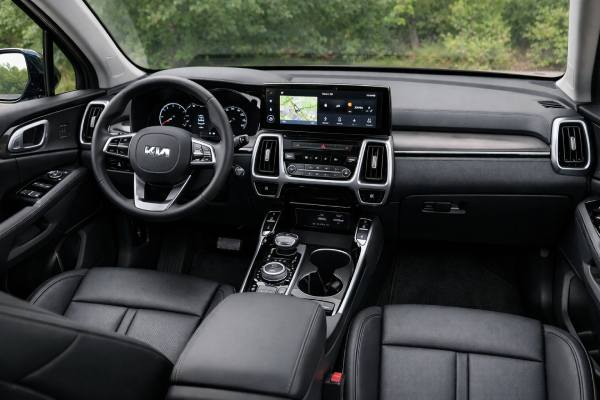

The MQ4-generation Kia Sorento with the 3.5-liter Smartstream V6 is aimed at buyers who want a three-row family SUV that still feels simple and durable: no turbocharger to heat-soak, no dual-clutch gearbox to second-guess in stop-and-go traffic, and enough displacement to move a loaded cabin without working hard. In FWD form, the powertrain’s character is typically smooth and predictable, with a broad torque curve that suits daily driving more than headline acceleration runs.
The ownership “shape” of this model is mostly about staying on top of fluids, filters, and heat management—because a large, naturally aspirated engine in a heavy vehicle will reward consistent maintenance and good cooling-system health. Also keep in mind that published outputs and even some hardware details can vary by market and emissions calibration, so the best practice is always to verify your exact VIN-spec in the service literature for your region.
Owner Snapshot
- Smooth, naturally aspirated V6 response that suits heavy loads and highway cruising.
- FWD layout usually means lower weight and fewer drivetrain wear points than AWD.
- Strong towing and family usability when properly equipped and maintained.
- Watch cooling-system condition and oil quality if you do short trips or tow often.
- A sensible oil service cadence is 10,000–12,000 km (6,000–7,500 mi) or 12 months (shorter for severe use).
Guide contents
- Kia Sorento MQ4 V6 FWD explained
- Kia Sorento 3.5 V6 specs and capacities
- Kia Sorento V6 trims and safety tech
- Reliability patterns and service campaigns
- Maintenance schedule and buyer tips
- Driving feel and real economy
- Rival comparison and verdict
Kia Sorento MQ4 V6 FWD explained
Think of this Sorento as the “traditional” configuration within a modern platform: a large-displacement gasoline V6, a conventional automatic transmission in most markets, and front-wheel drive. That combination matters because it shapes the way the vehicle ages. It tends to be easier on driveline parts than an AWD system (no rear differential, no transfer case, fewer seals and bearings), and it avoids the low-speed quirks some drivers associate with certain dual-clutch gearboxes.
What “Smartstream 3.5” usually means. Smartstream is Kia/Hyundai’s newer engine family branding. For 3.5-liter V6 applications, you may see variations such as multi-point injection (MPI) or direct injection (GDI), different compression ratios, and different rated outputs depending on fuel quality requirements and emissions rules. That’s why you’ll sometimes see published power figures that don’t perfectly match across markets. For ownership planning, the key takeaway is simpler: it’s a naturally aspirated V6 designed for refinement and steady pulling power rather than maximum efficiency.
FWD dynamics in a three-row SUV. A FWD Sorento typically feels stable and light on its feet at moderate speeds because the front axle does “everything” (drive, steer, and most of the braking). Under hard acceleration or on slick surfaces, you may notice more wheel slip than an AWD model—especially if the tires are budget-grade or unevenly worn. For drivers in mild climates, the trade is often worth it: fewer parts, less rotating mass, and commonly slightly better real-world fuel consumption than AWD.
2021–2023 ownership highlights.
- Practical packaging: MQ4’s platform is designed around family use—wide door openings, usable third-row access (by class standards), and a cargo area that’s easy to load.
- Heat and load are the real “stress tests”: Long idling with A/C on, short trips in cold weather, and towing put more stress on oil quality and cooling capacity than normal commuting.
- Electronics matter more than they used to: Even “simple” powertrains sit in a vehicle packed with driver assistance sensors and networked modules. Battery health (12 V) and clean electrical grounds can affect day-to-day reliability more than people expect.
If you want the smoothest, least complicated version of the MQ4 Sorento concept, the V6 FWD is usually the one to shortlist—just don’t skip the VIN-specific spec check, because the exact engine variant and equipment level can differ by country.
Kia Sorento 3.5 V6 specs and capacities
Below are VIN-and-market-dependent specs presented in a practical format. Use them for planning and comparisons, then confirm the exact numbers for your vehicle in official documentation.
Powertrain and efficiency (typical)
| Item | Specification |
|---|---|
| Engine family | Smartstream V6 3.5 |
| Layout | V6, DOHC, 24-valve (typical) |
| Displacement | 3.5 L (≈ 3,470 cc) |
| Induction | Naturally aspirated |
| Fuel system | MPI or GDI (market-dependent) |
| Timing drive | Chain (typical for this family) |
| Max power | Often listed around 200 kW (268 hp); some markets quote ≈ 290 hp depending on rating standard and calibration |
| Max torque | Often listed around 332 Nm (245 lb-ft); some calibrations are higher |
| Rated efficiency | Commonly around ~9–11 L/100 km combined for V6 FWD-class SUVs (varies heavily by test cycle and tires) |
| Real-world highway @ 120 km/h | Expect roughly ~9–12 L/100 km depending on wind, load, and speed stability |
Transmission and driveline
| Item | Specification |
|---|---|
| Transmission | Typically 8-speed automatic (torque-converter type in many markets) |
| Drive type | FWD |
| Differential | Open (traction control handles wheel slip) |
Chassis and dimensions (platform-level typical)
| Item | Specification |
|---|---|
| Front suspension | MacPherson strut |
| Rear suspension | Multi-link |
| Steering | Electric power steering |
| Brakes | 4-wheel discs (ventilated front; rear varies by spec) |
| Popular tire sizes | Commonly in the 17–20 in range depending on trim (e.g., 235/65 R17 through 255/45 R20) |
| Ground clearance | Commonly ~170–180 mm (≈ 6.7–7.1 in) |
| Length / width / height | Around 4,815 / 1,900 / 1,700 mm (≈ 189.6 / 74.8 / 66.9 in), market dependent |
| Wheelbase | Around 2,815 mm (≈ 110.8 in) |
| Turning circle | Often about 11.6 m (≈ 38.1 ft) |
| Fuel tank | Often ~67 L (≈ 17.7 US gal / 14.7 UK gal) |
Performance and capability (what to expect)
| Item | Typical real-world expectation |
|---|---|
| 0–100 km/h (0–62 mph) | Roughly ~7.8–8.8 s depending on output, tires, and load |
| Braking 100–0 km/h | Tire-dependent; prioritize quality tires for repeatable stops |
| Towing (braked) | Often up to ~2,000 kg (4,400 lb) when properly equipped; verify your tow package and local rating |
| Payload | Varies widely by trim and region; check door-jamb label |
Fluids and service capacities (verify before filling)
Because capacities vary by engine variant and region, the safest way to present these is as “what to confirm”:
- Engine oil: confirm viscosity (commonly 0W-20 or 5W-30 depending on climate/spec) and fill volume after filter change
- Coolant: confirm coolant type/standard and total capacity; always use the correct premix ratio
- ATF: confirm fluid spec and service method (drain-and-fill vs full exchange)
- A/C refrigerant: confirm type and charge amount from under-hood label
Safety and driver assistance (typical MQ4 equipment set)
| Category | What to look for |
|---|---|
| Crash ratings | Ratings depend on region and test protocol year; MQ4 generally performs strongly in modern tests |
| Headlights | Headlamp performance can vary by trim and option pack |
| ADAS | AEB, ACC, lane support, blind-spot features, rear cross-traffic alerts—availability depends on market and trim |
If you’re building a maintenance plan, the most important “spec” to lock down is your exact oil spec and capacity. That single detail affects long-term wear, turbo-or-no-turbo heat tolerance, and how forgiving the engine is to short trips.
Kia Sorento V6 trims and safety tech
Trim names vary widely by country, but the way Kia structures the lineup is usually consistent: a value-focused base grade, one or two comfort-focused mid grades, and a top grade that concentrates premium convenience and the most complete driver assistance suite.
Trims and options: what actually changes
When you’re comparing V6 FWD Sorentos, focus on differences that change cost to own or day-to-day function:
- Wheels and tires (big deal): Larger wheels can sharpen steering response, but they often increase tire cost, raise road noise, and worsen pothole damage risk. If you want long-distance comfort and lower running costs, a smaller wheel with a taller sidewall is usually the sweet spot.
- Brake and cooling package differences: Some markets bundle heavier-duty cooling, hitch wiring, or trailer stability logic with tow-rated packages. If you plan to tow, look for the factory tow prep rather than assuming any V6 can do the same job.
- Seating configuration: Some regions offer 6-seat captain’s chairs or a 7-seat bench. For families, the “best” choice is often the one that makes third-row access easiest for your routine.
- Infotainment and audio tiers: Higher trims can add larger screens and premium audio, but also more modules and features that can date over time. If you keep vehicles for 10+ years, prioritize core functions (navigation, CarPlay/Android Auto where offered, backup camera quality) over novelty features.
Quick identifiers when shopping used
- Exterior tells: Wheel size, headlamp design, and camera count (front/360 systems) can hint at trim.
- Interior tells: Seat material, cluster design, and presence of memory seat controls are often stronger indicators than badges.
- Build date vs model year: For 2021–2023, build timing can matter because some equipment and software revisions arrive mid-cycle.
Safety ratings and what they mean in practice
Safety ratings can be excellent, but they’re not “one number fits all.” A few helpful points:
- A model can achieve a strong score overall while still having trim-sensitive results in areas like headlights and certain driver-assist functions.
- Testing protocols evolve. A 2021 rating and a 2023 rating may not be directly comparable if the test changed—even if the vehicle barely did.
Safety systems and ADAS: what to check before buying
- Airbags and structure: Confirm front, side, and curtain airbag coverage, plus any center-airbag provision if offered in your region.
- Child-seat provisions: Look for ISOFIX/LATCH positions and top-tether anchor count that matches your family needs.
- ADAS status (standard vs optional): AEB and lane keeping may be standard, while adaptive cruise, blind-spot camera views, or parking collision functions may be optional.
- Calibration implications: After windshield replacement, bumper repairs, or alignment work, many systems require calibration. A bargain price can disappear quickly if sensors are misaligned and warning lights appear.
A practical buying rule: choose the trim that gives you the safety tech you’ll actually use (AEB and blind-spot coverage are high-value), then avoid overpaying for large wheels and cosmetic packages that raise running costs.
Reliability patterns and service campaigns
Reliability for a modern three-row SUV is rarely about a single weak part. It’s usually a mix of usage pattern, service quality, and whether the vehicle has had software updates and recall actions completed. For the 3.5 V6 FWD Sorento, the overall risk profile tends to be more “traditional SUV” than “high-strung powertrain,” but you still want to know the common fault zones.
Common to occasional issues (by prevalence and cost tier)
Common (low to medium cost, often age-related):
- Battery and charging health (12 V): Symptoms include random warning lights, infotainment resets, and slow start. Root cause is often an aging battery or parasitic draw from accessories. Remedy: proper battery test (not just voltage), clean grounds, correct replacement spec.
- Brake wear and vibration: Heavy SUVs eat front pads faster in city driving. If you feel steering shimmy under braking, you may be seeing rotor hot spots. Remedy: quality pads, correct bedding, and checking caliper slide pins.
- Suspension consumables: Bushings and links can develop noise as mileage climbs, especially on rough roads. Remedy: replace worn links/bushings; align afterward if needed.
Occasional (medium cost):
- Cooling-system leaks or weak components: Small leaks can become big ones under towing or hot-weather use. Symptoms: coolant smell, slow loss, heater performance changes. Remedy: pressure test, replace the failing component early, and use correct coolant.
- Engine mounts and driveline vibration: A V6’s torque can reveal mount wear. Symptoms: vibration at idle in gear, thump on shifts. Remedy: inspect mounts and exhaust hangers.
Rare but higher cost (watch for early signs):
- Internal engine concerns: Uncommon in well-maintained naturally aspirated engines, but oil neglect, overheating, or repeated short-trip sludge can trigger expensive outcomes. Symptoms: persistent knocking, overheating events, or repeated misfires. Remedy: avoid getting here—good oil and cooling maintenance is the prevention.
Symptoms → likely cause → recommended action
- Hot smell after towing → overheated ATF or brakes → inspect transmission temperature behavior, fluid condition, and brake hardware; consider shorter service intervals.
- Intermittent warning lights (ADAS or stability) → low 12 V voltage or sensor misalignment → battery test and scan; calibrate sensors after bodywork.
- Rough idle after long storage → stale fuel or intake deposits → fresh fuel, correct plugs, and a proper diagnostic before parts-swapping.
Software and calibrations
Modern Sorentos rely on networked modules. Updates can address:
- Driveability logic (shift scheduling, throttle mapping)
- Camera and radar fault thresholds
- Infotainment stability and connectivity bugs
If the vehicle has a persistent warning light, don’t assume a hard part is bad until a shop checks for software updates and known calibrations.
Recalls, TSBs, and extended coverage (how to approach)
Because campaigns vary by market and by powertrain, treat recall research as a routine step:
- Run the VIN through your region’s official recall portal.
- Ask for dealer printout history showing completion dates.
- If buying used, request evidence for any major campaign completion before money changes hands.
Even if a recall is not specific to your V6 configuration, completing all open actions protects resale value and reduces nuisance faults later.
Maintenance schedule and buyer tips
A 3.5-liter V6 in a heavy SUV can be extremely long-lived, but only if you maintain it like a load-bearing machine, not like an appliance. The good news is that the plan is straightforward.
Practical maintenance schedule (distance/time)
Use the shorter interval if you do short trips, dusty roads, extreme heat/cold, or towing.
- Engine oil and filter: every 10,000–12,000 km (6,000–7,500 mi) or 12 months; severe use: 7,500–8,000 km (4,500–5,000 mi)
- Engine air filter: inspect every service; replace about 20,000–30,000 km (12,000–18,000 mi) depending on dust
- Cabin air filter: 15,000–20,000 km (9,000–12,000 mi) or yearly
- Coolant: typically 5 years / 100,000 km (60,000 mi) initial, then shorter thereafter (confirm for your market)
- Spark plugs: often ~100,000–160,000 km (60,000–100,000 mi) depending on plug type and engine variant
- Automatic transmission fluid (ATF): “lifetime” claims rarely match real life; consider 60,000–90,000 km (37,000–56,000 mi) if you tow or drive hot/city-heavy
- Brake fluid: every 2 years (humidity matters more than mileage)
- Brake pads/rotors: inspect every service; replace by wear measurement, not guesswork
- Tire rotation: every 8,000–12,000 km (5,000–7,500 mi)
- Alignment check: yearly, and after any major pothole hit or suspension work
- 12 V battery: test yearly after year 3; replacement is commonly needed around 4–6 years depending on climate and usage
Fluids, specs, and “decision-grade” torque values
Because VIN/market variation is real, use this approach:
- Match oil viscosity and certification exactly (look for the spec on the oil cap, manual, or service system).
- Use the correct coolant standard; mixing types can cause gel formation or corrosion.
- For critical fasteners, follow service literature. As a general practice, treat these as “always torque-to-spec” items: wheel lug nuts, brake caliper bracket bolts, and suspension-to-knuckle fasteners.
Buyer’s guide: inspection checklist for used examples
Bring this list to a pre-purchase inspection:
- Cooling system: check for dried coolant residue around the radiator, hoses, and water pump area; verify stable operating temperature in traffic.
- Transmission behavior: confirm smooth engagement from Park to Drive/Reverse, no flare on upshifts, and no shudder under light throttle.
- Brakes: look for vibration, pulling, or uneven pad wear; check parking brake function.
- Tires: uneven wear suggests alignment or bushing issues; mismatched tire brands can harm traction and stability.
- Electronics: test every camera view, parking sensors, and driver-assist warnings; weak 12 V batteries can masquerade as “module problems.”
- Service history: prioritize evidence of regular oil service and any ATF/coolant/brake fluid replacement.
- Recalls: verify completion through an official VIN lookup and dealer records.
Long-term durability outlook
If you keep up with oil quality, coolant integrity, and periodic ATF refreshes, the V6 FWD formula is typically a strong long-term bet. Most expensive surprises come from neglected fluids, overheating events, or unresolved electronic faults that were never properly diagnosed.
Driving feel and real economy
The 3.5 V6 Sorento is rarely about drama. It’s about effortless motion—especially when the vehicle is full of people, luggage, and the normal weight creep of family life.
Ride, handling, and NVH (noise, vibration, harshness)
- Ride quality: On smaller wheels with taller tire sidewalls, the MQ4 platform usually feels composed and quiet over broken pavement. Larger wheel packages can look great but tend to transmit sharper impacts into the cabin.
- Straight-line stability: At highway speeds, a naturally aspirated V6 and conventional automatic pairing often feels relaxed—fewer downshifts than a smaller engine, and less “busy” throttle behavior on mild grades.
- Steering and balance: Expect light-to-moderate steering weight with a safe, front-led balance. In FWD, pushing hard into a corner can bring mild understeer earlier than AWD, especially on all-season tires.
- Braking feel: Confident when the brakes are fresh, but heavy SUVs can show fade faster on long descents. Good pads and fresh brake fluid help consistency.
Powertrain character
- Throttle response: Generally linear. A larger naturally aspirated engine gives predictable response without the “wait → surge” feel some turbo setups show.
- Low-rpm pull: Strong enough for daily driving, but it still benefits from revs when you want quick passing.
- Transmission logic: In most markets with an 8-speed automatic, the best feel is often in the normal mode. Sport modes may hold gears longer and increase engine braking on descents.
Real-world efficiency: what owners actually see
Fuel consumption varies massively with speed. A few realistic patterns:
- City-heavy driving: the V6 will use fuel—idling and repeated acceleration show up quickly.
- Highway cruising: steady speeds and gentle grades are where the V6 can feel surprisingly reasonable for its size.
- Cold weather: short trips can increase consumption noticeably because the engine spends more time warming up and the cabin heater load rises.
If your use case is mostly short trips, consider shortening the oil interval and treating fuel economy as a secondary goal. In this configuration, the “win” is smoothness and predictability, not hybrid-level consumption.
Load and towing behavior
With the right equipment, a V6 Sorento can tow confidently, but it’s still important to drive like you’re managing heat:
- Use a lower gear on long grades to keep transmission temperatures in check.
- Expect a meaningful fuel economy penalty under tow—often 20–40% depending on speed, trailer shape, and wind.
- Consider more frequent ATF service if towing is routine.
The best performance upgrade for this vehicle is rarely a part—it’s tires. A high-quality tire set improves braking distance, wet traction, steering precision, and road noise in one move.
Rival comparison and verdict
The 3.5 V6 FWD Sorento sits in a competitive space: family-focused three-row SUVs that must balance comfort, safety tech, operating costs, and long-term durability. Here’s how it tends to stack up in the real world.
Against turbo four-cylinder rivals
Many competitors rely on smaller turbocharged engines to meet emissions targets while offering strong torque on paper.
- Where the Sorento V6 wins: smoother response under load, less turbo heat management, and typically more consistent feel across temperature swings.
- Where turbos win: often better rated fuel economy and sometimes stronger low-rpm torque for quick “around town” moves.
If you dislike turbo behavior or you keep vehicles for a long time, the naturally aspirated approach can feel like the lower-stress choice—provided you accept the fuel cost.
Against hybrid alternatives
Hybrids can be excellent for city-heavy use.
- Hybrid advantage: noticeably lower fuel consumption in stop-and-go and often strong low-speed torque.
- V6 advantage: simpler long-term mechanical feel for some owners, plus steady highway character without the complexity of high-voltage systems (even though modern hybrids can be very reliable).
Your driving pattern decides the winner: city-heavy use leans hybrid; mixed/highway and towing lean V6.
Against larger, heavier three-row SUVs
Move one size up and you may gain cargo room and towing stability, but also more mass and cost.
- The Sorento’s advantage is often “right-sized” usability: easy to park, comfortable for most families, and still capable.
The practical verdict
Choose the 2021–2023 Sorento FWD with the 3.5 Smartstream V6 if you want:
- A smooth, predictable family SUV powertrain that doesn’t rely on boost.
- Lower drivetrain complexity than AWD, with easier long-term maintenance planning.
- Strong day-to-day drivability when loaded with passengers and gear.
Skip it (or at least compare carefully) if:
- Your driving is mostly short, city trips and fuel cost is a top priority.
- You need maximum foul-weather traction; tires help, but AWD still has an edge.
- You’re buying used without proof of completed recall actions and consistent oil service.
In a market full of clever solutions, this configuration is appealing because it’s straightforward. Treat it like a machine—keep fluids fresh, watch heat, buy good tires—and it’s set up to be a long-term, low-drama family tool.
References
- Smartstream G3.5 MPI Engine 2025 (Owner’s Manual)
- Official Kia Sorento 2020 safety rating 2020 (Safety Rating)
- 2021 Kia Sorento 4-door SUV 2021 (Safety Rating)
- Check for Recalls: Vehicle, Car Seat, Tire, Equipment 2026 (Recall Database)
- Recalls 2026 (Recall Lookup)
Disclaimer
This article is for informational purposes only and is not a substitute for professional diagnosis, inspection, or repair. Specifications, torque values, fluid types and capacities, service intervals, and procedures can vary by VIN, market, engine variant, and equipment; always verify details using your official owner’s manual and service documentation for your exact vehicle.
If you found this guide useful, please consider sharing it on Facebook, X (Twitter), or your favorite forum or group—your support helps us keep producing detailed, practical ownership resources.