

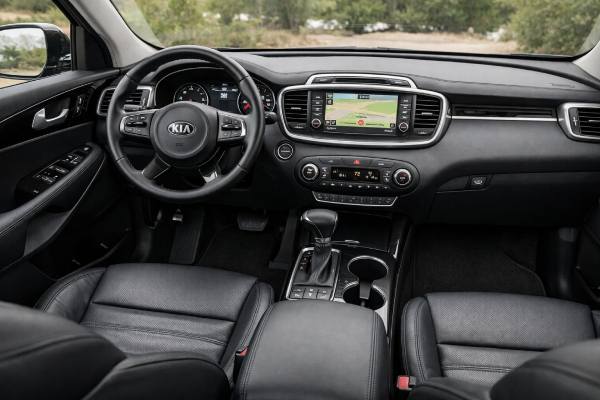

The 2016–2017 Kia Sorento (UM) with the 3.3-liter V6 (G6DH) and front-wheel drive is the “big-engine, simpler driveline” pick in the lineup. You get strong, smooth power for highway passing and family hauling, plus fewer AWD-specific service points (no transfer case or rear diff) to budget for over the long run. The tradeoff is traction in deep snow or steep, loose surfaces—tires matter more here than driveline hardware.
This variant also tends to be optioned as a higher-trim family SUV, so buyers should pay as much attention to feature condition (power liftgate, infotainment, driver assists) as to the engine itself. If you maintain fluids on time and keep the cooling system healthy, the V6 can be a durable workhorse for high-mileage use.
Owner Snapshot
- Strong V6 pull at highway speeds, especially when loaded with passengers and cargo
- FWD layout keeps driveline maintenance simpler and usually a bit lighter than AWD
- Comfortable long-distance family SUV if tires, alignment, and brakes are kept fresh
- Watch for oil seepage and cooling-system age issues as mileage climbs
- Plan oil and filter service every 8,000–10,000 km (5,000–6,000 mi) or 6–12 months (usage-dependent)
Section overview
- Sorento UM FWD V6 profile
- Sorento UM G6DH specs tables
- Sorento UM trims and safety tech
- Reliability and known weak spots
- Maintenance plan and buyer tips
- Real driving and fuel use
- Rivals and best alternatives
Sorento UM FWD V6 profile
Think of this Sorento as a midsize, three-row-capable crossover tuned for daily comfort with a confidence-inspiring power reserve. The 3.3-liter V6 is the main story: it’s naturally aspirated, so throttle response is predictable and power delivery stays smooth as revs build. That matters in real ownership—merging, short passing gaps, and climbing grades with kids and luggage feel less “busy” than with smaller engines that need more rpm or boost to do the same job.
With FWD, the Sorento’s driving feel is slightly lighter on turn-in than an AWD equivalent, and there’s less rotating mass in the driveline. In practice, that can translate to a calmer steering feel around town and fewer driveline fluids to change. You also remove two big ownership variables: transfer-case wear and rear differential service history. If your climate is mild and you’re not towing on slippery ramps, FWD is often the rational pick.
Where the FWD V6 Sorento needs thoughtful setup is traction management. The vehicle’s stability and traction control do a good job for normal use, but they can’t create grip. A quality all-season or winter tire (depending on your climate) is the biggest single upgrade you can make for safety and confidence.
From a packaging standpoint, the Sorento is family-first. It offers a usable third row for shorter trips, and the cabin ergonomics are designed around long drives: supportive seats, easy climate control access, and wide-opening doors. The V6 also pairs well with a fully loaded cabin because it doesn’t need to “hunt” as aggressively for power. If you prioritize smoothness, quiet cruising, and easy highway performance—and you can live without AWD traction—this is one of the most well-rounded UM configurations.
Sorento UM G6DH specs tables
Below are practical, ownership-focused specifications for the 2016–2017 Sorento UM FWD with the 3.3-liter V6 (G6DH) rated around 290 hp. Exact figures can vary by market, trim, wheel/tire package, and emissions configuration, so treat these as “typical” values and verify against your VIN documentation when ordering parts or fluids.
Powertrain and efficiency (typical)
| Item | Spec |
|---|---|
| Code | G6DH |
| Engine layout and cylinders | V6, DOHC, 24 valves (4 valves/cyl) |
| Displacement | 3.3 L (≈ 3,342 cc) |
| Bore × stroke | ≈ 92.0 × 83.8 mm (3.62 × 3.30 in) |
| Induction | Naturally aspirated (NA) |
| Fuel system | Gasoline direct injection (GDI) |
| Compression ratio | ≈ 11.5:1 (market-dependent) |
| Max power | 290 hp (≈ 216 kW) @ ≈ 6,400 rpm |
| Max torque | ≈ 342 Nm (≈ 252 lb-ft) @ ≈ 5,200 rpm |
| Timing drive | Chain |
| Rated efficiency | Commonly mid-10s L/100 km combined (trim/market dependent) |
| Real-world highway @ 120 km/h | Often ~9–11 L/100 km depending on load, wind, tires, and temperature |
Transmission and driveline
| Item | Spec |
|---|---|
| Transmission | 6-speed automatic (market code varies) |
| Drive type | FWD |
| Differential | Open (traction control manages wheel slip) |
Chassis and dimensions (typical UM body)
| Item | Spec |
|---|---|
| Suspension (front/rear) | MacPherson strut / multi-link |
| Steering | Electric power steering (EPS) |
| Brakes | 4-wheel disc (diameter varies by trim) |
| Common tire size | 235/55 R18 (popular fitment; depends on trim) |
| Ground clearance | ~185 mm (~7.3 in) |
| Length / width / height | ~4,780 / 1,890 / 1,685–1,700 mm |
| Wheelbase | ~2,780 mm (~109.4 in) |
| Turning circle (kerb-to-kerb) | ~11.2–11.6 m |
| Curb weight | ~1,820–1,950 kg (trim dependent) |
| Fuel tank | ~71 L (≈ 18.8 US gal / 15.6 UK gal) |
| Cargo volume | varies by row count and measuring method; typically ~320 L seats up (behind 3rd), ~1,000+ L behind 2nd, ~2,000 L max |
Performance and capability (typical)
| Item | Spec |
|---|---|
| 0–100 km/h (0–62 mph) | ~7.2–7.9 s (setup dependent) |
| Top speed | ~200–210 km/h (124–131 mph) |
| Braking 100–0 km/h | commonly ~38–42 m (tires and load matter) |
| Towing capacity | up to ~2,268 kg (5,000 lb) when properly equipped (market dependent) |
| Payload | typically ~600–700 kg (1,320–1,540 lb) (trim and options dependent) |
Fluids and service capacities (decision-useful)
| System | Typical spec |
|---|---|
| Engine oil | API/ILSAC as specified; common viscosity 5W-20 or 5W-30 (market/climate dependent) |
| Oil capacity | ~5.7 L (≈ 6.0 US qt) with filter (verify by VIN) |
| Coolant | Long-life ethylene glycol; typical 50/50 premix |
| ATF | SP-IV type fluid (verify exact spec for your market transmission) |
| A/C refrigerant | R-134a (many 2016–2017 vehicles); charge varies by system label |
Key torque specs (common “must know” items)
| Fastener | Typical torque |
|---|---|
| Wheel lug nuts | ~110–130 Nm (~81–96 lb-ft) depending on wheel |
| Engine oil drain plug | ~30–40 Nm (~22–30 lb-ft) typical range |
| Spark plugs | usually ~15–25 Nm (~11–18 lb-ft) depending on plug type |
If you’re building a maintenance budget, the “big levers” are oil service frequency, transmission fluid condition, brake wear (often faster on heavier trims), and tires—especially if you rely on all-season rubber year-round in colder climates.
Sorento UM trims and safety tech
Trims vary by region, but the 3.3 V6 commonly appears in upper mid or top trims because it was positioned as the “premium power” option. That means you’ll see more equipment that can age out—power liftgate struts, heated and ventilated seats, higher-end infotainment, parking sensors, and camera systems. When shopping, treat trim level as more than a comfort choice: it changes tire sizes, brake hardware in some markets, and sometimes towing equipment.
Quick trim identifiers (practical):
- V6 badge or “3.3” labeling (when fitted) and a generally more confident launch feel than 4-cylinder versions.
- Wheel size: 18-inch is common; 19-inch packages exist and can change ride quality and tire cost.
- Interior cues: upgraded audio branding, memory seat controls, and full LED tail lamps can hint at higher trims (market dependent).
Year-to-year notes (2016–2017):
- Equipment packaging often shifts: a feature that was optional in 2016 may be bundled in 2017 under a tech package. Always confirm by VIN build sheet or the actual vehicle, not brochure memory.
- Driver-assistance availability tends to widen over time, but not every vehicle has the sensors even if the steering wheel has cruise buttons—verify the radar/camera hardware.
Safety ratings (what matters for owners):
- Independent testing for this generation shows strong occupant protection performance in core structural tests, while some trims can be held back by headlight performance. In the real world, that means two Sorentos that look identical can provide different night-driving visibility depending on headlamp type and aim.
- If you care about crash avoidance, confirm whether the vehicle has forward collision warning / automatic emergency braking hardware. Some systems were optional and may require correct calibration after windshield replacement or front-end repair.
Safety systems and ADAS checklist (practical):
- Airbags: expect front, side, and curtain coverage; verify third-row curtain coverage if that matters to you.
- Child seats: look for ISOFIX/LATCH anchors in the second row; verify top tether positions if you plan three child seats.
- Stability systems: ABS, ESC, and traction control are standard in most markets; confirm hill-start assist if you live in hilly areas.
- ADAS availability (often trim/package dependent): forward crash prevention, blind-spot monitoring, rear cross-traffic alert, and lane departure warning. If equipped, insist on a dashboard warning-light self-check at start-up and test the parking sensors/camera clarity.
A buyer’s best approach is to decide on must-have safety features first (headlights, AEB, blind-spot monitoring), then shop the trim that reliably includes them—because retrofitting these systems is rarely cost-effective.
Reliability and known weak spots
Overall, the 3.3 V6 + 6-speed automatic combination is generally straightforward, but long-term reliability depends heavily on heat management, fluid condition, and how the vehicle was used (short trips vs long highway runs, towing, heavy city traffic).
Below is a practical “prevalence × cost tier” map that helps owners prioritize.
Common (low to medium cost):
- Oil seepage and gasket sweating (valve cover area or front cover edges):
Symptoms: burning-oil smell after a drive, dampness near gasket seams.
Likely cause: gasket aging plus heat cycles.
Remedy: reseal gaskets and clean PCV pathways; confirm no oil is reaching accessory belts. - Ignition coils and plugs aging (especially if service intervals were stretched):
Symptoms: misfire under load, rough idle, flashing MIL.
Cause: plug wear or coil degradation.
Remedy: replace plugs at the scheduled interval; coils as needed. Avoid “parts cannon” swapping—scan data helps. - Brake wear and rotor sensitivity on heavier trims:
Symptoms: steering shake under braking, squeal, longer pedal travel.
Cause: heat and pad material mismatch, especially with 19-inch wheels.
Remedy: quality pads/rotors and correct bedding; flush brake fluid on schedule.
Occasional (medium cost):
- Cooling system age issues (thermostat, radiator cap, hoses):
Symptoms: slow warm-up, temperature creep in traffic, coolant smell.
Cause: thermostat wear, hose swelling, cap losing pressure.
Remedy: proactive refresh if the vehicle is nearing a decade old; use the correct coolant type and bleed properly. - Transmission shift quality changes:
Symptoms: delayed engagement, harsh 2–3 shifts, flare on kickdown.
Cause: old ATF, adaptation drift, or solenoid wear.
Remedy: verify fluid level/condition, service ATF at sensible intervals, and check for software updates where supported.
Rare but high impact (higher cost):
- GDI-related intake carbon buildup (usage-dependent):
Symptoms: reduced power, rough cold idle, poorer economy.
Cause: direct injection doesn’t wash intake valves with fuel; deposits can accumulate.
Remedy: professional intake cleaning when symptoms appear; prioritize long, hot highway drives and quality oil changes to reduce buildup tendency. - Electrical convenience faults (higher-trim risk):
Symptoms: intermittent camera, power liftgate issues, infotainment reboots.
Cause: aging connectors, moisture, or module faults.
Remedy: start with battery health and ground checks; then diagnose modules.
Recalls, TSBs, and service actions (how to verify):
- Use official VIN-based recall lookup and dealer service history. Even if a campaign is “common knowledge,” completion status is vehicle-specific.
- After collision repair, insist on correct sensor calibration for any ADAS hardware—misaligned radar/camera systems can create false warnings or reduced functionality.
The V6’s best reliability strategy is boring but effective: keep oil fresh, keep coolant healthy, don’t ignore small leaks, and don’t treat transmission fluid as “lifetime” if you plan to keep the vehicle.
Maintenance plan and buyer tips
A useful maintenance plan balances the manufacturer schedule with real-world aging. For a 2016–2017 vehicle, time-based maintenance becomes as important as mileage: rubber, fluids, and electrical connections degrade even if the car isn’t driven hard.
Practical maintenance schedule (distance or time)
- Engine oil and filter: every 8,000–10,000 km (5,000–6,000 mi) or 6–12 months
Short trips, extreme heat/cold, heavy traffic, and towing justify the shorter end. - Engine air filter: inspect every 15,000 km; replace around 30,000–45,000 km (dusty regions sooner)
- Cabin filter: every 15,000–20,000 km or yearly if you value HVAC performance
- Coolant: typically 5 years / 100,000 km, then every 3–5 years depending on coolant type and climate
- Spark plugs (GDI engines often use long-life plugs): commonly 90,000–160,000 km depending on plug spec; verify for your exact engine variant
- PCV valve and hoses: inspect around 80,000–120,000 km; replace if sticky or if oil consumption symptoms appear
- Automatic transmission fluid (ATF): conservative approach is 60,000–90,000 km depending on usage; towing and hot climates benefit from earlier service
- Brake fluid: every 2 years regardless of mileage
- Brake pads/rotors: inspect at every tire rotation; replace based on measured thickness and rotor condition
- Tires: rotate every 8,000–10,000 km; alignment check yearly or after pothole impacts
- 12 V battery: test annually after year 4; typical replacement window 4–6 years (climate dependent)
Fluids and specs (buyer-focused guidance)
- Oil viscosity: choose the viscosity listed for your climate and market; using the correct grade helps both cold starts and high-temperature protection.
- ATF spec matters: “close enough” fluid can cause shift quality issues; match the exact specification for your transmission.
- Coolant compatibility: mixing coolant types can reduce corrosion protection—flush properly if history is unknown.
Pre-purchase inspection checklist (what to request)
- Service history proof: oil services, coolant changes, and any transmission service receipts.
- Cold start behavior: listen for timing-chain rattle (brief noise can be normal, extended rattle is not), confirm stable idle.
- Leak check: inspect undertray edges, oil pan area, and front cover perimeter for fresh oil.
- Transmission behavior: verify smooth engagement from Park to Drive, and check for consistent shifts under light throttle.
- Brake feel and steering: confirm no vibration under braking; check for uneven tire wear indicating alignment or suspension bushing wear.
- Electronics sweep: camera clarity, parking sensors, seat heaters/ventilation, and infotainment stability.
- Recall completion: verify using official VIN lookup and dealer records.
Long-term durability outlook: With consistent fluid maintenance and proactive cooling-system refreshes as it ages, this powertrain can be a solid 10–15 year family SUV. Neglect typically shows up first as shift quality complaints, oil leaks, and tired suspension/brakes rather than catastrophic engine failure.
Real driving and fuel use
On the road, the 3.3 V6 Sorento’s personality is defined by effortless cruising. Throttle response is clean and linear for a naturally aspirated engine, and the V6 has enough reserve that it rarely feels strained. In day-to-day driving, that usually means fewer dramatic downshifts than smaller engines—especially when you’re carrying passengers or climbing long grades.
Ride, handling, and NVH (noise/vibration/harshness):
- Ride quality: generally comfort-oriented. Larger wheels and lower-profile tires sharpen steering response but can add impact harshness over rough pavement.
- Steering feel: EPS is typically light at parking speeds and steadier at highway speeds. The Sorento isn’t a “sports SUV,” but it tracks confidently when alignment and tires are right.
- Cabin noise: wind and tire noise dominate at highway speed. Tire choice can noticeably change the sound level.
Transmission behavior:
- The 6-speed automatic is typically smooth when healthy. You want to feel crisp but not harsh shifts, and you want predictable kickdown when you ask for power.
- If you notice frequent “hunting” on gentle hills, it may be a sign of tired ATF, mismatched tire sizes, or an engine load sensor issue rather than a failing transmission.
Real-world efficiency (what owners actually see):
- City driving: often high-11s to low-13s L/100 km depending on traffic and warm-up time.
- Highway at 100–120 km/h: commonly ~9–11 L/100 km in good conditions.
- Mixed use: many owners land in the ~10–12 L/100 km band.
Cold weather can add significant fuel use because warm-up takes longer and winter fuel blends reduce energy content.
Traction and control (FWD specifics):
- In rain and light snow, traction control works well, but it can’t replace winter tires. If you live in a snowbelt region, treat winter tires as essential safety equipment, not an upgrade.
- With the V6’s torque, front tires do more work. If you accelerate hard while turning, you may notice inside-wheel slip—normal for an open differential setup.
Load and towing notes:
- When properly equipped, the V6 is a strong tow motor for moderate trailers. Expect a meaningful consumption penalty—often +20–40% depending on speed, trailer shape, and terrain.
- For towing confidence, prioritize: correct hitch hardware, trailer brakes where required, transmission fluid health, and fresh brake components.
If you want a Sorento that feels relaxed at speed and doesn’t mind a full cabin, this is the configuration that delivers that “bigger engine” ease—just budget realistically for fuel and tires.
Rivals and best alternatives
The 2016–2017 Sorento V6 FWD sits in a competitive midsize crossover space. The best rival depends on what you value most: interior space, long-term simplicity, driving feel, or towing confidence.
If you want similar V6 smoothness:
- Toyota Highlander V6 (same era): typically strong resale value and a reputation for durability. Often feels refined, but pricing can be higher on the used market for comparable mileage and equipment.
- Honda Pilot V6: spacious and family-oriented, often with a very functional cabin. Depending on year and drivetrain, maintenance priorities can differ (especially around transmission behavior and AWD systems).
If you prioritize handling and road feel:
- Mazda CX-9: often more engaging steering and a premium-feeling cabin. Many CX-9 models use turbocharged power rather than a NA V6, which changes the maintenance conversation (heat management and turbo-related service).
- Ford Edge (two-row): not a three-row alternative, but if you don’t need the third row, it can feel more nimble and simpler in daily use.
If you want maximum practicality per dollar:
- Hyundai Santa Fe (platform cousin): similar engineering DNA and packaging logic. The best buy is often the one with the cleanest maintenance history and least electrical “drama,” not necessarily the badge.
- Kia Sportage / smaller crossovers: worth considering if you rarely use the third row and want lower tire and brake costs.
How the Sorento V6 FWD stacks up (simple verdict):
- Strengths: smooth, confident highway performance; comfortable family packaging; simpler driveline than AWD; often well-equipped.
- Weak points: fuel use in city driving; feature-heavy trims can have more aging electronics; headlight performance can vary by trim and setup; traction depends heavily on tire choice.
Which buyers should choose it:
- You do mostly paved-road driving, want a calm long-distance SUV, and prefer the simpler maintenance footprint of FWD.
- You want V6 passing power without turbo complexity.
Who should look elsewhere:
- You regularly deal with steep snow, unplowed roads, or slippery boat ramps (AWD + proper tires may be worth it).
- You want the lowest possible running costs—smaller engines (or a different class of vehicle) may fit better.
When shopping, prioritize condition over trim hype: a well-maintained Sorento V6 with documented fluid services will generally outlast a “loaded” example with unknown history.
References
- 2016 Kia Sorento 2016 (Safety Rating)
- 2017 Kia Sorento 2017 (Safety Rating)
- Recalls 2026 (Recall Database)
- 2017 Kia Sorento SUV FWD 2017 (Vehicle Database)
Disclaimer
This article is for informational purposes only and is not a substitute for professional diagnosis, inspection, or repair. Specifications, torque values, fluid types, capacities, service intervals, and procedures can vary by VIN, market, production date, and equipment. Always confirm details using the official service information and labels for your specific vehicle before purchasing parts or performing maintenance.
If this guide helped you, consider sharing it on Facebook, X (Twitter), or your favorite forum to support our work.