
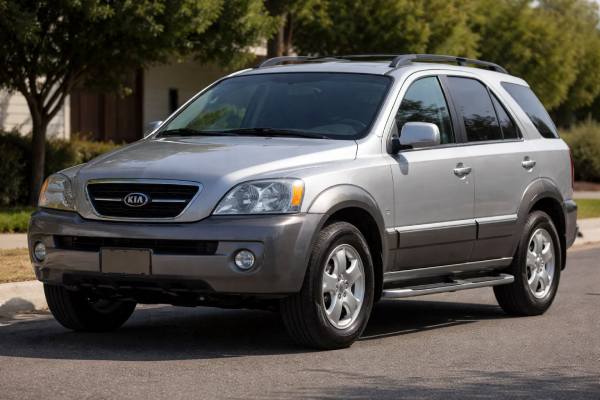
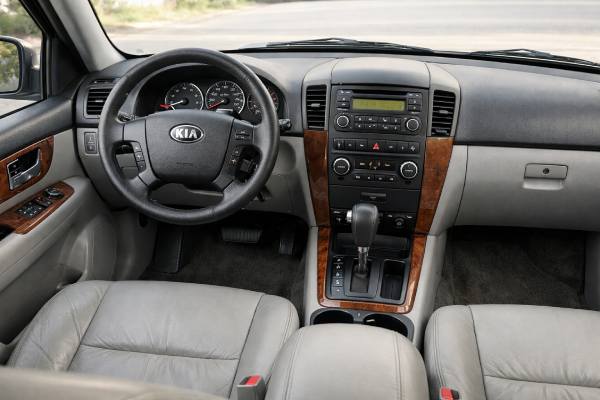

The 2002–2006 Kia Sorento BL is one of the last “classic” midsize SUVs in the affordable segment: body-on-frame construction, a proper rear-drive layout (in RWD form), and simple, serviceable mechanical systems. With the 2.4-liter G4JS inline-four rated around 139 hp, this variant leans more toward steady daily use than quick acceleration, but it can reward owners who value durability, parts availability, and straightforward maintenance. The engineering story is also about trade-offs: the Sorento BL’s truck-like structure tends to feel solid over rough roads and when loaded, yet it brings extra weight and fuel consumption compared with unibody crossovers of the same era. If you’re shopping today, the difference between an “okay” Sorento and a great one is almost always condition—cooling system health, driveline wear, corrosion, and service history.
Key Takeaways
- Body-on-frame and RWD layout deliver a sturdy feel and simpler driveline than 4WD versions.
- Practical packaging and a tall seating position make it easy to live with for family and cargo duty.
- The 2.4 G4JS is generally uncomplicated to service, with widely available consumables and sensors.
- Budget for age-related cooling and rubber wear (hoses, mounts, bushings) before chasing upgrades.
- Plan engine oil and filter service about every 10,000 miles (16,000 km) or 12 months (whichever comes first), then shorten if you do short trips or heavy city use.
Jump to sections
- Kia Sorento BL RWD profile
- Kia Sorento BL RWD specifications
- Kia Sorento BL RWD equipment and safety tech
- Common failures and recall themes
- Service planning and buying advice
- How it drives and what it uses
- RWD Sorento BL versus alternatives
Kia Sorento BL RWD profile
The Sorento BL sits in an interesting middle ground: it looks and feels like a traditional SUV, yet it was priced to compete with early crossovers. In RWD form, the layout is straightforward—engine up front, power sent to a rear differential through a driveshaft. That simplicity matters today because it reduces the number of rotating parts compared with a 4WD/4×4 version (no front diff, transfer case hardware, or front driveshaft), which can mean fewer leaks and fewer bearings and seals to age out.
With the 2.4-liter G4JS four-cylinder, the Sorento’s character is defined by “adequate, not urgent.” It is capable of commuter duty, errands, and moderate highway trips, but it is not the engine choice for heavy towing or frequent high-speed mountain driving. Owners typically value this configuration for three reasons:
- Lower drivetrain complexity than 4WD variants, which can reduce long-term maintenance tasks.
- Predictable handling on dry pavement: RWD can feel balanced at moderate speeds, especially with good tires.
- Serviceability: the engine bay and underbody systems are generally accessible, and most wear items are conventional.
The engineering trade-off is mass. Body-on-frame SUVs carry more structure, and that structure soaks up energy and road harshness, but it also asks more from the engine and brakes. When shopping, treat “how it was used” as a major spec. A Sorento that spent its life doing short trips with infrequent coolant and oil changes can develop far more issues than one that lived on longer drives with consistent maintenance.
Also be realistic about the “RWD” label. Depending on market and paperwork, some listings may loosely describe 2WD or part-time systems. The easiest confirmation is to inspect underneath: a true RWD Sorento will have a rear differential and driveshaft, but no front differential/half-shafts or transfer-case front output.
Kia Sorento BL RWD specifications
Specs for early-2000s vehicles can vary by market, emissions package, and transmission choice. The tables below focus on what typically defines a 2002–2006 Sorento BL with the 2.4 G4JS and a rear-drive layout.
Powertrain and efficiency (typical)
| Item | Specification |
|---|---|
| Code | G4JS |
| Engine layout and cylinders | Inline-4 (I-4), DOHC, 4 valves/cyl |
| Displacement | 2.4 L (≈ 2351 cc) |
| Bore × stroke | ≈ 86.5 × 100.0 mm (3.41 × 3.94 in) |
| Induction | Naturally aspirated |
| Fuel system | Typically MPFI (market-dependent) |
| Compression ratio | Commonly around 10.0:1 (varies) |
| Max power | 139 hp (≈ 104 kW) @ rpm (market-dependent) |
| Max torque | Often in the ~200–215 Nm range (≈ 148–159 lb-ft), rpm varies |
| Timing drive | Belt (verify by VIN/engine build) |
| Rated efficiency | Commonly ~11–14 L/100 km (≈ 17–21 mpg US / 20–25 mpg UK), depending on tires and gearing |
| Real-world highway @ 120 km/h | Often ~10–13 L/100 km in good tune; higher with roof loads, lift, or aggressive tires |
Transmission and driveline (common configurations)
| Item | Specification |
|---|---|
| Transmission | Commonly 5-speed manual or 4-speed automatic (varies by market) |
| Drive type | RWD |
| Differential | Rear open differential (LSD uncommon; verify by axle tag/option codes) |
Chassis and dimensions (typical ranges)
| Item | Specification |
|---|---|
| Platform type | Body-on-frame SUV |
| Suspension (front / rear) | Independent front (commonly double wishbone); rear multi-link / coil-spring layout (varies) |
| Steering | Power-assisted rack-type (spec varies) |
| Brakes | Front disc / rear disc (sizes vary by year/trim) |
| Wheels and tyres (common) | Often 16–17 in wheels; popular sizes include 235/70 R16 or similar |
| Ground clearance | Often around ~200 mm (≈ 7.9 in), market/tyre dependent |
| Length / width / height | Typically ~4,560–4,700 mm / ~1,860 mm / ~1,720–1,750 mm |
| Wheelbase | Typically ~2,710 mm (≈ 106.7 in) |
| Turning circle | Often ~11–12 m (≈ 36–39 ft) |
| Kerb weight | Often ~1,850–2,050 kg (≈ 4,080–4,520 lb), depending on trim and transmission |
| Fuel tank | Commonly ~80 L (≈ 21.1 US gal / 17.6 UK gal) |
Performance and capability (realistic expectations)
| Item | Typical outcome |
|---|---|
| 0–100 km/h (0–62 mph) | Usually in the low-to-mid 12s seconds (varies widely by condition and transmission) |
| Top speed | Typically ~160–175 km/h (≈ 99–109 mph), gearing dependent |
| Braking 100–0 km/h | Strongly tire- and brake-condition dependent; prioritize fresh fluid and quality pads |
| Towing | RWD towing ratings vary heavily by market; treat any claim as VIN-specific and verify on the door placard and official documentation |
| Payload | Usually modest for the class; suspension condition matters more than brochure numbers on older vehicles |
Fluids and service capacities (verify before filling)
Because this exact engine-and-market combination differs, use these as planning anchors, not final numbers.
| System | What to verify |
|---|---|
| Engine oil | Viscosity and spec per climate; capacity depends on oil pan/filter setup |
| Coolant | Type/spec and correct mix ratio (often 50/50) |
| Automatic transmission fluid | Exact ATF spec for your transmission code |
| Rear differential | Gear oil viscosity (commonly 75W-90 or similar), capacity varies by axle |
| A/C refrigerant | Refrigerant type and charge amount from under-hood label |
| Key torque specs | Wheel nuts, drain plugs, brake caliper bolts—confirm in service manual for your VIN |
Kia Sorento BL RWD equipment and safety tech
Because the Sorento BL ran across multiple years and markets, “trim” names can be misleading. The better approach is to identify what the vehicle actually has: braking hardware, stability systems, airbag count, and convenience equipment. For a 2.4 RWD example, equipment often clusters into practical, family-oriented features rather than performance upgrades.
Trims and options that matter in ownership
Common equipment differences you’ll see across trims and packages:
- Wheel and tire packages: Smaller wheels with taller sidewalls typically ride better and can be cheaper to keep in quality tires—an advantage on a heavy SUV.
- Seating and interior: Cloth vs leather is less important than seat frame condition, power-seat function, and whether the HVAC blend doors move smoothly.
- Audio and infotainment: Earlier units are basic; what matters today is whether the wiring has been modified cleanly and whether there are parasitic draw issues.
- Tow-related hardware: Some vehicles have cooling upgrades, a hitch receiver, or wiring. Treat add-on wiring as a potential reliability variable unless it’s tidy and fused.
Quick identifiers that help you decode a used listing:
- VIN and build plate: The most reliable way to confirm model year, restraint systems, and original axle/trans configuration.
- Underbody check: RWD should show a rear driveshaft and differential; beware of sellers calling “2WD” the same thing as “FWD” on this model line.
- ABS and stability indicators: A functioning ABS light self-test at key-on is a good sign; missing bulbs or taped-over lights are a red flag.
Safety ratings and what they mean here
Early-2000s crash-test regimes differ from modern tests, but they still provide useful comparisons between peers. This generation of Sorento was evaluated by major safety bodies in the period, and results highlight that structure alone does not guarantee excellent outcomes. If your priority is occupant protection in side impacts or modern crash-avoidance, remember that this era predates widespread autonomous emergency braking (AEB), lane keeping assistance, and advanced headlight standards.
Safety systems and driver assistance (typical)
For 2002–2006 SUVs, “driver assistance” largely means stability and braking aids rather than camera/radar systems:
- Airbags: Front airbags are common; side airbags and curtain airbags depend on trim and market.
- Child-seat provisions: Look for ISOFIX/LATCH anchors, and confirm they are intact and not corroded.
- ABS: Often fitted, but the system’s value depends on sensor and tone-ring condition—common failure points on older vehicles.
- Stability control (ESC): Availability varies; if present, it can be a meaningful upgrade for wet or winter driving, especially in a rear-drive SUV.
A practical safety takeaway: on older vehicles, the most effective “safety mod” is excellent tires, correctly aligned suspension, strong brakes with fresh fluid, and fully functional seat belts with properly tensioning retractors.
Common failures and recall themes
At this age, reliability is less about one dramatic weak spot and more about a predictable list of wear systems. It helps to think in two categories: age-driven issues (rubber, seals, corrosion, electronics) and load-driven issues (driveline wear, suspension stress, overheating).
Common issues (higher prevalence)
- Cooling system aging (medium cost, medium severity):
Symptoms: rising temperature in traffic, sweet smell, low coolant, heater performance changes.
Likely causes: radiator end-tanks cracking, tired hoses, thermostat sticking, weak cap, or slow seepage at joints.
Remedy: pressure-test, replace aged hoses and thermostat with quality parts, flush and refill with correct coolant mix, confirm fans operate correctly. - Rear driveline wear (low to medium cost, can become high):
Symptoms: clunk on takeoff, vibration at 60–90 km/h, hum that changes on throttle.
Likely causes: worn U-joints, driveshaft balance issues, differential fluid neglected, pinion seal seepage leading to low oil.
Remedy: inspect U-joint play, check diff oil level/condition, address seal leaks early, and do a proper driveline angle check after suspension work. - Front suspension and steering wear (medium cost, medium severity):
Symptoms: wandering, steering shimmy, uneven tire wear, knock over bumps.
Likely causes: tired control arm bushings, ball joints, tie-rod ends, or worn dampers.
Remedy: replace in matched pairs where appropriate, then align; avoid the “cheap single bushing” approach if multiple joints show play.
Occasional issues (condition- and history-dependent)
- Oil leaks (low to medium severity): Valve cover and crank seals can seep with age. The key is differentiating a “weep” from a leak that drops oil level between services.
- Ignition and fueling nuisances (low to medium cost): Misfires from aged coils, wires, or plugs; idle issues from vacuum leaks.
- Brake system fatigue (medium severity): Sticky calipers, old rubber brake hoses, and neglected brake fluid can degrade stopping consistency.
Rare but costly outcomes
- Overheat damage (high severity): Any sign of past overheating is a major buyer decision point. A heavy SUV with a small engine works hard; a marginal cooling system can tip into repeated heat cycles that warp components.
- Differential bearing noise (high cost): A neglected rear differential can become a rebuild rather than a fluid change.
Recalls, TSBs, and service actions
Instead of relying on memory or forum lists, verify recall status by VIN using official tools. On older vehicles, you’re looking for two outcomes: (1) whether safety recalls exist for your VIN, and (2) whether the remedy was completed. Ask for dealer paperwork, but also cross-check with official VIN lookup results.
Service planning and buying advice
A good maintenance plan for a 2002–2006 Sorento BL RWD is built around prevention. You want to keep fluids fresh, keep heat under control, and replace wear parts before they take adjacent components with them.
Practical maintenance schedule (distance and time)
Use this as a baseline, then shorten intervals for heavy city driving, towing, or frequent short trips.
- Engine oil and filter: about every 10,000 miles (16,000 km) or 12 months; consider 7,500 miles (12,000 km) if the engine sees short trips or high heat.
- Engine air filter: inspect every oil service; replace roughly every 15,000–30,000 miles (24,000–48,000 km) based on dust.
- Cabin air filter (if equipped): every 12 months or when airflow drops.
- Coolant: typically every 3–5 years depending on coolant type; always pressure-test after a refill.
- Spark plugs: commonly 60,000–100,000 km (40,000–60,000 miles) depending on plug type and ignition setup.
- Timing components: if your engine uses a belt, treat belt service as non-negotiable—replace on the manufacturer schedule or earlier if history is unknown.
- Automatic transmission fluid (if automatic): drain-and-fill intervals vary; a conservative approach is every 40,000–60,000 km (25,000–37,000 miles) for longevity on older units.
- Rear differential oil: every 40,000–80,000 km (25,000–50,000 miles) depending on usage; sooner if you see contamination or prior leaks.
- Brake fluid: every 2 years, regardless of mileage.
- Brake pads and rotors: inspect every tire rotation; heavy SUVs can consume front pads faster than expected.
- Tire rotation and alignment: rotate every 10,000–12,000 km (6,000–7,500 miles); align yearly or when wear appears.
- 12 V battery: test annually after year 3; replace proactively at 4–6 years depending on climate.
Fluid specs and capacities: how to handle uncertainty
For this exact variant, the safest ownership practice is to treat specs as VIN-locked:
- Photograph the under-hood labels and axle tags.
- Use the correct service literature for your market.
- If you must top off before you have documentation, choose conservative, widely compatible fluids (and then correct it with a full service once verified).
Buyer’s guide: inspection checklist that saves money
Bring a flashlight, a paper towel, and allow time for a cold start.
- Cold start behavior: stable idle within a minute, no heavy ticking, no sweet coolant smell.
- Cooling system: check for staining at radiator seams, hose joints, and water pump area; verify fans cycle.
- Driveline: feel for clunks on takeoff; listen for hum changes on throttle; check differential casing for wetness.
- Suspension: look for uneven tire wear, cracked bushings, and leaking dampers.
- Brakes: confirm firm pedal, no pulling, and no pulsing that suggests warped rotors or sticky calipers.
- Corrosion hotspots: frame rails, crossmembers, brake and fuel lines, and body seams—especially if the vehicle lived in salted climates.
- Electrics: windows, locks, HVAC modes, and charging voltage. Electrical “small problems” often point to water ingress or poor prior repairs.
Long-term durability outlook: these SUVs can age well when cooling, driveline fluids, and suspension are kept current. Deferred maintenance is what turns them into money pits.
How it drives and what it uses
In motion, the Sorento BL feels more like a light truck than a modern crossover. The body-on-frame structure gives it a solid, planted sensation over rough pavement, and the seating position provides good sightlines in traffic. The flip side is that you’ll notice more body movement and less “car-like” agility compared with unibody rivals.
Real-world ride, handling, and NVH
- Ride: generally composed at moderate speeds, especially on stock-sized tires with healthy dampers. Worn shocks transform it into a bouncy, unsettled SUV quickly.
- Handling: safe and predictable when the suspension is tight; however, a tall center of gravity means quick lane changes feel slower than crossovers.
- Steering: often light to moderate effort; play in tie rods or rack components shows up as wandering.
- Braking feel: can be confident with fresh fluid and quality pads, but old hoses and sticky calipers make the pedal feel inconsistent.
- Noise: wind and tire noise are normal for the era. A new driveline vibration or differential whine is not “normal”—treat it as a diagnostic clue.
Powertrain character
The 2.4 G4JS does its best work when driven smoothly:
- Throttle response: acceptable in town, but heavy throttle reveals the limits of 139 hp in a heavy chassis.
- Passing power: plan ahead; the SUV’s weight makes uphill passing a “downshift and patience” event.
- Transmission behavior: automatics of this era can hunt if fluid is old or if sensors are aging; manuals depend heavily on clutch condition and driveline mounts.
Efficiency: what owners actually see
Real-world economy depends on speed, tire choice, and mechanical condition more than people expect.
- City: often roughly 13–16 L/100 km (≈ 15–18 mpg US / 18–22 mpg UK) in typical stop-and-go.
- Highway (100–120 km/h): often 10–13 L/100 km (≈ 18–24 mpg US / 22–28 mpg UK) if the engine is healthy and tires are appropriate.
- Cold weather penalty: expect noticeably higher consumption due to longer warm-up and winter fuel blends.
A simple ownership win: keep tires properly inflated, align it annually, and fix small misfires early. On a heavy SUV, minor inefficiencies show up immediately at the pump.
RWD Sorento BL versus alternatives
To understand where this Sorento fits, compare it with other early-2000s midsize SUVs and crossovers. The key differentiator is construction: body-on-frame versus unibody.
Against unibody crossovers (Toyota Highlander, early Hyundai Santa Fe)
- Sorento advantage: sturdier underbody feel, often better tolerance for rough roads and loading, and a simpler rear-drive hardware set in RWD form.
- Crossover advantage: typically better fuel economy, more “car-like” handling, and often a more refined cabin experience.
- Buyer takeaway: if you want a comfortable commuter first, a unibody crossover usually wins. If you want a tougher-feeling platform and don’t mind fuel costs, the Sorento can make sense.
Against truck-based SUVs (Ford Explorer, Nissan Pathfinder, Mitsubishi Pajero Sport/Montero Sport in some markets)
- Sorento advantage: often competitive purchase price today, and parts can be straightforward to source.
- Rivals’ advantage: many offered stronger engines or more developed towing packages, which matters if you routinely carry weight.
- Buyer takeaway: the 2.4-liter Sorento is better framed as a daily SUV than a heavy-duty hauler.
RWD-specific considerations versus 4WD/4×4 versions
- RWD advantage: fewer components to maintain (no transfer case or front driveline), and often slightly lower running costs.
- 4WD advantage: better traction on snow, steep gravel, and muddy conditions; resale demand can be stronger in winter regions.
- Buyer takeaway: if you live where winters are real, RWD ownership is very tire-dependent. Good winter tires and a careful right foot matter more than extra horsepower.
The “best value” way to choose
On a vehicle of this age, the best competitor isn’t always another model—it’s a cleaner example. A Sorento with documented cooling work, regular fluid services (including differential), and tight suspension will feel more reliable than a “better” brand with unknown history. If you can’t verify service, negotiate assuming you will immediately do baseline fluids, belts, and tires.
References
- 2004 Kia Sorento 2004 (Safety Rating)
- Adult occupant protection Child restraints Pedestrian protection Safety equipment Car details 2003 (Safety Rating)
- Check for Recalls: Vehicle, Car Seat, Tire, Equipment | NHTSA 2026 (Recall Database)
- Kia Car Owners Manual | Kia UK 2026 (Owner’s Manual Portal)
- 7.2 Kia Service Intervals.xlsx 2025 (Service Intervals)
Disclaimer
This article is for informational purposes only and is not a substitute for professional inspection, diagnosis, or repair. Specifications, torque values, fluid types, capacities, service intervals, and procedures can vary by VIN, market, production date, and installed equipment. Always confirm details using your vehicle’s official service documentation and labels before performing maintenance or repairs.
If you found this guide useful, please consider sharing it on Facebook, X (Twitter), or your favorite forum to help others find reliable ownership information.