
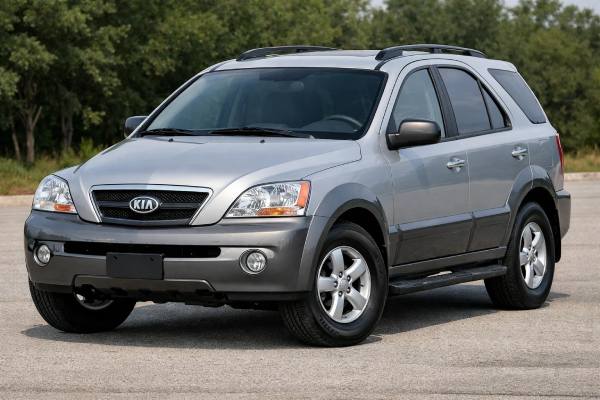
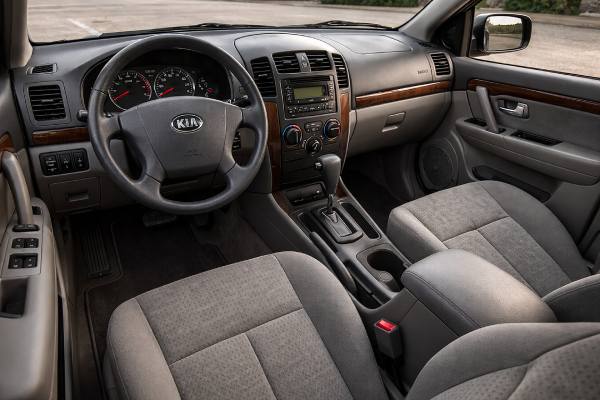
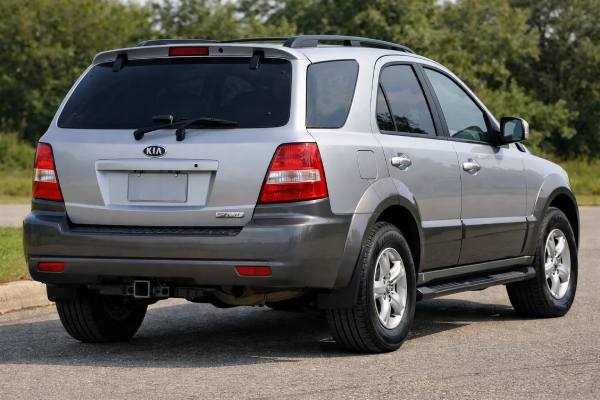
The first-generation Sorento BL is an old-school SUV in the best and worst ways: body-on-frame construction, a proper longitudinal drivetrain, and the kind of mechanical simplicity that can still make sense for owners who value durability over polish. In RWD form with the G6CU 3.5 V6 (192 hp), it drives more like a light truck than a modern crossover—stable at speed, honest steering, and a predictable rear-drive balance when unloaded.
The trade-off is age-related upkeep. Rubber hardens, sensors get lazy, and neglected cooling or timing-belt service can turn a bargain into a project. If you buy one on condition (not just mileage), the Sorento BL RWD can be a practical, roomy workhorse with solid towing manners for its era and a chassis that tolerates rough roads better than many car-based SUVs.
What to Know
- Body-on-frame toughness and a true longitudinal layout suit rough roads and utility use better than many crossovers.
- The G6CU V6 is smooth and easy to service, with good parts availability in most markets.
- RWD steering feel is straightforward, but traction on wet or snow surfaces depends heavily on tyres and load in the rear.
- Budget for age-driven repairs (cooling, belts, sensors, bushings) even on “low-mileage” examples.
- Plan engine oil and filter changes about every 16,000 km or 12 months (10,000 miles) in normal use, and sooner in severe duty.
Section overview
- Sorento BL RWD V6 profile
- Sorento BL 3.5 V6 specs
- Sorento BL RWD trims and safety
- Known problems and fixes
- Maintenance schedule and buying tips
- On-road feel and fuel use
- Rivals and best alternatives
Sorento BL RWD V6 profile
Think of the 2002–2006 Sorento BL as Kia’s “traditional SUV” era: a ladder frame, a longitudinal engine bay, and suspension tuned to carry weight and handle imperfect roads. In RWD form, the layout is simple—engine up front, driveshaft to a solid rear axle—so the chassis has fewer front driveline parts than the 4WD versions. That simplicity can reduce some maintenance burden (no transfer case service, no front CV joints), and it also changes how the vehicle feels: lighter steering, slightly cleaner turning behavior in tight spaces, and less driveline wind-up on dry pavement.
The G6CU 3.5-liter V6 is the headline for drivability. At 192 hp in the stated tune, it delivers usable midrange torque and a more relaxed highway character than the smaller four-cylinder options. It’s not a modern high-efficiency engine, but it tends to be straightforward to diagnose: conventional ignition, conventional sensors, and a timing-belt service that—while critical—follows familiar patterns for any belt-driven DOHC V6 of the era.
Ownership reality comes down to two questions:
- Is it structurally sound? Frame and underbody corrosion can be the deciding factor in colder, salted regions. A clean body doesn’t guarantee a clean frame, so buyers should inspect critical seams and boxed sections.
- Was it maintained on schedule? Old SUVs hide neglect well. A quiet engine at idle can still have overdue coolant, aged belts, and brittle hoses. For the G6CU, a missed timing-belt interval is not a “maybe later” item—it’s a “verify now” item.
Where this Sorento still shines is utility. The cabin is boxy, visibility is good by modern standards, and the chassis can tolerate potholes and loading in a way that many unibody crossovers do not. If your use case is mixed city and highway with occasional hauling, the Sorento BL RWD can be a rational choice—provided you buy the best-maintained example you can find and treat maintenance as part of the purchase price.
Sorento BL 3.5 V6 specs
Below is a practical specification set for the Sorento BL RWD with the G6CU 3.5 V6 (192 hp). Exact numbers vary by market, model year, and transmission. Use the ranges to sanity-check listings and plan service.
Powertrain and efficiency
| Item | Specification |
|---|---|
| Code | G6CU |
| Engine layout and cylinders | V6, 6 cylinders; DOHC; 4 valves/cyl |
| Displacement | 3.5 L (3497 cc) |
| Induction | Naturally aspirated |
| Fuel system | Port fuel injection (PFI/MPFI depending on market) |
| Compression ratio | Varies by market (typ. ~10:1 class) |
| Max power | 192 hp (143 kW) @ rpm (market-dependent) |
| Max torque | Typically ~280–300 Nm (206–221 lb-ft) @ rpm (market-dependent) |
| Timing drive | Belt |
| Rated efficiency | Varies widely by cycle/market; expect high single-digit to low double-digit L/100 km in mixed driving |
| Real-world highway @ 120 km/h (75 mph) | Commonly ~10–12 L/100 km (23–20 mpg US / 28–24 mpg UK) depending on tyres, load, and gearing |
Transmission and driveline
| Item | Specification |
|---|---|
| Transmission | 5-speed manual or 4/5-speed automatic (market/year dependent) |
| Drive type | RWD |
| Differential | Typically open rear differential |
Chassis and dimensions
| Item | Specification |
|---|---|
| Suspension (front/rear) | Independent front; solid rear axle (multi-link/coil setup in most markets) |
| Steering | Hydraulic power steering (ratio varies by year) |
| Brakes | Front disc / rear disc (some markets may vary); check rotor size by trim |
| Wheels/tyres (popular) | Common: 235/70 R16 or 245/70 R16 (varies by trim/market) |
| Ground clearance | ~203 mm (8.0 in) |
| Length / width / height | ~4567 mm (179.8 in) / 1865 mm (73.4 in) / ~1730 mm (68.1 in) |
| Wheelbase | ~2710 mm (106.7 in) |
| Turning circle (kerb-to-kerb) | Typically ~11.0–11.5 m (36–38 ft) |
| Kerb (curb) weight | Commonly ~1800–1950 kg (3970–4300 lb) |
| GVWR | Market/trim dependent; verify on door-jamb plate |
| Fuel tank | Often ~80 L (21.1 US gal / 17.6 UK gal) |
| Cargo volume | Varies by method; typical “SUV box” practicality is strong even if published VDA/SAE figures differ |
Performance and capability
| Item | Typical range |
|---|---|
| Acceleration 0–100 km/h (0–62 mph) | ~10–12 s (transmission and load dependent) |
| Top speed | ~170–180 km/h (106–112 mph) |
| Braking distance 100–0 km/h | Depends heavily on tyres and brake condition; older ABS calibration varies |
| Towing capacity | Market-rated; confirm from handbook/plate. Many examples are rated in the 1800–2500 kg class when properly equipped |
| Payload | Market/trim dependent; verify on vehicle sticker |
Fluids and service capacities (typical planning values)
These are for planning and comparison. Always verify for your VIN/market.
| Item | Typical specification |
|---|---|
| Engine oil | Usually 5W-30/5W-40 class (climate dependent); capacity varies by sump/filter |
| Coolant | Ethylene-glycol long-life coolant; mix ratio typically 50/50 unless climate dictates |
| Transmission/ATF | Spec varies by transmission; use the correct Kia-approved ATF only |
| Differential oil | GL-5 gear oil commonly used; viscosity depends on climate and axle spec |
| A/C refrigerant | Commonly R134a in this era; charge varies by market |
| Key torque specs (critical fasteners only) | Wheel lug nuts often ~90–110 Nm (66–81 lb-ft); verify for wheel type |
Safety and driver assistance (era-appropriate)
| Item | Notes |
|---|---|
| Crash ratings | Vary by year/market; check official rating pages for your exact model year |
| ADAS suite | This era generally has no AEB, ACC, or lane support. Expect ABS and (in later years/markets) ESC/TCS availability depending on trim |
Sorento BL RWD trims and safety
Trim naming varies by country, but most Sorento BL lineups follow a familiar pattern: a base trim focused on value, a mid-grade with comfort equipment, and a top trim with leather and convenience features. Because this generation mixes “truck” fundamentals with car-like interior options, it’s worth focusing on what changes ownership outcomes—driveline equipment, braking hardware, and safety systems—rather than just cosmetics.
Trims and options that matter
Common trim themes you will see:
- Base/value trims (often LX or similar): cloth seats, simpler audio, fewer power features, sometimes smaller wheels that ride better and cost less to re-tyre.
- Mid trims (often EX or similar): more power features, upgraded audio, possible limited-slip or towing package variations by market.
- Top trims (often with “Limited” naming): leather, sunroof, premium audio, and cosmetic upgrades that can raise replacement costs (bigger wheels, more electronics).
Practical identifiers when shopping:
- Interior tells: leather vs cloth, steering wheel controls, sunroof presence, and head-unit type are quick signals of trim tier.
- Underbody clues: rear tow hitch wiring and a factory receiver often indicate towing preparation; check for proper cooling system upkeep if towing is likely.
- Brakes and wheels: larger wheel packages can mean different brake sizes or at least different pad/rotor part numbers. Always match parts to VIN.
Year-to-year differences are usually evolutionary rather than radical. Still, it’s common for later-year examples to have more standardized safety equipment (depending on region) and minor calibration improvements for engine/transmission behavior.
Safety ratings and what they really mean here
When you read crash ratings for a 2002–2006 SUV, keep two realities in mind:
- Test protocols evolved. A “good” rating in an older test does not automatically translate to modern crash performance. Likewise, a missing rating often means “not tested,” not “unsafe.”
- Trim and equipment can affect results. Side airbag availability, ESC availability, tyre choices, and even ride height changes can influence real-world outcomes.
In this generation, the most meaningful safety equipment is often basic but impactful:
- ABS: widely fitted, but verify function during a test drive (pulsation under hard braking on a loose surface, no warning lights).
- ESC/TCS (where fitted): on a tall, body-on-frame SUV, stability control can materially reduce loss-of-control risk. If you can choose a trim/year with ESC in your market, it’s a worthwhile priority.
- Airbags: expect front airbags as standard; side airbags may be trim- or market-dependent.
Driver assistance and service implications
There is essentially no modern ADAS here, which simplifies ownership:
- No radar sensors to align.
- No camera calibration after windshield replacement.
- No automated braking systems to diagnose.
That said, basic safety systems still require correct service practices. If ABS or stability-control warning lights appear, the fix is often a wheel-speed sensor, wiring damage, or a tone ring issue—small parts that can create big safety consequences if ignored. For buyers, “no warning lights” is not enough; you want proof of correct tyre sizing on all corners and a clean scan of stored fault codes if possible.
Known problems and fixes
At this age, the Sorento BL’s issues are less about a single fatal flaw and more about maintenance history plus time. Below is a practical map of common, occasional, and rarer issues, with symptoms, root causes, and the kind of repair you should expect.
Common: age-and-service driven
- Timing belt interval missed (high severity):
Symptoms: unknown service history, belt noise, or simply no documentation.
Likely cause: overdue belt, aged tensioners/idlers, sometimes water pump not replaced “while you’re in there.”
Remedy: replace timing belt kit (belt, tensioner, idlers) and usually water pump. Treat this as a purchase requirement, not a future plan. - Cooling system fatigue (medium to high severity if ignored):
Symptoms: temperature creep under load, coolant smell, crusted radiator end tanks, heater performance changes.
Likely cause: old coolant, brittle hoses, radiator aging, weak thermostat.
Remedy: pressure test, replace weak components, refresh coolant with correct spec mix, and confirm fans operate properly. - Oil leaks from gaskets and seals (low to medium severity):
Symptoms: burning oil smell near exhaust, drips, wet valve covers.
Likely cause: valve cover gaskets and aging seals.
Remedy: gasket replacement and PCV system check (a restricted PCV can worsen seepage).
Occasional: drivability and electrics
- Crank/cam sensor or ignition-related misfires (medium severity):
Symptoms: intermittent stalling, rough running, check-engine light under heat soak.
Likely cause: aging sensors, coil degradation, wiring fatigue.
Remedy: scan data, confirm sensor signals, replace with quality parts, inspect connectors for oil intrusion. - Automatic transmission shift quality concerns (medium severity):
Symptoms: flare on upshift, delayed engagement, harsh shifting when cold/hot.
Likely cause: aged ATF, solenoid wear, valve-body contamination, or incorrect fluid spec.
Remedy: correct-fluid service (not “universal” ATF), filter service where applicable, and diagnosis before committing to a rebuild. - Front-end clunks and loose steering feel (low to medium severity):
Symptoms: knocking over bumps, wandering, uneven tyre wear.
Likely cause: worn sway bar links, control-arm bushings, ball joints, or steering linkage play.
Remedy: systematic inspection with pry-bar checks; align after parts replacement.
Rare but costly: structure and corrosion
- Frame and underbody corrosion (high severity):
Symptoms: flaking scale on frame, soft spots, questionable repairs, misaligned panels, or “fresh undercoat” hiding rust.
Likely cause: salted-road exposure and time.
Remedy: walk away from severe structural rust. Cosmetic rust is manageable; structural frame corrosion is not.
Recalls, TSBs, and service actions (how to handle)
For a vehicle this old, your goal is not to memorize every bulletin—it’s to verify completion:
- Run the VIN through the official recall database for your country.
- Ask for dealer printouts or prior repair invoices.
- If records are missing, assume unknown status and budget for baseline safety maintenance (brakes, tyres, suspension, fluids).
Pre-purchase checks worth paying for
- Compression balance and scan for pending codes.
- Cooling system pressure test and inspection for oil/coolant cross-contamination.
- Evidence of timing belt replacement (dated invoice, parts stickers, or shop record).
- Road test for transmission behavior (cold start and fully warm).
- Underbody inspection focusing on frame rails, mounts, and suspension pickup points.
Maintenance schedule and buying tips
A strong maintenance plan for the Sorento BL RWD is about preventing “small” failures from becoming expensive ones. Use the schedule below as a practical baseline, then adjust for your climate and driving style.
Practical maintenance schedule (distance/time)
- Engine oil and filter: every 16,000 km or 12 months (10,000 miles) in normal use; consider 8,000–10,000 km (5,000–6,000 miles) for short trips, heavy city driving, or hot/cold extremes.
- Air filter (engine): inspect every oil change; replace about every 24,000–32,000 km (15,000–20,000 miles) or sooner in dusty regions.
- Cabin air filter: every 12 months (or twice yearly if you drive in dusty cities).
- Coolant: typically every 4–5 years; sooner if the coolant is unknown or contaminated.
- Spark plugs: commonly 48,000–96,000 km (30,000–60,000 miles) depending on plug type and market spec; replace coils or wires only if testing indicates.
- Serpentine/aux belt and hoses: inspect every service; replace at first signs of cracking, glazing, or softness.
- Timing belt service: follow the manufacturer interval for your market; many owners treat ~100,000 km (60,000 miles) or ~5 years as a conservative standard on older belt-driven engines. Replace tensioners/idlers and often the water pump at the same time.
- Automatic transmission fluid (if equipped): service every 60,000–80,000 km (40,000–50,000 miles) unless the handbook specifies otherwise. Use only the correct specification fluid.
- Rear differential oil: every 60,000–80,000 km or sooner if towing.
- Brake fluid: every 2 years regardless of mileage.
- Brake pads/rotors: inspect at every service; replace based on thickness and condition, not guesswork.
- Tyre rotation and alignment: rotate every 10,000–12,000 km; align annually or when you change suspension parts.
- 12 V battery: test annually after 3 years; replace proactively around 4–6 years depending on climate.
Fluids and specifications (decision-ready guidance)
- Choose oil viscosity based on climate and the handbook, but avoid “mystery blends.” A high-mileage engine benefits more from correct viscosity and frequent changes than from thick oil as a band-aid.
- For the automatic transmission, the wrong ATF is a common hidden cause of poor shift quality. If records are unclear, service it correctly and then evaluate behavior—don’t assume the gearbox is bad before confirming fluid spec and level.
Essential torque values (common planning figures)
Always verify for your exact hardware, but these are typical decision-grade numbers:
- Wheel lug nuts: ~90–110 Nm (66–81 lb-ft)
- Engine oil drain plug: often ~30–40 Nm (22–30 lb-ft)
- Spark plugs: often ~18–25 Nm (13–18 lb-ft)
Buyer’s guide: what to seek, what to avoid
Prefer:
- Documented timing-belt service, coolant service, and regular oil changes.
- Clean frame rails and intact factory seams (no “fresh undercoat mystery”).
- Straight tracking on the road, even tyre wear, and quiet driveline.
Be cautious with:
- “Low mileage” examples with missing records (age still degrades rubber and fluids).
- Overheated history (even one event can warp components).
- Modified suspension lifts or oversized tyres (they can stress steering and driveline parts).
Likely reconditioning costs after purchase:
- Full fluid baseline (oil, coolant, brake fluid, diff oil, possibly ATF).
- Suspension wear items (links, bushings, ball joints).
- Brake refresh and a full set of tyres if date codes are old.
Long-term durability is realistic if you treat maintenance as part of normal ownership. The BL Sorento does not demand exotic tools, but it does demand consistency.
On-road feel and fuel use
The Sorento BL RWD feels fundamentally different from modern unibody SUVs. You sit higher, the body structure communicates more road texture, and the suspension’s first priority is control over rough surfaces rather than “car-like” isolation. Many owners actually prefer this for bad roads and utility use, because the chassis feels robust and predictable when loaded.
Real-world ride, handling, and NVH
- Ride quality: generally firm at low speed, with a sturdy “one-piece” feel over potholes. The rear axle can feel busy on broken pavement when unladen; adding cargo often improves rear composure.
- Handling balance: stable and safe at moderate speeds, but tall-body roll is present. This isn’t a vehicle you buy for sharp turn-in; you buy it for steadiness and ground clearance.
- Steering: typically light-to-moderate hydraulic assist. Feedback is honest but not sporty, and worn front-end parts can make it wander—so a tight, well-aligned example feels noticeably better than a neglected one.
- Braking feel: adequate when the system is healthy. Old brake fluid, worn caliper slides, and low-quality pads can make the pedal feel inconsistent, so maintenance quality matters more than the brake design.
Powertrain character (G6CU V6)
The 3.5 V6 is usually the best match for the Sorento’s weight. Expect:
- Smooth delivery and better midrange than the smaller engines.
- Predictable throttle response (older calibration; not “instant,” but consistent).
- Automatic behavior that depends strongly on fluid condition and adaptation. A good unit shifts decisively without flare. A tired unit often hesitates into gear or hunts on grades.
Real-world efficiency (what owners actually see)
Fuel consumption varies widely because tyre choice, alignment, load, and driving speed matter more on a tall SUV. A realistic expectation set:
- City: often in the 13–16 L/100 km range (18–15 mpg US / 22–18 mpg UK), depending on traffic and warm-up time.
- Highway (100–120 km/h): often 10–12 L/100 km (23–20 mpg US / 28–24 mpg UK) if tyres and alignment are correct.
- Mixed: commonly 11–14 L/100 km (21–17 mpg US / 26–20 mpg UK).
Cold weather can raise consumption notably because warm-up is slower and driveline oils thicken. If your vehicle spends its life on short trips, budget more for fuel and for maintenance (oil changes and battery life).
Load and towing notes
When properly equipped and maintained, the Sorento BL’s truck-style foundation supports towing better than many crossovers of the same era. The key is temperature management:
- Keep the cooling system healthy.
- Use the correct transmission fluid and consider more frequent service if you tow.
- Ensure brakes and tyres are high quality; they control the outcome more than the engine does.
Rivals and best alternatives
The Sorento BL RWD sits in a specific niche: traditional SUV packaging at a typically lower entry price than the Japanese leaders. When comparing, focus on three things: structure condition, powertrain service costs, and parts availability in your region.
Closest rivals (same “traditional SUV” philosophy)
- Nissan Pathfinder (R50/R51 era): often strong V6 availability and decent long-distance comfort. Some versions offer better on-road refinement, but rust and transmission history can be deal-breakers. Choose based on condition and proof of correct servicing.
- Toyota 4Runner (similar era): typically excellent durability reputation and resale value. The downside is price—good ones cost more, and neglected ones still cost you later. If you can afford a clean 4Runner, it’s a benchmark.
- Mitsubishi Pajero/Montero Sport (market dependent): rugged, often very capable in poor conditions. Diesel variants can be appealing where supported, but maintenance quality varies dramatically by owner.
- Jeep Grand Cherokee (WJ era): comfortable and capable, but can demand more electrical and suspension attention as it ages. Great when maintained; frustrating when not.
Where the Sorento BL RWD wins
- Value for money: you often get body-on-frame strength and a roomy cabin for less than the big-name rivals.
- Simple drivetrain (in RWD form): fewer moving parts than 4WD versions can mean fewer wear points to chase.
- Practical packaging: boxy cargo area, straightforward ergonomics, and good sightlines.
Where it loses ground
- Modern safety and refinement: even the best BL Sorento won’t feel like a newer unibody SUV in NVH, braking sophistication, or crash-structure design.
- Fuel consumption: the V6 delivers usability, but it does not deliver modern efficiency.
- Age-related maintenance: by now, condition and documentation matter more than the badge.
Which alternative is “best” depends on your priority
- If you want maximum long-term durability and can pay more: a clean-era Toyota 4Runner is hard to beat.
- If you want balance of comfort and capability and you find a well-kept example: Pathfinder can be strong.
- If you want lowest cost to buy but still need a truck-style SUV: the Sorento BL RWD is compelling—if you verify frame condition and timing-belt history.
A practical rule: pick the vehicle with the best verified maintenance record and the cleanest structure, even if it’s not your first choice on paper. At this age, history beats hype.
References
- Vehicle Detail Search – 2004 KIA SORENTO 4 DR RWD 2004 (Recall Database)
- 2004 Kia Sorento 4-door SUV 2004 (Safety Rating)
- Engine Oil Grades and Capacities 2023 (Service Manual)
- Service Intervals 2026 (Owner’s Manual)
Disclaimer
This article is for informational purposes only and is not a substitute for professional diagnosis, inspection, or repair. Specifications, torque values, service intervals, and procedures can vary by VIN, market, model year, and equipment. Always confirm details using official Kia service information and the documentation specific to your vehicle.
If you found this guide useful, please consider sharing it on Facebook, X (Twitter), or your preferred platform to help others find reliable owner information.