
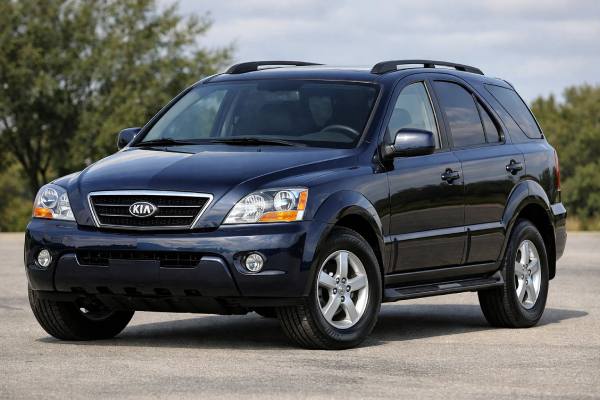
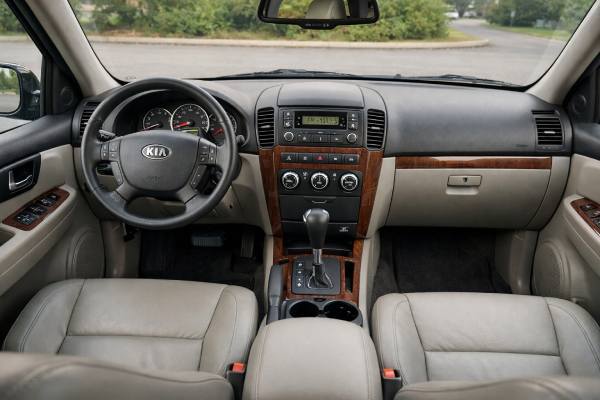
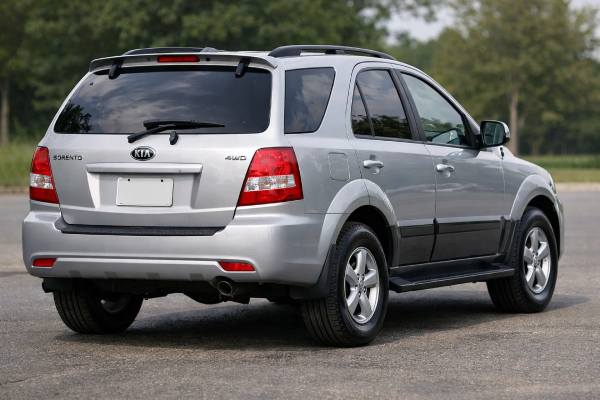
The facelift-era Kia Sorento BL with the 3.8-liter G6DA V6 is one of the more unusual midsize SUVs of its time: body-on-frame toughness, a strong naturally aspirated V6, and—here—rear-wheel drive that keeps the layout simple and often a bit lighter than 4WD versions. For owners, that combination can be a real value if your use is mostly road miles and occasional towing rather than deep mud or snow.
The 3.8’s biggest appeal is effortless torque for passing and hauling, paired with a conventional automatic and straightforward driveline. The trade-off is fuel use that reflects the vehicle’s weight and shape, plus the typical age-related work you should expect on a 2007–2009 SUV: cooling system upkeep, rubber bushings, and careful inspection for corrosion depending on climate history. Buy well, service consistently, and this Sorento can still be a dependable workhorse.
Owner Snapshot
- Strong V6 torque makes towing and highway merging feel easy for a mid-2000s SUV.
- RWD layout reduces 4WD complexity (no transfer case) and can mean fewer driveline service points.
- Body-on-frame chassis handles rough roads and payload better than many unibody crossovers of the same era.
- Watch for age-related cooling leaks, oil seepage, and suspension wear—repairs add up if deferred.
- Change engine oil every 8,000–10,000 km (5,000–6,000 mi) or 6 months in mixed/severe use.
Guide contents
- Sorento BL RWD facelift profile
- Sorento BL 3.8 specs and measurements
- Sorento BL equipment and safety
- Reliability problems and recalls
- Maintenance schedule and buying tips
- Road manners and fuel use
- Rivals and best alternatives
Sorento BL RWD facelift profile
Think of the 2007–2009 facelift Sorento BL as Kia’s “last of the old-school” midsize SUVs before crossovers took over. It rides on a body-on-frame chassis, uses a longitudinal (front-to-back) drivetrain layout, and—on this specific variant—sends power to the rear wheels. That matters for ownership because it shapes both the driving feel and the maintenance story.
What the facelift brought. The facelift years generally improved day-to-day livability: refreshed exterior details, interior revisions depending on market, and incremental changes to equipment packaging. The core mechanical concept stayed the same—truck-style underpinnings with SUV packaging—so you still get the benefits that attracted buyers originally: towing confidence, decent durability on broken pavement, and straightforward mechanical access compared with some tightly packaged unibody rivals.
Where the 3.8 V6 fits. The G6DA 3.8-liter V6 is the “top-end” engine choice in many markets, and it changes the Sorento’s personality. Instead of working hard to build speed, the V6 tends to move the vehicle with low-effort torque and calmer throttle inputs. For a used buyer, that often translates to less strain in everyday driving—especially with passengers, cargo, or a trailer—provided the cooling system and oil-change history are solid.
RWD specifically: why some buyers seek it out. If you don’t need low-range gearing or frequent winter traction, RWD has practical upsides:
- Less hardware to maintain than 4WD/AWD: no transfer case fluid, no front differential service, fewer seals and shafts.
- Potentially lower curb weight than a comparable 4WD build, which helps acceleration and can marginally help fuel use.
- Predictable towing behavior on dry roads, with a simpler driveline that many general repair shops understand well.
The flip side is traction on slick surfaces. With a light rear axle (no cargo, no trailer), RWD can spin a tire sooner on ice or wet hills, especially on older all-season tires. The solution is rarely exotic: quality tires, correct alignment, and realistic expectations in winter weather.
Who this Sorento suits best today. It’s a good fit for buyers who want a durable daily SUV with occasional towing duty and who prefer a simpler driveline over maximum all-weather capability. If your life includes deep snow, steep unpaved climbs, or frequent mud, you’ll usually be happier with the 4WD version—or a modern AWD crossover with updated stability systems—rather than forcing a RWD truck-based SUV into a role it wasn’t optimized for.
Sorento BL 3.8 specs and measurements
Specifications vary by market, trim, and homologation year, but the tables below reflect the Kia Sorento BL facelift (2007–2009) with the G6DA 3.8L V6 and rear-wheel drive. Use them as a practical reference, then verify against your VIN and local service documentation.
Powertrain and efficiency
| Item | Spec |
|---|---|
| Code | G6DA |
| Engine layout and cylinders | V6, 6 cylinders, DOHC, 4 valves/cyl |
| Bore × stroke | 96.0 × 87.0 mm (3.78 × 3.43 in) (typical G6DA) |
| Displacement | 3.8 L (3,778 cc) |
| Induction | Naturally aspirated (NA) |
| Fuel system | MPI (multi-point injection) (typical for this era) |
| Compression ratio | ~10.x:1 (varies by calibration/market) |
| Max power | 262 hp (195 kW) @ rpm* |
| Max torque | ~343–348 Nm (253–257 lb-ft) @ rpm* |
| Timing drive | Chain (Lambda V6 family) |
| Rated efficiency | Official figures vary; typical combined consumption often lands around 12–14 L/100 km (17–20 mpg US / 20–24 mpg UK) depending on gearing and test cycle |
| Real-world highway @ 120 km/h | Commonly 11–13 L/100 km (18–21 mpg US / 22–26 mpg UK) on healthy tires and correct alignment |
*Peak rpm values and exact torque curves vary by ECU calibration and emissions package.
Transmission and driveline
| Item | Spec |
|---|---|
| Transmission | 5-speed automatic (most common pairing; verify by VIN/door sticker) |
| Drive type | RWD |
| Differential | Typically open (limited-slip, if offered, is market/trim dependent) |
Chassis and dimensions
| Item | Spec |
|---|---|
| Suspension (front/rear) | Front independent (double wishbone-type in many markets) / rear solid axle with links |
| Steering | Hydraulic power steering (ratio varies by market) |
| Brakes | Disc front/rear (diameters vary by trim and wheel size) |
| Wheels/tyres (popular sizes) | Commonly 235/70 R16 or 245/65 R17 (market/trim dependent) |
| Ground clearance | Often around ~200 mm (~7.9 in) (varies by trim and tyre) |
| Length / width / height | Approximately 4,590–4,700 mm / ~1,865 mm / ~1,730–1,760 mm |
| Wheelbase | About ~2,710 mm (~106.7 in) |
| Turning circle (kerb-to-kerb) | Often ~11.2–11.8 m (36.7–38.7 ft) |
| Kerb (curb) weight | Commonly ~1,850–2,000 kg (4,080–4,410 lb) depending on equipment |
| Fuel tank | Often ~75–80 L (19.8–21.1 US gal / 16.5–17.6 UK gal) |
| Cargo volume | Method varies by market; expect a practical mid-size SUV load area with large variation by seat position and measurement standard |
Performance and capability
| Item | Spec |
|---|---|
| Acceleration 0–100 km/h (0–62 mph) | Typically ~8.5–9.5 s depending on weight and conditions |
| Top speed | Often ~185–195 km/h (115–121 mph) |
| Braking 100–0 km/h | Strongly tire- and brake-condition dependent; expect mid-40 m range when healthy |
| Towing capacity | Often up to ~2,200–2,700 kg (4,850–5,950 lb) braked depending on rating system and hitch class |
| Payload | Commonly ~450–650 kg (990–1,430 lb) depending on trim and GVWR |
Fluids and service capacities (typical, verify before filling)
| Item | Spec |
|---|---|
| Engine oil | API/ACEA per market; commonly 5W-20 or 5W-30; capacity often ~4.5–5.0 L (4.8–5.3 US qt) with filter |
| Coolant | Ethylene-glycol long-life coolant as specified by Kia/Hyundai; capacity varies by radiator and heater core |
| Transmission/ATF | Kia/Hyundai-spec ATF (often SP-III for many 5-speed units of this era); capacity varies widely by drain vs dry fill |
| Differential | Typically 75W-90 GL-5 gear oil (fill amount depends on housing) |
| A/C refrigerant | Type and charge depend on market label under hood; do not guess |
Safety and driver assistance (period-correct)
| Item | Spec |
|---|---|
| Crash ratings | IIHS published ratings for this generation (varies by test type and year); NHTSA provides recall and complaint data and may provide star ratings for some configurations |
| Headlight rating (IIHS) | Older vehicles often have no modern headlight score; verify by model year page |
| ADAS suite | Typically none (no AEB/ACC/LKA in this era); focus is on airbags, ABS, and stability systems where fitted |
Sorento BL equipment and safety
On the 2007–2009 Sorento BL facelift, trim names and equipment levels vary a lot by region, so the smartest approach is to identify what you’re looking at from physical cues and the VIN/build plate, then confirm option codes where possible. With the 3.8 V6, many vehicles were sold in higher trims, but it’s not automatic—some markets paired the V6 with relatively simple interiors.
Trims and options that matter mechanically
Rather than focusing on luxury features, prioritize options that change ownership cost or capability:
- Tow package / hitch class: The presence of a factory-style hitch, transmission cooler, and correct wiring can materially affect towing reliability. A retrofit hitch is fine, but make sure cooling and wiring were done properly.
- Wheel and tire package: Larger wheels can improve steering response but may worsen ride on rough roads and increase tire cost. On an older SUV, ride quality and tire availability often matter more than appearance.
- Brake package differences: Some trims and markets use different rotor sizes or caliper setups. When you do brakes, matching parts to the exact build prevents vibration and uneven pad wear.
- Interior seating and comfort options: Leather, power seats, sunroof, and premium audio don’t change drivability, but they do change the list of potential failures (window regulators, seat motors, sunroof drains, amplifier corrosion).
Quick identifiers when shopping
A practical “parking-lot checklist” helps you avoid misidentified vehicles:
- Engine confirmation: The V6 typically has a wider intake manifold and different engine cover layout than four-cylinder/diesel variants. If the seller can’t clearly confirm engine type, treat it as a red flag until you see documentation.
- RWD vs 4WD: Look under the vehicle: RWD has a rear driveshaft and rear differential but no front driveshaft/transfer case output to the front axle. If you see a transfer case and front prop shaft, it’s not RWD.
- Rear axle condition: Check for wetness around the differential cover and axle seals. A light “mist” may be old residue, but active seepage needs attention.
Safety systems and what to expect
This era’s safety is primarily structural design + basic electronic aids, not modern driver assistance. Typical equipment includes:
- Airbags: Front airbags are common; side and curtain airbags vary by market and trim. If side-curtain airbags are present, they usually have labels on the A- or B-pillar trim.
- ABS and stability control: ABS is common. Stability control (ESC) availability varies by market; if equipped, there’s usually a dash icon and sometimes a disable button.
- Child seat provisions: Many markets use ISOFIX/LATCH anchors, but the number of positions and tether anchor placement vary. Confirm with the seat hardware and labels, not assumptions.
Crash-test ratings: how to interpret them for a 2007–2009 SUV
When you read ratings for an older model, focus on two things:
- Which test version was used: Moderate overlap frontal and side tests have evolved, so compare within the same era rather than to a 2025 vehicle.
- Which equipment was on the tested vehicle: Airbag configuration and stability systems can differ by trim and market.
In practical terms, you should treat crash ratings as one input. For real-world safety, your best wins come from: correct tires, working brakes, functioning ABS/ESC, and headlights that actually perform well at night (fresh lenses, quality bulbs, proper aim).
Reliability problems and recalls
At this age, reliability is less about a single “bad design” and more about whether the Sorento has been maintained on time, repaired correctly, and kept away from corrosion damage. The 3.8 V6 itself is generally respected for smooth power, but any engine can become expensive if it’s overheated, run low on oil, or neglected.
Below is a practical issue map by prevalence and cost tier, followed by symptoms and fixes.
Common (expect to see) — low to medium cost
- Cooling system seepage and aging plastics
Symptoms: Sweet smell, slow coolant loss, damp radiator seams, intermittent overheating in traffic.
Likely causes: Radiator end tanks aging, hose clamps loosening, thermostat wear, tired cap.
Remedy: Pressure test, replace weak components as a set (cap/hoses/thermostat as needed), and use the correct coolant type. - Oil seepage from gaskets and seals
Symptoms: Oil smell after a drive, wet valve cover edges, drips near front cover area.
Likely causes: Valve cover gaskets hardening; general seal aging.
Remedy: Reseal with quality gaskets; confirm PCV function to reduce crankcase pressure. - Ignition wear: plugs and coil issues
Symptoms: Misfire under load, flashing check-engine light, rough idle.
Likely causes: Old spark plugs, weakening coil(s), moisture intrusion at connectors.
Remedy: Replace plugs at proper interval; test coils rather than guessing; inspect boots.
Occasional — medium cost
- Automatic transmission shift quality complaints
Symptoms: Hesitation, harsh shifts, delayed engagement when cold.
Likely causes: Old ATF, incorrect fluid type, worn mounts, adaptation issues.
Remedy: Verify correct ATF specification, service fluid appropriately (drain/fill cycles are often safer than aggressive flushing on high-mileage units), and check mounts before condemning the transmission. - Rear differential noise or seepage
Symptoms: Whine on cruise, clunk on take-up, wet pinion seal area.
Likely causes: Aged gear oil, bearing wear, seal wear, driveline U-joint play.
Remedy: Inspect U-joints first, service gear oil, then evaluate bearings/seals. - Front suspension wear
Symptoms: Clunks over bumps, vague steering, uneven tire wear.
Likely causes: Ball joints, control arm bushings, sway bar links, shocks/struts aging.
Remedy: Replace worn parts in matched pairs; align after suspension work.
Rare but high impact — higher cost
- Overheating events leading to engine damage
Symptoms: Temperature spikes, repeated coolant loss, milky oil (worst case).
Likely causes: Ignored leaks, failed radiator, severe hose failure.
Remedy: Treat overheating as urgent. A single severe overheat can turn a good V6 into a costly project. - Corrosion hotspots (market dependent)
Symptoms: Flaky frame sections, brake/fuel line corrosion, seized fasteners, recurring alignment issues.
Likely causes: Road salt exposure, poor underbody washing, long-term outdoor storage.
Remedy: Inspect thoroughly before purchase; structural corrosion is a “walk away” in many cases.
Recalls, TSBs, and service actions: what to do now
For the facelift Sorento generation, the safest habit is to assume there may be open recalls or service campaigns depending on market. Your steps:
- Run a VIN check using an official recall database (national transport authority site where applicable).
- Ask the seller for dealer service history showing recall completion.
- Inspect for recall-related symptoms (for example, warning lights, ABS behavior, unusual brake pedal feel) and confirm repairs with documentation, not promises.
Even when a recall is completed, parts age continues. Consider a post-purchase baseline inspection—fluids, brakes, tires, and a cooling system pressure test—so you start ownership from a known condition.
Maintenance schedule and buying tips
A 2007–2009 Sorento BL can be a satisfying long-term SUV if you follow a maintenance rhythm that matches its age and mission. The goal is to prevent the expensive events—overheating, transmission distress, and driveline wear—by staying ahead of fluids and rubber parts.
Practical maintenance schedule (distance/time)
Use the shorter interval if you do short trips, heavy city driving, towing, or hot/cold extremes.
| Item | Interval (typical) | Notes |
|---|---|---|
| Engine oil and filter | 8,000–10,000 km (5,000–6,000 mi) or 6 months | Use the viscosity specified for your climate; keep level near full |
| Engine air filter | 15,000–30,000 km | More often in dusty areas |
| Cabin air filter | 15,000–30,000 km | Helps HVAC performance and odor control |
| Coolant | Every 4–5 years | Earlier if any contamination or recurring loss |
| Spark plugs | ~60,000–100,000 km | Depends on plug type; confirm what’s installed |
| Serpentine belt and hoses | Inspect every service; replace by condition | Replace at first cracking/glazing or swelling |
| Automatic transmission fluid | 40,000–60,000 km (heavy use) / 60,000–90,000 km (light use) | Use correct ATF spec; avoid “universal” fluids |
| Rear differential oil | 60,000–90,000 km | More often with towing |
| Brake fluid | Every 2 years | Moisture control protects ABS components |
| Brake pads/rotors | Inspect every 10,000–15,000 km | Caliper slide lubrication is crucial on older vehicles |
| Tire rotation and balance | 8,000–10,000 km | Extend tire life and reduce vibration |
| Alignment check | Annually or with tire wear | Especially after suspension work |
| 12 V battery test | Annually; replace typically 4–6 years | Weak batteries trigger odd electrical issues |
Fluids, specifications, and “don’t guess” rules
Because specs vary by market, use these guidelines safely:
- Engine oil: Choose the manufacturer-recommended viscosity for your climate; for many markets, 5W-20 or 5W-30 is common.
- ATF: Confirm the exact transmission and required fluid. Using the wrong ATF is a fast path to shift issues.
- Coolant: Match the coolant chemistry to what the system is designed for; mixing types can create sludge and corrosion.
- Gear oil: A quality GL-5 75W-90 is typical for the rear differential, but confirm if your axle has special requirements.
Key torque specs (use as decision guidance, verify before final tightening)
- Wheel lug nuts: commonly ~90–110 Nm (66–81 lb-ft)
- Spark plugs: often ~18–25 Nm (13–18 lb-ft) depending on plug design
- Oil drain plug: commonly ~30–40 Nm (22–30 lb-ft)
If you’re not certain, treat torque numbers as “lookup required” rather than “close enough.” Stripped threads on an older engine or axle housing are avoidable pain.
Buyer’s guide: what to check before paying
Bring a checklist and insist on a cold start.
- Cooling system health: No oil in coolant, stable temperature, fans cycling correctly, no pressure buildup immediately from cold.
- Transmission behavior: Smooth engagement into Drive/Reverse, no flare (engine revs rising without speed), no burnt ATF smell.
- Driveline and rear axle: No clunks on take-up, no vibration under load, no wet pinion seal area.
- Suspension and steering: Even tire wear, no wandering, no repeated clunks over small bumps.
- Rust and underbody: Inspect frame sections, brake/fuel lines, and mounting points. Severe corrosion is a deal-breaker.
- Electrical and HVAC: Windows, locks, blower speeds, A/C performance, and instrument cluster lights.
Best ownership outlook: These Sorentos reward buyers who purchase based on condition, not mileage alone. A clean, documented example that has had fluids, cooling parts, and suspension work done can be far cheaper over three years than a “cheap” one that needs everything at once.
Road manners and fuel use
The Sorento BL facelift drives like what it is: a midsize SUV with truck-style foundations, refined by a strong V6. If you’re coming from a modern unibody crossover, you’ll notice the difference immediately—especially in ride motions over bumps and the way the chassis feels when loaded.
Ride, handling, and NVH
- Ride quality: The body-on-frame structure and rear solid axle (common on this platform) tend to feel sturdy on rough roads, but you may also feel more vertical motion over sharp edges compared with unibody SUVs. Fresh shocks and correct tire pressure make a bigger difference than many owners expect.
- Steering: Hydraulic steering usually feels more natural than early electric systems, but wear in front-end joints can make it vague. A good example tracks straight and doesn’t require constant correction.
- Cabin noise: Expect more wind and road noise than a current crossover at 120 km/h, especially if door seals are tired or the tires are aggressive. Quiet tires and a proper alignment are the best “NVH upgrades” you can buy.
Powertrain character: the 3.8 V6 advantage
This V6 is about effortless midrange, not high-rev drama. Around town, it allows light throttle driving without constant downshifts. On the highway, it gives you confident passing power, which is valuable in a heavier SUV. The trade-off is fuel use: there is no turbo efficiency trick here—just displacement moving mass.
The 5-speed automatic (typical pairing) is generally predictable. If it’s hunting between gears on gentle grades, that can indicate:
- Old ATF or the wrong ATF
- A failing mount that changes driveline angles
- Tires with mismatched rolling diameters (yes, even on RWD, bad tire matching can create odd behaviors)
Real-world efficiency expectations
Rather than fixating on a single number, plan around realistic ranges:
- City-heavy use: often 14–17 L/100 km (14–17 mpg US / 17–20 mpg UK) depending on traffic and warm-up time.
- Highway 100–120 km/h: often 11–13 L/100 km (18–21 mpg US / 22–26 mpg UK).
- Cold weather: add 5–15% consumption penalty depending on trip length and tire choice.
If your numbers are worse than these ranges, check tire pressure, alignment, brake drag, and any check-engine codes first. A partially stuck brake caliper or tired oxygen sensor can quietly cost you fuel every day.
Towing and load behavior (where this Sorento shines)
With the V6, the Sorento is typically more comfortable towing than many four-cylinder crossovers of the same era. What matters for safe towing is not just engine power but cooling, braking, and stability:
- Use a weight-appropriate hitch and wiring; avoid improvised solutions.
- Service ATF and differential oil more frequently if you tow.
- Expect a significant fuel penalty under tow—often +20–40% depending on trailer shape and speed.
- Replace tired shocks before towing; stability improves dramatically.
For many owners, this is where the Sorento BL still makes sense today: it’s a capable, honest utility vehicle—provided it’s kept in good mechanical shape.
Rivals and best alternatives
When you compare a 2007–2009 Sorento BL V6 RWD to its peers, the key is to compare mission to mission. This Sorento is closer to traditional SUVs than to the car-like crossovers that became dominant soon after.
Traditional SUV rivals (closest match)
- Toyota 4Runner (same era): Typically stronger resale value and a long durability reputation. Often more expensive used, and parts can cost more. Many buyers choose it for proven longevity, but the price premium is real.
- Nissan Pathfinder (R51): Strong towing capability and available V6/V8 depending on market. Ownership can be excellent if maintained, but some examples carry higher risk of costly drivetrain or cooling-related issues depending on year and configuration.
- Jeep Grand Cherokee (WK): Great engine choices and strong towing. Can be rewarding but often demands more careful maintenance planning and budget for electrical and suspension-related aging.
Where the Sorento wins: purchase price, simpler ownership when you find a clean example, and a strong V6 that feels more modern than some older competitors.
Where it loses: safety tech is dated, fuel use is rarely a highlight, and corrosion history can be a deal-breaker in salty climates.
Crossover alternatives (if you don’t need body-on-frame)
If your use is mostly commuting, school runs, and light cargo, a unibody crossover can make more sense:
- Hyundai Santa Fe (same era): Often more car-like ride comfort and sometimes better fuel use, with less “truck feel.” Towing and rough-road robustness are usually lower.
- Honda Pilot / Toyota Highlander (same era): Typically more refined on-road, often better interior packaging. Usually costs more to buy in comparable condition.
Which buyers should still choose the Sorento BL V6 RWD?
Pick it if you want:
- A sturdy, conventional SUV feel
- Confident V6 torque for hills, passengers, and occasional towing
- A simpler driveline than a 4WD version
Skip it if you need:
- Frequent winter traction without changing your habits
- Modern driver assistance (AEB, ACC, lane support)
- Best-in-class fuel economy
The smart verdict
A good Sorento BL facelift is not “cheap transportation.” It’s value utility—a vehicle that can still do real work, but only if you buy based on condition and keep up with fluids, cooling health, and suspension wear. When you find one with documented service, clean underbody, and smooth transmission behavior, it can be a genuinely satisfying SUV for the right owner.
References
- Vehicle Detail Search – 2008 KIA SORENTO 2008 (Recall Database)
- 2008 Kia Sorento 4-door SUV 2008 (Safety Rating)
- Manuals & Docs 2026 (Owner’s Manual)
Disclaimer
This article is for informational purposes only and is not a substitute for professional inspection, diagnosis, or repair. Specifications, torque values, fluid types, service intervals, and procedures can vary by VIN, market, and equipment. Always verify details using your vehicle’s official owner’s manual and service documentation before performing maintenance or parts selection.
If this guide helped you, please consider sharing it on Facebook, X (Twitter), or your favorite forum/community to support our work.