
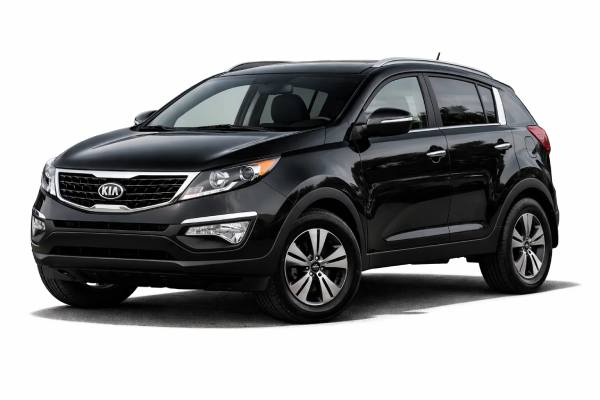
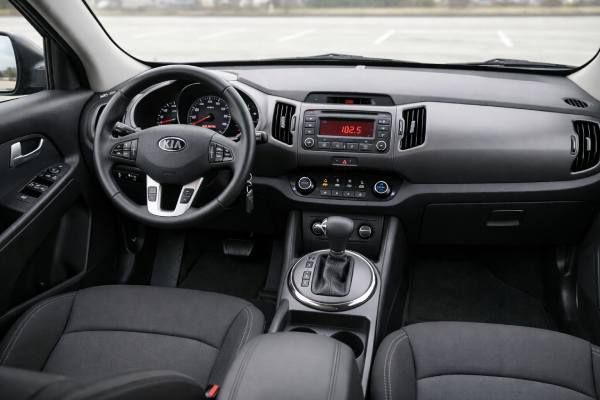
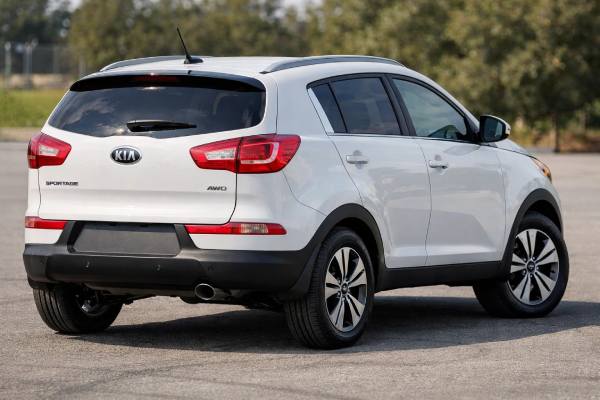
The 2011–2013 Kia Sportage SL was the version that pushed the Sportage into the modern compact-crossover class. In AWD form with the 2.4-liter G4KE petrol engine, it paired a much stronger body, better ride isolation, and a more polished cabin with a simple naturally aspirated four-cylinder and Kia’s front-biased Dynamax all-wheel-drive system. On paper, that makes it one of the most sensible SL variants for owners who want more traction and easier winter use without stepping into the turbo SX.
The catch is that this is still a used early-2010s crossover, and condition matters more than trim hype. The 2.4 MPI engine is generally more straightforward than later direct-injection petrols, but some engines were later covered by Kia’s KSDS software campaign because of connecting-rod-bearing concerns. Add normal suspension wear, stop-lamp-switch history on some 2011 cars, and the later HECU fire-risk recall, and the buying verdict becomes clear: the right Sportage is a solid value, while the wrong one can turn into a catch-up project.
Core Points
- The 2.4 AWD gives the SL useful real-world torque and better foul-weather confidence than the base front-drive models.
- Independent rear suspension helps the Sportage ride and track better than many budget crossovers from the same period.
- The cabin, cargo area, and rear-seat packaging still work well for family use.
- The main ownership caution is engine history: oil level discipline, KSDS status, and recall completion matter.
- A practical maintenance rhythm is every 20,000 miles or 12 months at the official baseline, with shorter oil intervals being the smarter used-car habit.
Start here
- Kia Sportage SL AWD identity
- Kia Sportage SL AWD spec data
- Kia Sportage SL AWD trims and safety
- Problem areas and Kia campaigns
- Maintenance routine and buyer advice
- Real-world driving and efficiency
- How the AWD Sportage stacks up
Kia Sportage SL AWD identity
The AWD 2.4 SL Sportage sits at the center of this generation’s appeal. It is not the stripped entry model, and it is not the quicker turbo SX either. Instead, it is the version many buyers ended up with because it combines the more useful 2.4-liter engine, the six-speed automatic, and on-demand all-wheel drive in a crossover that still feels modern enough today. That balance matters. The SL was a real leap over the older KM in styling, body rigidity, interior quality, and passive safety. It feels like a proper family crossover rather than a budget SUV trying to mimic one.
Mechanically, this variant is simpler than some buyers expect. The G4KE is a naturally aspirated 2.4-liter inline-four with multi-point injection, dual overhead camshafts, and continuously variable valve timing. That is a good ownership trait. It avoids the intake-valve carbon concerns that often shadow early direct-injection petrol engines, and it also avoids the added heat and plumbing of the turbocharged SX. In normal use, the engine is smooth, predictable, and easy to service. Its job is not to thrill. Its job is to move a compact SUV with enough ease that the car never feels underpowered in regular family use.
The AWD system also deserves a clear explanation. Kia marketed it as Dynamax, a front-biased setup that normally sends power to the front axle and shuffles torque rearward when conditions call for it. In slippery weather, it can manually lock into a near-even torque split at lower speed. That is useful for snow, wet grass, muddy tracks, or boat-ramp work, but it does not turn the Sportage into a hardcore off-roader. Ground clearance is modest, the approach and departure angles are decent but not extreme, and the tyres fitted to most U.S.-market AWD trims are road-focused rather than trail-oriented.
What makes the AWD 2.4 worth considering today is how coherent the whole package feels. The SL body is lower and wider than the older Sportage, but it still gives the commanding seat height buyers want. The chassis uses independent suspension at both ends, and that gives it a more mature, more settled ride than many cheaper rivals. The interior also still holds up reasonably well, especially in LX and EX form where equipment levels are strong without the SX’s heavier performance focus.
In used form, this variant is strongest when bought as a condition-led family crossover. Buyers who need a dependable winter commuter, a practical small SUV, or a value-priced alternative to a CR-V or RAV4 will understand its appeal quickly. Buyers chasing badge image or sportiness will not. This Sportage succeeds because it is balanced, not because it dominates a single category.
Kia Sportage SL AWD spec data
The 2011–2013 AWD 2.4 Sportage uses a spec sheet that looks modest by current standards but remains sensible for its size and era. The big picture is simple: decent power, a conventional six-speed automatic, a compact body, and enough traction hardware to make the AWD badge worth having in everyday driving.
Powertrain and efficiency
| Item | Kia Sportage AWD (SL) 2.4 |
|---|---|
| Code | G4KE |
| Engine layout and cylinders | Inline-4, DOHC, 4 cylinders, 4 valves/cyl |
| Bore × stroke | 88.0 × 97.0 mm (3.46 × 3.82 in) |
| Displacement | 2.4 L (2,359 cc) |
| Induction | Naturally aspirated |
| Fuel system | Multi-point injection |
| Compression ratio | 11.0:1 |
| Max power | 176 hp (131 kW) @ 6,000 rpm |
| Max torque | 228 Nm (168 lb-ft) @ 4,000 rpm |
| Timing drive | Chain |
| Rated efficiency | About 11.8 / 8.7 L/100 km city/highway |
| Rated efficiency in mpg | 20 / 27 mpg US, about 24.0 / 32.4 mpg UK |
| Real-world highway @ 120 km/h (75 mph) | Usually around 8.8–9.8 L/100 km in healthy trim |
Transmission, driveline, chassis, and dimensions
| Item | Kia Sportage AWD (SL) 2.4 |
|---|---|
| Transmission | 6-speed automatic with Sportmatic |
| Drive type | AWD |
| Differential | Open front and rear, with electronically managed center coupling |
| AWD system | Dynamax on-demand AWD with lock mode at lower speed |
| Suspension (front/rear) | MacPherson strut / multi-link |
| Steering | Rack-and-pinion, motor-driven assist; 2.96 turns lock-to-lock |
| Brakes | 300 mm (11.8 in) front discs; 284 mm (11.2 in) rear discs on AWD |
| Wheels and tyres | Most common AWD size: 235/55 R18 |
| Ground clearance | 172 mm (6.77 in) |
| Approach / departure angle | 28.1° / 28.2° |
| Length / width / height | 4,440 / 1,855 / 1,635 mm (174.8 / 73.0 / 64.4 in) |
| Height with roof rails | 1,645 mm (64.8 in) |
| Wheelbase | 2,640 mm (103.9 in) |
| Turning circle | 10.58 m (34.7 ft) |
| Kerb weight | About 1,522 kg (3,355 lb) in 2013 LX/EX AWD automatic form |
| GVWR | Verify by door-jamb certification label and VIN |
| Fuel tank | 58 L (15.3 US gal / 12.8 UK gal) |
| Cargo volume | 739 / 1,546 L (26.1 / 54.6 ft³), SAE-style measurement |
Performance, fluids, and safety
| Item | Kia Sportage AWD (SL) 2.4 |
|---|---|
| 0–100 km/h (0–62 mph) | Typically around the low-10-second range in period testing |
| Top speed | Roughly 180 km/h (112 mph), market and tyre dependent |
| Braking distance | Not consistently published in open official material for this exact trim |
| Towing capacity | 907 kg (2,000 lb) |
| Payload | Market and trim dependent; verify by certification label |
| Engine oil | About 4.4–4.6 L service fill range is typical; verify by VIN and dipstick |
| Oil grade | Use Kia-approved oil meeting owner-manual requirements for climate and market |
| Coolant | About 6.7 L (7.1 US qt) for automatic petrol |
| Automatic transmission fluid | About 7.1 L (7.5 US qt); SP-IV type |
| Rear differential oil | 0.65 L (0.69 US qt); API GL-5 SAE 75W/90 |
| Transfer case oil | 0.6 L (0.63 US qt); API GL-5 SAE 75W/90 |
| Brake / clutch fluid | 0.7–0.8 L; DOT-3 or DOT-4 |
| Wheel-nut torque | 88–107 Nm (65–79 lb-ft) |
| Crash ratings | Euro NCAP 5 stars; IIHS Good in moderate overlap front, side, roof strength, and head restraints |
| Headlight rating | Not issued in the older IIHS format for this exact period |
| ADAS suite | None; no AEB, ACC, lane-centering, or blind-spot monitoring |
The key technical point is that this Sportage is conventional in a good way. There is no hybrid layer, no dual-clutch gearbox, and no turbocharging on this engine. That simplicity is one of the main reasons it still makes sense as a used AWD crossover.
Kia Sportage SL AWD trims and safety
In the U.S. market, the AWD 2.4 Sportage was not usually the stripped model. The base trim leaned more heavily on front-wheel drive and the manual gearbox, while AWD was more common once buyers moved into LX and EX territory. That matters because the exact ownership feel of this Sportage depends heavily on trim. The same engine and drivetrain can feel either basic and sensible or genuinely well-equipped, depending on whether you are looking at a lower LX or a richer EX with more convenience features.
For 2011, Kia launched the new Sportage in Base, LX, and EX trims, with the turbo SX arriving later. By 2013, the lineup had settled into Base, LX, EX, and SX, and the 2.4-liter engine remained standard on Base, LX, and EX while the SX kept the turbo engine. For AWD buyers, the sweet spot is usually LX or EX. Those trims brought the automatic transmission, the all-wheel-drive option, and the equipment that makes the SL feel like more than just a stylish shell.
Useful identifiers are straightforward. The AWD 2.4 EX commonly rides on 18-inch alloys with 235/55 R18 tyres, while lower trims may use 17-inch or even 16-inch setups in some years or option combinations. EX models also added more upscale exterior trim, roof rails, upgraded climate control, better audio and infotainment content, and richer cabin materials. In 2012, Kia revised equipment by making 17-inch alloy wheels standard on LX and adding rear suspension dynamic dampers and improved floor insulation for better NVH. In 2013, LX gained LED accent lighting, while EX gained new options such as available power-folding mirrors. Those changes are not huge mechanically, but they do affect the feel and desirability of the used car.
Safety is one of the SL’s strongest selling points relative to older Sportages. Standard equipment in the early U.S. launch included advanced front airbags, front seat-mounted side airbags, side curtain airbags, ABS, ESC, EBD, brake assist, TPMS, hill-start assist, and downhill brake control. That was a strong package for the period, especially in a vehicle positioned below premium brands. It gave the Sportage a much more credible family-crossover safety case than the older KM.
Crash-test results support that improvement, with an important caveat. IIHS rated the redesigned 2011 Sportage Good in the original moderate-overlap frontal, side, roof-strength, and head-restraint tests, which helped it qualify for Top Safety Pick in the older IIHS criteria. That is a real strength. Later, when IIHS added the tougher small-overlap test, the Sportage generation performed poorly. So the honest reading is this: the 2011–2013 Sportage was strong by the standards in force when it launched, but it does not deliver the crash performance expected from newer compact SUVs.
What the SL does not offer is modern driver assistance. There is no autonomous emergency braking, adaptive cruise control, lane-keeping system, or blind-spot monitor. Buyers must judge it as a solid passive-safety crossover with stability electronics, not as an active-safety technology leader.
Problem areas and Kia campaigns
The AWD 2.4 Sportage has a reliability profile that is easy to understand once you separate normal used-car wear from the genuinely important factory campaigns. The biggest issue is not that every 2.4 fails. It is that some 2011–2013 Sportage vehicles with the 2.4 MPI engine were later included in Kia’s KSDS product-improvement campaign because of connecting-rod-bearing wear concerns. That moves engine history from “nice to have” to “core buying question.”
The main issues break down like this:
- Common, medium to high severity: engine noise or failure risk on poorly maintained 2.4 MPI cars.
Symptoms: metallic knock, warning lights, reduced power, or a blinking MIL after KSDS activation.
Likely root cause: excessive connecting-rod-bearing wear.
Recommended remedy: confirm whether KSDS software was installed, inspect immediately if symptoms appear, and do not keep driving a noisy engine. - Common, low to medium severity: suspension wear.
Symptoms: front-end clunks, vague straight-line feel, uneven tyre wear, humming wheel bearings.
Likely root cause: drop links, bushes, ball joints, dampers, or bearings aging out.
Recommended remedy: replace worn hardware in matched pairs and align the vehicle afterward. - Occasional, medium severity: AWD driveline neglect.
Symptoms: binding feel, unusual rear-end noise, vibration on full lock, or diff whine.
Likely root cause: overdue rear diff or transfer oil service, tyre-size mismatch, or worn coupling-related hardware.
Recommended remedy: correct tyre matching first, then service transfer and rear diff fluids and diagnose further if noise remains. - Occasional, low to medium severity: stop-lamp-switch faults on some 2011 vehicles.
Symptoms: intermittent brake-light operation, ESC lamp behavior, cruise-cancel issues, shift-interlock complaints.
Likely root cause: faulty stop-lamp switch.
Recommended remedy: confirm SC121 recall completion. - Occasional, high severity: HECU short-circuit risk on recalled vehicles.
Symptoms: sometimes no warning before failure; recall status is the main clue.
Likely root cause: internal HECU electrical short.
Recommended remedy: confirm SC284 or equivalent recall completion immediately.
Unlike the smaller 1.6 GDI Sportage, this 2.4 MPI engine does not make intake-valve carbon build-up a headline issue. That is a useful ownership advantage. It does, however, still care about oil condition. The chain drive is not a routine replacement item, but it depends on clean, correct oil and proper level checks. If a seller cannot show consistent oil service, the car deserves extra caution.
The campaigns are the major ownership dividing line. The KSDS product improvement for some 2011–2013 2.4 MPI Sportages added ECU logic to detect early bearing wear. Kia also tied extended engine coverage to completion of that campaign in the U.S. That is not the kind of update to ignore. Add the HECU fire-risk recall covering certain 2010–2013 Sportages and the 2011 stop-lamp-switch campaign, and the rule becomes simple: never buy this Sportage on appearance alone. Buy it on documentation.
For pre-purchase checks, request a cold start, a full fault-code scan, proof of recall and campaign completion, service records showing oil discipline, and inspection of the rear diff, transfer case, and underbody. A clean history is worth far more than a shinier example with no paperwork.
Maintenance routine and buyer advice
The official broad interval guidance for 2011–2015 Sportage models in Kia’s published service sheets is 20,000 miles or 12 months, whichever comes first. That may be the baseline, but it is not the smartest way to run an aging AWD 2.4 in mixed real-world use. Used examples benefit from a more conservative approach, especially when you remember that the engine’s long-term reputation depends heavily on oil condition and level awareness.
A practical maintenance schedule for the AWD 2.4 looks like this:
- Engine oil and filter: every 10,000 to 12,000 km, or 12 months at the outside on light use. On hard use or short trips, even sooner is sensible.
- Engine air filter and cabin filter: inspect every annual service and replace when loaded, usually every 20,000 to 30,000 km.
- Spark plugs: inspect on mileage and running quality; replace before misfires begin stressing coils or catalysts.
- Coolant: inspect condition and level regularly, then replace by time and service history rather than waiting for visible trouble.
- Automatic transmission fluid: do not rely on “lifetime fluid” thinking. A cautious used-car service at roughly 60,000 to 90,000 km intervals is sensible where history is unclear.
- Rear differential oil and transfer case oil: treat them as real service items on AWD cars, especially if the vehicle tows, sees snow, or runs mixed tyres in its history.
- Brake fluid: every 2 years.
- Brake pads, discs, and slider hardware: inspect at every service.
- Tyres: rotate regularly, keep all four closely matched, and do not mix rolling diameters on an on-demand AWD system.
- Suspension and steering: inspect bushes, links, bearings, and alignment yearly.
- 12 V battery: test from year four onward.
- Timing chain: no fixed replacement interval, but monitor for noise, oil-neglect history, and timing-related fault codes.
The useful public capacity data are good enough to make maintenance decisions. The fuel tank is 58 L, rear diff oil capacity is 0.65 L, transfer case oil capacity is 0.6 L, automatic-transmission fluid capacity is about 7.1 L, coolant for the automatic petrol is about 6.7 L, and wheel-nut torque is 88–107 Nm. For engine oil, verify final fill level by dipstick and the exact VIN-specific manual or service documentation before making hard decisions off a generic number.
Buyer inspection should start with the engine, not the body. Ask for a true cold start. The engine should fire cleanly, settle without harsh knock, and not show chain or bearing noise. Then drive it long enough to feel the automatic shift quality and the AWD behavior. A good Sportage should feel smooth, predictable, and stable, not jerky or reluctant.
Underneath, inspect for leaking dampers, cracked bushes, torn CV boots, diff seepage, rusty brake hardware, and accident repair. The SL is not as rust-prone as some older KMs, but winter-use neglect still shows up.
The best years to target are documented 2012–2013 cars with full campaign history and consistent oil service. A 2011 can still be a good buy, but only if the stop-lamp-switch recall and later campaign history are clear. Long-term durability is respectable when maintenance is routine and the engine has been cared for. Without that, this becomes exactly the sort of cheap AWD crossover that ends up costing more than a better rival.
Real-world driving and efficiency
The AWD 2.4 Sportage is one of those crossovers that feels better in daily use than its numbers suggest. It is not quick on paper, but it has enough mid-range pull that it rarely feels strained in the way smaller naturally aspirated engines can. Around town, the combination of upright seating, light steering, and smooth six-speed automatic makes it easy to place and easy to live with. The engine responds cleanly, the transmission usually behaves sensibly, and the car feels more mature than many buyers expect from an early-2010s value-brand SUV.
Ride quality is a clear strength. The SL’s independent rear suspension gives it a composed, planted character over patched roads and uneven surfaces. It does not feel floaty, but it also does not slam into expansion joints the way some cheaper crossovers do. The 18-inch tyre package common on AWD EX models adds a little firmness, yet the overall balance remains comfort-led. Straight-line stability is good, and the Sportage settles into highway cruising with more polish than the old KM ever managed.
Handling is safe and tidy rather than eager. The steering is light and not especially talkative, but the car turns in cleanly and holds a line predictably. The AWD system earns its keep mostly in poor conditions rather than dry-road excitement. In rain, snow, or slush, the Sportage puts power down more cleanly than the FWD versions and feels more composed when surfaces change grip mid-corner. The lock mode is useful on very low-traction surfaces, but this is still a road-biased AWD system. Tyres make a big difference. A good winter or all-weather set transforms the vehicle far more than the badge alone.
The 2.4 engine’s character suits the vehicle well. It is smoother and easiergoing than a small petrol working too hard, and it avoids the peaky, slightly abrupt feel some early turbo fours had. The automatic transmission is not lightning quick, but it generally shifts cleanly and does not hunt badly in normal use. Kickdown is acceptable rather than sharp. That fits the Sportage’s character: this is a relaxed family crossover, not a performance one.
In real fuel use, owners should expect more than the optimistic highway impression but not anything shocking for a naturally aspirated AWD compact SUV. The official U.S. figure is 20/27 mpg city/highway for the AWD 2.4 automatic. In reality, most healthy examples land around 10.5 to 11.8 L/100 km in mixed driving, with city-heavy use often in the low-12s and careful highway cruising nearer the high-8s or low-9s. At a true 120 km/h, around 8.8 to 9.8 L/100 km is realistic for a clean, properly aligned car on the right tyres.
Cold weather, roof accessories, winter tyres, a sticky brake caliper, or old spark plugs can all move those numbers in the wrong direction. Towing or a full vacation load can add 15 to 25 percent to consumption. Even so, the overall driving verdict is favorable. The AWD 2.4 Sportage feels solid, comfortable, and competent, and that matters more in this class than headline acceleration.
How the AWD Sportage stacks up
The Sportage AWD 2.4 sits in a used-car field full of familiar names, and that context matters. The most obvious rival is the Hyundai Tucson, because it shares much of its engineering and much of its reputation. In truth, those two are often impossible to separate on paper. Buy the one with the better underbody, the cleaner service file, and the fuller campaign history. Badge preference should come second.
Against the Honda CR-V and Toyota RAV4, the Sportage usually loses on long-term reputation, resale strength, and the sense that the vehicle will tolerate neglect indefinitely. Honda and Toyota still dominate that part of the conversation. But the Kia answers with design, equipment value, and a driving experience that often feels a little more substantial than people expect. The SL generation was a real step forward, and in good condition it does not feel like a bargain-bin alternative.
Compared with the Nissan Qashqai or Rogue Sport in markets where the comparison fits, the Sportage feels more like a true compact SUV and less like a tall hatchback. Against the Ford Escape of the same era, the Kia typically offers a calmer ownership profile than some of Ford’s more complicated powertrain choices. Against the Volkswagen Tiguan, it usually gives up badge cachet and some cabin detailing, but it can win on mechanical simplicity and lower used-market risk.
The exact AWD 2.4 version also deserves its own verdict inside the Sportage lineup. It is the balanced choice. The smaller petrols can feel underpowered once loaded, while the turbo SX adds pace but also more heat, more stress, and a slightly narrower sweet spot as a used buy. The AWD 2.4 is the one that makes sense for drivers in colder climates, for owners who see mixed weather, or for buyers who want a crossover that feels substantial without becoming fussy.
Its biggest weakness versus the best rivals is not how it drives. It is the need to verify campaigns and engine history carefully. A CR-V buyer often worries less about whether a software campaign was completed or whether bearing-related warranty logic was installed. A Sportage buyer has to do that homework. That is the trade-off for the stronger price-to-equipment ratio.
So how does it compare overall? A documented, well-kept AWD 2.4 Sportage is a smart value play. It gives you strong passive safety for the era, useful traction, good interior packaging, and a more mature chassis than many people remember. But it only wins when bought on evidence. If the service file is vague or the campaigns are unfinished, the safer long-game purchase is often one of the Japanese rivals. If the paperwork is there, the Kia becomes easy to justify.
References
- 2013 Kia Sportage Specifications 2013 (Specifications)
- käyttöohjekirja 2010 (Owner’s Manual)
- 2011 Kia Sportage 2026 (Safety Rating)
- Part 573 Safety Recall Report 23V-652 2023 (Recall Report)
- Service Intervals 2016 (Service Guide)
Disclaimer
This article is for informational purposes only and is not a substitute for professional diagnosis or repair. Specifications, torque values, service intervals, fluids, procedures, towing limits, and campaign coverage can vary by VIN, market, trim, and production date, so always verify the exact details against official service documentation and recall records for the specific vehicle.
If this guide helped you, please consider sharing it on Facebook, X, or another social platform to support our work.