
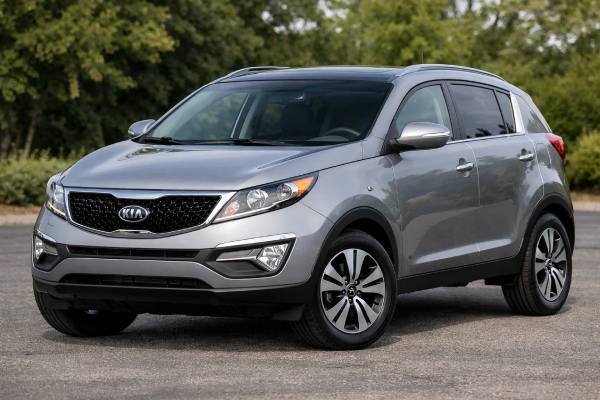
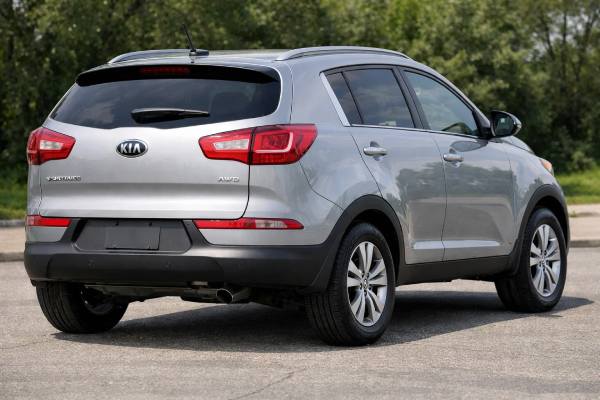
The 2010–2013 Kia Sportage FWD with the 2.0-liter D4HA diesel is one of the most rational versions of the third-generation Sportage. It pairs the sharper SL-generation body and more car-like platform with a torque-rich common-rail diesel and the lower weight and lower service complexity of front-wheel drive. On paper, that gives buyers a useful mix: strong mid-range pull, low official fuel consumption, decent towing ability for a compact SUV, and fewer drivetrain parts to maintain than the AWD model. In practice, that balance still holds up well today. The catch is that this engine belongs to the DPF era, so service history and usage pattern matter more than they do on an older, simpler diesel. A well-kept FWD D4HA can still be an efficient family SUV. A neglected short-trip car can quickly become expensive through filter, intake, brake, and suspension work.
Quick Specs and Notes
- Strong low-end torque and a 6-speed manual make the FWD diesel feel easier in daily driving than the equivalent naturally aspirated petrol.
- FWD means lower weight, fewer driveline fluids, and a simpler long-term maintenance picture than the AWD diesel.
- Official combined fuel use for early European 2WD manual versions was very competitive for a compact SUV of this age.
- The main ownership caveat is diesel-use mismatch: short trips, ignored filter warnings, and weak oil history can undo the engine’s economy advantage.
- A sensible real-world service target is every 8,000–10,000 miles or 12 months.
Explore the sections
- Kia Sportage SL FWD character
- Kia Sportage SL spec map
- Kia Sportage SL cabin and protection
- Fault trends and recall checks
- Maintenance plan and buyer filter
- On-road diesel manners
- Best alternatives for this Kia
Kia Sportage SL FWD character
The SL-generation Sportage is the model that turned Kia’s compact SUV into a true mainstream crossover. It grew into a cleaner, wider, more road-focused vehicle than the earlier Sportage, and it did so without becoming difficult to understand mechanically. That is especially true in FWD 2.0 diesel form. This version keeps the more modern SL body, fully independent suspension, and tidy cabin packaging, but it avoids the extra rear driveline hardware of the AWD models. For a used buyer, that matters more than many trim brochures admit. It means less weight, fewer fluid services, fewer joints and couplings, and slightly lower rolling losses.
The 136 hp D4HA itself is a sensible engine for this platform. Kia’s official technical material gives it 100 kW and about 319 Nm, which is enough to make the Sportage feel easy in normal use. You do not have to chase revs to move the car cleanly, and motorway work suits it better than the similarly sized petrol engines of the same period. The engine’s character is strongest between low and mid rpm, which is exactly where a family SUV spends most of its time.
FWD also clarifies who this car is for. If you live on paved roads, do longer trips, and do not need winter traction beyond good tyres and stability control, the front-drive Sportage is the cleaner buy. It keeps the useful seating height, decent boot, and practical rear space, but it skips the AWD complexity that many owners never actually use. That makes it a better fit for commuters, small families, airport runs, and mixed urban-motorway use than for heavy snow regions or muddy rural access roads.
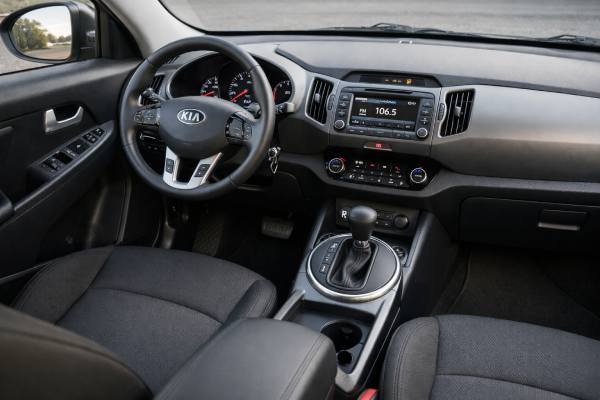
The SL platform itself still holds up well. It feels more modern than the earlier Sportage generations, and even today the dashboard layout remains easy to understand. The driving position is upright, rear-seat space is respectable, and the boot is genuinely usable for family travel, shopping, or airport luggage. That is part of the reason the SL Sportage still feels relevant in the used market.
The caution, of course, is diesel ownership. The DPF-equipped diesel needs the correct fuel quality, the correct oil specification, and a usage pattern that allows it to regenerate properly. That is a polite way of saying this engine rewards discipline. A low-mileage car that has spent its life on cold urban trips can be less attractive than a higher-mileage example with long-distance use and complete maintenance records. For this Sportage, the best used example is rarely the one with the lowest odometer reading. It is the one whose history proves it was used in a way that suits a modern diesel.
Kia Sportage SL spec map
The table below focuses on the 2010–2013 Kia Sportage SL 2.0 D4HA diesel in front-wheel-drive form. Where official documents vary by model year or market, the variation is stated clearly.
| Powertrain and efficiency | Specification |
|---|---|
| Code | D4HA |
| Engine layout and cylinders | Inline-4, 4 cylinders, DOHC, 4 valves per cylinder |
| Bore × stroke | 84.0 × 90.0 mm (3.31 × 3.54 in) |
| Displacement | 2.0 L (1,995 cc) |
| Induction | Turbocharged, variable-geometry turbo |
| Fuel system | Common-rail direct injection |
| Compression ratio | about 16.0:1 |
| Max power | 136 hp (100 kW) @ 4,000 rpm |
| Max torque | about 319–320 Nm (235–236 lb-ft) from about 1,800 rpm |
| Timing drive | Chain |
| Rated efficiency | 5.5 L/100 km combined for early 2WD manual figures |
| Real-world highway @ 120 km/h | usually lands above the official combined figure, often in the mid-6 L/100 km range when healthy |
| Transmission and driveline | Specification |
|---|---|
| Transmission | 6-speed manual; automatic availability depended on market |
| Drive type | FWD |
| Differential | Conventional open front differential |
| Chassis and dimensions | Specification |
|---|---|
| Suspension front | Fully independent, subframe-mounted MacPherson struts, coil springs, gas-filled dampers, anti-roll bar |
| Suspension rear | Fully independent, subframe-mounted multi-link, coil springs, gas-filled dampers |
| Steering | MDPS electric power-assisted rack and pinion; 15.9:1 overall ratio |
| Brakes | Front 300 × 28 mm ventilated discs; rear 262 × 10 mm solid discs |
| Wheels and tyres | 215/70 R16, 225/60 R17, or 235/55 R18 |
| Ground clearance | 172 mm (6.8 in) |
| Angles | Approach 22.7° / departure 28.2° / ramp-over 17.7° |
| Length / width / height | 4,440 / 1,855 / 1,635 mm (174.8 / 73.0 / 64.4 in) |
| Wheelbase | 2,640 mm (103.9 in) |
| Turning circle | 10.58 m (34.7 ft) |
| Kerb weight | about 1,533 kg (3,380 lb) |
| GVWR | about 2,090 kg (4,608 lb) |
| Fuel tank | 58 L (15.3 US gal / 12.8 UK gal) |
| Cargo volume | 564 L seats up / 1,353 L seats down, VDA |
| Performance and capability | Specification |
|---|---|
| Acceleration 0–100 km/h | 11.3 s |
| Top speed | 181 km/h (112 mph) |
| Braking distance | Not consistently published in open official material for this exact version |
| Towing capacity | 2,000 kg braked / 750 kg unbraked |
| Payload | about 557 kg (1,228 lb), derived from kerb and gross weight figures |
| Fluids and service capacities | Specification |
|---|---|
| Engine oil | ACEA C3 5W-30; owner manual lists 8.0 L with filter for the 2.0 diesel, while later Kia oil-capacity sheets list 8.0 L for 2011–2012 and 7.6 L for 2013–2015 SL 2.0 R diesel entries |
| Coolant | Ethylene-glycol based; about 8.5 L manual |
| Transmission fluid | Manual: API GL-4 SAE 75W/85, about 1.8–1.9 L |
| Differential / transfer case | Not applicable on FWD |
| Brake and clutch fluid | FMVSS116 DOT-3 or DOT-4; about 0.7–0.8 L |
| A/C refrigerant and compressor oil | Verify by VIN and under-bonnet label before service |
| Key torque specs | Wheel nuts 88–107 Nm (65–79 lb-ft) |
| Safety and driver assistance | Specification |
|---|---|
| Euro NCAP | 5 stars; 93% adult, 86% child, 49% pedestrian, 86% safety assist |
| Headlight rating | No modern IIHS headlight score published for this Europe-spec diesel variant |
| ADAS suite | No AEB, ACC, lane centering, blind-spot monitoring, or traffic-sign assist |
The most important caution in the spec sheet is oil fill. Kia’s own documents show both 8.0 L and 7.6 L entries for SL 2.0 R diesel applications, so buyers and technicians should always confirm by VIN before refilling. That small detail says a lot about this model in general: it is straightforward, but it still deserves exact, documented servicing.
Kia Sportage SL cabin and protection
The FWD 2.0 diesel usually sits in the middle of the SL Sportage range, and that is often exactly where the smart used buy lives. Entry trims can feel a little sparse, while high-spec cars can add large wheels, panoramic roofs, and more aging electronics than many owners really need. Mid-spec diesel FWD cars tend to give you the best blend of comfort, lower running cost, and less reconditioning risk.
In equipment terms, the lineup varied by country, but most 2.0 diesel FWD cars were sold with a sensible family-oriented mix. Common items included alloy wheels, air conditioning or climate control, cruise control, power windows, a multi-function steering wheel, roof rails, rear-seat ISOFIX mountings, and on many examples Bluetooth or USB-era audio features. The real used-market distinction is not leather versus cloth. It is smaller wheels versus larger wheels, manual simplicity versus extra equipment, and documented maintenance versus cosmetic trim appeal.
That is especially true for ride quality. Sixteen- and seventeen-inch cars are usually the nicest long-term match for this Sportage. They ride better, tyre choice is broader, and the chassis feels less busy on patched roads. Eighteen-inch wheels can improve the stance, but they rarely improve the ownership verdict on an older compact SUV. For a diesel family car, smaller wheels and cleaner history are usually worth more than a richer trim badge.
Safety equipment was a genuine strength for the SL at launch. The 2010 Sportage performed strongly in Euro NCAP testing, and the tested diesel specification reflected the kind of trim level many European buyers actually chose. Front seatbelt pretensioners, load limiters, front airbags, side body airbags, side head airbags, and standard electronic stability control gave the car a strong baseline by the standards of its time. The child-occupant score was also good, and ISOFIX availability made it practical for family use.
What the SL does not have is modern crash-avoidance technology. There is no autonomous emergency braking, no adaptive cruise, no blind-spot monitoring, and no lane-centering. That means the most valuable safety checks in the used market are the simplest ones. You want no airbag or ABS warning lights, intact belts, a straight body, healthy tyres, good brakes, and no evidence of poor accident repairs.
That creates a clear used-market rule. Do not overpay for the visual appeal of a top trim while ignoring the fundamentals. A mid-spec FWD diesel with smaller wheels, clean structure, working restraint systems, and full service records is often a better buy than a richer-looking car with patchy history and more electronics waiting to age badly. The SL Sportage still offers respectable safety for its era, but only if the specific vehicle in front of you has not been compromised by neglect, crash repair, or corrosion.
Fault trends and recall checks
The FWD D4HA Sportage does not usually fail in one dramatic, model-defining way. Its weak spots are more pattern-based. The first pattern is diesel-use mismatch. The second is ordinary age and mileage wear. The third is deferred maintenance that owners assume they can postpone because the car still starts and drives. Those three categories explain most expensive used examples.
The diesel particulate filter sits at the center of the first pattern. DPF-equipped cars need the correct fuel quality and the correct oil specification, but in real use the bigger issue is trip type. Repeated short trips, interrupted regeneration, and drivers who ignore warning behaviour are what usually push the system toward trouble. Symptoms include rising fuel use, sluggish response, frequent active regeneration, or warning lights that appear after town-only use. Remedy starts with diagnosis, not guesswork. Some cars only need proper regeneration and a healthier driving pattern. Others need deeper cleaning or replacement because the owner ignored the earlier signs.
Fuel filtration is the second diesel-specific watchpoint. A clogged diesel fuel filter can reduce performance, make the engine hard to start, and place extra strain on the emissions system. That makes service history on the fuel filter unusually important. A Sportage with patchy records, poor fuel-quality history, or repeated hard-start complaints deserves caution even if it drives acceptably once warm.
Beyond the diesel system, the usual compact-SUV wear items show up. Front links, bushes, wheel bearings, rear brake drag, and tired tyres are common enough to change the way the car feels on a test drive. None of these are unusual for a vehicle of this age, but they can stack up quickly if the seller has been postponing maintenance. Cold-start chain noise also deserves attention on badly serviced cars, especially if oil changes were pushed too far or the wrong oil was used. The engine uses a chain rather than a belt, but that does not make it immune to neglect.
A practical issue map looks like this:
- Common, medium severity: DPF loading, EGR and intake contamination, front suspension links and bushes, rear brake drag.
- Common, low to medium severity: blower-motor resistor faults, parking sensors, door-lock actuators, wheel bearings.
- Occasional, medium severity: injector leak-back, fuel-filter restriction, thermostat weakness, glow-plug or control issues.
- Occasional, medium to high severity: chain-noise complaints on poorly serviced engines, automatic shift complaints where fitted, heavy corrosion in harsh climates.
- Rare, high severity: serious accident damage, engine wear from chronic oil neglect, badly clogged emissions hardware ignored for too long.
On recalls and service actions, the honest answer is that campaign history is market-specific and VIN-specific. Buyers should always use Kia’s recall system and ask for dealer confirmation rather than rely on seller memory. For this exact FWD diesel powertrain, a direct VIN lookup is more useful than broad internet summaries, because SL Sportages were sold with many engines, trims, and regional differences.
Maintenance plan and buyer filter
This Sportage responds well to preventive care, and the diesel FWD layout keeps that care relatively manageable. Kia’s service-interval sheets show broad published numbers, but for an older DPF diesel the smarter approach is to treat those official figures as a ceiling, not a goal. Oil quality, fuel filtration, and regular longer drives matter enough here that shorter real-world intervals are often the cheaper strategy.
A practical maintenance plan looks like this:
| Item | Practical interval |
|---|---|
| Engine oil and filter | Every 8,000–10,000 miles or 12 months |
| Engine air filter | Inspect every service; replace around 15,000–20,000 miles |
| Cabin air filter | Every 12 months or about 15,000 miles |
| Fuel filter | Replace at the official interval or sooner if contamination is suspected |
| Coolant | About every 5 years, then by age and history |
| Timing chain | No fixed interval; inspect for noise, stretch signs, and timing faults |
| Auxiliary belt | Inspect every service; replace on cracks, noise, or glazing |
| Manual transmission fluid | Around 50,000–60,000 miles is sensible preventive practice |
| Brake fluid | Every 2 years |
| Pads, discs, sliders, and hoses | Inspect every service |
| Tyre rotation | Every 6,000–8,000 miles |
| Alignment check | Annually or after suspension work |
| 12 V battery test | Yearly after year 4 |
For this model, the most important fluid decision is oil. Kia’s official documents point to ACEA C3 5W-30 for the SL 2.0 R diesel, but they also show why buyers must verify capacity by VIN: some official materials list 8.0 liters, while later Kia capacity sheets list 7.6 liters for later SL 2.0 R diesel entries. Manual gearbox oil is a straightforward GL-4 75W/85 fill of about 1.8–1.9 liters, and the FWD layout means there is no rear differential or transfer-case service to budget for.
The buyer’s checklist should be strict:
- Cold-start the engine and listen for chain or top-end rattle.
- Check for DPF, engine, ABS, or airbag warnings.
- Read the service file for frequent oil changes, not just annual stamps.
- Confirm fuel-filter replacement history.
- Inspect the underside for corrosion, bent arms, and brake-pipe decay.
- Check rear brakes for drag and front suspension for clunks.
- Look for uneven tyre wear that suggests poor alignment or bush wear.
- Verify recalls by VIN, not by conversation.
The best-used example is usually a mid-spec manual on 16- or 17-inch wheels with full history and evidence of regular longer-distance use. The one to avoid is the diesel that lived on short urban runs, wears cheap mismatched tyres, and comes with vague answers about the fuel filter, warning lights, or oil type. This is a good engine when it is maintained like a modern diesel. It is a frustrating one when it is treated like an old-school diesel that can tolerate anything.
On-road diesel manners
The FWD 136 hp diesel is not the fastest SL Sportage, but it may be the easiest one to use well. The official 0–100 km/h time of 11.3 seconds does not sound quick, yet the car feels more capable than that figure suggests because the useful part of the torque arrives low in the rev range. Around town and on B-roads, that matters more than peak power. The engine pulls cleanly from modest speeds, so the Sportage feels less strained than the petrol version when you have passengers or a boot full of luggage.
The chassis suits the engine. The fully independent suspension and electric rack steering give the SL a tidy, predictable feel. It is not sporty, but it is composed. Straight-line stability is good, the steering is light without feeling disconnected, and on 16- or 17-inch wheels the ride is more comfortable than many buyers expect from an early-2010s Kia crossover. The FWD setup also helps keep the front axle honest. There is no extra rear driveline mass, so the car feels a little lighter on its feet than the AWD diesel.
Official economy is one of this version’s strongest selling points. Early European 2WD figures gave the 2.0 diesel manual a 5.5 L/100 km combined number. In real use, healthy cars usually sit above that, especially at motorway pace, but the diesel still makes sense for drivers who cover distance. A realistic ownership view is that mixed use lands closer to the mid-6s or low-7s L/100 km depending on traffic, temperature, and tyre choice, while steady 120 km/h cruising often stays in the mid-6s if the car is healthy and not regenerating frequently.
In more familiar terms, that usually means:
- City driving: about 7.0–8.2 L/100 km.
- Highway driving: about 6.0–6.8 L/100 km.
- Mixed driving: about 6.3–7.2 L/100 km.
That works out to roughly:
- 29–34 mpg US in town.
- 35–39 mpg US on the highway.
- 33–37 mpg US combined.
Towing is another quiet strength. This Sportage can handle a useful braked trailer weight for its class, and the diesel torque helps it stay relaxed with moderate loads. You still need to be realistic about front-drive traction on wet ramps or muddy campsites, but for road-based trailer use the drivetrain has enough shove to cope. Fuel use will rise sharply under load, of course, and that is normal.
The overall road verdict is simple. The FWD D4HA Sportage is not an enthusiast’s SUV. It is a long-legged, practical diesel crossover that feels most at home covering distance with little fuss. If your driving pattern fits that description, it remains one of the better-used value picks in the SL range.
Best alternatives for this Kia
The closest rival is the Hyundai ix35, and that comparison is almost entirely about condition and specification because the engineering overlap is so strong. If you find an ix35 with a better history, straighter body, and healthier suspension, buy it. If the Sportage is the cleaner car, buy the Sportage. Badge alone should not decide that matchup.
Against a Honda CR-V diesel of similar age, the Kia usually loses a little polish but wins more often on price. The Honda is the more naturally refined long-distance car, but the Sportage often gives you stronger value for the money when service history is equally good. Against a Toyota RAV4 diesel, the Kia again loses some badge-security appeal, but that gap matters less once the vehicles are this old. Condition and maintenance quality matter more than reputation at this stage.
The Volkswagen Tiguan is the more premium-feeling alternative, yet it can also bring more complexity and higher repair exposure as it ages. The Nissan Qashqai is easier to park and widely available, but it does not always match the Sportage on rear-seat and cargo usefulness. So the Kia’s best case is not that it dominates the class. It is that it balances space, torque, safety for its era, and reasonable serviceability without asking premium used-SUV money.
The Sportage’s strongest use cases are clear:
- You want a roomy, modern-feeling diesel family SUV.
- You cover enough motorway or mixed-distance mileage to justify diesel.
- You prefer widely available parts and straightforward servicing.
- You do not need AWD complexity.
Its weakest use cases are just as clear:
- You mainly do short, cold urban trips.
- You want the quietest and most refined SUV in the class.
- You are unwilling to stay ahead of diesel maintenance.
- You are shopping only by mileage or visual trim.
That leads to the real verdict. Choose the FWD D4HA Sportage if you want a practical diesel family SUV, cover enough distance to justify a DPF diesel, and care more about sensible ownership than about badge prestige. Avoid it if your life is mostly cold urban trips or if you know you will postpone maintenance. In the right use case, this is one of the most coherent versions of the SL Sportage. In the wrong use case, it is just another used diesel waiting to punish optimism.
References
- Instruktionsbok 2013 (Owner’s Manual)
- Engine Oil Grades and Capacities – Kia 2023 (Service Guide)
- 7.2 Kia Service Intervals V25.12.xlsx 2026 (Service Intervals)
- Kia Sportage – Euro NCAP Results 2010 2010 (Safety Rating)
- Kia Recalls | Kia Europe 2026 (Recall Database)
Disclaimer
This article is for informational purposes only and is not a substitute for professional diagnosis, repair, or inspection. Specifications, torque values, intervals, procedures, and approved fluids can vary by VIN, market, transmission, equipment, and production date, so always verify the exact details against the correct official service documentation for the specific vehicle.
If this guide helped you, please consider sharing it on Facebook, X, or another platform to support our work.