
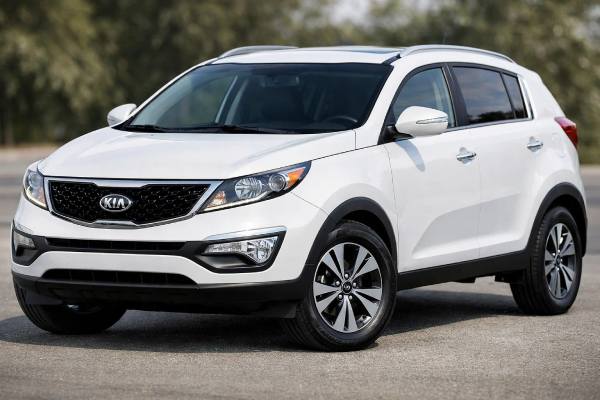
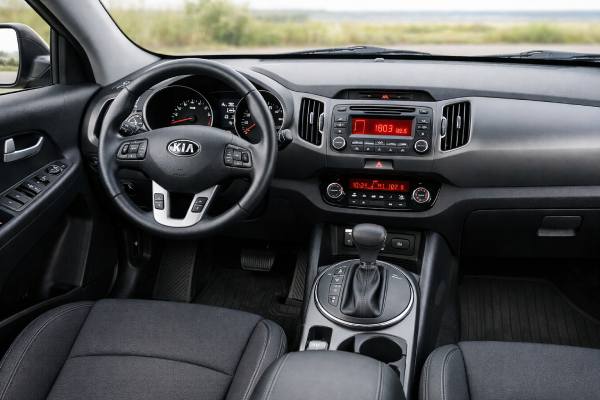
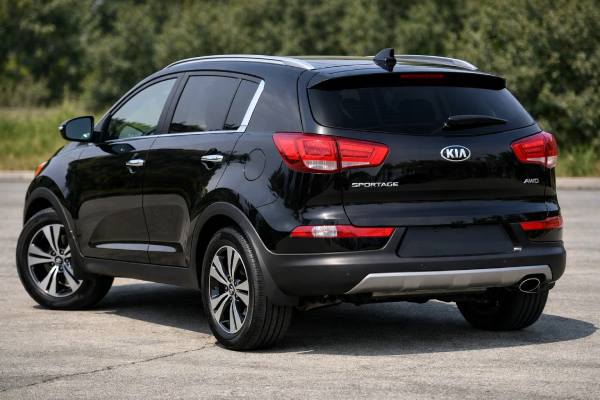
The 2014–2016 facelifted Kia Sportage AWD with the 2.4-liter petrol engine is one of the most sensible versions of the third-generation Sportage. It blends the sharper post-facelift styling, a strong equipment list, and a more polished crossover chassis with a naturally aspirated four-cylinder and on-demand all-wheel drive. That makes it easier to recommend today than some turbocharged rivals from the same era. It is not especially fast, and it is not the most fuel-efficient compact SUV in the class, but it offers a useful mix of space, predictable handling, solid winter-road traction, and relatively straightforward long-term ownership.
For buyers, the appeal is balance rather than one standout headline. The 2.4-liter engine is strong enough for everyday use, the six-speed automatic is proven when serviced properly, and AWD adds real all-weather confidence. The important caveat is that this is still a mid-2010s direct-injection crossover. Oil quality, transmission servicing, suspension wear, and recall completion matter far more than trim badges or a polished dealer listing.
Top Highlights
- The 2.4-liter petrol engine delivers useful real-world response without the extra heat and complexity of the turbocharged SX model.
- Kia’s on-demand AWD system adds worthwhile traction in rain, snow, and steep loose surfaces without turning the Sportage into a heavy-duty off-roader.
- Cabin practicality, rear-seat comfort, and fold-flat cargo space remain strong for a compact SUV from this period.
- The main ownership watchpoints are engine maintenance history, HECU recall completion, and front suspension wear on rough-road cars.
- A practical service rhythm is every 10,000 miles or 12 months, with shorter oil intervals on hard use or short-trip driving.
Start here
- Kia Sportage SL facelift snapshot
- Kia Sportage SL key figures
- Kia Sportage SL trims and safety tech
- Ownership risks and service campaigns
- Maintenance schedule and smart buying
- Road behavior and real-world consumption
- How the facelift Sportage stacks up
Kia Sportage SL facelift snapshot
The facelifted SL Sportage sits in a useful middle ground between bargain compact SUVs and more expensive mainstream rivals. By 2014, Kia had already solved the biggest challenge facing earlier Sportages: making the vehicle feel genuinely modern in daily use. The SL-generation redesign brought a lower, wider stance, fully independent suspension, a more settled highway character, and a cabin that felt better packaged and more mature than the older KM model. The 2014–2016 facelift then refined the formula with minor design changes, better standard equipment, and a cleaner trim structure in many markets.
The AWD 2.4-liter model is especially easy to understand. It uses a naturally aspirated direct-injection inline-four driving through a six-speed automatic and Kia’s on-demand AWD system. That means no low-range gearbox, no locking differential, and no pretense of serious off-road hardware. But it does mean better wet-weather traction, cleaner pull-away on slippery inclines, and more confidence in snow or heavy rain than the front-wheel-drive version. For most owners, that is exactly the right level of extra capability.
This variant also avoids one of the bigger used-car temptations in the lineup: the turbocharged SX. The SX is clearly faster, but the 2.4 AWD is usually the calmer long-term ownership bet. It runs cooler, has less stressed hardware, and tends to sit in trims that are practical without being overloaded with aging electronics. That does not make it basic. Depending on year and trim, you can still find leather, heated seats, a panoramic roof, navigation, rear camera, premium audio, and good everyday convenience features.
From an engineering point of view, the appeal is that the Sportage feels honest. Steering is light but direct enough, the AWD system is mostly invisible until you need it, and the suspension tune is comfortable without feeling sloppy. For a family crossover, that balance matters more than brochure drama.
The weak side of the ownership picture is also easy to understand. The 2.4 GDI engine depends on clean oil and careful maintenance. The automatic transmission is durable but not lifetime-fill magic. The AWD system is useful, though it adds weight and another layer of service needs compared with FWD. On older cars, suspension joints, tyres, brakes, and underbody condition shape the verdict quickly.
That makes this Sportage a condition-led buy. A clean, documented AWD 2.4 can still be a practical and credible daily SUV in 2026. A cheap one with vague engine history and incomplete recall work can become an expensive correction project. More than most compact SUVs, this version rewards buyers who look underneath the car, not only at the options list.
Kia Sportage SL key figures
The table below focuses on the facelifted 2014–2016 Kia Sportage AWD with the 2.4-liter petrol engine and six-speed automatic. Kia’s open U.S. specifications do not always publish every service capacity, so where factory-public figures are incomplete, the table flags VIN verification rather than guessing.
| Powertrain and efficiency | Specification |
|---|---|
| Code | G4KE / 2.4 GDI inline-four, depending market cataloging |
| Engine layout and cylinders | Inline-4, 4 cylinders, DOHC, 4 valves per cylinder |
| Bore × stroke | 88.0 × 97.0 mm (3.46 × 3.82 in) |
| Displacement | 2.4 L (2,359 cc) |
| Induction | Naturally aspirated |
| Fuel system | Gasoline direct injection |
| Compression ratio | 11.3:1 |
| Max power | 182 hp (136 kW) @ 6,000 rpm |
| Max torque | 177 lb-ft (240 Nm) @ 4,000 rpm |
| Timing drive | Chain |
| Rated efficiency | 22 mpg US combined, 19 city / 26 highway for 2016 AWD 2.4 automatic |
| Real-world highway @ 120 km/h (75 mph) | typically about 9.2–10.0 L/100 km in healthy condition |
| Transmission and driveline | Specification |
|---|---|
| Transmission | 6-speed automatic with H-Matic |
| Transmission code | Kia does not consistently publish a retail-facing code on the open spec sheets |
| Drive type | AWD |
| 4WD system | Full time, on demand |
| Differential | Open differential layout with electronically managed rear torque transfer |
| Chassis and dimensions | Specification |
|---|---|
| Suspension front | MacPherson strut |
| Suspension rear | Multi-link independent |
| Steering | Motor power-assisted rack-and-pinion |
| Steering ratio | about 15.9:1 |
| Brakes | 11.8 in front disc / 11.2 in rear disc |
| Most popular tyre size | 225/60 R17 or 235/55 R18 |
| Ground clearance | 172 mm (6.8 in) |
| Approach / departure / breakover | 28.1° / 28.2° / 18.7° |
| Length / width / height | 4,440 / 1,855 / 1,636 mm (174.8 / 73.0 / 64.4 in) |
| Wheelbase | 2,639 mm (103.9 in) |
| Turning circle | about 10.6 m (34.7 ft) |
| Kerb weight | roughly 3,426–3,571 lb (1,554–1,620 kg), trim dependent |
| GVWR | 4,608 lb (2,090 kg) on 2016 LX and EX |
| Fuel tank | 15.3 US gal / 58.0 L / 12.7 UK gal |
| Cargo volume | about 564 L (19.9 ft³) seats up / 1,353 L (47.8 ft³) seats down |
| Performance and capability | Specification |
|---|---|
| 0–100 km/h (0–62 mph) | about 10.5–11.0 s |
| Top speed | roughly 180 km/h (112 mph) |
| Braking distance 100–0 km/h | typically around 40–42 m on good tyres |
| Towing capacity | 2,000 lb (907 kg) braked in U.S. published specs |
| Payload | about 1,037–1,182 lb (470–536 kg), trim dependent |
| Fluids and service capacities | Specification |
|---|---|
| Engine oil | API/ACEA-equivalent quality per market manual, commonly 5W-20 or 5W-30; 4.6 L (4.9 US qt) |
| Coolant | Phosphate-based ethylene-glycol coolant; verify exact refill capacity by VIN before service |
| Transmission / ATF | Kia-approved ATF; 7.1 L (7.5 US qt) listed lubricant capacity |
| Differential / transfer case | AWD hardware present; verify fluid type and capacity by VIN and service manual |
| A/C refrigerant | Verify by under-bonnet label and service documentation |
| A/C compressor oil | Verify by compressor label and service documentation |
| Key torque specs | Wheel nuts 88–107 Nm (65–79 lb-ft) |
| Safety and driver assistance | Specification |
|---|---|
| IIHS | Good in moderate overlap front, side, roof strength, and head restraints; Poor in small overlap front |
| Euro NCAP | The SL-generation Sportage earned 5 stars in period testing, though facelifted U.S.-market specification differs by region |
| Headlight rating | No modern IIHS headlight score published for this generation |
| ADAS suite | No AEB, ACC, lane centering, or blind-spot monitoring in the modern sense |
A few details deserve context. First, AWD on this Sportage is not a serious off-road system. It is a traction aid for mixed weather and mild loose-surface use. Second, the engine code naming can vary by market databases, while Kia’s U.S. media material mainly identifies the powertrain by displacement and GDI layout. Third, factory-published service information for this generation is not always complete in open public documents, so it is better to verify exact fluid fills by VIN than to pretend every value is universal.
Kia Sportage SL trims and safety tech
For the facelift years, the 2.4-liter AWD Sportage generally sat in LX and EX trim levels, while the SX used the turbocharged 2.0-liter engine. That split matters because the AWD 2.4 tends to land in the most practical part of the range. You get the stronger naturally aspirated engine, standard automatic transmission, and optional or standard AWD depending on trim, without stepping into the turbo model’s more performance-oriented character.
The LX is usually the simpler, more durable used buy. It commonly came with 17-inch alloys, cloth trim, keyless entry, Bluetooth, a six-speaker audio system, steering-wheel audio and cruise controls, air conditioning, rear vents, 60:40 split-fold rear seating, and a cabin layout that ages well because there is less to go wrong. In many years, an AWD LX could also be optioned with a Popular Package that added a rear spoiler, roof rails, trip computer, rear armrest, illuminated mirrors, touchscreen audio with rear camera display, and automatic headlights.
The EX is the comfort-focused step up. In 2016, it added leather seating surfaces as standard, along with dual-zone climate control, heated front seats, Smart Key with push-button start, power driver’s seat, larger wheels, and more upscale trim pieces. Premium-package EX models add the features many used buyers are now tempted by: panoramic roof, navigation, ventilated front seats, premium audio, folding mirrors, and rear parking assist. Those cars feel richer, but they also add more cost if the next owner needs to sort electrical or trim faults.
Mechanically, there are no big suspension or brake personality changes between AWD LX and AWD EX 2.4 models. The differences are more about wheels, tyres, and convenience equipment than hard parts. That means the used-car priority list stays simple: buy the better-maintained vehicle before you buy the fancier trim.
Safety equipment was strong for the time. Kia gave the Sportage advanced front airbags, side airbags, full-length side curtain airbags with rollover sensor, ABS, ESC, traction control, hill-start assist, downhill brake control, and LATCH anchors. In period context, that is a very solid passive and stability-control package for a compact crossover.
Crash-test results are mixed in a useful way. The Sportage earned strong scores in IIHS moderate overlap, side impact, roof strength, and head restraint testing, but the driver-side small overlap result for 2011–2016 models was Poor. That makes the safety picture more nuanced than a simple “five-star era crossover” summary. It performed well in many key crash areas for its time, but it does not match newer platforms in more demanding frontal-offset testing.
There is no meaningful modern ADAS story here. No automatic emergency braking, no lane-keeping assist, no blind-spot collision systems, and no adaptive cruise. That means on a used example, the biggest safety advantages are still basic ones: healthy brakes, correct tyres, straight structure, working airbags, and confirmed recall completion. A clean AWD LX or EX with intact safety systems is a better ownership proposition than a fully loaded example with deferred repairs.
Ownership risks and service campaigns
The 2014–2016 Sportage AWD 2.4 is generally dependable when maintained, but it has several watchpoints that deserve honest attention. The first is engine-care discipline. The 2.4-liter direct-injection engine is not a fragile concept, but it does not reward long oil intervals, low oil level, or vague service history. Chain-driven engines often encourage owner complacency because there is no belt to replace. In practice, clean oil matters just as much because chain, tensioner, and cam phasing health depend on it.
A practical issue map looks like this:
- Common, medium severity: front suspension links, bushes, top mounts, tyres, and alignment wear.
- Common, low to medium severity: rear brake drag, wheel bearings, door-lock actuators, parking sensors, and blower resistor faults.
- Occasional, medium severity: ignition-coil misfires, oil seepage, thermostat aging, and carbon buildup associated with direct injection.
- Occasional, medium to high severity: delayed transmission servicing leading to harsher shifts, AWD coupling neglect, steering coupling or rack-related knocks.
- Rare, high severity: serious engine wear from chronic oil neglect, accident-repaired shells, and structural corrosion in harsh climates.
Direct injection deserves special mention. The 2.4 GDI engine gives the Sportage stronger output than an older port-injected engine of similar size, but it also brings the familiar possibility of intake-valve carbon buildup over time. Not every engine develops obvious symptoms, yet rough idle, lazy throttle response, or reduced refinement on higher-mileage examples can point in that direction. This is not a reason to avoid the car. It is a reason to ask better questions about maintenance and fuel quality.
Transmission and AWD reliability are usually good if the car has not been ignored. The six-speed automatic is much better treated as a serviceable unit than as a sealed-for-life component. Owners who change fluid at sensible intervals tend to have fewer complaints about shift quality. The AWD system is similarly robust for its intended use, but tyre mismatch, repeated overheating, or total fluid neglect can turn a low-drama system into an expensive one.
The major recall issue buyers must know is the HECU-related fire-risk campaign affecting certain 2014–2016 Sportage vehicles. This is not something to treat casually. The official campaign centered on the hydraulic electronic control unit and the risk of an engine compartment fire. Buyers should not rely on seller memory. They should verify completion by VIN through Kia or NHTSA records and ask for dealer documentation if possible.
There is also a smaller but important long-term ownership lesson here. Because the Sportage looks modern enough to feel newer than it is, some owners postpone maintenance as though it were a much newer car. That is where trouble starts. A used 2016 Sportage can still be an excellent daily vehicle, but only if it is treated like a mature used crossover with real service needs, not like an appliance that will tolerate endless delay.
Maintenance schedule and smart buying
The best way to own a facelift AWD 2.4 Sportage is to keep maintenance boring and predictable. This is not a vehicle that rewards heroic repair once things are already wrong. It rewards regular fluid service, tyre discipline, and early attention to drivability changes.
A sensible real-world maintenance plan looks like this:
| Item | Practical interval |
|---|---|
| Engine oil and filter | Every 7,500–10,000 miles or 12 months |
| Engine air filter | Inspect every service; replace around 15,000–20,000 miles |
| Cabin air filter | Every 12 months or about 15,000 miles |
| Spark plugs | Around 60,000–100,000 miles depending on plug type and condition |
| Coolant | About every 5 years, then according to age and condition |
| Timing chain | No fixed replacement interval; inspect for noise, stretch symptoms, and timing faults |
| Auxiliary belt | Inspect every service; replace on cracks, glazing, or noise |
| Automatic transmission fluid | About 30,000–50,000 miles is wise on an aging AWD automatic |
| AWD driveline fluids | Check service history and refresh at sensible intervals |
| Brake fluid | Every 2 years |
| Brake pads, discs, sliders, and hoses | Inspect every service |
| Tyre rotation | Every 6,000–8,000 miles |
| Alignment check | Annually or after tyre or suspension work |
| 12 V battery test | Yearly after year 4 |
The most important fluid choice is engine oil. The public spec sheets list a 4.6-liter oil capacity, but viscosity and specification should always match the correct market manual and climate. For long-term durability, the bigger lesson is interval discipline. Direct-injection four-cylinders respond better to fresh oil than to optimistic service schedules.
Because this is the AWD version, maintenance is broader than on a front-drive Sportage. You have more driveline hardware, more tyre sensitivity, and more reason to avoid mismatched tyre circumference. Even when the system is working normally, four different brands or unevenly worn tyres can make the drivetrain work harder than it should.
The used-buyer inspection checklist should be strict:
- Listen for cold-start rattle or rough idle.
- Check that the transmission shifts cleanly once warm.
- Confirm AWD operation on a low-grip surface if conditions allow.
- Inspect tyres for matching brand, size, and wear pattern.
- Look under the vehicle for leaks, bent suspension arms, or impact damage.
- Test brakes for drag, vibration, or uneven pedal feel.
- Check every window, lock, camera, mirror, and infotainment function.
- Verify HECU recall completion by VIN.
- Look for signs of poor crash repair around the rear quarters, front structure, and tailgate aperture.
The best version to buy is often an EX AWD with solid records and modest options, or an LX AWD with the right equipment and cleaner maintenance history. The models to avoid are not defined by trim. They are defined by missing records, neglected tyres, warning lights, and sellers who describe maintenance in vague language. Long term, this Sportage can be durable and easy to live with. It just needs the kind of ownership discipline that many compact SUVs never receive.
Road behavior and real-world consumption
The facelift AWD 2.4 Sportage drives like a compact crossover that was tuned for real people rather than brochure theatrics. Around town, visibility is decent, the controls are light, and the engine gives enough low-end response to avoid feeling underpowered. The six-speed automatic is conventional in the best sense. It does not shift as quickly as a modern dual-clutch unit, but it is usually smoother and less fussy in stop-and-go use.
On the move, the 2.4-liter engine feels adequate rather than quick. Its 182 hp output is enough for clean merging, moderate passing, and full-load family use, but this is not a fast SUV. What matters more is the way it delivers its effort. Throttle response is predictable, the engine is smoother than the diesel alternatives, and it works well with the automatic’s gearing. In day-to-day use, that makes the Sportage feel easier than its acceleration numbers suggest.
Ride quality is one of the SL Sportage’s better traits. On 17-inch wheels, the AWD model absorbs broken pavement well and feels settled on longer drives. Eighteen-inch versions look better to some buyers, but they can sharpen impacts and raise tyre replacement cost. Steering is light, not especially communicative, yet accurate enough to place the car confidently. Body roll is present but not excessive, and the chassis feels secure rather than playful.
The AWD system is unobtrusive in normal driving. Most of the time, the Sportage behaves like a front-drive crossover with extra traction waiting in reserve. In snow, heavy rain, loose gravel, or steep wet driveways, the system helps the car move off more cleanly and with less wheelspin than a FWD model. It is not intended for rock crawling or repeated deep-mud punishment, but for real mixed-weather daily use it adds tangible value.
Real-world fuel economy is respectable but clearly not class-leading. EPA figures for the 2016 AWD 2.4 automatic are 19 mpg city, 26 highway, and 22 combined. In practice, many owners see something like this:
- City driving: about 11.5–12.8 L/100 km.
- Highway driving: about 9.0–10.0 L/100 km.
- Mixed driving: about 10.2–11.2 L/100 km.
That works out roughly to:
- 18–20 mpg US in town.
- 23–26 mpg US on the highway.
- 21–23 mpg US combined.
Cold weather, roof accessories, poor tyres, short trips, or a clogged intake tract can worsen those figures noticeably. This is not a crossover you buy for efficiency leadership. You buy it because the fuel use is acceptable in exchange for AWD traction, simple naturally aspirated power, and strong everyday practicality.
Under moderate towing, the Sportage remains stable enough within its rating, but expect slower hill work and a meaningful fuel penalty. A 20–30 percent increase in consumption under trailer load is normal. In overall driving terms, the Sportage AWD 2.4 succeeds by being easy, steady, and predictable. That matters more in real ownership than sharp handling ever would.
How the facelift Sportage stacks up
The facelifted AWD 2.4 Sportage competes in one of the strongest used-SUV classes of the 2010s. Its most obvious rivals are the Hyundai Tucson, Honda CR-V, Toyota RAV4, Nissan Rogue, and Volkswagen Tiguan. The Sportage does not dominate them across the board, but it makes a strong case when condition and price are considered together.
Against the Hyundai Tucson, the choice is mostly about condition and specification because the vehicles share so much underneath. Buy whichever one has the cleaner body, better service records, healthier tyres, and better recall history. Against a Honda CR-V of similar age, the Kia usually feels a little less polished overall, but it often costs less to buy and can match it for everyday utility. The Toyota RAV4 still carries the strongest reputation advantage, yet that reputation often creates a price premium that only makes sense if the Toyota is also the better-kept car.
The Tiguan is the more premium-feeling option, but it can also bring more complexity and higher age-related repair exposure. The Nissan Rogue is often a comfortable road-biased alternative, though many buyers prefer the Sportage’s conventional six-speed automatic over the Rogue’s CVT.
The Sportage’s strongest use cases are easy to define:
- You want a naturally aspirated petrol AWD crossover without a turbocharger.
- You value real winter traction but do not need serious off-road ability.
- You prefer a conventional automatic to a CVT or dual-clutch gearbox.
- You are buying on total condition and equipment rather than brand image.
Its weakest use cases are just as clear:
- You want class-leading fuel economy.
- You want the sharpest steering and chassis response.
- You mostly do short urban trips and never use AWD.
- You are unwilling to stay ahead of fluid and tyre maintenance.
That leads to the actual verdict. The 2014–2016 Sportage AWD 2.4 is not the most glamorous compact SUV of its era, and it is not the cheapest one to feed. But it is one of the more coherent and easier-to-understand used choices if you want naturally aspirated petrol power, good equipment, and useful all-weather traction. The facelift years are especially attractive because the design and features still feel modern enough, while the core mechanical package remains straightforward.
For most buyers, the smartest move is not chasing the highest trim. It is finding the cleanest, best-documented AWD 2.4 you can afford, with confirmed recall completion and no signs of postponed maintenance. Do that, and the facelift Sportage still makes a lot of sense as a dependable compact family SUV.
References
- 2016 Kia Sportage Specifications 2015 (Specifications)
- 2016 Kia Sportage Features and Options 2015 (Features Guide)
- 2015 Kia Sportage 2026 (Safety Rating)
- Gas Mileage of 2016 Kia Sportage 2026 (Fuel Economy Database)
- Part 573 Safety Recall Report 22V-051 2022 (Recall Report)
Disclaimer
This article is for informational purposes only and is not a substitute for professional diagnosis, repair, or inspection. Specifications, torque values, service intervals, procedures, and fluid requirements can vary by VIN, market, trim, and equipment, so always verify the exact details against official service documentation for the specific vehicle.
If this guide was useful, please consider sharing it on Facebook, X, or another platform to support our work.