
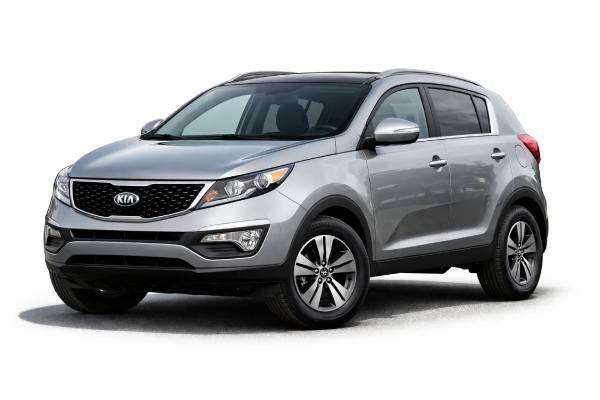
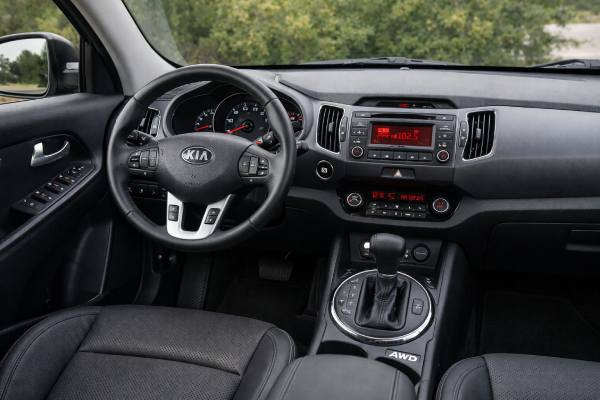
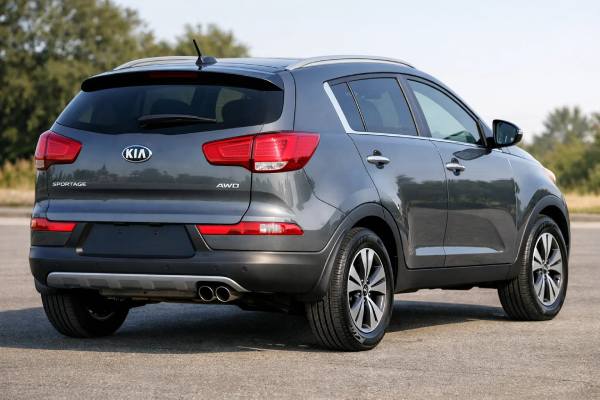
The facelifted 2014–2016 Kia Sportage SL AWD with the G4KH 2.0-litre turbo engine is the sharpest road-going version of the old SL range. In North American terms, this is essentially the SX Turbo AWD: a compact SUV with real straight-line pace, a standard 6-speed automatic, and an on-demand all-wheel-drive system that adds confidence in poor weather without turning the vehicle into a heavy off-roader. It also sits at an interesting point in Kia’s history. The body structure, cabin design, and safety performance had already become competitive, but the engineering was still conventional enough that ownership stayed understandable. The big attractions are easy torque, strong passing power, and a more premium equipment level than the ordinary petrol trims. The caution is just as clear. This is a direct-injected turbo Theta II engine, so maintenance quality matters a great deal. Oil service, recall history, and tyre matching shape ownership far more than the badge on the tailgate.
Top Highlights
- The 2.0-litre turbo makes the facelift SL genuinely quick for its class, especially in mid-range passing.
- AWD adds useful wet-weather and winter traction without making the Sportage feel heavy or dull.
- SX Turbo trim brings stronger equipment, larger brakes, and a more upscale cabin than lower trims.
- Engine history is the main caveat, because bearing-related Theta II issues and skipped oil changes can become expensive.
- A sensible real-world oil interval is every 8,000–10,000 km or 6–12 months, even if a longer schedule once looked acceptable on paper.
What’s inside
- Kia Sportage SL turbo identity
- Kia Sportage SL turbo data
- Kia Sportage SL lineup and protection
- Known trouble spots and campaigns
- Maintenance strategy and buyer checks
- Boosted performance in daily use
- Rivals and market position
Kia Sportage SL turbo identity
The facelift SL Sportage arrived when Kia already knew how to build a convincing compact SUV. The basic third-generation platform had been in place since 2011, so by 2014 the formula was mature: sharp styling, a rigid steel unibody, independent rear suspension, electric power steering, and a cabin that felt more upscale than earlier Sportages ever had. What changed the personality in this version was the engine. The G4KH 2.0-litre turbocharged direct-injection four-cylinder turned the Sportage from merely adequate into something that could actually feel fast in everyday use.
That matters because the rest of the vehicle was already good enough to handle more power. The 6-speed automatic is conventional rather than exotic, the AWD system is on-demand rather than permanent heavy-duty hardware, and the suspension stays road-focused. As a result, this Sportage is not a rugged off-road special. It is a quick compact crossover with useful bad-weather traction. The AWD system helps on wet roads, snow, loose gravel, and steep ramps, while the turbo engine gives the car strong low- and mid-range punch that the ordinary 2.4-litre version cannot match.
In North America, the 2.0T was tied closely to the SX trim, and that is important for used buyers. You are not just getting more power. You are also generally getting the most complete version of the facelift SL, with 18-inch sport wheels, a more distinctive grille and lighting package, better seats and trim, stronger audio options, and more convenience equipment. That higher equipment level helps the car feel more premium than the basic trims even today.
The ownership case is attractive for the right person. You get a compact footprint, respectable cargo space, decent crash-test performance for the era, and enough power to make motorway driving or mountain roads feel easy. The trade-offs are clear, too. Fuel economy is only average, the 18-inch wheel and tyre package costs more to keep, and the turbo GDI engine demands better service discipline than the slower naturally aspirated version.
That is the key to understanding this model now. It is not the cheapest SL to run, but it is the most rewarding one to drive on normal roads. It suits buyers who want a compact SUV that feels stronger than its age suggests and do not mind maintaining it properly. The wrong buyer sees a fast old Kia and assumes it can be run cheaply forever. The right buyer sees a well-equipped turbo AWD crossover that still works well if its history is strong and its mechanicals have not been ignored.
Kia Sportage SL turbo data
The table below focuses on the facelift 2014–2016 Kia Sportage SL AWD with the 2.0-litre G4KH turbocharged petrol engine rated at 260 hp in North American trim. This is the core specification for the SX Turbo AWD. A few figures varied slightly between 2014, 2015, and 2016, but the underlying package stayed very consistent.
| Powertrain and efficiency | Data |
|---|---|
| Code | G4KH |
| Engine layout and cylinders | Inline-4, 4 cylinders, DOHC, 4 valves per cylinder |
| Bore × stroke | 86.0 × 86.0 mm (3.39 × 3.39 in) |
| Displacement | 2.0 L (1,998 cc) |
| Induction | Turbocharged |
| Fuel system | Gasoline direct injection |
| Compression ratio | 9.5:1 |
| Max power | 260 hp (194 kW) @ 6,000 rpm |
| Max torque | 365 Nm (269 lb-ft) @ 1,850–3,000 rpm |
| Timing drive | Chain |
| Engine oil capacity | 4.6 L (4.9 US qt) |
| Rated efficiency | EPA: 11.8 L/100 km combined, 12.4 city, 9.4 highway (21 / 19 / 25 mpg US) |
| Real-world highway @ 120 km/h | Usually about 9.5–10.5 L/100 km (24.8–22.4 mpg US / 29.7–26.9 mpg UK) |
| Transmission and driveline | Data |
|---|---|
| Transmission | 6-speed automatic with H-Matic |
| Transmission fluid capacity | 7.8 L (8.2 US qt) |
| Drive type | AWD |
| 4WD system | Full time on demand |
| Final drive ratio | 3.320:1 |
| Differential | Open front and rear, electronically controlled center coupling |
| Chassis and dimensions | Data |
|---|---|
| Suspension, front / rear | MacPherson strut with stabilizer / multi-link |
| Steering | Motor power-assisted rack-and-pinion |
| Turns lock-to-lock | 2.83 |
| Minimum turning radius | About 10.6 m (34.8 ft) |
| Brakes | Four-wheel discs with ABS, ESC, hill-start assist, and downhill brake control |
| Brake size, front / rear | 300 mm (11.8 in) / 284 mm (11.2 in) |
| Wheels and tyres | 18 × 7.0J wheels with 235/55 R18 tyres |
| Ground clearance | 172 mm (6.8 in) |
| Approach / departure / breakover angle | 28.1° / 28.2° / 18.7° |
| Length / width / height | 4,450 / 1,854 / 1,636 mm (175.2 / 73.0 / 64.4 in) |
| Wheelbase | 2,639 mm (103.9 in) |
| Kerb weight | About 1,626–1,662 kg (3,585–3,664 lb), equipment dependent |
| GVWR | About 2,130 kg (4,696 lb) |
| Fuel tank | 58 L (15.3 US gal / 12.8 UK gal) |
| Cargo volume | 739 L / 1,546 L (26.1 / 54.6 ft³), SAE |
| Performance and service | Data |
|---|---|
| 0–100 km/h (0–62 mph) | About 8.0–8.5 s in typical independent testing |
| Top speed | About 200 km/h (124 mph), electronically limited or drag-limited depending on market |
| Towing capacity | 907 kg (2,000 lb) |
| Payload | Roughly 450–500 kg, equipment dependent |
| Coolant | Ethylene-glycol based coolant for aluminum engine and radiator |
| Rear differential / transfer case | AWD fluid service required, but public factory capacity data is not consistently published in open sources |
| A/C refrigerant | R-134a |
| Wheel nut torque | 88–107 Nm (65–79 lb-ft) |
| Safety and driver assistance | Data |
|---|---|
| IIHS moderate overlap front | Good |
| IIHS original side test | Good |
| IIHS roof strength | Good |
| IIHS head restraints and seats | Good |
| IIHS driver-side small overlap | Poor |
| ADAS suite | No factory AEB, ACC, lane-centering, blind-spot monitoring, or rear cross-traffic alert |
The numbers explain why this model still draws interest. It is not a high-clearance off-road vehicle, but it is a compact AWD SUV with genuinely strong turbo power, respectable space, and enough chassis ability to feel worthwhile today.
Kia Sportage SL lineup and protection
For the facelift years, the turbo engine sat at the top of the mainstream Sportage range. In practice, that means the G4KH AWD version is not just an engine option but a full trim upgrade. In North America, the 2.0T was effectively the SX Turbo, so buyers got a different ownership experience from the regular LX or EX rather than simply more power in the same shell.
Mechanically, the key changes were easy to feel. The SX Turbo kept the 6-speed automatic as standard, added the turbocharged direct-injection engine, and usually rode on 18-inch sport alloys with 235/55 tyres. Kia also paired the turbo trim with a more distinctive exterior treatment, including model-specific grille details, LED daytime running lights, LED taillights, dual exhaust finishers, and a generally more aggressive appearance than the ordinary 2.4 cars. That matters on the used market because it gives quick visual clues, but the VIN and equipment sticker still matter more than styling details alone.
Inside, the SX Turbo was also better equipped. Kia’s 2016 features and options sheet lists leather seating, heated front seats, ventilated front seats, dual-zone automatic climate control, smart key with push-button start, touchscreen audio with rear camera display, available navigation, and available Infinity audio in the upper trims. A panoramic sunroof was standard on SX in 2016 and optional or unavailable elsewhere. Those features help the facelift Sportage feel more expensive than many compact SUVs from the same period.
Safety equipment was strong for the era, although not modern by current standards. Kia’s own feature sheet lists dual front airbags, front seat-mounted side airbags, full-length side curtain airbags with rollover sensor, ABS, ESC, hill-start assist, downhill brake control, traction control, active front head restraints, and LATCH anchors. That is a credible package for a mid-2010s compact crossover, and it backed up a very respectable IIHS record in the original moderate-overlap, side, roof-strength, and head-restraint tests.
The caveat is the later driver-side small-overlap result. IIHS rates 2011–16 Sportage models Poor in that test. So while the facelift SL still has a solid safety base for its age, it should not be described as modern in crash structure or avoidance tech. There is no autonomous emergency braking, no adaptive cruise control, no lane-keeping assistance, and no blind-spot system. Parking assistance and rear camera systems were about as far as the active-safety story went.
That puts more emphasis on condition. A clean SX Turbo with healthy tyres, working ESC, no accident shortcuts, and intact airbag systems is a much better safety proposition than a neglected example wearing budget tyres and ignored warning lights. With this model, equipment matters, but maintenance matters more. The smartest used buyers treat safety as a mechanical condition issue first and a trim-level issue second.
Known trouble spots and campaigns
The facelift Sportage Turbo’s reputation depends heavily on one fact: it uses a Theta II turbocharged direct-injection engine. That brings strong performance, but it also means buyers need to take engine history very seriously. This is not a model that should be judged only by mileage or cosmetics. Service record, oil-change quality, and campaign completion are the real filters.
The most important problem area is connecting-rod-bearing wear and the wider family of Theta II engine issues. Kia issued a warranty extension letter in 2016 covering 2011–2014 Sportage 2.0T and 2.4 engines for short-block concerns tied to connecting-rod wear. Later service bulletins and campaign procedures also brought 2014–2018 Sportage 2.0 T-GDI vehicles into the KSDS and P1326 diagnostic world. In practical terms, buyers need to watch for cold or warm engine knock, flashing MIL behavior, limp mode, poor service history, and any mention of P1326. A car that already has documented campaign work and clear dealer history is much safer to consider than one with vague answers.
Carbon buildup is the next predictable turbo-GDI issue. Because fuel is injected directly into the cylinders, the intake valves do not get the same cleaning effect older port-injected engines had. Over time, rough idle, misfires, weak cold running, or reduced throttle crispness can point to intake deposits. This is not unique to Kia, but it matters more on an older turbo direct-injected engine with unknown service history.
Turbo-related oil discipline is also critical. This engine is not unusually complex, but it does rely on clean oil and good oil level. Neglect can lead to timing-chain wear, tensioner noise, turbo stress, and general top-end unhappiness. If a seller cannot explain the oil strategy beyond “it was serviced when needed,” assume it was not serviced often enough. On this model, preventive oil changes are much cheaper than bearing, turbo, or chain work.
The AWD system is generally durable, but only if owners do the basics. Mismatched tyres, large tread-depth differences, or ignored rear driveline fluid service can load the coupling and rear driveline unnecessarily. A vibration under load, grumbling from the rear, or obvious tyre mismatch is a warning. This is not an AWD system that likes careless tyre replacement.
Outside the powertrain, expect normal age-related issues: front lower-arm bushes, anti-roll-bar links, wheel bearings, seized rear brake hardware, old batteries, and occasional EPS complaints. None of those are shocking, but they add up on neglected cars. Underbody corrosion also deserves a proper look, especially in salt-belt climates.
Recall history matters. The 2022 HECU recall covers 2014–2016 Sportage vehicles built through mid-November 2015, and later 2023 HECU action broadened fire-risk concern across older Kia lines, including 2010–2013 Sportage. For a facelift SL, that means checking VIN history and dealer records rather than assuming the repair was done. With this model, campaign paperwork is part of the value.
Maintenance strategy and buyer checks
A used Sportage Turbo needs a maintenance strategy that reflects what it is: a compact AWD crossover with a direct-injected turbo engine, not a basic economy car. The official historical schedules may once have looked generous, but that is not the smartest way to care for a ten-year-old G4KH today. A conservative plan protects the expensive parts.
A practical schedule for current ownership looks like this:
| Item | Practical interval |
|---|---|
| Engine oil and filter | Every 8,000–10,000 km or 6–12 months |
| Engine air filter | Inspect every service; replace about every 20,000–30,000 km |
| Cabin air filter | Every 12 months |
| Spark plugs | About every 60,000–75,000 km depending on plug type and use |
| Timing chain | No set replacement interval; inspect if there is rattle, correlation faults, or oil-neglect history |
| Coolant | Refresh by age and condition, not only by appearance |
| Automatic transmission fluid | About every 45,000–60,000 km if long-term smoothness matters |
| Rear differential and transfer case fluids | About every 40,000–60,000 km on AWD models |
| Brake fluid | Every 2 years |
| Brake inspection | Every service, especially rear calipers and slide hardware |
| Tyre rotation | About every 10,000–12,000 km |
| Alignment check | At tyre replacement or after suspension work |
| 12 V battery test | Annually after year four |
| PCV and boost-hose inspection | Every service on higher-mileage cars |
Oil choice matters more here than on the slower 2.4. A high-quality full-synthetic oil of the correct viscosity is the safe move, and running the oil low is not acceptable on a turbocharged Theta II. Transmission service also matters. Kia called the 6-speed automatic “filled for life” in some owner-facing contexts, but used-car reality says otherwise. Fresh fluid helps shift quality, converter smoothness, and long-term life.
The buyer’s checklist should be systematic:
- Start the engine completely cold and listen for knock, chain noise, or top-end clatter that lasts too long.
- Check for stored codes, especially any history involving P1326.
- Ask whether KSDS or related product-improvement work has been completed.
- Inspect for oil seepage around the timing cover, turbo area, and sump.
- Confirm all four tyres match closely in brand, size, and wear.
- Test the AWD on a low-grip surface if possible and feel for vibration or coupling oddness.
- Inspect rear brakes carefully, because they can corrode or drag quietly.
- Check the underbody for rust, especially line brackets, rear floor seams, and suspension points.
- Verify HECU recall completion through official records.
The best buys are usually 2015–2016 cars with clear dealer history, campaign proof, healthy tyres, and recent fluid service. The most dangerous bargains are the shiny, modified, or cheaply tuned examples with no paperwork. Long-term durability can be decent here, but only if the car has been treated like a turbo AWD vehicle from the start.
Boosted performance in daily use
This is the section where the SX Turbo AWD earns its reputation. The Sportage is not a hot hatch, but for a compact SUV from the mid-2010s it feels properly strong. The turbo engine builds torque early, so normal driving requires very little effort. Pulling away, merging, or passing on a two-lane road all feel much easier than in the ordinary petrol Sportage. That effortless mid-range is the reason people still look for this engine.
The 6-speed automatic is not as sophisticated as the newer 8-speed units that followed in the industry, but it suits the car well enough. It shifts smoothly in everyday driving and reacts reasonably quickly to a firm throttle input. In traffic, it feels conventional and easy. Under harder use, it can sometimes pause before a decisive downshift, but once the turbo is in its useful band the car gathers speed with more authority than its age suggests.
Ride quality depends heavily on wheel and tyre condition. On its 18-inch package, the SX Turbo rides firmly but not harshly when the suspension is healthy. The SL platform is already better tied down than the old KM, so the car stays composed on motorway undulations and fast A-road curves. There is still typical crossover body roll, but the Sportage does not feel clumsy. The higher-performance dampers listed by Kia in the SX equipment sheet help the car feel tighter than the softer trims.
Electric steering is accurate rather than especially talkative. Around town it is light enough to make the Sportage easy to place, and on faster roads it settles into predictable weighting. The chassis balance is secure, especially with good tyres, but there is still a front-heavy feel when you push hard. That is normal for a turbocharged compact AWD crossover of this type.
Noise levels are respectable. The engine is quieter than the older V6 KM models under cruise and less strained than the 2.4 when asked to accelerate hard. Tyre roar from the 18-inch package is usually the biggest refinement penalty, especially on cheap replacement tyres. A good SX on quality rubber feels substantially more polished than many budget SUVs of the same age.
Real-world fuel use is the obvious trade-off for the extra performance. Expect roughly 12–14 L/100 km in dense urban use, around 9.5–10.5 L/100 km on a true 120 km/h highway run, and about 10.5–12.0 L/100 km in mixed driving. That is acceptable, not impressive. Moderate towing or repeated short trips will push the figures higher very quickly.
AWD behavior is reassuring rather than sporty. On rain, slush, or gravel, the system helps the car put its turbo torque down cleanly. In snow, it is far better than a front-drive turbo crossover would be, provided the tyres are good. The verdict is simple: the SX Turbo AWD is quick enough to be interesting, but its real strength is how easy that performance is to use every day.
Rivals and market position
The closest internal rival is the Hyundai Tucson with the same platform roots, but the Sportage SX Turbo usually feels like the more style-led and more aggressive interpretation of the package. If both cars have equal history and equal condition, the Kia often has the stronger visual appeal. In real used-car shopping, though, the cleaner underbody and better paperwork should win.
Against the Toyota RAV4 of the same period, the Kia offers more pace and a stronger sense of equipment value, especially in top trim. The Toyota usually wins on reputation and lower perceived risk. Buyers who want the safest emotional purchase often choose the Toyota. Buyers who want stronger performance and richer equipment for the money tend to see the Kia’s appeal more quickly.
The Honda CR-V is a different proposition. It is usually easier to recommend to families who value packaging, visibility, and low-drama ownership. The Sportage Turbo counters with meaningfully stronger acceleration, a more assertive design, and a tighter, more premium-feeling top-trim cabin than many people expect. If you want a calm family appliance, the Honda makes more sense. If you want a compact SUV with real punch, the Kia is more interesting.
The Ford Escape 2.0T and Mazda CX-5 2.5 are also fair comparisons. The Ford can feel quicker in some trims and often has a more American tuning flavor, but long-term risk perception is not necessarily better. The Mazda is typically the better handler and the more polished driver’s car, though it often lacks the same low-rpm turbo shove in naturally aspirated form. The Kia sits between them as a fast, well-equipped, slightly underappreciated option.
That underappreciated quality is what defines the facelift SL Turbo AWD today. It is not the most refined, not the most economical, and not the most risk-free. But it combines real-world pace, useful traction, strong trim equipment, and still-respectable practicality in a package many buyers overlook. The right owner is someone who wants a compact AWD SUV with genuine performance and is prepared to verify the engine history carefully. The wrong owner is someone shopping only by price.
Viewed honestly, the 2014–2016 Sportage SX Turbo AWD is one of the most appealing old Sportages if it has the right records behind it. It is also one of the easiest to get wrong if it does not. That is why the best examples are worth seeking out and the careless ones are worth walking away from.
References
- 2016 Kia Sportage Specifications 2016 (Specifications)
- 2016 Kia Sportage Features & Options 2016 (Features and Options)
- Gas Mileage of 2016 Kia Sportage 2016 (Fuel Economy)
- 2014 Kia Sportage 2014 (Safety Rating)
- Part 573 Safety Recall Report 22V-051 2022 (Recall Database)
Disclaimer
This article is for informational purposes only and is not a substitute for professional diagnosis or repair. Specifications, torque values, intervals, procedures, and fitted equipment can vary by VIN, market, model year, and trim, so always verify details against the correct official service documentation for the exact vehicle.
If this guide helped you, please consider sharing it on Facebook, X, or another platform to support our work.