
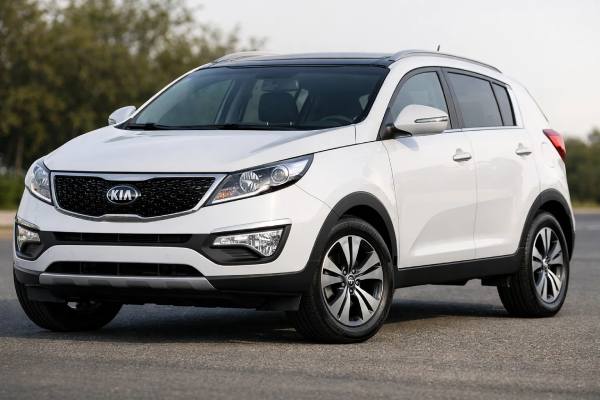
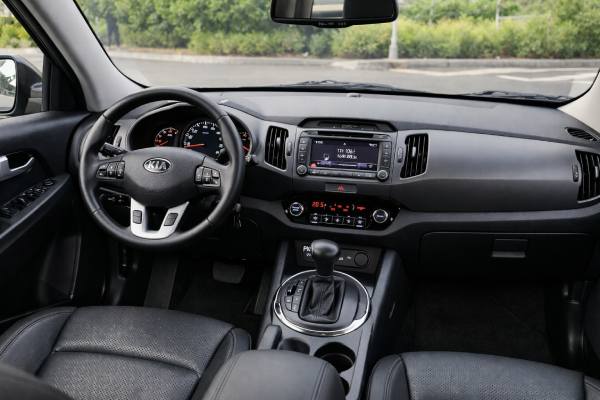
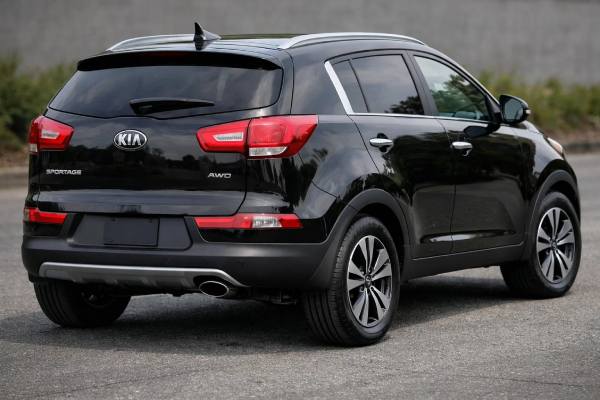
The facelifted 2014–2016 Kia Sportage FWD with the 2.4-liter naturally aspirated gasoline engine is one of the most straightforward versions of the SL generation. It combines the sharper post-2014 styling update with the stronger 182 hp 2.4-liter direct-injection four-cylinder, front-wheel drive, and a conventional 6-speed automatic. That matters because this version avoids AWD transfer-case complexity and also avoids the extra heat and plumbing of the turbocharged SX, while still giving the Sportage enough power to feel properly usable in modern traffic.
In ownership terms, it sits in a practical middle ground. The cabin is roomy, the boot is genuinely useful, and the facelift brought better noise control, upgraded trim, and a more polished feel. The weak points are also clear. Fuel economy is only average for a compact SUV, the 2.4-liter GDI engine needs careful oil monitoring, and later safety expectations moved faster than this platform did. Buy the right one, though, and it remains a sensible, good-looking family crossover.
Quick Specs and Notes
- The facelift 2.4-liter engine gives this Sportage enough real-world power without the added complexity of the turbo model.
- FWD versions are lighter, simpler, and often cheaper to own than AWD trims.
- The SL facelift still offers strong cabin room and a useful cargo area for a compact SUV.
- Oil consumption, carbon build-up, and deferred automatic-transmission servicing are the main long-term ownership watch points.
- A practical oil and filter interval for used examples is 5,000–7,500 mi / 8,000–12,000 km, even if a market sheet suggests longer intervals.
Explore the sections
- Kia Sportage SL Gasoline Identity
- Kia Sportage SL 2.4 Spec Grid
- Kia Sportage SL Features and Crash Protection
- Common Faults and Factory Actions
- Upkeep Plan and Shopping Advice
- Real-World Pace and Refinement
- How the Facelift Sportage Stacks Up
Kia Sportage SL Gasoline Identity
The 2014 facelift gave the SL Sportage a useful mid-cycle reset. Kia updated the grille and wheels, sharpened the lighting, improved noise and vibration control, and revised the equipment mix. More importantly for this exact version, the facelift years line up with the stronger 2.4-liter direct-injection gasoline engine rated at 182 hp in common North American trim. That extra output matters because the earlier naturally aspirated 2.4 was adequate rather than convincing. The facelift car feels less strained in normal use.
This version makes the most sense for buyers who want the SL Sportage’s space and style without stepping into the turbo model or the AWD system. Front-wheel drive keeps the vehicle lighter, removes a few expensive driveline service points, and gives the steering a slightly cleaner feel on the road. You still get the same seating position, the same practical body, and the same strong day-to-day visibility. For many used buyers, that is the best balance in the range.
The engine itself is the key to understanding the car. In catalog and database listings, the 2.4-liter Theta-family engine can be labeled inconsistently across markets, but in facelift U.S.-spec form the important facts are simple: it is a 2.4-liter gasoline direct-injection inline-four with 182 hp and 177 lb-ft, paired with a 6-speed automatic. It is not especially charismatic, but it is strong enough to move the Sportage well, especially once rolling. Around town it feels smooth and predictable, while on the highway it has enough reserve for normal overtaking without asking the driver to work hard.
That usability is why the facelift 2.4 FWD Sportage still has a place on the used market. It offers honest family transport in a package that still looks modern enough, and it tends to cost less than a comparable Honda CR-V, Toyota RAV4, or Mazda CX-5. The interior is not luxurious, but it is well laid out. The rear seat is usable for adults. The boot is large enough for real family duty. And because the drivetrain is relatively conventional, a well-serviced example is usually easier to own than some small-turbo rivals from the same era.
The weakness is that this is still an early-2010s compact crossover. It does not set any standard for fuel economy, cabin isolation, or modern active safety. The 2.4-liter GDI engine also needs more attention than a casual used-car shopper may expect. Oil level checks matter. Oil change discipline matters. Cooling system health matters. In other words, this is a version that rewards careful ownership. If you buy a clean one with records, it can be a very satisfying practical SUV. If you buy a neglected one, the price advantage disappears quickly.
Kia Sportage SL 2.4 Spec Grid
The facelift 2014–2016 Sportage 2.4 FWD sold in a few slightly different trim and emissions configurations, but the core mechanical numbers stay consistent. The table below reflects the common North American facelift 2.4-liter front-drive automatic setup and notes where trim-specific differences can shift the exact figure.
| Powertrain and efficiency | Specification |
|---|---|
| Code | Theta-family 2.4 gasoline inline-four; database naming can vary by market |
| Engine layout and cylinders | Inline-4, 4 cylinders, DOHC, 4 valves per cylinder |
| Bore × stroke | 88.0 × 97.0 mm (3.46 × 3.82 in) |
| Displacement | 2.4 l (2,359 cc) |
| Induction | Naturally aspirated |
| Fuel system | Gasoline direct injection |
| Compression ratio | 11.3:1 |
| Max power | 182 hp (136 kW) @ 6,000 rpm |
| Max torque | 240 Nm (177 lb-ft) @ 4,000 rpm |
| Timing drive | Chain |
| Rated efficiency | About 9.8–11.8 l/100 km combined depending year, trim, and emissions calibration |
| Real-world highway @ 120 km/h | Usually about 8.0–9.0 l/100 km in healthy condition |
| Transmission and driveline | Specification |
|---|---|
| Transmission | 6-speed automatic with manual shift mode |
| Drive type | FWD |
| Differential | Open front differential |
| Final drive | Common FWD figure around 3.064:1 in later facelift spec sheets |
| Chassis and dimensions | Specification |
|---|---|
| Body structure | Unibody |
| Suspension front | MacPherson strut with stabilizer bar |
| Suspension rear | Multi-link rear suspension |
| Steering | Motor-assisted rack-and-pinion |
| Turns lock-to-lock | 2.83 |
| Turning circle | About 10.6 m (34.8 ft) |
| Brakes | Four-wheel disc brakes with ABS, ESC, hill-start assist, and downhill brake control |
| Brake size front / rear | 300 mm / 284 mm (11.8 in / 11.2 in) |
| Common tyre size | 225/60 R17 on mainstream FWD trims; 235/55 R18 on higher grades |
| Ground clearance | 173 mm (6.8 in) |
| Approach / departure angle | 28.1° / 28.2° |
| Length | 4,440 mm (174.8 in) |
| Width | 1,854 mm (73.0 in) |
| Height | 1,636 mm (64.4 in) |
| Wheelbase | 2,639 mm (103.9 in) |
| Weight, capacity, and performance | Specification |
|---|---|
| Kerb weight | About 1,488–1,554 kg (3,280–3,426 lb) for FWD 2.4 trims |
| GVWR | About 2,090 kg (4,608 lb) |
| Fuel tank | 58 l (15.3 US gal / 12.8 UK gal) |
| Cargo volume | 564 l (19.9 ft³) seats up / 1,546 l (54.6 ft³) seats folded, SAE-based published figures |
| 0–100 km/h | About 10.2–10.8 sec depending trim and test conditions |
| Top speed | About 180 km/h (112 mph) class, depending market and test method |
| Towing capacity | 907 kg (2,000 lb) |
| Payload | Roughly 540–600 kg (1,190–1,320 lb), trim dependent |
| Fluids and service capacities | Specification |
|---|---|
| Engine oil | 4.6 l (4.9 US qt); viscosity depends on climate and market manual, commonly 5W-20 or 5W-30 |
| Coolant | Phosphate ethylene-glycol type; total capacity varies by fill method and should be VIN-verified before service |
| Automatic transmission fluid | About 7.1 l (7.5 US qt) dry-fill figure in common facelift spec sheets |
| Differential / transfer case | Not applicable on FWD |
| Brake fluid | DOT 3 or DOT 4 depending market documentation |
| A/C refrigerant | Verify on under-bonnet label before ordering |
| Key torque specs | Wheel nuts: 107–127 Nm (79–94 lb-ft) |
| Safety and driver assistance | Specification |
|---|---|
| Euro NCAP | 5 stars for the SL-generation Sportage structure in period testing |
| IIHS | 2011–16 structure rated Good in moderate overlap, side, roof strength, and head restraints; Poor in driver-side small overlap |
| Headlight rating | No widely used IIHS headlight score for this pre-2017 model in period records |
| ADAS suite | No AEB, ACC, lane centering, blind-spot monitoring, or rear cross-traffic braking |
The important takeaway is that this version is mechanically simple by class standards. It is not light or especially efficient, but it is roomy, stable, and conventional enough to remain attractive as a used daily driver.
Kia Sportage SL Features and Crash Protection
The facelift Sportage was sold with a broad spread of trims, but the 2.4 FWD configuration usually sat in the volume part of the lineup rather than the high-performance end. In practical terms, that means you will most often find it as an LX or EX depending year and market. The good news is that even the simpler trims are not stripped. Kia used the facelift to add more standard technology and convenience equipment, and by 2016 the lineup had been simplified in a way that made features easier to find.
The 2014 facelift itself brought visible and useful changes. Kia added the stronger 2.4-liter GDI engine in place of the earlier 2.4 MPI setup, revised the grille and wheel designs, added new lighting details, and worked on noise and vibration reduction. That matters on the used market because the facelift cars feel more settled and more contemporary than the earlier 2011–2013 versions, even though the core platform stayed the same.
In trim terms, entry-level FWD models typically include cloth seats, air conditioning, cruise control, a rear spoiler, roof rails, trip computer, and a straightforward infotainment setup. Mid-grade cars often add leather trim, smart key access, upgraded audio, larger wheels, automatic climate control, and more convenience features. Option packages could bring navigation, panoramic roof, ventilated seats, premium audio, fog lamps, and rear camera hardware. These are welcome extras, but they matter less than condition, because the 2.4 FWD Sportage is not defined by large mechanical trim splits. The main split is powertrain choice, not suspension tune or differential hardware.
Safety equipment was competitive when new. Most facelift cars carry front, side, and curtain airbags, ABS, ESC, hill-start assist, and downhill brake control. Child-seat mounting is straightforward, and the SL Sportage did well in Euro NCAP’s period testing for the generation. In IIHS testing tied to the 2011–16 body shell, the Sportage rated Good in moderate overlap front, side impact, roof strength, and head restraints and seats. That is the strong part of the story.
The weak part is small overlap. The same IIHS generation rating shows a Poor result in the driver-side small-overlap frontal test for 2011–16 Sportage models. That is not a small footnote. It is the clearest reminder that a facelifted SL is still an early-2010s crossover, not a current one. It was built for an earlier safety benchmark and shows it in the more demanding modern test.
There is also no meaningful modern ADAS layer. You do not get automatic emergency braking, adaptive cruise control, lane centering, blind-spot monitoring, or rear cross-traffic braking. Parking sensors and a rear camera may appear on better-equipped cars, but those are convenience features rather than accident-avoidance systems. So when choosing among used examples, the safest strategy is simple: prioritize a clean crash history, working airbag and stability-control systems, correct warning-light behavior, and good tyres over any trim badge or panoramic roof.
Common Faults and Factory Actions
The facelift 2.4 FWD Sportage is not a fragile vehicle, but it has several well-known patterns that matter to buyers. Most are manageable if caught early. The problem is that many used examples are now old enough for several medium-cost issues to overlap.
The most important reliability theme is engine oil management. The 2.4-liter GDI engine can consume oil as mileage rises, especially if previous owners stretched oil changes, ignored low oil level, or relied too heavily on very long service intervals. The usual symptoms are a falling dipstick reading between services, rougher startup, carbon-heavy tailpipe deposits, and in worse cases timing-chain noise or top-end wear. This is not a car to run low on oil. Buyers should treat regular level checks as part of normal ownership, not as an emergency-only habit.
A second engine-related issue is carbon build-up. Because this is a direct-injection engine, intake valves do not get the cleaning effect of fuel passing over them. Over time, especially on short-trip cars, intake deposits can contribute to rough idle, lazy throttle response, cold-start hesitation, and minor fuel-economy loss. Coils, plugs, and injectors can also contribute to misfire complaints, so diagnosis matters. Not every rough-running 2.4 needs major work, but ignoring drivability faults usually makes the end bill worse.
Occasional EVAP and fuel-system issues also appear in this model range. Some 2011–2016 Sportage vehicles with the 2.4-liter ULEV engine were covered by an evaporative canister inspection service campaign. That does not automatically make every facelift car problematic, but it is a reminder to check for stored EVAP codes, fuel smell, slow refueling, or repeated check-engine warnings. A clean scan and a proper drive cycle are valuable on a pre-purchase inspection.
Beyond the engine, the other common wear points are typical compact-SUV items. Front suspension bushes, drop links, and wheel bearings age into knocks or looseness. Rear brakes can corrode or drag if maintenance has been light. Automatic transmissions are generally durable, but old fluid and harsh use can lead to sluggish shifts, flare, or shudder that owners too often describe as “normal for Kia.” It is not. A healthy 6-speed automatic should shift cleanly.
The best-known official safety action affecting facelift 2014–2016 Sportage models is the HECU-related recall, tied to a potential electrical short circuit that could increase engine-compartment fire risk. That is not a routine service bulletin. It is something to verify by VIN and dealer history before purchase. If the seller does not know whether recall work was completed, assume nothing.
On a test drive, watch for three things: any hint of oil starvation or top-end noise, any shift harshness from the 6-speed automatic, and any unresolved warning lights. A good Sportage feels ordinary in the best way. It should start cleanly, idle smoothly, track straight, brake evenly, and show no drama. The car itself is not the problem. Neglect is.
Upkeep Plan and Shopping Advice
The 2.4 FWD facelift Sportage responds best to conservative maintenance. That does not mean expensive maintenance. It means timely maintenance. These cars stay affordable when oil, fluid, and cooling-system discipline is handled early rather than late.
A practical ownership plan looks like this:
- Engine oil and filter: every 5,000–7,500 mi / 8,000–12,000 km on real used-car duty, especially for short trips, heat, or stop-start traffic.
- Air filter: inspect at each service and replace roughly every 20,000–30,000 mi / 32,000–48,000 km.
- Cabin filter: every 12 months or sooner if airflow drops.
- Spark plugs: around 100,000 mi / 160,000 km on factory iridium plugs, sooner if misfires or oil consumption are present.
- Timing chain: no routine replacement interval, but inspect for startup rattle, correlation faults, or oil-history red flags.
- Coolant: refresh by age if history is unclear, and inspect the radiator, hoses, thermostat, and reservoir at the same time.
- Automatic transmission fluid: despite “lifetime fluid” thinking, a practical drain-and-fill around 60,000–90,000 mi / 96,000–145,000 km is wise on an older crossover.
- Brake fluid: every 2 years.
- Brake inspection: every service; check pad wear, rear-brake drag, hose condition, and disc corrosion.
- Tyre rotation and alignment: every 6,000–8,000 mi / 10,000–12,000 km.
- Battery testing: yearly from year 4 onward.
- Aux belt and hoses: inspect annually.
Useful service figures for budgeting include:
- Engine oil capacity: 4.6 l.
- Automatic transmission fluid: about 7.1 l dry-fill figure.
- Fuel tank: 58 l.
- Wheel-nut torque: 107–127 Nm.
- Brake fluid: DOT 3 or DOT 4 depending market documentation.
As a buyer, the checklist is simple but important:
- ask for full service records, not just a stamped booklet;
- confirm oil-change frequency and oil top-up history;
- verify HECU recall completion by VIN;
- scan the car for stored or pending EVAP, misfire, and transmission codes;
- inspect the underside for subframe corrosion, brake-line condition, and damaged splash shields;
- check for uneven tyre wear, steering pull, and rear-brake drag;
- listen for chain rattle on a cold start;
- inspect for oil seepage around the timing cover, valve cover, and lower engine area.
The best examples are stock, unmodified cars with sensible tyres, clean shift quality, and clear maintenance paperwork. Cars to avoid are the ones with glossy paint, no records, low oil on the dipstick, heavy startup noise, and a seller who says the engine “always uses a little oil.” Long-term durability is decent if the car is maintained proactively. It becomes expensive when owners treat a GDI engine like an appliance.
Real-World Pace and Refinement
The 2.4 FWD Sportage is easy to understand from the driver’s seat. It is not quick in a dramatic way, but it is usefully strong. The extra power from the facelift-era 182 hp engine makes the car feel more settled than the earlier naturally aspirated version, especially when joining highways or carrying passengers. This is not a sports crossover, but it is no longer underpowered either.
Throttle response is decent in normal driving, though not especially sharp from a standstill. Like many naturally aspirated direct-injection fours of its time, the engine feels better once the vehicle is moving than it does from a dead stop. Mid-range response is the useful zone. That suits the 6-speed automatic, which is calibrated for smoothness more than urgency. In a healthy car, the transmission fades into the background. It should not hunt constantly, flare between gears, or slam into downshifts. If it does, that points to a maintenance or wear issue rather than a design trait.
Ride quality is one of the facelift Sportage’s stronger points. Kia’s NVH and damping work in the facelift years was worthwhile. On 17-inch wheels, the car rides with decent control and enough compliance for broken roads, expansion joints, and long commutes. Larger wheels sharpen the look but add some edge. Straight-line stability is good, and the Sportage feels planted at highway speed in a reassuring way.
Handling is competent rather than playful. The steering is light and accurate enough, but it does not communicate much. The FWD layout helps the nose feel a bit lighter than AWD versions, yet there is still noticeable body roll if you push hard. This is a family crossover tuned for security, not entertainment. The chassis balance is predictable, and on good tyres that matters more than any sporty ambition.
Noise levels are average for the class and age. The facelift is quieter than the early SL, but wind and tyre noise are still more noticeable than in some Japanese rivals. The engine is smooth enough at cruise, though it becomes more vocal under full throttle. Braking is stable and easy to modulate when the system is maintained properly. A neglected car, however, can feel soft or rusty through the pedal surprisingly quickly.
Real-world fuel economy is acceptable, not standout. Expect around 9.5–11.5 l/100 km in mixed use depending on wheel size, route, and traffic. A steady highway run can drop into the high-7s or low-8s, while dense urban use often pushes the figure well into the 11s. That is the cost of a naturally aspirated 2.4 in a compact SUV body. It is one reason some rivals with smaller engines look stronger on paper, though not all of them match the Sportage for simplicity.
Load carrying is fine, and the engine copes reasonably well with passengers and luggage. Towing is possible within the modest published limit, but this is not the best tow vehicle in the class. Its real strength is everyday competence. It is comfortable enough, strong enough, and steady enough to work well for family use without asking the driver to adapt to a quirky powertrain.
How the Facelift Sportage Stacks Up
The facelift 2.4 FWD Sportage sits in a crowded class, and its rivals are strong. The most obvious comparison set includes the Honda CR-V 2.4, Toyota RAV4 2.5, Mazda CX-5 2.5, Hyundai Tucson or ix35, Ford Escape 2.5, and Volkswagen Tiguan. Each one has an edge somewhere. The Sportage’s case is strongest when value, style, and conventional mechanical layout matter more than class-leading efficiency.
Against the Honda CR-V, the Kia usually loses on space efficiency and long-distance polish. The Honda also tends to carry the stronger mainstream reliability reputation. Against the Toyota RAV4, the Sportage again struggles to match resale confidence and efficiency. The Mazda CX-5 feels more engaging and better finished inside. Those are all real advantages for the rivals.
Where the Sportage fights back is balance and pricing. It often looks more upscale than its price suggests, especially in facelift form. The interior is simple and easy to use. The 2.4 naturally aspirated engine avoids the complexity and heat stress of small turbo rivals. And the FWD layout keeps the car mechanically simpler than AWD alternatives without taking away the cabin space people actually buy this class for.
Compared with the Hyundai Tucson or ix35, the Sportage is very close mechanically, so this is often a condition-and-price decision rather than an engineering one. Compared with the Ford Escape, the Kia generally feels less ambitious dynamically but also less likely to burden the owner with the kinds of turbo and cooling-system anxieties that can follow neglected small-displacement turbo crossovers. Compared with the Tiguan, it gives up some cabin quality and German road feel, but often makes much more sense as a long-term used buy.
This Sportage is best for three kinds of owner:
- the buyer who wants a compact SUV that is roomy, attractive, and mechanically conventional;
- the family driver who wants simple FWD usability rather than AWD marketing;
- the used buyer who values records and condition more than badge prestige.
It is less well suited to someone who wants the best fuel economy, the sharpest handling, or the most modern safety tech. It also is not the right choice for buyers who dislike routine oil checks or who want a car that can survive neglect without consequence.
Overall, the facelift 2.4 FWD Sportage compares well because it knows exactly what it is. It is not the most efficient or the most refined rival. It is the practical, good-looking, reasonably simple one. In used form, that can be a very strong formula, provided the previous owner respected the engine and completed the recall work.
References
- 2014 Sportage – What’s new 2013 (Press Release)
- 2016 Kia Sportage Specifications 2015 (Technical Data)
- 2016 Kia Sportage 4-door SUV 2026 (Safety Rating)
- EXCESSIVE OIL CONSUMPTION NU/GAMMA/THETA/KAPPA ENGINES 2021 (TSB)
- 2016-2018MY K900 and 2014-2016MY Sportage HECU Basis of Safety Defect Determination 573.6(c)(6) 2022 (Recall Database)
Disclaimer
This article is for informational purposes only and is not a substitute for professional diagnosis, repair, or workshop procedure. Specifications, torque values, service intervals, fluid requirements, and repair methods can vary by VIN, market, trim, emissions calibration, and production date, so always verify critical details against official service documentation for the exact vehicle.
If this guide was useful, please consider sharing it on Facebook, X, or another platform to support our work.