
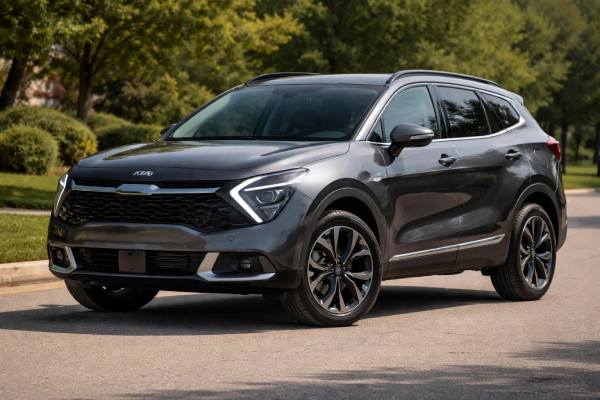
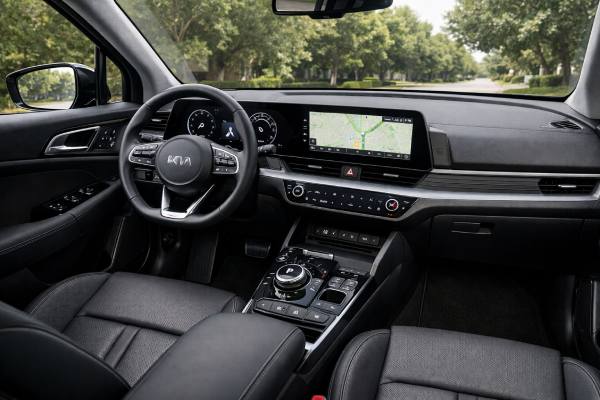
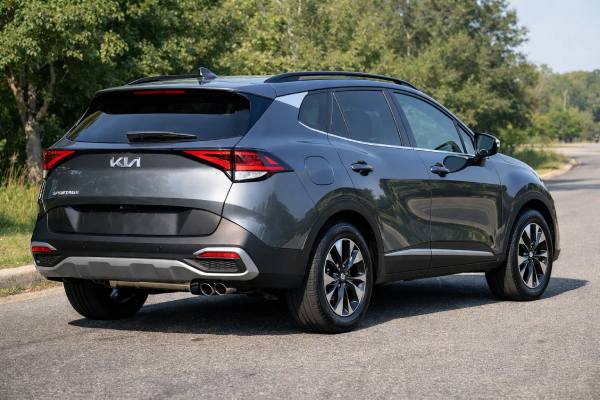
The current Kia Sportage NQ5 with front-wheel drive and the 2.5-liter G4KN engine is a practical compact SUV built around everyday usability rather than headline speed. It gives buyers a naturally aspirated four-cylinder, a conventional 8-speed automatic, generous cabin room, and a strong safety story without asking them to live with a turbocharger, a CVT, or hybrid complexity. That combination explains why this version makes sense for many long-term owners. It is smooth, roomy, and easy to drive, with real cargo space and lower mechanical drama than some rivals. The trade-off is clear as well: the 187 hp engine is competent, not quick, and the car feels more mature than sporty. One important detail is timing. The NQ5 generation arrived globally in 2022, but the 2.5-liter North American gas model effectively reached most buyers as a 2023 model-year vehicle. In today’s market, this is the Sportage for buyers who want space, simplicity, and modern safety tech in one package.
Essential Insights
- The 2.5-liter engine and 8-speed automatic deliver smooth, conventional daily driving.
- Cabin room and cargo space are among this model’s strongest real-world advantages.
- Safety equipment and crash-test results are strong, especially on better-equipped later builds.
- The main ownership caveats are early-build recall checks, occasional injector or misfire complaints, and the need to avoid stretched oil changes.
- A sensible oil and filter routine is every 8,000–12,000 km or 6–12 months, depending on use.
What’s inside
- Kia Sportage NQ5 design and ownership
- Kia Sportage NQ5 data and capacities
- Kia Sportage NQ5 trims and driver aids
- Weak points, recalls and fixes
- Service plan and buying advice
- Road manners and fuel use
- NQ5 Sportage against competitors
Kia Sportage NQ5 design and ownership
The NQ5 Sportage changed the model’s character more than many buyers realize. Earlier Sportages were compact in the traditional sense, but this generation grew into a roomier, more family-focused crossover with a longer wheelbase, a taller cabin, and far better rear-seat space. In front-wheel-drive 2.5-liter form, that shift matters because it gives buyers the most straightforward version of the range. You get the newer body, the larger interior, and the modern safety architecture, but without AWD hardware, hybrid components, or the extra weight and tyre expense that come with more specialized trims.
That makes this powertrain a logical entry point into the NQ5 line. The G4KN 2.5-liter engine produces 187 hp and 178 lb-ft, and it works through a conventional 8-speed automatic. For many owners, that matters more than the numbers themselves. A conventional automatic still feels natural in traffic, easy in parking maneuvers, and predictable when the car is loaded with passengers or luggage. It also avoids the rubber-band feel of many CVTs and the occasional low-speed awkwardness that some dual-clutch systems can show.
Another reason this version stands out is packaging. The Sportage’s long 108.5-inch wheelbase helps rear-seat comfort, while the tall roof and broad cargo area make it easier to use as a true family vehicle. This is not a crossover that only looks spacious in photos. It is genuinely practical in child-seat duty, airport runs, and weekly shopping. The FWD versions also keep ground clearance at a usable 7.1 inches, which is enough for steep driveways, uneven roads, and winter slush without adding the ride height and weight of off-road-oriented trims.
There is one timeline detail worth clarifying. The title range says 2022–present, which fits the global NQ5 program, but the 2.5-liter front-drive configuration is best understood in North America as a 2023-onward product. That matters when buyers compare recalls, safety ratings, or trim features, because early 2023 build cars do not always match the equipment logic of 2025 or 2026 vehicles.
In ownership terms, the NQ5 2.5 FWD is best seen as a value-focused, long-haul daily driver. It is not the most exciting choice in the class, and it does not chase hybrid fuel economy. But it offers strong space, mature road manners, and fewer drivetrain complications than some alternatives. For many buyers, that balance is exactly the point.
Kia Sportage NQ5 data and capacities
The table below focuses on the U.S.-market 2.5-liter front-wheel-drive Sportage, because that is the configuration that matches the G4KN 187 hp setup most closely. Where Kia’s public U.S. material does not publish a figure, it is better to say so than to fill the gap with generic database numbers.
| Powertrain and efficiency | Kia Sportage FWD NQ5 2.5 |
|---|---|
| Engine code | G4KN / Smartstream 2.5 GDI |
| Layout and cylinders | Inline-4, DOHC, 4 valves per cylinder |
| Bore × stroke | Not published in public U.S. specs pages |
| Displacement | 2.5 L (2,497 cc) |
| Induction | Naturally aspirated |
| Fuel system | Dual injection, GDI and MPI |
| Compression ratio | 13.0:1 |
| Max power | 187 hp (139 kW) @ 6,100 rpm |
| Max torque | 241 Nm (178 lb-ft) @ 4,000 rpm |
| Timing drive | Verify by VIN and service literature |
| Transmission | 8-speed automatic |
| Drive type | FWD |
| Differential | Open |
| Rated efficiency, 2023–2025 FWD | 8.4 L/100 km combined, about 28 mpg US |
| Rated efficiency, 2026 FWD | 8.4 L/100 km combined, 9.4 city and 7.1 highway L/100 km, or 25/33/28 mpg US |
| Real highway at 120 km/h | About 7.4–8.3 L/100 km is a fair expectation |
The biggest technical story here is not output. It is the engine layout. Kia uses both direct and port injection on this 2.5-liter unit, which helps emissions and drivability while reducing some of the deposit concerns associated with pure direct-injection engines. It does not eliminate maintenance sensitivity, but it is a sensible design for a mainstream crossover.
| Chassis and dimensions | Kia Sportage FWD NQ5 2.5 |
|---|---|
| Front suspension | MacPherson strut |
| Rear suspension | Independent multi-link |
| Steering | Column-mounted motor-driven power steering; public specs do not list ratio |
| Brakes | Four-wheel discs with ABS |
| Front brake disc | 320–325 mm (12.6–12.8 in), depending on year and trim |
| Rear brake disc | 300 mm (11.8 in) |
| Common tyre sizes | 235/65 R17, 235/60 R18, 235/55 R19 |
| Ground clearance | 180 mm (7.1 in) |
| Approach angle | About 17.5–18.7° depending on year |
| Departure angle | About 25.5–25.8° depending on year |
| Breakover angle | About 17.2–17.8° depending on year |
| Length | 4,661 mm (183.5 in) |
| Width | 1,864 mm (73.4 in) |
| Height | About 1,679 mm (66.1 in), depending on trim |
| Wheelbase | 2,756 mm (108.5 in) |
| Turning circle | Public Kia pages do not clearly publish a dependable kerb-to-kerb figure for all FWD trims |
| Kerb weight | 1,558–1,677 kg (3,434–3,697 lb), depending on trim and year |
| GVWR | About 2,150 kg (4,740 lb), depending on trim |
| Fuel tank | 54.1 L (14.3 US gal / 11.9 UK gal) |
| Cargo volume | 1,121 L (39.6 ft³) seats up / 2,098 L (74.1 ft³) seats down, SAE |
| Performance and service capacities | Kia Sportage FWD NQ5 2.5 |
|---|---|
| 0–100 km/h | Kia does not publish a North American figure |
| Top speed | Not published in public U.S. specs pages |
| Braking distance | Not published in public U.S. specs pages |
| Towing capacity | 1,134 kg (2,500 lb) braked / 750 kg (1,653 lb) unbraked |
| Payload | Roughly 473–592 kg (1,043–1,306 lb), depending on trim |
| Engine oil | SAE 0W-20 in most markets; 5.6 L (5.9 US qt) drain and refill |
| Coolant | Verify exact type and capacity by VIN and service manual |
| Automatic transmission fluid | 6.5 L (6.9 US qt), verify exact fluid spec by service literature |
| Differential / transfer case | Not applicable to FWD |
| A/C refrigerant | Verify under-hood label and VIN-specific service data |
| A/C compressor oil | Verify by refrigerant system type |
| Wheel nut torque | 107–127 Nm (79–94 lb-ft) |
| Safety and driver assistance | Kia Sportage FWD NQ5 2.5 |
|---|---|
| IIHS 2023 | Top Safety Pick, with headlight and equipment caveats |
| IIHS 2024–2025 | Top Safety Pick |
| IIHS 2026 | Top Safety Pick+ for vehicles built after May 2025 |
| Headlight rating | Trim-dependent; important when comparing used vehicles |
| ADAS availability | Forward collision avoidance, lane support, blind-spot features, rear cross-traffic alert, and additional camera-based aids depending on trim and package |
Kia Sportage NQ5 trims and driver aids
Trim choice changes the NQ5 Sportage more than the engine does. The 2.5-liter FWD drivetrain stays basically the same, but equipment, tyre size, safety content, and cabin atmosphere can shift quite a lot from one trim to the next. In the 2023–2025 years, the mainstream gas lineup generally centered on LX, EX, SX, and SX Prestige in front-drive form, while X-Line and X-Pro versions pushed the model toward AWD and a more rugged look. For 2026, Kia refreshed the Sportage and adjusted the trim structure, but the same basic rule still applies: the most sensible long-term buys are usually the mid-grade trims with the smaller wheel packages.
LX models are the value point. They give you the core packaging and much of the safety foundation, but they can feel sparse next to better-equipped versions. EX is often the sweet spot for the 2.5 FWD buyer because it adds comfort, convenience, and a more complete daily-driver feel without pushing tyre and option costs too far upward. SX and SX Prestige bring the richer interior experience, larger digital displays, and more upscale cabin details many buyers want, but those trims can also mean more technology, more expensive replacement parts, and less forgiving tyre sidewalls.
Package strategy matters as much as trim. In the pre-refresh years, Kia offered packages such as EX Premium that added items like a panoramic roof and a smart power liftgate. In the 2026 model year, package logic shifted, with examples such as LX Convenience, EX Panoramic Sunroof, and the X-Line Technology package on the AWD side. That means used-car shoppers should decode the actual equipment on the vehicle rather than rely on a badge alone.
Safety and ADAS are one of this Sportage’s strongest selling points, but they are not identical across the range. Depending on year and package, the NQ5 can include:
- Forward collision avoidance with vehicle, pedestrian, and cyclist detection.
- Junction-turning intervention on better-equipped versions.
- Lane departure warning and lane-keeping or lane-following support.
- Blind-spot collision warning and rear cross-traffic alert.
- Blind-Spot View Monitor on higher trims or option packages.
- Rear parking collision avoidance on selected upper trims.
- Smart cruise control and larger camera-based convenience systems.
Crash-test evolution is also worth noting. Early 2023 ratings were strong, but some awards depended on specific headlamps. By 2024 and 2025, the Sportage maintained a strong IIHS record, and the refreshed 2026 model reached Top Safety Pick+ for vehicles built after May 2025. For buyers, that means two practical things. First, trim-level headlights matter. Second, after any windshield, bumper, or front-end repair, ADAS recalibration should be treated as part of proper repair, not a dealer upsell.
Weak points, recalls and fixes
The 2.5-liter front-drive NQ5 is not a problem vehicle in the broad sense, but it does have a clear set of watch points. Most are manageable, and many are ordinary modern-crossover issues rather than deep engineering flaws. The right way to judge this Sportage is by prevalence, severity, and whether the car’s service and recall history has been handled properly.
Start with the lower-cost, more common items. City-driven cars can wear front brakes quickly, and rear brake hardware can become noisy or sticky if the vehicle spends a lot of time on short trips or in damp climates. Suspension links and small bushings can also begin to speak up as mileage rises, especially on larger wheels. These are not unusual failures, but they do affect refinement. Common symptoms are a hot wheel after driving, light clunks over sharp bumps, or uneven pad wear during inspection.
A level above that are occasional medium-cost issues. Misfire faults are the most relevant example on the 2.5 gas model. The official service side has addressed injector-related misfire cases on this engine family, so a car with repeated P0300 to P0304 history deserves close attention. In practice, symptoms may be rough cold starts, flashing malfunction lamps under load, or a stumble that feels worse after a hot soak. The root cause can be plugs, coils, or injectors, so the right answer is proper diagnosis, not blind parts swapping.
Because this is a GDI and MPI engine, intake deposit risk is lower than on a direct-injection-only rival, but not zero. Cars that live on short trips, low-quality fuel, or very long oil intervals can still age poorly. That is why service history matters more than brochure promises.
The recalls are the most important ownership filter on early vehicles. Two headline items stand out on early 2023 builds. One involved the brake booster, where a diaphragm misalignment could create a vacuum leak and reduce brake assist, leading to a hard pedal and longer stopping distances. Another involved the electric oil pump controller on certain 8-speed automatic vehicles, where an internal fault could create thermal damage and fire risk. There was also a cluster-related campaign affecting warning display behavior on some 2023 vehicles. None of these automatically make the model a poor choice, but they do make VIN-based recall confirmation non-negotiable.
For pre-purchase work, ask for:
- Complete recall completion records.
- Scan results, not just a dashboard with no warning lights.
- Cold-start behavior with no stumble or extended cranking.
- Smooth part-throttle acceleration with no misfire under load.
- Normal brake pedal feel and no signs of hard-pedal complaints.
- Evidence of regular oil servicing rather than stretched intervals.
Handled properly, the NQ5 2.5 FWD looks like a normal modern crossover. Neglected, it can become the sort of car that feels fine on a short test drive but starts asking for money soon after purchase.
Service plan and buying advice
The best maintenance plan for this Sportage is slightly more conservative than the longest official interval logic suggests. That is especially true if the car sees short trips, hot weather, heavy traffic, or long idle time. The 2.5-liter engine is not fragile, but like most modern naturally aspirated gasoline engines, it rewards clean oil, consistent filter changes, and attention to small drivability issues before they turn into larger problems.
A practical schedule for long-term ownership looks like this:
- Engine oil and filter: every 8,000–12,000 km or 6–12 months, sooner in severe service.
- Tyre rotation: every 8,000–12,000 km to protect front-tyre wear on FWD models.
- Engine air filter: inspect around 24,000 km and replace around 48,000 km, sooner in dust-heavy use.
- Cabin air filter: every 16,000–24,000 km, depending on climate and dust.
- Brake inspection: every service; city cars can wear pads faster than mileage alone suggests.
- Brake fluid: about every 2–3 years is sensible, even if mileage is low.
- Automatic transmission fluid: inspect condition regularly and consider preventive service earlier than a lifetime-fill mindset would suggest if the car works hard.
- Coolant: verify the exact interval by VIN and service manual.
- Spark plugs: verify by official service schedule, but inspect drivability and misfire history well before high mileage.
- 12 V battery: test annually from year four onward.
Useful decision-making specs are straightforward. The engine oil fill is 5.6 L, wheel torque is 107–127 Nm, and most markets specify 0W-20 for the 2.5-liter engine, with climate-specific variation in some regions. Public owner-manual data also shows 6.5 L for automatic transmission fluid capacity, though the correct fluid spec should always be confirmed against service literature and VIN.
For buyers, the smartest used versions are often EX or similarly balanced trims with 17- or 18-inch wheels. They keep the ride more settled, tyre replacement is less painful, and there is still plenty of cabin equipment. Very early 2023 vehicles deserve the most careful recall screening. Later vehicles benefit from running changes, stronger safety recognition, and more polished equipment logic.
Use this checklist before you buy:
- Confirm recalls by VIN and dealer record.
- Check for any history of misfire or injector work.
- Scan engine, transmission, ABS, and ADAS systems.
- Inspect front tyres for uneven wear from missed rotations or alignment issues.
- Confirm smooth shifts and no flare or hesitation from the 8-speed automatic.
- Verify proper ADAS operation and ask whether windshield or bumper repairs were followed by calibration.
- Look for coolant residue, seepage, or oil misting around the engine bay.
- Road-test the car on broken pavement for suspension noise.
Long-term, the durability outlook is good if the car is maintained on time and bought with a clean recall and scan history. This is not a buy-any-example vehicle, but it is a good buy when chosen carefully.
Road manners and fuel use
The NQ5 2.5 FWD does not feel underpowered in normal use, but it is not quick by current class standards. The engine’s real strength is how naturally it responds. Throttle inputs are easy to meter in traffic, the 8-speed automatic behaves like a traditional automatic should, and the car does not need aggressive revs to move away cleanly from a stop. There is enough torque for daily driving, but when the vehicle is full of passengers or merging uphill, the transmission has to work for it. That is normal for this setup.
Ride quality is one of the FWD Sportage’s better traits. The long wheelbase helps it settle into a calm highway rhythm, and the chassis feels planted rather than busy. Steering effort is light, which suits the car’s family role, though it does not offer much feedback. Cornering balance is safe and predictable, with moderate body movement but no major surprises. Smaller-wheel versions usually feel more relaxed and quieter over patched asphalt than 19-inch trims.
Noise levels are reasonable. Around town, the engine stays muted. At highway speed, wind and tyre noise are present but controlled. Under hard acceleration, the 2.5-liter engine gets more vocal and coarse than some turbo rivals, yet it avoids the artificial surge or delayed kickdown that can make other crossovers feel less natural.
Official fuel economy explains the powertrain’s place in the market. For 2023–2025 front-drive models, the EPA figure is about 25 mpg city, 32 mpg highway, and 28 mpg combined. For 2026 front-drive models, the highway number improves to 33 mpg, with the combined figure staying at 28 mpg. In metric terms, that means roughly:
- City: about 9.4 L/100 km official.
- Highway: about 7.1–7.4 L/100 km official.
- Combined: about 8.4 L/100 km official.
Real-world results usually land near these ranges:
- City: about 9.8–11.8 L/100 km.
- Highway at 100–120 km/h: about 7.2–8.3 L/100 km.
- Mixed driving: about 8.3–9.4 L/100 km.
Cold weather, short trips, and heavy use of the climate system can push those figures upward quickly. That is one reason the gas Sportage makes more sense for buyers who value simplicity, space, and predictable driving feel over class-leading economy.
In simple terms, the driving verdict is easy. The 2.5 FWD Sportage is calm, easy, and grown-up. It is better at commuting, carrying people, and covering distance in comfort than it is at feeling lively or sporty.
NQ5 Sportage against competitors
The front-drive 2.5-liter Sportage sits in one of the busiest parts of the market, so context matters. Against the Toyota RAV4 2.5, the Kia usually wins on cabin design freshness, cargo presentation, and perceived value for money, while the Toyota still leads on reputation and hybrid availability. Against the Honda CR-V, the Sportage counters with more distinctive styling and, in many trims, a richer dashboard layout, but the Honda often feels a little more polished in steering and space efficiency.
The Mazda CX-5 is the driver’s choice in this group. It has better steering feel, a more premium road feel, and a tidier sense of body control. The Sportage answers with a larger-feeling cabin, stronger day-to-day packaging, and a less intimate, more family-first layout. For buyers who prioritize passengers and cargo over driver engagement, the Kia often makes more sense.
The Hyundai Tucson is the closest relative. The comparison comes down to taste and trim strategy rather than hard engineering. The Sportage tends to feel a bit more adventurous in design, while the Tucson often reads as more restrained. In front-drive 2.5-liter form, the two share the same broad strengths: conventional automatic transmission, decent performance, and respectable practicality.
Where the Sportage makes its most persuasive case is in balance. It is not the quickest, not the most efficient, and not the sharpest to drive. Yet it combines several useful qualities in one place:
- A roomy second row and large cargo area.
- A conventional non-CVT automatic.
- Strong available safety tech.
- Good trim spread from basic to near-premium.
- Straightforward ownership for buyers who do not want hybrid complexity.
Its weaknesses are just as clear:
- Performance is adequate rather than strong.
- Early build recall screening matters.
- Fuel economy is fine, not class-leading.
- Larger wheels can hurt comfort and replacement cost.
Buy this Sportage if you want a roomy, modern, front-drive family crossover with a traditional automatic and solid safety credentials. Choose a hybrid rival if fuel economy is the main goal, or a Mazda CX-5 if steering feel matters more than space. But if you want a practical, lower-drama daily SUV that still feels current in 2026, the NQ5 Sportage 2.5 FWD remains a very convincing choice.
References
- Compare Specs of the 2026 Kia Sportage | Model Chart: LX, EX, SX, SX Prestige, X-Line, X-Pro Prestige | Kia 2026 (Specifications)
- Recommended lubricants and capacities – Kia Owner’s Manual 2026 (Owner’s Manual)
- Gas Mileage of 2025 Kia Sportage 2025 (Fuel Economy)
- 2026 Kia Sportage 4-door SUV 2026 (Safety Rating)
- Check for Recalls: Vehicle, Car Seat, Tire, Equipment 2025 (Recall Database)
Disclaimer
This article is for informational purposes only and is not a substitute for professional diagnosis or repair. Specifications, torque values, intervals, capacities, procedures, and equipment vary by VIN, market, model year, and trim, so always verify the exact vehicle against official Kia service documentation before servicing, diagnosing, or buying.
If this guide helped you, please share it on Facebook, X, or another platform to support our work.