


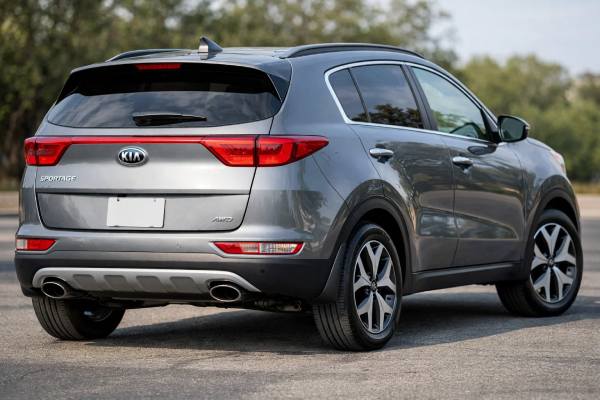
The 2016–2018 Kia Sportage QL with the 1.6-liter G4FJ turbo petrol engine is one of the more appealing versions of the fourth-generation Sportage. In European-market front-wheel-drive form, it combines 177 hp-class output with a six-speed manual, giving it stronger mid-range performance than the base 1.6 GDi while avoiding the extra weight and complexity of the AWD hardware. It also lands in a useful sweet spot for used buyers: modern enough to offer a stiff body shell, solid crash protection, and a roomy boot, yet still simple enough to service without the added cost layers of hybrid systems or premium-brand running costs. The key ownership question is not whether it is quick enough, but whether it has been maintained properly. On this engine, regular oil changes, correct spark-plug service, and a healthy intake and boost system matter more than headline mileage. A good one feels strong, refined, and easy to live with.
Quick Specs and Notes
- Stronger real-world shove than the base 1.6 GDi, thanks to 265 Nm from 1,500 to 4,500 rpm.
- FWD manual form is simpler than AWD or DCT versions, so long-term ownership risk is lower.
- Spacious for the class, with a 503 L VDA boot and a 62 L fuel tank.
- The main caveat is maintenance discipline: neglected oil service hurts turbo petrol engines faster than many owners expect.
- A sensible working interval for engine oil is every 10,000–15,000 km or 12 months.
Guide contents
- Sportage QL 1.6 T-GDi Overview
- Sportage QL Specs and Data
- Sportage QL Trims and Safety
- Reliability and Known Faults
- Maintenance and Buying Advice
- Driving and Real-World Performance
- Against Qashqai, Tucson and Tiguan
Sportage QL 1.6 T-GDi Overview
For this exact version, the important point is that the 2016–2018 Sportage 1.6 T-GDi is not simply “the petrol Sportage.” It is the Gamma-family G4FJ engine: a 1,591 cc, direct-injection, turbocharged inline-four with a broad torque band and a noticeably more useful mid-range than the naturally aspirated 1.6 GDi. In front-wheel-drive manual form, it gives the QL Sportage enough punch to feel relaxed on faster roads without turning the car into a hard-edged performance SUV.
That balance is what makes this variant attractive today. You get the stronger engine, a sturdy body structure, useful cargo space, and a mature ride, but you avoid two cost multipliers that matter in the used market: the rear driveline of the AWD version and the extra calibration and wear concerns of the seven-speed dual-clutch gearbox. The FWD manual layout is the simpler ownership choice, and for many buyers it is the sweet spot of the range.
The QL-generation Sportage was also a meaningful step forward in chassis engineering. Kia gave it a much stiffer body than the older model, with a larger share of high-strength steel and better structural rigidity. That shows up in the way the car feels on the road. Even now, a healthy QL still feels solid over poor surfaces, stable at motorway speed, and quieter than many people expect from a mainstream compact SUV of this age.
Packaging is another part of the appeal. At 4,480 mm long with a 2,670 mm wheelbase, the Sportage has enough footprint to work well as a family car without becoming awkward in town. Boot space is generous, and the rear seat is usable rather than token. This is one reason the 1.6 T-GDi works better in the Sportage than some small turbo engines do in heavier crossovers: the vehicle itself is practical enough to justify the stronger petrol engine.
The 2018 facelift did not completely change the car, but it did update the emissions package. The basic output remained broadly similar, while later examples gained gasoline particulate filter hardware and newer emissions compliance. That means buyers today can choose between earlier cars that feel more mechanically simple and later cars that offer newer-spec emissions equipment and, in some markets, broader safety technology.
Ownership history matters more than trim badge. A well-kept 2016 car with full service invoices is usually a better buy than a scruffier late car with patchy history. On this model, maintenance quality shapes the verdict far more than model year alone.
Sportage QL Specs and Data
The figures below focus on the European-spec 2016–2018 Kia Sportage QL 1.6 T-GDi front-wheel-drive model. Where public figures vary slightly by year or market sheet, the ranges are noted. Where a value is not clearly published in open technical material, it is left qualified rather than guessed.
| Item | Value |
|---|---|
| Code | G4FJ |
| Engine layout and cylinders | Inline-4, DOHC, 16 valves, 4 valves per cylinder |
| Bore × stroke | 77.0 × 85.4 mm (3.03 × 3.36 in) |
| Displacement | 1.6 L (1,591 cc) |
| Induction | Turbocharged |
| Fuel system | Direct injection |
| Compression ratio | 10.0:1 |
| Max power | 177 PS / about 174 bhp / 130 kW @ 5,500 rpm |
| Max torque | 265 Nm (195 lb-ft) @ 1,500–4,500 rpm |
| Timing drive | Chain |
| Rated efficiency | About 7.3–7.4 L/100 km combined, depending on year and market sheet |
| Real-world highway @ 120 km/h (75 mph) | Usually about 7.5–8.5 L/100 km |
| Transmission and driveline | Value |
|---|---|
| Transmission | 6-speed manual |
| Drive type | Front-wheel drive |
| Differential | Conventional open front differential |
| AWD / DCT note | Other 1.6 T-GDi versions could be paired with AWD and DCT, but this exact FWD setup is the simpler manual form |
| Chassis and dimensions | Value |
|---|---|
| Front suspension | MacPherson strut |
| Rear suspension | Multi-link |
| Steering | Electric rack-and-pinion |
| Steering ratio | 14.34:1 |
| Brakes | 305 mm ventilated front discs (12.0 in), 302 mm rear discs (11.9 in) |
| Popular tyre sizes | 225/60 R17 or 245/45 R19 |
| Ground clearance | Market-dependent; verify by tyre package |
| Length | 4,480 mm (176.4 in) |
| Width | 1,855 mm (73.0 in) |
| Height | 1,635 mm (64.4 in) |
| Wheelbase | 2,670 mm (105.1 in) |
| Turning circle | Public material varies in presentation; verify by local spec sheet |
| Kerb weight | About 1,449 kg (3,195 lb) |
| GVWR | About 2,120 kg (4,674 lb) |
| Fuel tank | 62 L (16.4 US gal / 13.6 UK gal) |
| Cargo volume | 503 L (17.8 ft³) VDA with mobility kit; slightly less with temporary spare |
| Performance and capability | Value |
|---|---|
| 0–100 km/h | 9.2 s |
| Top speed | 205 km/h (127 mph) |
| Braking distance | Tyres and test method dependent; no single factory figure should be treated as universal |
| Towing capacity | 1,900 kg (4,189 lb) braked; 750 kg (1,653 lb) unbraked |
| Payload | About 671 kg (1,479 lb), based on published curb and gross weight |
| Fluids and service capacities | Value |
|---|---|
| Engine oil | SAE 5W-30 ACEA A5/B5; 4.0 L (4.23 US qt) |
| Coolant | Long-life ethylene-glycol type; exact fill varies by VIN and market documentation |
| Manual transmission fluid | Verify by VIN and gearbox code before refill |
| A/C refrigerant | R-1234yf; charge varies by label and equipment |
| A/C compressor oil | Verify by A/C label and service documentation |
| Wheel nut torque | 107–127 Nm (79–94 lb-ft) |
| Safety and driver assistance | Value |
|---|---|
| Euro NCAP | 5 stars |
| Adult occupant | 90% |
| Child occupant | 83% |
| Safety assist | 71% |
| Standard passive safety | Front, side, and curtain airbags; ISOFIX child-seat mounting points |
| ADAS availability | Depends strongly on trim and year; higher trims add features such as autonomous emergency braking, lane support, blind-spot monitoring, and rear cross-traffic warning |
The practical takeaway is simple: the 1.6 T-GDi FWD is not the lightest or most frugal version of the Sportage, but it is one of the better-balanced ones. It has enough torque to suit the size of the car, enough towing headroom to be genuinely useful, and a simpler driveline than the more complex alternatives.
Sportage QL Trims and Safety
The trim picture for this engine is straightforward in principle but messy in practice because Kia varied equipment by country. In many European markets, the 1.6 T-GDi was closely tied to better-equipped trims, especially the GT Line image of the early QL years. That is useful for used buyers because it means many turbo petrol examples come with a richer equipment baseline than lower-powered fleet cars.
GT Line models are usually easy to identify. Common visual cues include larger alloy wheels, more aggressive front and rear styling details, darker trim finishes, and sportier cabin touches. Inside, these cars often gained better upholstery, a thicker steering wheel, alloy pedal trim, and a more polished dashboard presentation. For many buyers, the stronger petrol engine and the better trim package arrive together.
Mechanical differences across trims were not as dramatic as on some rivals, but wheel and tyre packages do affect the ownership experience. A 17-inch Sportage usually rides more quietly and more softly than a 19-inch GT Line car, while the larger wheels deliver a sharper visual stance at the cost of more road noise and a firmer reaction over broken surfaces. For buyers who value long-distance comfort, tyre brand and wheel size matter more than a brochure comparison suggests.
By 2018, some markets widened 1.6 T-GDi availability across more mainstream grades. That can make later cars attractive because they may combine the stronger engine with smaller wheels, lower insurance, or a less flashy look. From a buying standpoint, that can be the ideal mix: the right engine without the most expensive trim extras.
Safety is one of the stronger reasons to consider the QL Sportage. The model earned a five-star Euro NCAP result, supported by strong adult and child occupant scores. More importantly, the structure itself was improved over the earlier Sportage, with a stiffer shell and more advanced high-strength steel. That gives the vehicle a solid base, not just a software-led safety story.
Passive safety equipment was competitive for the class. Airbag coverage was broad, and ISOFIX child-seat points made the Sportage family-friendly from the start. Active safety is where trim and year matter most. Earlier or lower-trim cars may have the core stability and braking systems but miss the more desirable driver-assistance features. Later and higher-spec cars can add forward collision warning and braking, lane support, high-beam assist, speed-limit recognition, blind-spot monitoring, and rear cross-traffic alerts.
That means the safest used buy is not automatically the newest car or the GT Line car. It is the specific car whose equipment list matches the features you actually want. A seller’s advert often overstates safety equipment, so checking the VIN-based spec is worth the effort. On a car of this age, confirmed equipment and a clean crash history matter more than badge language in the listing title.
Reliability and Known Faults
The 1.6 T-GDi FWD manual is one of the safer QL Sportage combinations from a reliability standpoint because it avoids two extra complexity layers: AWD hardware and the dual-clutch transmission. That does not make it trouble-free. It does mean that most ownership risk sits in the engine, its maintenance history, and the usual age-related chassis wear, rather than in multiple costly subsystems at once.
The most common problem pattern is neglect rather than one dramatic defect. This is a direct-injection turbo petrol engine with a timing chain, and it depends on clean oil, correct service intervals, and good ignition components. When these cars are maintained on time, they usually age reasonably well. When they are stretched too far between oil changes or driven mostly on short cold trips, they tend to develop the familiar turbo-petrol symptoms: rough idle, misfires, sluggish boost response, oil consumption complaints, and timing-noise worries.
A practical way to group the typical issues is by prevalence and cost.
- Common, low to medium cost: overdue oil service, tired spark plugs, aging ignition coils, dirty filters, weak batteries, and worn brake hardware.
- Occasional, medium cost: boost-hose leaks, intercooler plumbing issues, clutch wear from heavy urban use, and suspension consumables such as drop links, bushes, and top mounts.
- Occasional, medium to high cost: timing-chain stretch symptoms, noisy tensioner operation on poorly serviced cars, and turbocharger wear where oil history is weak.
- Rare, but worth checking: unresolved recall or service-action work, electrical faults caused by poor previous repairs, or corrosion on underbody fixings and shields in hard winter climates.
Direct injection also raises the normal long-term concern about intake-valve carbon build-up. Not every car develops a serious problem, but cars that live on short trips and rarely see sustained temperature can become rougher and less responsive with age. This usually shows up as poor cold running, uneven idle quality, and a sense that the engine no longer pulls as cleanly as it should. The fix is not guessing. It is proper diagnosis, intake and boost-system inspection, and then cleaning or repair as needed.
The timing chain deserves sensible caution. There is no routine owner-manual replacement interval in normal service, so this is a condition-based item. A healthy engine should not sound obviously loose on cold start, and it should not show timing-correlation faults. A chain job is not part of routine maintenance, but it becomes a serious bill if ignored when the warning signs appear.
Recall awareness matters too. Some QL-generation Sportage recalls in North America involved systems that may not apply to every European 1.6 T-GDi FWD car. Still, the wider lesson is important: always verify outstanding campaigns by VIN and keep proof of completion in the history file. That paperwork adds real value at resale and removes doubt when the vehicle changes hands.
For a buyer, the best checks are simple and revealing. Ask for a cold start. Listen for chain noise. Drive the car from low revs in a high gear and make sure boost builds smoothly. Check for smoke, flat spots, warning lights, and clutch slip. Look underneath for impact damage, corrosion, and poor previous repairs. In this model, a complete service file is usually more valuable than a slightly lower odometer reading.
Maintenance and Buying Advice
This Sportage rewards disciplined maintenance. The official schedule is not especially harsh on paper, but a used turbo direct-injection engine almost always benefits from shorter real-world intervals than the broadest factory maximums suggest. If you want this car to stay smooth, responsive, and reliable into older age, routine service matters more than optional upgrades.
A practical maintenance plan for long-term ownership looks like this:
- Engine oil and filter: every 10,000–15,000 km or 12 months. Use the correct viscosity and specification, and stay near the shorter end if the car does repeated short trips, city driving, or frequent cold starts.
- Engine air filter: inspect at every oil service and replace when dirty, typically around 15,000–30,000 km depending on dust and environment.
- Cabin air filter: replace regularly, usually every 15,000 km or yearly, because a blocked filter affects cabin airflow and HVAC load.
- Spark plugs: replace at about 75,000 km. On an older turbo engine, this is not a good interval to ignore.
- Coolant: follow the official long-life schedule, but inspect condition and level at every service and verify exact refill type by VIN.
- Brake fluid: replace at the proper time-based interval, not only by mileage. Two years is a sensible working rule if history is unclear.
- Brake pads and discs: inspect at each service, especially on cars used in urban traffic or on salted roads.
- Manual transmission fluid: if service history is unknown, changing it early is sensible even if the owner’s schedule is less aggressive.
- Serpentine belt and hoses: inspect from midlife onward for age cracking, glazing, or seepage.
- Timing chain: no routine replacement interval, so inspect by symptoms, cold-start noise, and fault history.
- Tyres, alignment, and rotation: check frequently. Uneven wear changes how this car drives more than many owners expect.
- 12 V battery: test annually once the battery is more than four years old.
Useful service figures for planning include about 4.0 L of engine oil and 107–127 Nm wheel-nut torque. Beyond that, exact capacities should be verified against the car’s VIN, under-hood labels, and official service literature before any refill or repair.
For buyers, the inspection checklist should focus on the areas most likely to affect ownership cost:
- Full service history with invoices, not just stamps.
- Evidence of correct oil grade and regular oil changes.
- Spark-plug replacement history.
- Smooth cold start with no chain rattle.
- Clean boost delivery with no hesitation under load.
- No clutch slip in a higher gear.
- Even tyre wear and no cheap mismatched tyres.
- No coolant smell, oily residue, or unexplained fluid loss.
- Working safety systems, cameras, sensors, and infotainment.
- Recall and service-action confirmation by VIN.
Which years are best? A 2018 car is appealing if you want the newer emissions spec and often broader ADAS availability. A 2016–2017 car can be the better value if you want a simpler early example and care more about condition than late-cycle updates. In either case, the best trim is usually the best-kept trim. A carefully maintained mid-grade car will age better than a neglected flagship.
The long-term durability outlook is good rather than perfect. The body and basic chassis are strong, the cabin holds up reasonably well, and the FWD manual layout helps keep risk under control. The difference between a satisfying Sportage and an expensive one is nearly always previous-owner discipline.
Driving and Real-World Performance
On the road, the 1.6 T-GDi Sportage feels more mature than its specification alone suggests. This is not a lightweight crossover, and it does not feel overtly sporty in the first five minutes. Instead, it feels stable, planted, and mechanically settled. The rigid body shell and fully independent suspension give it a composed motorway character, while the steering is quick enough to make the car feel more responsive than a soft family SUV usually does.
The engine is the reason to choose this version over the base petrol. With 265 Nm available from just 1,500 rpm, the Sportage has enough torque to avoid the strained, high-rev feel that can affect naturally aspirated compact SUVs. In normal driving, that matters more than the headline 0–100 km/h figure. You do not need to thrash it to keep up with traffic. It pulls cleanly from the mid-range and feels more relaxed on overtakes and hills than the entry-level engine.
Officially, 0–100 km/h takes about 9.2 seconds and top speed is 205 km/h. In everyday use, it feels brisk rather than fast. The manual gearbox suits the engine’s character well because it lets the driver stay in the useful torque band without the slight hesitation or low-speed awkwardness that some dual-clutch crossovers can show. The six-speed manual also reinforces the appeal of this specific setup as the simpler driver’s choice.
Ride quality depends heavily on wheel size. Cars on smaller wheels are calmer and more compliant, while 19-inch examples look sharper but can feel busier over broken pavement. That is why used-car tyre choice matters so much. A Sportage on quality tyres feels more refined, grips better, and usually brakes more consistently than one wearing cheap rubber in the same size.
At speed, straight-line stability is one of the car’s strengths. It feels secure on long highway runs, and cabin refinement is solid for the class. Wind and tyre noise are present, as expected in a family SUV, but a healthy Sportage does not feel crude or flimsy. The cabin’s sense of solidity is part of what still makes the QL competitive as a used buy.
Real-world economy is respectable but not class-leading. Expect around 9.5–10.5 L/100 km in heavy city use, about 7.5–8.5 L/100 km at a true 120 km/h motorway cruise, and around 8.0–8.8 L/100 km in mixed driving. Winter weather, short trips, roof accessories, and larger wheels can push those numbers upward. That means the 1.6 T-GDi is a good choice for buyers who want petrol smoothness and usable torque, but not for those whose first priority is the lowest possible fuel bill.
Towing ability is a pleasant surprise. With a strong braked towing figure for a 1.6-liter petrol SUV, the car can handle moderate towing duties well, though front-wheel-drive traction, clutch wear, and fuel consumption all need realistic expectations. Under full load, it remains stable and competent, but it no longer feels quick. That is fair for the segment and the engine size.
Against Qashqai, Tucson and Tiguan
Against its main rivals, the 2016–2018 Sportage 1.6 T-GDi FWD makes the strongest case as the balanced choice. It is not the softest-riding compact SUV on large wheels, and it is not the class leader for fuel economy. What it does offer is a convincing mix of torque, structural solidity, practical space, and relatively manageable long-term ownership when you choose the front-wheel-drive manual form.
Versus a Nissan Qashqai of the same period, the Kia usually feels more substantial and more planted. The Sportage has a stronger sense of body integrity, and in this engine form it feels more effortless on open roads. The trade-off is that it is not quite as economy-focused and may cost more to feed in city-heavy use. Buyers who value a more settled, longer-legged family SUV tend to prefer the Kia.
Versus the Hyundai Tucson, the comparison is naturally close because the two vehicles share much of their underlying engineering. The real difference often comes down to styling, trim, and the exact used example available. The Sportage leans more heavily on bold design and, in GT Line form, has more visual personality. The Tucson often feels like the more conservative sibling. If two cars are equally well maintained, personal taste may decide the result.
Versus a Volkswagen Tiguan, the Sportage often wins on straightforward ownership logic rather than premium polish. The Tiguan may offer a more upscale interior impression in some trims, but the Kia’s simpler FWD manual 1.6 T-GDi setup can be easier to justify as a used purchase. It feels honest in what it offers: good space, good structure, useful performance, and no premium-brand cost expectation.
The 1.6 T-GDi Sportage is also a better fit for some buyers than a diesel alternative. If you do shorter trips, want to avoid diesel emissions-system concerns, and still need more punch than a base petrol crossover usually gives, this engine makes sense. It is not the cheapest car to run, but it can be the easier one to live with over time if your driving pattern suits petrol.
So where does that leave this exact model? It is the version to choose if you want the fourth-generation Sportage’s roomy packaging and mature chassis with a genuinely useful petrol engine, but without the extra complication of AWD or a dual-clutch transmission. It is not the crossover to buy purely on image. It is the one to buy when the maintenance history is strong and you want a family SUV that still has some mechanical character.
References
- Sportage 2016 (Press Kit)
- Scheduled maintenance service n.d. (Owner’s Manual)
- Recommended lubricants and capacities n.d. (Owner’s Manual)
- Five-star safety ratings for all-new Kia Optima and Sportage 2015 (Safety Rating)
- 2017 Kia Sportage 4-door SUV 2017 (Safety Rating)
Disclaimer
This article is for informational purposes only and is not a substitute for professional diagnosis, repair, or market-specific technical guidance. Specifications, torque values, service intervals, capacities, procedures, and equipment can vary by VIN, production date, market, trim, and emissions standard, so always verify against the official Kia service documentation for the exact vehicle before carrying out maintenance or repairs.
If this article was useful, please share it on Facebook, X, or another platform to support our work.