
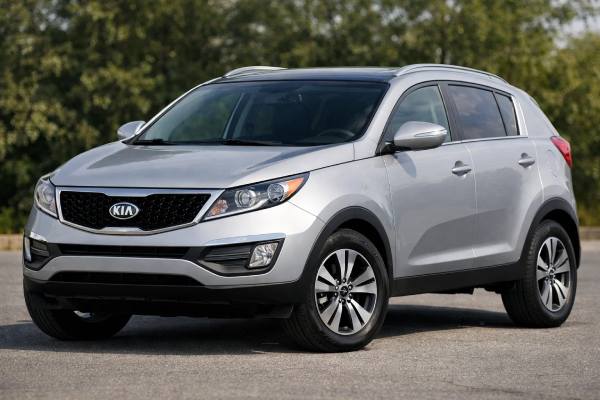
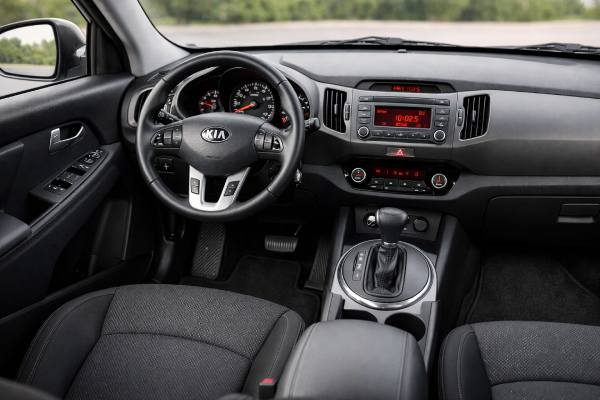
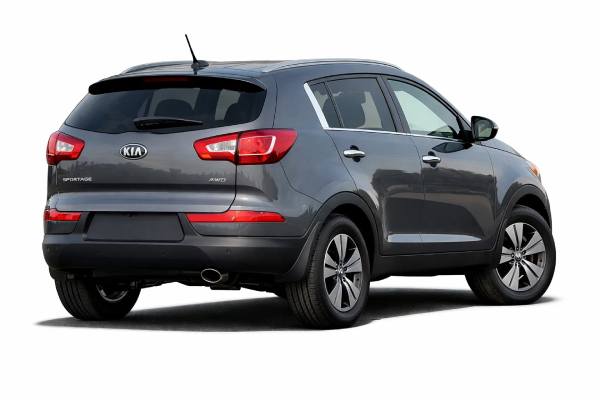
The 2011–2013 Kia Sportage FWD with the 2.4-liter G4KE engine is one of the more interesting compact SUVs from its era because it combines a sharp design, a roomy cabin, and genuinely simple front-drive packaging. This was the SL-generation Sportage, the model that pushed Kia much further into the mainstream crossover market. Instead of old-school SUV compromises, it offered a unibody body shell, independent suspension, and the sort of everyday road manners buyers now expect.
In 176 hp front-wheel-drive form, the 2.4-liter engine gave the Sportage enough performance for family use without the extra cost and complexity of the turbo SX or the AWD system. That still matters today. The strengths are easy to understand: solid space efficiency, low-effort driving, and strong value on the used market. The weak points are just as important: Theta II engine risk, recall history, and the need for careful service verification before buying.
Top Highlights
- The 2.4-liter G4KE gives the Sportage enough everyday pace without the extra heat and complexity of the turbo model.
- Front-wheel drive keeps weight and service needs lower than AWD, which helps long-term ownership costs.
- Cargo space and rear-seat room are still competitive for a compact SUV from this period.
- The biggest ownership risk is incomplete engine-campaign history on the Theta II 2.4 MPI engine.
- A current Kia legacy guide lists 7,500 miles or 12 months for normal service on 2011–2013 Sportage models.
Section overview
- Kia Sportage SL petrol snapshot
- Kia Sportage SL specs chart
- Kia Sportage SL trims and safety
- Trouble spots and factory actions
- Service needs and buyer checks
- Real-world pace and road manners
- Rival matchups and ownership value
Kia Sportage SL petrol snapshot
The SL-generation Sportage was a major shift for Kia. It replaced the softer, rounder KM model with something more assertive in design and more modern in packaging. The basic formula was simple but effective: unibody construction, fully independent suspension, front-drive architecture, and engines sized for mainstream compact-SUV duty. That made the Sportage feel much more like a family crossover than a traditional small SUV, and it is the main reason these cars still fit modern daily use surprisingly well.
In FWD 2.4-liter form, the Sportage sits in the sensible middle of the SL range. It gives up the added traction of AWD and the stronger punch of the SX turbo, but it avoids their extra parts, weight, and potential repair cost. For many owners, that is exactly the right trade. Most compact-SUV buyers spend nearly all of their time on paved roads, in city traffic, or on long highway runs. For that use, the front-wheel-drive Sportage gives you the same cabin, nearly the same practicality, and a lower-complexity driveline.
The G4KE 2.4-liter engine also deserves context. It is part of Hyundai-Kia’s Theta II family and, in this application, uses multi-point injection rather than direct injection. That matters because it avoids the intake carbon pattern associated with many later DI-only engines. It is also naturally aspirated, so it does not carry the extra thermal load, intercooler plumbing, and turbo hardware of the SX. On paper, 176 hp and 168 lb-ft do not make it fast. In real use, though, it is enough to move the Sportage with reasonable confidence, especially with the six-speed automatic.
What keeps this model from being an easy blind recommendation is not design or packaging. It is the ownership history that follows the Theta II engine family. Engine bearing concerns, software updates, product-improvement campaigns, and later recall activity mean paperwork matters as much as condition. A clean-looking Sportage with poor campaign history is a riskier buy than a slightly worn one with complete dealer records. That is the central ownership lesson with this model.
Viewed fairly, the 2011–2013 Sportage FWD 2.4 is still appealing. It is roomy, easy to drive, reasonably efficient for a naturally aspirated petrol SUV, and usually cheaper than equivalent Honda or Toyota rivals. But it is not a car to buy on style alone. The best examples are documented, quiet, recall-complete, and obviously maintained. The worst ones can quickly turn the apparent bargain into a repair fund.
Kia Sportage SL specs chart
The figures below focus on the U.S.-market 2011–2013 Kia Sportage FWD with the 2.4-liter G4KE engine rated at 176 hp. Some details vary by trim, emissions certification, transmission, and model year, so VIN-level verification still matters before ordering parts or quoting workshop values. The most reliable anchor points come from Kia’s official specification sheets and official features material.
Powertrain and efficiency
| Item | Typical figure for Sportage SL FWD 2.4 |
|---|---|
| Code | G4KE |
| Engine layout and cylinders | Front transverse inline-4, 4 cylinders |
| Valvetrain | DOHC, 4 valves per cylinder, CVVT |
| Bore × stroke | 88.0 × 97.0 mm (3.46 × 3.82 in) |
| Displacement | 2.4 L (2,359 cc) |
| Induction | Naturally aspirated |
| Fuel system | Multi-point injection |
| Compression ratio | 11.0:1, or 10.5:1 on SULEV versions |
| Max power | 176 hp (131 kW) @ 6,000 rpm |
| Max torque | 228 Nm (168 lb-ft) @ 4,000 rpm |
| Timing drive | Chain |
| Rated efficiency | 11.2 / 7.8 L/100 km city/highway for FWD automatic; 11.8 / 8.7 L/100 km for FWD manual (21/30 and 20/27 mpg US) |
| Real-world highway @ 120 km/h | Roughly 8.0–8.8 L/100 km in healthy condition |
Transmission and driveline
| Item | Typical figure |
|---|---|
| Transmission | 6-speed manual or 6-speed automatic with Sportmatic |
| Drive type | FWD |
| Differential | Open |
Chassis and dimensions
| Item | Typical figure |
|---|---|
| Front suspension | Independent MacPherson strut |
| Rear suspension | Independent multi-link |
| Steering | Rack-and-pinion, motor-driven power assist |
| Front brakes | 300 mm (11.8 in) vented discs |
| Rear brakes | 262 mm (10.3 in) discs |
| Most common tyre sizes | 215/70 R16, 225/60 R17, 235/55 R18 |
| Ground clearance | 172 mm (6.77 in) |
| Approach / departure angle | 28.1° / 28.2° |
| Length / width / height | 4,440 / 1,854 / 1,636 mm (174.8 / 73.0 / 64.4 in) |
| Wheelbase | 2,639 mm (103.9 in) |
| Turning circle | 10.6 m (34.7 ft) |
| Kerb weight | 1,432–1,445 kg (3,157–3,186 lb) |
| Fuel tank | 57.9 L (15.3 US gal / 12.8 UK gal) |
| Cargo volume | 739 L seats up / 1,546 L seats folded (26.1 / 54.6 ft³) |
Performance and service data
| Item | Typical figure |
|---|---|
| 0–60 mph | About 9.3 s in instrumented testing |
| 0–100 km/h | Roughly 9.7–10.0 s |
| Top speed | About 180 km/h (112 mph), market dependent |
| Braking distance | About 36.3 m (119 ft) from 60–0 mph instrumented testing |
| Towing capacity | 907 kg (2,000 lb) |
| Engine oil | Commonly 5W-30; oil-pan campaign data lists 4.4 L (4.65 US qt) for the serviced oil-pan fill |
| Coolant | Published spec listings commonly place total capacity near 7.1 L (7.5 US qt) |
| Automatic transmission fluid | SP-IV type; published service data commonly lists about 7.6 US qt total |
| Manual transmission oil | SAE 75W-85 API GL-4; about 2.0 US qt |
| Differential / transfer case | Not applicable on FWD |
| Key torque specs | Oil drain plug 34.3–44.1 Nm; oil pressure switch 7.8–11.8 Nm; wheel nuts 88.3–107.9 Nm |
The numbers show why the FWD 2.4 Sportage feels balanced rather than dramatic. It offers useful passenger and cargo room, modern-enough road geometry, and respectable efficiency for a naturally aspirated petrol crossover. It is not a performance SUV, but it is not underpowered for ordinary family use.
Kia Sportage SL trims and safety
The trim walk on the 2011–2013 Sportage matters because equipment differences are large enough to change both ownership cost and the buying experience. At launch in 2011, Kia positioned the range around Base, LX, and EX trims, then later added the SX as the more powerful turbo model. For this article’s 2.4-liter FWD version, the real shopping zone is usually LX and EX, because they offer the best overlap of comfort, wheels, convenience features, and resale appeal without stepping into the turbo hardware of the SX.
The base 2.4-liter Sportage was fairly simple. Early cars could be found with smaller wheels, manual transmission, and a lighter equipment load. LX brought the spec many buyers now expect from a used family crossover: better wheels, more convenience features, and more attractive interior trim. EX moved the Sportage further upscale with available leather, upgraded climate control, navigation, premium audio options, and a generally richer look and feel. On 2013 models, Kia also introduced detail changes such as revised badging, standard LED accent lighting on LX and EX, standard power-folding mirrors, and a few trim-specific interior updates.
Quick identifiers help when online ads are vague:
- 16-inch wheels usually point to lower-spec cars.
- 17-inch and 18-inch wheels often indicate LX or EX equipment.
- Panoramic sunroof, push-button start, and richer interior trim usually mean an upper-spec EX.
- Turbo SX models are easy to spot but sit outside this 176 hp article.
Safety equipment was a real selling point for the SL generation. Kia fitted dual front airbags, front seat-mounted side airbags, full-length curtain airbags with rollover sensor, ABS, electronic stability control, traction control, brake assist, electronic brake-force distribution, hill-start assist, downhill brake control, side-impact door beams, tire-pressure monitoring, and LATCH child-seat anchors as standard on U.S.-market cars. That is a strong baseline for the class and era.
Crash-test results need careful framing. IIHS rated the 2011–2016 Sportage Good in moderate-overlap frontal testing, and 2012–2016 models Good in side impact after structural and airbag changes. The model was named a Top Safety Pick in the 2012–2013 period under the standards used at that time. But the later small-overlap driver-side test for 2011–2016 models came back Poor, which is the key reason this generation should not be described as outstanding by modern standards. In plain terms, the SL Sportage was competitive when new, but newer crash protocols exposed a meaningful weakness.
This is also a pre-ADAS vehicle. There is no automatic emergency braking, no adaptive cruise control, no lane-keeping assistance, no blind-spot monitoring, and no rear cross-traffic alert. For some owners, that is a drawback. For others, it is a benefit because there are fewer expensive sensors, cameras, and calibration jobs after repairs. Either way, it is important to judge this Sportage against its era, not against a 2024 crossover.
Trouble spots and factory actions
The 2011–2013 Sportage FWD 2.4 is best understood as a crossover with one major ownership theme: engine and campaign history matter more than cosmetic condition. That does not mean every G4KE Sportage is a problem car. It means buyers need to separate normal used-car wear from the known issues tied to the Theta II engine family and related factory actions.
Common and usually low to medium cost
Like many compact SUVs of this age, the Sportage regularly needs the normal front-end refresh items: anti-roll-bar links, bushes, top mounts, and sometimes wheel bearings. Brake sliders can stick, rear calipers can age badly in rust-belt use, and cabin electrical irritations such as window switches or aging infotainment pieces are not unusual. None of those issues are unique to Kia, and most are manageable if caught early.
Common and more serious
The serious topic is connecting-rod-bearing wear on some Theta II 2.4 MPI engines. Kia issued a product-improvement campaign that adds the Knock Sensor Detection System, or KSDS, to detect excessive bearing wear before catastrophic failure. On applicable 2011–2013 Sportage 2.4 MPI vehicles, completion of that update also tied into long-block warranty coverage for connecting-rod-bearing damage up to 15 years or 150,000 miles from first service date. That single point is one of the most important used-buy checks on this vehicle. If a seller cannot show campaign completion or dealer confirmation, the buyer should verify it by VIN before purchase.
Oil leakage is another real concern on some 2011–2012 cars. Kia issued a service campaign for oil-pan inspection and replacement on certain SL Sportage 2.4 MPI vehicles because improper sealing could allow oil leakage, create a stall risk, and, in extreme cases, contribute to fire risk. The campaign also updated the oil-pressure switch. Symptoms to watch for are seepage around the lower engine, burning-oil smell, or a suspiciously cleaned underbody.
Occasional but critical
A later safety recall affected certain 2011–2013 Sportage vehicles because the HECU could short-circuit and increase the risk of an engine-compartment fire, even while parked. That is not a theoretical issue to ignore. Buyers should confirm recall completion and look closely at the ABS and HECU area for evidence of prior work, corrosion, or improvised repairs.
There is also an anti-theft software campaign for some 2011–2016 Sportage models not equipped with an engine immobilizer. That update is less about mechanical durability and more about ownership security, but it still matters in markets where theft exposure is high.
A useful positive note is that the 2.4 MPI engine avoids one major modern headache: direct-injection intake carbon buildup. It still needs careful oil monitoring and clean operation, but it does not carry that specific extra maintenance burden. So the reliability picture is not simply “bad.” It is more precise than that: a well-documented car can be a solid used buy, while an undocumented one is risky regardless of how nice it looks.
Service needs and buyer checks
The smartest way to maintain a 2011–2013 Sportage 2.4 FWD is to follow a conservative real-world plan rather than stretching every fluid to the maximum possible interval. Kia’s published legacy schedules provide a useful baseline, but on a now-older crossover with known engine campaign history, shorter intervals and better records are worth the extra effort.
| Item | Practical interval | Notes |
|---|---|---|
| Engine oil and filter | 5,000–7,500 miles or 12 months | Shorter intervals make sense on Theta II engines |
| Engine air filter | Inspect every service, replace 15,000–20,000 miles | Sooner in dusty use |
| Cabin air filter | 12 months | Helps HVAC performance and interior air quality |
| Coolant | About 5 years, then every 2–3 years | Verify exact coolant spec by VIN |
| Spark plugs | About 60,000 miles, depending on plug type | Check fitted plug specification first |
| Serpentine belt | Inspect every service | Replace at first cracking, glazing, or noise |
| Automatic transmission fluid | 40,000–60,000 miles as preventive service | Helpful for long-term shift quality |
| Manual transmission oil | 40,000–60,000 miles | Often overlooked on manual cars |
| Brake fluid | Every 2–3 years | Moisture affects ABS and pedal feel |
| Brake inspection | Every service | Rear brakes can seize before wearing out |
| Tyre rotation and alignment | 6,000–8,000 miles | Helps spot suspension wear early |
| Timing components | No routine belt interval; inspect chain noise and timing-related faults | Do not ignore startup rattle or correlation codes |
| Battery test | Annually after year 4 | Weak batteries create false drivability complaints |
The most useful decision-making values for owners are simple. The serviced oil-pan fill used in Kia’s campaign documentation is 4.4 liters, the drain-plug torque is 34.3–44.1 Nm, the oil-pressure-switch torque is 7.8–11.8 Nm, and wheel nuts tighten to 88.3–107.9 Nm. Those numbers help owners spot workshops that are guessing rather than working from documentation.
If you are buying one, inspect in this order:
- Dealer or VIN proof of KSDS completion and recall status.
- Cold start quality, idle smoothness, and any bottom-end knock.
- Oil leaks around the pan, front cover area, and lower engine.
- Transmission shift quality, especially on the six-speed automatic.
- Front suspension play, brake binding, and uneven tyre wear.
- Underbody condition, especially if the vehicle lived in a salt climate.
- Operation of the panoramic roof, climate control, power accessories, and all warning lights.
The best used version for most owners is an LX or EX FWD automatic with full records and completed campaigns. A lower-spec manual can also be a good long-term buy if it is clean and simple. The version to avoid is the cheap example with missing engine-campaign proof, a fresh underbody wash, and a seller who says the engine noise is “normal.” Long-term durability is acceptable when the vehicle has been maintained carefully. It is poor when owners ignore the documented weak spots.
Real-world pace and road manners
The Sportage SL 2.4 FWD is a good example of a vehicle that feels better in daily use than its headline power figure suggests. It is not quick in an absolute sense, but the combination of a naturally aspirated 2.4-liter engine, a six-speed gearbox, and a relatively tidy crossover body gives it enough everyday pace to feel settled rather than strained. Instrumented testing put similar 2.4-liter front-drive Sportage models at about 9.3 seconds from 0–60 mph and roughly 119 feet from 60–0 mph, which places it squarely in the “adequate family crossover” category rather than anywhere near sporty.
The strongest dynamic trait is ease of use. Visibility is good, the seating position is upright without feeling truck-like, and the steering is light enough for parking and town driving. On the highway, the Sportage tracks cleanly and does not feel nervous. Ride quality is firmer than a large sedan but generally well judged for a compact SUV of this time. It absorbs patchy pavement better than some rivals that chased a firmer, more European feel.
Handling is predictable rather than involving. The front-drive layout keeps the vehicle simple and usually honest at the limit. There is body roll, and the steering does not offer much detailed feedback, but the chassis feels coherent. That matters because this model was not sold as an enthusiast choice. It was sold as a practical crossover with modern styling and acceptable efficiency, and on that brief it still works. The FWD configuration is also fine for most drivers unless they regularly deal with deep snow, steep loose surfaces, or repeated trailer work.
Fuel economy needs one important note. Kia later restated fuel economy figures for affected 2012–2013 Sportage models, so some older reviews and brochures show different numbers. Official 2013 FWD 2.4 figures commonly appear at 21/30 mpg US for the automatic and 20/27 mpg US for the manual. In real use, a healthy automatic usually lands around 10.0–11.5 L/100 km in city traffic, 8.0–8.8 L/100 km on open highway, and about 9.0–10.0 L/100 km mixed. Those are reasonable numbers for a naturally aspirated petrol compact SUV, though not standout ones by today’s standards.
The engine character is also easy to live with. Throttle response is clean, there is no turbo lag, and the six-speed automatic generally behaves predictably. The trade-off is that the Sportage needs revs for stronger acceleration. It does not have the low-end shove of a small turbo engine or diesel. But it also avoids the added complexity that comes with them. That balance is the core of this model’s appeal: simple, usable, and modern enough, provided the engine’s campaign history is in order.
Rival matchups and ownership value
The 2011–2013 Sportage FWD 2.4 makes the most sense when compared with mainstream compact crossovers of the same era: the Honda CR-V, Toyota RAV4, Hyundai Tucson, Ford Escape, and, toward the end of the period, the Mazda CX-5. It does not clearly dominate that group, but it does have a specific value case that still works in the used market.
| Rival | Rival’s main advantage | Sportage’s reply |
|---|---|---|
| Honda CR-V 2.4 | Stronger reputation for long-term ownership confidence | Sharper styling and often lower used pricing |
| Toyota RAV4 2.5 | Better resale strength and broad buyer trust | Comparable practicality for less money |
| Hyundai Tucson 2.4 | Nearly identical engineering and parts familiarity | Often similar hardware at a slightly better price |
| Ford Escape 2.5 | Familiar repair ecosystem in North America | Better cabin design and stronger feature value |
| Mazda CX-5 2.0/2.5 | Better steering feel and chassis polish | Usually cheaper to buy and easier to equip well |
Its closest rival is the Hyundai Tucson, because the two share so much underneath. In practice, shopping between them often comes down to price, condition, and trim rather than any major engineering difference. That is good news for Sportage buyers, because it means the Kia is not an oddball. It sits in a well-understood mechanical family with wide parts support.
Against the CR-V and RAV4, the Sportage usually loses on trust and resale rather than on practicality. Both Japanese rivals built stronger reputations for long-term trouble-free ownership. The Kia answers with better feature value, a more dramatic exterior design, and usually a cheaper entry point. That can make it a smart buy for owners who are disciplined enough to verify service records and factory actions instead of relying on badge reputation alone.
The biggest weakness in that comparison is obvious: Theta II engine risk changes the ownership equation. A CR-V or RAV4 with thin paperwork is still risky, but the Sportage is riskier because the known engine and recall history raises the cost of getting it wrong. That is why this model rewards informed buyers more than casual shoppers. When the paperwork is complete, the value case is strong. When it is not, the low asking price can be a trap.
So who should buy one? The best owner profile is someone who wants a well-equipped compact crossover, drives mostly on paved roads, does not need AWD, and is willing to verify recalls and campaign history before handing over money. For that buyer, the 2011–2013 Sportage FWD 2.4 can still be a good used SUV. It is roomy, modern-looking, easy to drive, and often more affordable than its best-known rivals. Just do not confuse low purchase price with low risk. On this model, records are part of the vehicle.
References
- 2013 Kia Sportage Specifications 2013 (Manufacturer Specifications)
- 2013 Kia Sportage Features & Options 2013 (Manufacturer Features)
- 2013 Kia Sportage 4-door SUV 2013 (Safety Rating)
- Part 573 Safety Recall Report 23V-652 2023 (Recall Database)
- MPG Disclaimer | Kia 2022 (Fuel Economy Notice)
Disclaimer
This article is for informational purposes only and is not a substitute for professional diagnosis or repair. Specifications, torque values, service intervals, procedures, and fitted equipment vary by VIN, market, emissions certification, trim, and transmission, so always verify critical details against official service documentation for the exact vehicle.
If this guide helped you, please consider sharing it on Facebook, X, or other social platforms to support our work.