
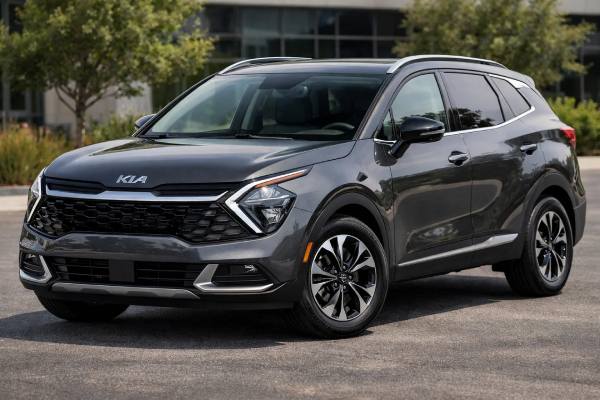
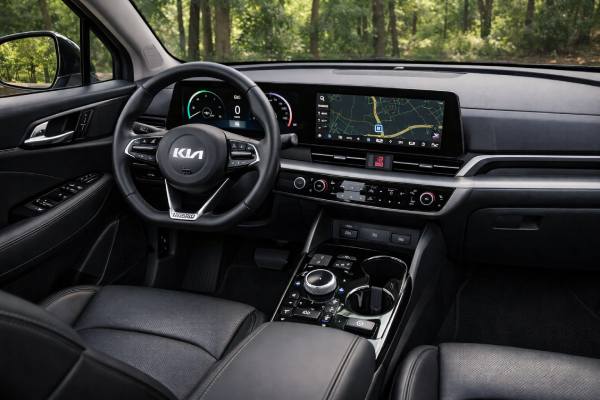
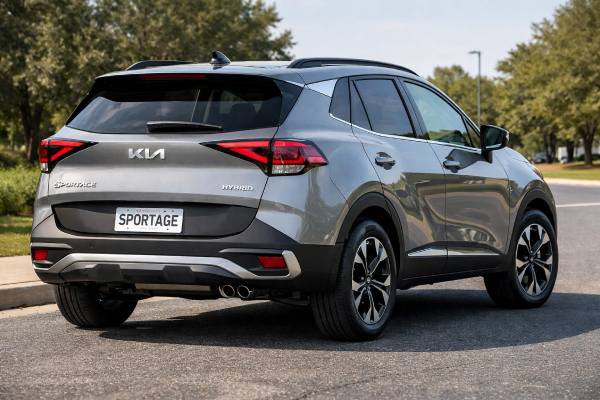
The Kia Sportage Hybrid FWD is the version that turns the Sportage from a good family SUV into a very convincing all-rounder. It combines the 1.6-liter turbocharged G4FT petrol engine with a full hybrid system, a compact lithium-ion battery, and a conventional 6-speed automatic transmission rather than an eCVT. That detail matters in daily use because the powertrain feels more natural and more direct than many rivals, especially when merging or climbing hills. The front-wheel-drive layout also keeps weight and drag down, so this version delivers some of the best economy in the lineup without giving up cabin space or towing usefulness. One point needs context, though: the 227 hp figure belongs to the launch-to-2025 U.S.-spec FWD hybrid tune. Current 2026 updates now quote higher output in some markets, so buyers should always verify by VIN and model year. This guide focuses on the original 227 hp FWD hybrid most shoppers mean when they search for this configuration.
Fast Facts
- The turbo-hybrid powertrain gives the Sportage stronger mid-range punch than many naturally aspirated hybrid rivals.
- FWD versions deliver the best official economy in the range and avoid the extra weight of AWD.
- The cabin is unusually roomy for the class, with excellent rear legroom and a genuinely useful cargo area.
- Main caveat: software updates, 12 V battery behavior, and hybrid cooling-system checks matter more here than on a basic non-hybrid SUV.
- A sensible service rhythm is engine oil and filter every 10,000 miles or 12 months, with shorter intervals in heavy short-trip use.
Quick navigation
- Kia Sportage hybrid mission
- Kia Sportage hybrid by numbers
- Kia Sportage hybrid grade map
- Known faults and factory fixes
- Service plan and shopping tips
- On-road feel and efficiency
- Against the main alternatives
Kia Sportage hybrid mission
The Sportage Hybrid FWD sits in a very useful spot in the lineup. It gives buyers most of what makes the current-generation Sportage attractive, namely space, comfort, and strong technology content, while fixing the two biggest weaknesses of the regular non-hybrid model: average fuel economy and only moderate low-speed torque. The result is a family SUV that feels easier in traffic, quieter at a steady cruise, and better suited to everyday mixed driving than the base petrol version.
The engineering recipe is straightforward on paper but smart in practice. Kia paired its 1.6-liter turbocharged G4FT gasoline engine with a hybrid system motor and a compact battery pack, then connected everything to a 6-speed automatic. That last point is a real differentiator. Many hybrid rivals use eCVT gearboxes, which are efficient but can sound strained under hard acceleration. The Sportage hybrid feels more familiar. It still blends engine and motor assistance in the background, but the 6-speed transmission gives the powertrain a more conventional, less elastic response. For drivers moving from a normal automatic SUV, the transition is easy.
This FWD version is also the efficiency leader within the Sportage range. Early U.S. figures for the 227 hp model quoted as much as 42/44/43 mpg in LX FWD form, which puts it among the more economical compact hybrid SUVs without requiring a small, cramped cabin. Cargo room and rear-seat space are standout advantages. That makes the car appealing not only to commuters, but also to families who want one vehicle to handle school runs, highway trips, and regular errands without feeling tight or underpowered.
There is one complication that matters for shoppers today. Kia’s current 2026 update now publishes a higher system-output figure, so a “Sportage Hybrid” search can mix 227 hp launch cars with later 232 hp updates and AWD trims. In real terms, that means buyers should decode the exact year, trim, and drivetrain rather than trust a generic sales title.
For the right owner, the appeal is clear. This is the Sportage for people who want strong fuel economy but do not want a dull powertrain, and for people who want hybrid efficiency without giving up mainstream SUV practicality. It is not the cheapest Sportage to buy used, but it is often one of the easiest to justify over the long term.
Kia Sportage hybrid by numbers
The 227 hp FWD hybrid uses the same basic NQ5 Sportage shell as the rest of the range, but its spec sheet blends turbo-petrol and hybrid details in a way that can confuse used-car buyers. Some listings copy data from AWD cars, some mix in later 232 hp numbers, and some quote overseas 230 PS figures as though they are identical. The table below focuses on the launch-to-2025 227 hp FWD hybrid and notes where public factory documents vary by year or region.
| Powertrain and efficiency | Kia Sportage FWD Hybrid 227 hp |
|---|---|
| Code | G4FT-based 1.6 T-GDi hybrid system |
| Engine layout and cylinders | Inline-4, turbocharged, 4 cylinders |
| Valvetrain | DOHC, 4 valves per cylinder |
| Displacement | 1.6 L (1,598 cc) |
| Motor | Single hybrid system motor, 44.2 kW |
| Battery chemistry | Lithium-ion polymer |
| Battery capacity | 1.49 kWh |
| Induction | Turbo |
| Fuel system | Gasoline Direct Injection (GDI) |
| Compression ratio | 10.5:1 |
| Max power | 227 hp combined on launch-to-2025 U.S. FWD versions |
| Max torque | 258 lb-ft combined, about 350 Nm |
| Timing drive | Verify by VIN and service literature |
| Rated efficiency | Up to 42/44/43 mpg US, about 5.6/5.3/5.5 L/100 km |
| Real-world highway at 120 km/h | Usually about 5.8–6.8 L/100 km in favorable conditions |
| Transmission and driveline | Kia Sportage FWD Hybrid 227 hp |
|---|---|
| Transmission | 6-speed automatic, shift-by-wire |
| Transmission code | Not published in open public brochures reviewed |
| Drive type | FWD |
| Differential | Open front differential |
| Drive modes | Eco, Sport, and drive-mode selection by trim/year |
| Chassis and dimensions | Kia Sportage FWD Hybrid 227 hp |
|---|---|
| Front suspension | MacPherson strut |
| Rear suspension | Independent multi-link |
| Steering | Column-mounted motor-driven power steering |
| Brakes | 4-wheel disc; front ventilated 12.8 in (325 mm), rear solid 11.8 in (300 mm) on current published hybrid specs |
| Most common tyre sizes | 235/65 R17 or 235/60 R18 on FWD trims |
| Ground clearance | 7.1 in (180 mm) on FWD examples |
| Length | 183.5 in (4,661 mm) on launch brochure data |
| Width | 73.4 in (1,864 mm) |
| Height | About 65.6–66.3 in (1,666–1,684 mm), trim-dependent |
| Wheelbase | 108.5 in (2,756 mm) |
| Kerb weight | Roughly 3,598–3,831 lb (1,632–1,738 kg), trim-dependent current-spec range |
| GVWR | 4,982 lb (2,260 kg) on current FWD hybrid specs |
| Fuel tank | 13.7 US gal (51.9 L / 11.4 UK gal) |
| Cargo volume | Up to 39.6 ft³ (1,121 L) seats up and 74.1 ft³ (2,098 L) seats folded in launch brochure data; current dual-floor figures are slightly lower |
| Payload | About 1,151–1,384 lb (522–628 kg), depending on trim and options |
| Performance and capability | Kia Sportage FWD Hybrid 227 hp |
|---|---|
| 0–100 km/h | U.S. brochures do not publish an official figure; expect roughly low-8-second performance in healthy FWD examples |
| Top speed | Not typically published for U.S. hybrid material |
| Braking distance | Not published in open factory sources reviewed |
| Towing capacity | 2,000 lb (907 kg) with trailer brakes, 1,653 lb (750 kg) without |
| Fuel requirement | Regular unleaded, 87 octane or higher |
| Fluids and service capacities | Kia Sportage FWD Hybrid 227 hp |
|---|---|
| Engine oil | API SN Plus / SP, commonly 0W-20 by Kia oil-capacity guide |
| Engine oil capacity | 4.8 L (5.1 US qt) |
| Coolant | Verify exact type and fill procedure by VIN and workshop literature |
| Transmission fluid | Verify exact fluid specification and capacity by VIN |
| Differential | Front transaxle layout; verify any service fill by VIN |
| A/C refrigerant | Verify by under-bonnet label and service literature |
| Key torque specs | Verify by official service manual before repair work |
| Safety and driver assistance | Kia Sportage FWD Hybrid |
|---|---|
| IIHS | 2025 Sportage rated Good overall in current IIHS testing framework |
| Structural note | 2024 models added B-pillar and door-beam reinforcements plus a rear seat-mounted side thorax airbag for better side protection |
| Airbags | Front, side, and curtain airbags |
| Child-seat provisions | LATCH / ISOFIX anchors and tether points |
| ADAS suite | Forward Collision-Avoidance Assist, Lane Following Assist, Lane Keep Assist, rear parking warning, and trim-dependent blind-spot, rear cross-traffic, parking assist, and smart cruise features |
The most important spec takeaway is simple: the 227 hp FWD hybrid is the earlier version of the current-generation Sportage Hybrid, and newer public Kia pages now show a later, more powerful tune. Buyers should match figures to the exact model year before comparing listings.
Kia Sportage hybrid grade map
Trim structure matters a lot on this model because the Sportage Hybrid did not always offer every drivetrain with every grade. In the early U.S. rollout, the FWD hybrid was most closely associated with the value-focused LX trim, while upper hybrid trims were often AWD-only. That is important because a seller may describe any Sportage Hybrid as if the powertrain and equipment mix are interchangeable. They are not.
The best way to understand the 227 hp FWD hybrid is to think of it as the efficiency-led version of the lineup. In base or mid-level form, it usually rides on smaller wheels, which helps both comfort and economy. That is often a good thing in the real world. A 17-inch FWD car generally rides more calmly, makes less tyre noise, and costs less to re-tyre than a larger-wheel AWD model. For buyers who want a sensible long-term daily driver, that is usually the smarter setup.
Typical equipment on the lower and middle hybrid trims included:
- Large touchscreen infotainment with smartphone integration.
- Dual-zone climate control on many trims.
- Rear-seat vents and multiple USB ports.
- Standard forward collision warning with automatic braking.
- Lane keeping and lane following support.
- Rear parking sensors or warning systems, depending on trim.
Move higher in the range and the Sportage adds the features most buyers notice on a test drive: larger displays, Harman Kardon audio, panoramic roof, power tailgate, blind-spot assist, rear cross-traffic braking, 360-degree camera views, and more advanced cruise functions. The problem is that many of those richer trims were paired with AWD rather than FWD. So if you want the lighter, more economical front-drive hybrid, you may need to accept a simpler equipment list.
That is not necessarily a bad compromise. The lower hybrid trims often make the most sense as used buys because they combine the best EPA numbers with simpler wheel-and-tyre packages and fewer expensive extras to fix later.
Safety equipment is one of the Sportage’s stronger selling points. Even the lower trims brought meaningful active safety hardware, not just marketing language. Kia’s brochures and feature guides show standard forward collision avoidance, lane support, rear occupant alert, and rear parking warning, while blind-spot and parking-assist features became available or standard only higher up the range. That means buyers should decode the actual safety equipment on the car, not just assume all hybrids came equally loaded.
After any windscreen replacement, front-end repair, or bumper damage, it is also wise to confirm that the driver-assistance systems were recalibrated properly. On a modern hybrid SUV, safety hardware is only as trustworthy as the last repair. The best used example is not the one with the longest options list. It is the one with the clearest spec history and the fewest unanswered questions.
Known faults and factory fixes
The Sportage Hybrid FWD has a generally good reliability outlook, but it is a more software-dependent vehicle than the old formula of non-hybrid SUV plus simple automatic. That does not make it fragile. It does mean that updates, warning lights, and electrical behavior deserve more attention than on a basic petrol Sportage.
The most important known patterns are these:
Common or recurring, usually medium seriousness
- 12 V battery complaints or odd warning-light behavior on some early vehicles.
Symptoms can include intermittent warnings, no-start complaints, or strange low-voltage behavior. Kia issued battery-management logic improvements on certain 2023–2024 Sportage HEV vehicles to address overcharging of the 12 V lithium battery. On a used example, I would want proof that campaign work was checked or completed. - Hybrid control software updates.
Some 2023–2025 hybrids received control-unit logic improvements related to driveability signals. In plain terms, this means the correct software level matters. A car that feels fine today may still be overdue for a dealer campaign that improves the way the hybrid system responds. - Brake corrosion from low mechanical brake use.
This is common on hybrids in general. Because regenerative braking reduces friction-brake use, discs and pads can corrode on lightly used cars or vehicles driven mostly in wet climates. The issue is usually low to medium cost, but buyers should inspect it carefully.
Occasional, medium cost
- Auxiliary electric water pump or hybrid cooling hardware concerns on early hybrid-family vehicles.
These are not universal, but coolant-related electrical faults should be taken seriously. Any warning lights tied to hybrid cooling, unusual pump noise, or signs of coolant seepage deserve proper diagnosis. - 12 V battery weakness causing misleading electronic faults.
A weak support battery can trigger multiple systems to complain at once, including parking sensors, driver-assistance functions, or hybrid warnings. - Infotainment and sensor calibration issues after repairs.
Windshield replacement, front-end repairs, or bumper damage can leave the car with poorly calibrated safety systems even when no major fault message appears.
Less common, but worth watching
- High-mileage turbo-petrol concerns such as carbon buildup, coil-pack misfire, and oil neglect.
- Suspension noises from links or bushings on rough-road cars.
- Cabin rattles from interior trim and load-area fittings.
For a pre-purchase inspection, I would ask for:
- Full service history and software campaign history.
- A dealer or specialist battery and fault-code scan.
- Proof of recall and campaign completion.
- Brake inspection with disc thickness and corrosion comments.
- Cooling-system pressure check if any hybrid warnings are present.
- Confirmation that all ADAS functions work and have been calibrated after glass repairs.
The headline reliability story is encouraging. The hybrid hardware itself looks durable when serviced properly, and the battery pack has strong warranty backing. Most ownership headaches come from software status, low-voltage battery behavior, neglected brakes, or poor repair history rather than from one chronic mechanical failure.
Service plan and shopping tips
This Sportage rewards consistent, sensible care. Hybrids are often sold as low-maintenance cars, and in some areas that is true. Brake wear can be lower, stop-start operation is seamless, and the battery system is designed to manage itself. But this is still a turbocharged direct-injection engine with a full hybrid layer on top, and that means maintenance discipline still matters.
A practical service plan looks like this:
| Item | Practical interval | Notes |
|---|---|---|
| Engine oil and filter | Every 10,000 miles / 12 months max | Earlier changes are wise for repeated short trips, towing, or very hot climates |
| Engine air filter | Inspect yearly, replace around 20,000–30,000 miles | Earlier in dusty use |
| Cabin air filter | 12 months or 15,000–20,000 miles | Keeps HVAC and demist performance healthy |
| Spark plugs | Inspect around 40,000 miles, replace by 50,000–60,000 miles | Turbo hybrid engines do not like weak plugs |
| Coolant | Inspect yearly, replace strictly by VIN-based factory schedule | Use exact approved coolant only |
| Brake fluid | Every 2 years | Cheap protection for ABS and braking feel |
| Brake inspection | Every service | Regen can hide corrosion until it becomes expensive |
| Tyre rotation | Every 5,000–7,500 miles | Important for ride, noise, and efficiency |
| Wheel alignment | Check yearly or after pothole strikes | Saves tyres and keeps the car tracking straight |
| 12 V battery test | Begin annual testing from year 4 | Prevents false hybrid and ADAS faults |
| Hybrid system scan | At routine service or before purchase | Confirms campaign status and battery-health trends |
| Transmission fluid | Verify requirement by VIN and severe-use schedule | Do not assume “sealed for life” means “ignore forever” |
| Hybrid battery cooling path | Inspect and keep intake area clear | Important for battery temperature control |
The most useful factory service figure published openly is the oil specification: 0W-20 with a 4.8-liter capacity for the NQ5 1.6 T-GDi including HEV and PHEV variants in Kia’s oil-capacity guide. That is worth checking against invoices, because generic or vague oil records are a warning sign on any turbocharged hybrid.
For buyers, the inspection checklist is straightforward:
- Confirm there are no hybrid, check-engine, ABS, or ADAS warnings.
- Check the brakes for corrosion, not just pad depth.
- Inspect the tyres for uneven wear and cheap brand mismatches.
- Make sure the air conditioning works properly, because hybrid cooling and cabin cooling can be linked in comfort expectations.
- Look for evidence of front-end or windshield repair.
- Listen for clunks from the front suspension over sharp edges.
- Verify smooth transitions between electric assist and engine load.
The best years to seek are usually the later 227 hp cars with campaign work already completed and clean dealer history. The cars to avoid are the ones with repeated battery complaints, vague software history, or sellers who shrug off warning lights as “just hybrid stuff.” Long-term durability looks good when the car has been updated, serviced, and driven regularly.
On-road feel and efficiency
The Sportage Hybrid FWD drives like a normal SUV that happens to be unusually good at saving fuel. That is probably its biggest strength. It does not ask the driver to adapt to strange controls or an overworked transmission. You simply start, drive, and notice that it has more low-speed shove and less fuel-stop frequency than the ordinary petrol model.
In city traffic, the hybrid system covers the first few yards smoothly and quietly, then hands off to the turbo petrol engine without much drama. Under light throttle, the transitions are clean. Under heavier throttle, you can feel the petrol engine step in more clearly, but the overall result is still smoother than many early hybrids. The 6-speed automatic helps here. It gives the car a more familiar, more grounded feel than an eCVT competitor, especially when accelerating onto a motorway or passing slower traffic.
Ride quality is another strong point. FWD examples on 17-inch wheels are the sweet spot. They soak up broken pavement well, stay composed over undulations, and keep tyre roar at a reasonable level. Steering is light but predictable, and body control is secure rather than sporty. The Sportage feels stable on the highway and easy to place in town, which suits its family-SUV mission.
Real-world fuel use is usually very good, though not magical. Healthy FWD examples typically return something like:
- City: 5.0–5.8 L/100 km, or about 41–47 mpg US and 49–56 mpg UK.
- Highway at 100–120 km/h: 5.8–6.8 L/100 km, or about 35–41 mpg US and 42–49 mpg UK.
- Mixed driving: 5.4–6.2 L/100 km, or about 38–44 mpg US and 46–52 mpg UK.
Cold weather can raise those numbers noticeably because the petrol engine runs more often for cabin heat and battery conditioning. Winter mixed use can easily climb into the mid-6s or even low-7s L/100 km. That is still respectable for a roomy compact SUV.
Performance is brisk rather than fast. U.S. public material emphasizes the 227 hp output and 258 lb-ft combined torque more than it does a published sprint number, but the car feels convincingly strong in daily driving. Passing performance is better than the official figures suggest because the hybrid assist fills in the low end well.
The overall driving verdict is easy: this is one of the better-executed mainstream hybrid SUVs if your priorities are calm ride quality, usable torque, natural controls, and strong real-world economy without sacrificing cabin room.
Against the main alternatives
The Sportage Hybrid FWD competes in one of the hardest-fought parts of the market, and its rivals are strong. The Toyota RAV4 Hybrid remains the default recommendation for buyers who want maximum reputation and strong resale. The Honda CR-V Hybrid feels polished and efficient, with a refined hybrid system. The Hyundai Tucson Hybrid is its closest cousin and shares much of the same underlying logic. The Ford Escape Hybrid is lighter and often very efficient, but it does not feel as substantial inside.
Where the Sportage fights back is in the shape of the whole package. It offers a roomier cabin than many direct rivals, especially in the rear seat. It has one of the most convincing interiors in the segment for design and day-to-day usability. It also delivers a nice balance between hybrid efficiency and conventional driving feel. Buyers who dislike eCVT behavior often get along with the Sportage much more quickly than they do with a RAV4 or CR-V hybrid.
Its strongest advantages are:
- A spacious interior with excellent rear legroom.
- Strong low-speed torque and easy daily drivability.
- Good official fuel economy for a roomy SUV.
- A conventional-feeling automatic transmission.
- Strong warranty coverage for the powertrain and hybrid battery.
Its weaker points are just as clear:
- The Toyota remains the benchmark for simple hybrid reputation.
- The Hyundai offers many of the same strengths, so pricing and condition matter.
- The turbocharged engine adds some long-term complexity compared with naturally aspirated hybrid rivals.
- Upper trim FWD availability can be limited, so buyers may need to compromise on equipment.
For value, the Sportage makes a compelling case. It is especially attractive for drivers who want one family SUV that feels modern, roomy, and efficient, but who do not want to give up everyday performance. It also makes more sense than a diesel for urban and mixed use, because the hybrid tolerates short trips far better.
The final verdict is favorable. The 227 hp FWD Sportage Hybrid is one of the smartest versions of the current-generation Sportage when matched to the right buyer. It offers the space people expect from a compact SUV, the economy many people hope a hybrid will deliver, and a driving experience that feels more natural than some headline rivals.
References
- 2024 Kia Sportage | Crossover SUV – Pricing & Features | Kia 2024 (Official Model Page)
- The all-new Sportage. Move in new ways. – Dealer E Process 2023 (Brochure)
- Engine Oil Grades and Capacities – Kia 2023 (Service Guide)
- 2025 Kia Sportage 2025 (Safety Rating)
- bms s/w logic improvement for dtc p1bb2 (sc335) 2025 (TSB)
Disclaimer
This article is for informational purposes only and is not a substitute for professional diagnosis, repair, or VIN-specific technical advice. Specifications, torque values, service intervals, procedures, towing limits, software campaigns, and equipment vary by VIN, market, trim, and model year, so always verify details against official service documentation for the exact vehicle.
If this guide helped you, please consider sharing it on Facebook, X, or another social platform to support our work.