
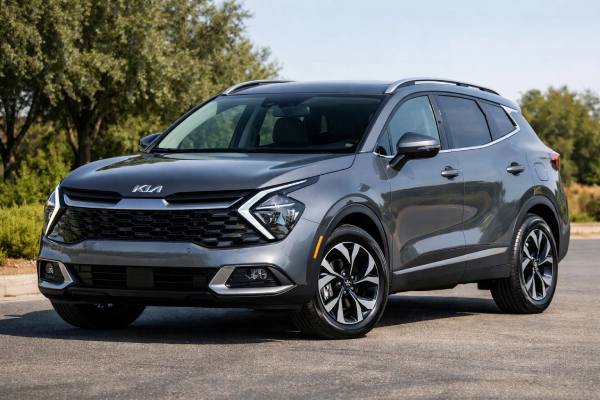
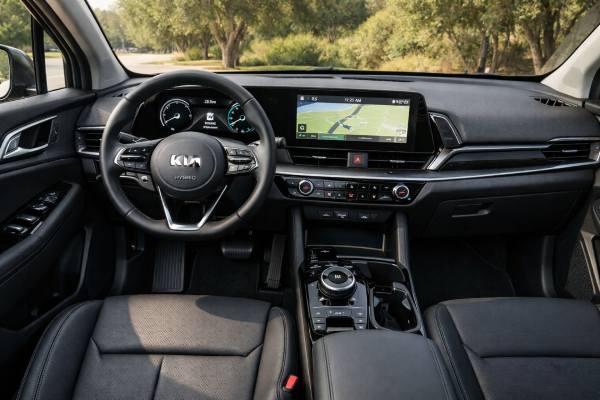
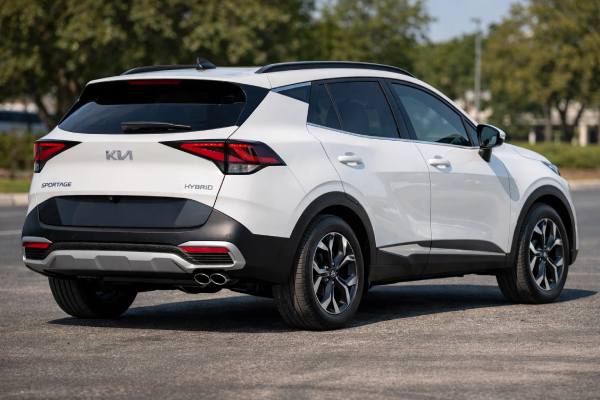
The Kia Sportage Plug-in Hybrid is the most technically ambitious regular Sportage in the lineup. It combines a turbocharged 1.6-liter petrol engine, a stronger electric motor, a useful battery for daily EV driving, and standard AWD in a package that still feels like a family SUV first. That balance is the reason it stands out. It can handle short commutes on electricity alone, cover long trips without charging anxiety, and give buyers more traction and stronger mid-range response than the non-hybrid versions. It also keeps a conventional 6-speed automatic instead of a CVT, which many owners still prefer. The main caution is that this model changed during its run. Early North American versions were commonly described as 261 hp, while current official 2026 U.S. material now lists 268 hp. In other words, this is one vehicle line with two slightly different output stories. For buyers who want real everyday practicality with lower fuel use and winter-ready traction, it remains one of the more sensible plug-in hybrids in the compact SUV class.
Quick Specs and Notes
- Strong space efficiency and standard AWD make it more versatile than many plug-in hybrid rivals.
- The PHEV powertrain is smoother and quicker in real traffic than the regular non-hybrid Sportage.
- EV range is useful enough for short daily driving, especially if home charging is easy.
- The main ownership caveats are software campaign checks, brake corrosion from light friction-brake use, and trim-related tyre cost.
- A sensible oil and filter routine is every 8,000–12,000 km or 6–12 months, depending on usage.
Navigate this guide
- Kia Sportage PHEV ownership picture
- Kia Sportage PHEV specs and range
- Kia Sportage PHEV trims and protection
- Trouble spots, recalls and updates
- Care schedule and used-buy tips
- Everyday driving and charging
- PHEV Sportage versus alternatives
Kia Sportage PHEV ownership picture
The Sportage Plug-in Hybrid sits in a very specific place in the NQ5 range. It is not the budget version, and it is not the pure efficiency champion if you never charge it. Its value comes from the way it combines three useful traits at once: standard AWD, a real electric-only commuting window, and the cabin size of one of the roomiest compact SUVs on the market. That combination matters more than a single power or range number.
In daily use, the Sportage PHEV feels like the grown-up version of the regular gas Sportage. The electric motor fills the gaps in the turbocharged 1.6-liter engine’s response, so it pulls away more cleanly and feels less strained at urban speeds. The standard AWD system also changes the car’s personality. It is not an off-roader, but it gives the PHEV a useful edge on wet roads, snow, steep ramps, and loose surfaces. Current official Kia material pairs that AWD hardware with terrain modes for snow, sand, and mud, which tells you exactly what the vehicle is designed to do: handle mixed real-world conditions, not chase hardcore trail credentials.
Packaging is one of the model’s strongest selling points. The Sportage body is large for this class, and even though the PHEV sacrifices some cargo room compared with lower-spec gas versions, it still offers a genuinely useful rear seat and luggage area. That matters because many plug-in hybrids ask buyers to trade practicality for electrification. The Sportage does not feel that compromised. It still works as a family vehicle first.
There is, however, one timeline issue buyers should understand. The title figure of 261 hp matches the earlier output commonly associated with 2023–2025 North American Sportage PHEV models. Current official 2026 U.S. Kia pages now show 268 hp and 271 lb-ft, along with 34 miles of EPA-estimated electric range and about two hours for a 240V charge. That means anyone shopping “2022–present” examples needs to separate the earlier 261 hp cars from the refreshed 2026 version. They are close relatives, but not identical.
Ownership also looks slightly different from a regular hybrid. Charging access matters. If you can plug in at home or at work, the Sportage PHEV makes far more sense than if it will spend its life running as a heavier hybrid. Temperature matters too. The owner’s manual explains that the car can maintain or switch to hybrid mode when battery temperature is too low or too high, and heating demand in very cold weather can also force the petrol engine to run. That is normal PHEV behavior, but it shapes the real-world experience more than brochure numbers do.
Viewed honestly, the Sportage PHEV is for buyers who want one car to do city errands, winter commuting, and longer family trips without changing vehicles or routines too much. That is why it remains attractive even as the market fills with more specialized electrified rivals.
Kia Sportage PHEV specs and range
For this article, the baseline market is North America, because that is where the AWD Sportage Plug-in Hybrid most clearly matches the 1.6-liter turbocharged, all-wheel-drive configuration. The biggest year split is output. Earlier versions were widely presented as 261 hp, while current official 2026 Kia U.S. figures now show 268 hp. The underlying layout remains the same: a 1.6-liter turbo engine, one traction motor, a 13.8 kWh battery, and a 6-speed automatic.
| Powertrain and efficiency | Kia Sportage Plug-in Hybrid AWD |
|---|---|
| Engine code | G4FT / Smartstream 1.6 T-GDI family |
| Engine layout and cylinders | Inline-4, DOHC, 4 valves per cylinder |
| Bore × stroke | Public current U.S. specs pages do not publish this figure |
| Displacement | 1.6 L (1,598 cc) |
| Motor type | AC synchronous permanent magnet motor |
| Motor count and axle | Single traction motor integrated with hybrid transmission |
| System voltage | 360 V |
| Battery chemistry | Lithium-ion polymer |
| Battery size | 13.8 kWh |
| Induction | Turbocharged |
| Fuel system | Gasoline direct injection |
| Compression ratio | 10.5:1 |
| Engine power | 177 hp @ 5,500 rpm |
| Engine torque | 264 Nm (195 lb-ft) @ 1,500–4,500 rpm |
| Motor power | 97 hp @ 2,300–3,600 rpm |
| Motor torque | 304 Nm (224 lb-ft) @ 0–2,100 rpm |
| Combined power | 261 hp on earlier versions; 268 hp on current 2026 U.S. spec |
| Combined torque | 271 lb-ft on current 2026 U.S. spec |
| Timing drive | Verify by VIN and service literature |
| Rated efficiency | 83 MPGe combined, 36 mpg engine-only combined on current 2026 U.S. spec |
| Real-world highway @ 120 km/h | Roughly 7.0–8.2 L/100 km in charge-sustaining mode is a realistic expectation |
The efficiency story deserves context. A plug-in hybrid does not have one fixed fuel-use identity. With a charged battery, short trips can be extremely cheap to run. With a depleted battery, the Sportage behaves like a heavier hybrid SUV. That means driver routine matters more here than on a normal petrol crossover.
| Transmission and driveline | Kia Sportage Plug-in Hybrid AWD |
|---|---|
| Transmission | 6-speed automatic |
| Drive type | Standard AWD |
| Differential | Public Kia specs do not list a true locking differential; AWD is paired with terrain modes |
| Chassis and dimensions | Kia Sportage Plug-in Hybrid AWD |
|---|---|
| Suspension front / rear | MacPherson strut / independent multi-link |
| Steering | Column-mounted motor-driven power steering |
| Brakes | Four-wheel discs with ABS |
| Front brake disc | 325 mm (12.8 in) ventilated |
| Rear brake disc | 300 mm (11.8 in) solid |
| Most common tyre size | 235/55 R19 |
| Ground clearance | 211 mm (8.3 in) |
| Approach / departure / breakover | 18.9° / 26.9° / 17.7° |
| Length / width / height | 4,684 mm / 1,864 mm / 1,699 mm (184.4 / 73.4 / 66.9 in) |
| Wheelbase | 2,756 mm (108.5 in) |
| Turning circle | 5.9 m (19.3 ft) curb-to-curb |
| Kerb weight | 1,912–1,954 kg (4,215–4,307 lb) |
| GVWR | 2,440 kg (5,379 lb) |
| Fuel tank | 42.0 L (11.1 US gal / 9.2 UK gal) |
| Cargo volume | 977 L (34.5 ft³) seats up / 1,855 L (65.5 ft³) seats down, SAE |
| Safety and driver assistance | Kia Sportage Plug-in Hybrid AWD |
|---|---|
| Euro NCAP | Not directly applicable to the North American PHEV specification used here |
| IIHS | 2026 Sportage reached Top Safety Pick+ for vehicles built after May 2025 |
| Headlight rating | Good or Acceptable depending on trim and lamp package |
| ADAS suite | Forward crash prevention is standard; blind-spot detection and rear automatic braking vary by trim/package |
Kia Sportage PHEV trims and protection
The Sportage Plug-in Hybrid range is simpler than the regular gas Sportage lineup, and that actually helps buyers. In North America, the core PHEV formula has centered on X-Line and X-Line Prestige. Both bring standard AWD, the same basic powertrain concept, and the same plug-in character. The differences are mostly about equipment, appearance, and ownership cost rather than major mechanical changes.
The X-Line is the more rational buy for many long-term owners. It keeps the key PHEV hardware, gives you the rugged visual treatment people usually want from the electrified AWD Sportage, and avoids a few of the most expensive trim-level add-ons. The X-Line Prestige is the more premium version. It typically layers in the features buyers notice every day: richer interior materials, more camera-based convenience features, upgraded driver aids, better audio, and a more upscale dashboard feel. That makes it more desirable in the used market, but it also increases repair and replacement exposure after minor accidents.
One useful detail is that the PHEV trims do not radically change the car’s underlying dynamic behavior. This is not a lineup where one version gets a special suspension or a different transmission tune that transforms the verdict. The bigger differences come from wheel and feature content. Larger premium wheels and low-profile tyres look good, but they can make replacement more expensive and can slightly dull ride comfort on poor roads.
Year-to-year changes matter more than trim names suggest. The current 2026 update is the most important dividing line. It brings the higher official 268 hp figure in U.S. Kia material, a reshaped front end, refreshed equipment logic, and a stronger current IIHS position for vehicles built after May 2025. Earlier 2023–2025 PHEV cars remain appealing, but they should be bought with more attention to software campaigns and early-build recalls.
On safety, the Sportage remains a strong class performer, but the details are not completely uniform. IIHS currently shows the 2026 Sportage with Good results in the small overlap, updated moderate overlap, and updated side tests, plus standard front crash prevention systems rated Good. Headlights vary by trim and option. That is important, because a used Sportage PHEV with lower-rated lamps does not deliver the same night-driving confidence as a better-equipped version. IIHS also notes that 2026 vehicles built after May 2025 benefited from changes to rear seatbelts for improved rear-occupant protection in the updated moderate overlap test. That is the sort of small running change buyers rarely notice, but it can matter.
ADAS availability is also trim-sensitive. Depending on year and specification, the Sportage PHEV can include:
- Forward Collision-Avoidance Assist with pedestrian, cyclist, and junction detection.
- Blind-Spot Collision Warning or Blind-Spot Collision-Avoidance Assist.
- Blind-Spot View Monitor on higher trims.
- Lane departure warning and lane-keeping or lane-following support.
- Rear cross-traffic support and rear automatic braking on richer equipment levels.
- Smart cruise and additional junction or evasive features on newer or better-equipped cars.
As with any late-model electrified SUV, recalibration matters after repairs. Windshield replacement, radar work, front bumper repair, and alignment changes can all affect driver-assistance behavior. A clean-looking repair bill is not enough. The right buyer asks whether calibration was completed properly.
Trouble spots, recalls and updates
The Sportage PHEV is not known as a fundamentally fragile vehicle, but it is more system-dense than the regular 2.5-liter gas model, and that changes the ownership risk profile. Most of the major concerns are software, sensors, or electrified-system ancillaries rather than catastrophic mechanical faults. That is good news, but only if the car has been serviced correctly and all campaigns have been completed.
A practical reliability map looks like this:
- Common, low to medium cost: brake surface corrosion, sticky rear brake hardware, tyre wear, and occasional suspension clunks from links or bushes on rough-road cars.
- Occasional, medium cost: charging complaints tied to cable connection issues, 12V support-battery related warnings, and drivability concerns that need software updates or system diagnosis rather than simple parts replacement.
- Occasional, medium to high cost: repeated misfire, rough cold starts, injector or ignition-system diagnosis, and cooling-system related warnings in the hybrid hardware.
- Rare, high cost: neglected electrified-system faults, coolant intrusion into auxiliary electric water pump hardware on affected vehicles, or persistent hybrid-system warnings that require dealer-level troubleshooting.
The most common everyday issue on plug-in hybrids is not the battery itself. It is the friction brakes. Because regenerative braking handles so much normal deceleration, the pads and discs can rust or glaze if the car lives in damp weather or does only short, light-duty trips. Symptoms are grinding after rain, uneven pad wear, or a brake feel that seems rougher than mileage suggests. The fix is usually straightforward: inspection, cleaning, and, sometimes, discs and pads before the numbers on paper suggest they should be worn out.
Software and campaign history matter more here than on a simpler gas Sportage. A 2025 service campaign covered Hybrid Control Unit logic on certain 2023–2025 Sportage HEV and PHEV vehicles after repeated “accelerate” CAN signals related to conventional cruise-control operation. Earlier 2023 hybrid and plug-in hybrid Sportage vehicles also had an instrument-cluster recall for blank-display behavior on affected builds. More recently, certain 2026 Sportage PHEV vehicles were included in an instrument-cluster-related recall population. None of that means the model is a bad buy. It means VIN-based campaign verification is essential.
Battery health itself looks better than many buyers fear. There is no broad public pattern suggesting unusually severe high-voltage battery degradation on this model. Normal seasonal range loss is far more likely than a true battery fault. In winter, heating demand and battery temperature management can reduce EV operation noticeably, and the owner’s manual makes clear that the vehicle can switch or remain in hybrid mode when battery temperature is outside its preferred window. That is protection logic, not necessarily a defect.
For used buyers, the smartest pre-purchase checks are very specific:
- Confirm all recalls and service campaigns by VIN.
- Scan the car for stored hybrid, battery, charging, ABS, and ADAS faults.
- Test AC charging and make sure the charging door, cable connection, and charge timers work normally.
- Watch for brake corrosion and uneven rear brake wear.
- Check for coolant warnings, hybrid-system warnings, or inverter-coolant messages.
- Verify smooth transitions between EV and hybrid operation on the road.
This is a model where “drives fine” is not a complete inspection result. The best cars are the ones with quiet electronic histories, completed campaigns, and evidence that someone actually used the plug-in system properly.
Care schedule and used-buy tips
The Sportage PHEV rewards routine more than heroic maintenance. Owners do not need to fear the drivetrain, but they do need to be organized. A plug-in hybrid that receives timely software checks, regular oil service, clean charging hardware, and occasional brake attention tends to stay easy to live with. A neglected one can become irritating, because its problems often show up as warnings, limited EV behavior, or annoying drivability faults instead of one single obvious breakdown.
A practical maintenance plan for long-term ownership looks like this:
- Engine oil and filter: every 8,000–12,000 km or 6–12 months, sooner for short trips, cold weather, or repeated engine cycling.
- Engine air filter: inspect about every 24,000 km and replace around 48,000 km, sooner in dusty conditions.
- Cabin air filter: every 16,000–24,000 km depending on climate and dust.
- Brake inspection: at every service. This matters more than on many normal petrol SUVs because regenerative braking can hide brake neglect.
- Brake fluid: about every 2–3 years is a sensible working rule.
- Tyre rotation and alignment checks: every 8,000–12,000 km, especially because the PHEV is heavy and premium tyres are expensive.
- Coolant and inverter-coolant system: follow the official schedule for the exact VIN and market.
- Spark plugs: verify by official schedule, but do not ignore misfire history simply because mileage is still modest.
- Charging hardware: inspect the charging inlet, cable seal surfaces, and charging door for damage or contamination regularly.
- Hybrid battery cooling path: keep vents and under-seat ducting clear and clean.
- 12V support battery and power management: test system behavior if the vehicle shows repeated low-voltage warnings or struggles after sitting.
The owner’s manual adds some PHEV-specific realities that gas-only buyers may not expect. Scheduled charging works only with AC charging or the portable cable. The car also monitors temperature closely and can remain in hybrid mode or switch out of EV mode to protect the battery or support cabin heating. Those are not faults. They are reminders that the PHEV version has a second operating logic layer beyond the engine alone.
For buyers, trim choice matters. A well-kept X-Line is often the smartest used purchase because it gives you the core PHEV experience without every possible luxury-cost multiplier. X-Line Prestige examples are more desirable and can be worth it, but only when service history, calibration history, and cosmetic condition are all strong. On a plug-in hybrid, accident quality matters more than usual. Front-end repairs, bumper work, and cooling-system work should always prompt questions about ADAS calibration and electrified-system inspection.
Use this checklist before buying:
- Verify every open recall and campaign by VIN.
- Confirm the car charges normally on AC power.
- Check the brake discs for corrosion and uneven wear.
- Scan for hybrid, battery, charging, and driver-assistance faults.
- Test cold-start hybrid operation and warm transition behavior.
- Inspect tyres closely for uneven wear and budget accordingly for replacement.
- Ask whether the windshield, front bumper, or sensors have ever been replaced.
- Look for evidence that the owner actually plugged the car in and did not just use it as a heavy hybrid.
The long-term durability outlook is good when the car is bought carefully. The Sportage PHEV is not the cheapest compact SUV to own, but it can be a very satisfying one if the electrified systems have been respected rather than ignored.
Everyday driving and charging
This is where the Sportage PHEV makes its case. It feels more effortless than the regular petrol Sportage and more normal than some rival plug-in hybrids. The reason is the pairing of the electric motor with a conventional 6-speed automatic. Step-off response is smooth, low-speed maneuvering feels natural, and the car does not have the disconnected sensation that some CVT-based hybrids create. For many drivers, that alone will make it easier to live with.
In town, the PHEV feels quietly strong. The electric torque fills in the first few metres of motion, so the SUV moves away cleanly and reacts well to small throttle inputs. When the petrol engine joins in, the transition is generally unobtrusive. The manual also confirms that the driver can switch among Automatic, Hybrid, and Electric modes, which helps make the car feel usable rather than mysterious. On short urban trips with a charged battery, it can feel close to an EV. On mixed trips, it behaves like a refined hybrid with more punch than the ordinary gas version.
Ride quality is mature rather than sporty. The chassis is stable, the wheelbase helps highway composure, and the standard AWD gives the car a planted feel in poor weather. Steering is light and easy, not especially communicative. That suits the vehicle’s family role. The PHEV’s added mass is noticeable only if you push hard into corners or brake repeatedly downhill. Even then, the vehicle’s character stays safe and controlled.
Charging is one of its practical advantages. Current Kia specs quote about two hours on 240V AC equipment. Level 1 charging is slower, but still workable for owners who leave the car parked overnight. In daily life, that means the Sportage PHEV works best when charging is routine, not occasional. Even one predictable overnight charge can transform running costs for short-distance users.
Real-world range and efficiency depend heavily on driving pattern:
- EV-only city use: roughly 40–55 km is a realistic working window in mild weather, with less in cold weather.
- EV-only highway use at 100–120 km/h: often closer to 28–45 km depending on speed, temperature, and terrain.
- Charge-sustaining mixed use: around 6.5–7.8 L/100 km is achievable for many drivers.
- Charge-sustaining highway use: about 7.0–8.2 L/100 km is a fair expectation at typical motorway speeds.
- Cold-weather penalty: winter heating and low battery temperature can reduce useful EV operation by roughly 20–35 percent.
There are a few PHEV-specific nuances buyers should know. In very cold weather, the vehicle may stay in hybrid mode to allow heating. Under temperature stress, it may also maintain or switch to hybrid mode to protect the high-voltage battery. And towing significantly reduces electric range. Kia says that directly in the spec material, and it matches real-world experience. With a trailer or a full load, the Sportage PHEV is still competent, but it becomes much more of a hybrid SUV than an electric commuter.
The bottom line is simple. The Sportage PHEV drives like a good modern family crossover first and an electrified experiment second. That is a compliment.
PHEV Sportage versus alternatives
The Sportage PHEV does not dominate this segment in one single metric. It wins by combining enough of the right ones. Against the Toyota RAV4 Prime, the Kia usually loses on outright performance and the Toyota’s established plug-in reputation. The RAV4 Prime is the quicker, more urgent vehicle. But the Kia counters with a more spacious-feeling cabin, a calmer design balance, and often a more comfortable everyday ride. Buyers who care more about family usability than straight-line pace may prefer the Sportage.
Against the Hyundai Tucson Plug-in Hybrid, the comparison is closer because the two share much of their engineering. Here the decision usually comes down to styling, trim content, and dealer network preference rather than a major mechanical difference. The Sportage tends to feel slightly bolder and more lifestyle-oriented, while the Tucson presents itself more conservatively. In practical ownership, they are direct classmates.
Against the Mazda CX-50 Hybrid or CX-5-era alternatives, the Kia feels more modern as a plug-in product and more spacious in the rear. Mazda still tends to win on steering feel and driver engagement, but the Sportage is more effective as a family-centered electrified tool. Against Ford Escape PHEV, the Kia offers standard AWD in the version covered here and a more rugged all-weather identity, though the Ford can appeal to drivers who prioritize front-drive efficiency and lighter feel.
The biggest strategic rival may actually be a regular hybrid rather than another plug-in hybrid. If you cannot charge regularly, the Sportage Hybrid makes a stronger financial argument. It is lighter, simpler to use, and less dependent on routine. The Sportage PHEV only earns its extra complexity when the battery is used consistently.
That leads to a clear set of buying decisions:
- Choose the Sportage PHEV if you can charge at home or work, want AWD as standard, and need real family space.
- Choose a strong conventional hybrid if charging will be rare or inconvenient.
- Choose a RAV4 Prime if maximum acceleration is the priority.
- Choose the Kia over many rivals if balanced ride, cabin room, and traditional automatic-transmission feel matter more than headline numbers.
What makes the Sportage PHEV attractive in 2026 is that it still feels coherent. It does not ask the owner to adapt too much. It just adds a useful electric layer to a well-packaged compact SUV. That is not the flashiest formula in the segment, but it is one of the more convincing ones.
References
- 2026 Kia Sportage Plug-in Hybrid 2026 (Manufacturer Page)
- Compare Trim Levels of the 2026 Kia Sportage Plug-in Hybrid | Model Chart: X-Line, X-Line Prestige | Kia 2026 (Specifications)
- Scheduled maintenance service precaution 2026 (Owner’s Manual)
- 2026 Kia Sportage 2026 (Safety Rating)
- Check for Recalls: Vehicle, Car Seat, Tire, Equipment 2025 (Recall Database)
Disclaimer
This article is for informational purposes only and is not a substitute for professional diagnosis or repair. Specifications, torque values, intervals, capacities, procedures, and equipment vary by VIN, market, model year, and trim, so always verify the exact vehicle against official Kia service documentation and campaign records before servicing, diagnosing, towing, charging, or buying.
If this guide helped you, please share it on Facebook, X, or another platform to support our work.