
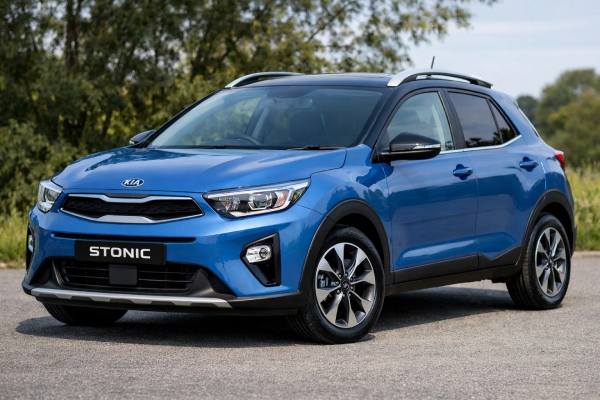
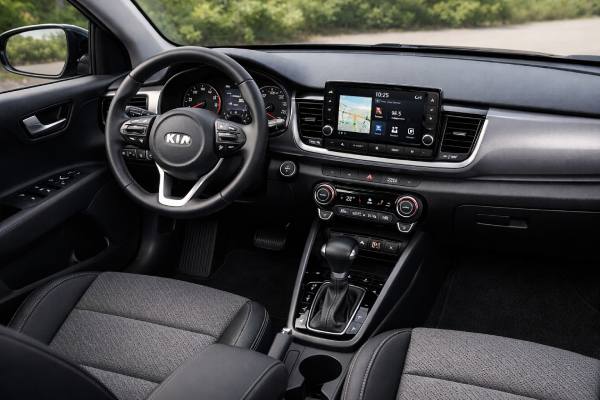
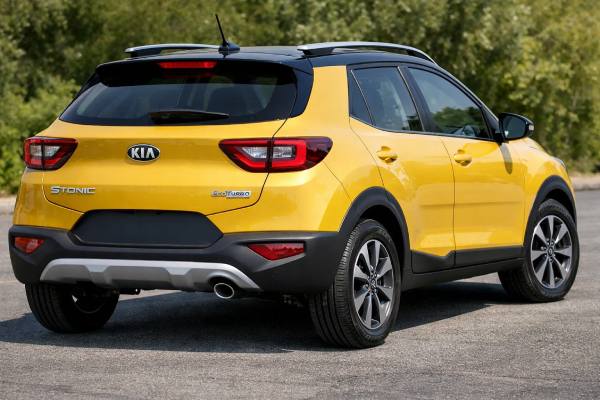
The facelifted 2020–2023 Kia Stonic YB 1.0 T-GDi 100 mild hybrid is the clever middle ground in the range. It gives you the punch and flexibility missing from the old 1.2, but without turning the car into a heavy, expensive full hybrid. In Kia service and brochure material, you may see this drivetrain described in two ways: as a Kappa 1.0 T-GDi MHEV or as the facelift-era Smartstream G1.0 T-GDi 48V HEV. In practical terms, it is the same basic idea: a 998 cc turbocharged direct-injection three-cylinder petrol engine, a 48-volt mild-hybrid system, and Kia’s clutch-by-wire intelligent manual transmission on the 100 hp version.
That combination suits the Stonic unusually well. The car stays light, compact, and easy to park, but it gains better low-speed response, cleaner stop-start behavior, and useful fuel-saving coasting functions. The trade-off is that this is still a small crossover with modest rear space, a firm ride on bigger wheels, and more complexity than the old naturally aspirated petrol.
Quick Specs and Notes
- The 100 hp mild-hybrid powertrain is much more usable than the 1.2, especially in town and on slip roads.
- Compact size, light kerb weight, and simple front-wheel-drive layout keep it easy to own and easy to place.
- Lower-trim 15-inch and 16-inch cars usually deliver the best comfort, tyre cost, and real-world economy balance.
- The 48V battery has shorter warranty coverage than the main vehicle, so battery health matters more after year two.
- Plan engine oil service every 15,000 km or 12 months in normal European use, or 10,000 miles or 12 months in UK guidance.
What’s inside
- Stonic YB facelift essentials
- Stonic YB 100 MHEV specs
- Stonic YB grades and ADAS
- Faults, recalls and weak points
- Service plan and buying tips
- Real-world pace and economy
- Versus Arona, Kamiq and Captur
Stonic YB facelift essentials
The 2020 facelift changed the Stonic more than its modest styling revision suggests. Kia updated the nose and lighting, improved connectivity, added a larger infotainment system, and most importantly introduced the 48-volt EcoDynamics+ mild-hybrid powertrain. That powertrain pairs the 1.0-litre T-GDi engine with a belt-driven mild-hybrid starter-generator, a compact 48V lithium-ion polymer battery, and a clutch-by-wire intelligent manual transmission, usually called iMT. The point was not electric driving. It was to trim emissions, smooth stop-start operation, and let the engine switch off earlier and more often during coasting.
That matters because the Stonic has always been better as a light, car-like crossover than as a heavy-duty small SUV. The body is compact, the wheelbase is modest, and the car still feels closer to a raised supermini than a scaled-down Sportage. In the facelift model, the 100 hp MHEV finally gives the chassis an engine that matches its weight and mission. You get more low-end flexibility than with the old 1.2, yet the car remains lighter and mechanically simpler than many full-hybrid rivals.
There is also a naming detail worth understanding if you are shopping used. In some parts catalogues and service lists, this engine sits under the Kappa family label. In facelift owner literature, it also appears as Smartstream G1.0 T-GDi 48V HEV. Buyers often assume those are different engines. In this Stonic context, they are usually two naming lenses on the same facelift-era 998 cc turbo mild-hybrid setup. That is useful to know when ordering filters, oil, or ignition parts.
The 100 hp tune is also the conservative choice within the mild-hybrid lineup. Kia offered the facelift 1.0 mild hybrid in 100 hp and 120 hp forms, depending on market and year. The 100 hp version keeps the same 172 Nm peak torque as the manual 120 hp car, but uses a gentler state of tune and normally comes with the 6-speed iMT rather than the 7-speed DCT. For buyers worried about long-term ownership, that is the sweet spot. You still need to respect turbo-petrol servicing and the extra 48V hardware, but you avoid the dual-clutch gearbox and keep the car lighter, cheaper, and easier to live with.
Its limitations are easy to predict. This is not the Stonic for repeated motorway sprints with four adults and luggage, nor is it the most spacious option in the class. Yet for urban and suburban use, short commuting, and mixed roads, it is arguably the most balanced facelift Stonic powertrain.
Stonic YB 100 MHEV specs
The table below focuses on the facelifted European-market 1.0 T-GDi 100 MHEV with the 6-speed intelligent manual transmission. Figures can vary slightly by trim, wheel size, and national homologation sheet, so where a range exists, it is shown as a range.
Powertrain and efficiency
| Item | Kia Stonic YB facelift 1.0 T-GDi 100 MHEV |
|---|---|
| Code / family | Kappa / Smartstream G1.0 T-GDi 48V HEV |
| Engine layout and cylinders | Inline-3, 3 cylinders, turbocharged |
| Valvetrain | 12 valves, 4 valves per cylinder |
| Bore × stroke | 71.0 × 84.0 mm (2.80 × 3.31 in) |
| Displacement | 1.0 L (998 cc) |
| Mild-hybrid motor | Belt-driven starter-generator, single unit, engine-mounted |
| System voltage | 48 V |
| Battery chemistry | Lithium-ion polymer |
| Induction | Turbo |
| Fuel system | Direct injection |
| Compression ratio | 10.5:1 |
| Max power | 100 hp (74 kW) @ 4,500–6,000 rpm |
| Max torque | 172 Nm (127 lb-ft) @ 1,500–4,000 rpm |
| Timing drive | Chain |
| Rated efficiency | 5.3–5.7 L/100 km (44.4–41.3 mpg US / 53.3–49.6 mpg UK) |
| Real-world highway @ 120 km/h | Usually around 6.0–6.8 L/100 km, depending on trim, tyres, weather, and load |
Transmission and driveline
| Item | Kia Stonic YB facelift 1.0 T-GDi 100 MHEV |
|---|---|
| Transmission | 6-speed iMT, clutch-by-wire intelligent manual |
| Transmission code | 6iMT in owner literature |
| Drive type | FWD |
| Differential | Open |
Chassis and dimensions
| Item | Kia Stonic YB facelift 1.0 T-GDi 100 MHEV |
|---|---|
| Front suspension | MacPherson struts |
| Rear suspension | Torsion-beam axle |
| Steering | Electric rack-and-pinion |
| Front brakes | 280 × 22 mm ventilated discs (11.0 × 0.87 in) |
| Rear brakes | 262 × 10 mm solid discs (10.3 × 0.39 in) |
| Common tyre sizes | 185/65 R15, 195/55 R16, 205/55 R17 |
| Ground clearance | 165 mm (6.5 in) |
| Length | 4,140 mm (163.0 in) |
| Width | 1,760 mm (69.3 in) |
| Height | 1,485 mm (58.5 in) on 15/16-inch wheels, about 1,505 mm (59.3 in) on 17-inch wheels |
| Wheelbase | 2,580 mm (101.6 in) |
| Turning circle | About 10.2 m (33.5 ft) kerb-to-kerb |
| Kerb weight | 1,125 kg (2,480 lb) |
| GVWR | 1,680 kg (3,704 lb) |
| Fuel tank | 45 L (11.9 US gal / 9.9 UK gal) |
| Cargo volume | 352 L (12.4 ft³) seats up / 1,155 L (40.8 ft³) seats folded, VDA |
Performance and capability
| Item | Kia Stonic YB facelift 1.0 T-GDi 100 MHEV |
|---|---|
| 0–100 km/h | 10.7 s |
| Top speed | 183 km/h (113.7 mph) |
| Towing capacity | 900 kg (1,984 lb) braked / 450 kg (992 lb) unbraked |
| Payload | About 555 kg (1,224 lb), based on listed gross and kerb mass |
Fluids and service capacities
| Item | Specification |
|---|---|
| Engine oil | SAE 0W-20, API SN Plus/SP or ILSAC GF-6; 3.6 L (3.8 US qt) |
| Coolant | Ethylene-glycol based coolant for aluminium radiator; 5.9 L (6.2 US qt) |
| Manual gearbox oil | 1.5–1.6 L (1.6–1.7 US qt) |
| iMT actuator fluid | 0.082 L (0.087 US qt) |
| A/C refrigerant | R-1234yf; 450 ±25 g (15.9 ±0.9 oz) |
| A/C compressor oil | PAG 30; 120 ±10 g (4.1 ±0.3 fl oz equivalent by mass) |
| Brake and clutch fluid | DOT 4 LV, ISO 4925 Class-6; 0.7–0.8 L (0.7–0.8 US qt) |
| Key torque spec | Wheel nuts: 107–127 Nm (79–94 lb-ft) |
Safety and driver assistance
| Item | Kia Stonic YB facelift context |
|---|---|
| Euro NCAP | Original Stonic rating based on Rio structure; 85% adult, 84% child, 62% vulnerable road user, 25% safety assist |
| Rating status | 2017 rating carried through facelift review and mild-hybrid addition in August 2020 |
| ADAS on facelift cars | FCA, lane keeping, lane following, driver attention warning, and high-beam assist often standard in many markets; ACC, blind-spot, rear cross-traffic assist, and speed-limit assist usually grade-dependent |
The core story in the numbers is simple: this is a light, genuinely compact crossover with a modernized small turbo engine and a mild-hybrid layer that improves drivability more than headline power.
Stonic YB grades and ADAS
Facelift Stonic trim structures varied by country, so the best way to read the range is by function rather than by badge. In Dutch-market 2021 documents, the 100 hp MHEV was available in multiple trims, from ComfortLine through GT-Line and GT-PlusLine. That gives a useful baseline because it shows how Kia positioned the powertrain: not as a niche eco special, but as a mainstream drivetrain available from sensible entry trims right up to the sportier flagship look.
At the lower end, the 100 MHEV makes the most sense. Base-grade cars typically ride on 15-inch wheels with 185/65 R15 tyres, which are cheaper, quieter, and more forgiving over broken roads. Mid trims often move to 16-inch alloys, rear parking aids, reversing camera, cruise control, and nicer cabin materials. GT-Line models then add 17-inch wheels, LED lighting, sportier bumpers, synthetic-leather trim elements, and cosmetic upgrades that make the Stonic look sharper than it actually needs to be.
There are a few useful identifiers for buyers. First, mild-hybrid manual cars use the iMT system rather than a conventional clutch linkage. Second, MHEV versions can have practical packaging differences, including a cargo-floor setup that is not always as flexible as the non-hybrid version because the floor sits in the lower position. Third, GT-Line cars are easy to spot from the outside through the 17-inch wheels, more aggressive bumpers, and black trim details.
Safety and driver assistance deserve careful reading because used-car ads often simplify too much. Euro NCAP’s official Stonic result still points back to the 2017 rating framework, with the facelift review in August 2020 confirming that the mild-hybrid addition did not fundamentally change the structural basis of the car. The headline ratings look decent for adult and child protection, but the low original safety-assist score came from the way the car was assessed with standard equipment at the time, when AEB and lane support were handled as part of a safety pack.
That is why facelift cars can be better equipped in real use than the older rating summary suggests. In several facelift trim sheets, forward collision avoidance, lane keeping, lane following, driver attention warning, high-beam assist, and ISOFIX points are standard. Higher trims often add adaptive cruise control, blind-spot assist, rear cross-traffic avoidance, and speed-limit recognition. In other words, there are really two Stonic safety stories: the structural base, which stayed broadly the same, and the equipment story, which improved meaningfully after the facelift.
By year, the biggest changes came at the 2020 facelift itself: new lighting signatures, new infotainment with Kia Connect or UVO functions depending on market, a larger screen, more digital instrumentation, and the mild-hybrid/iMT powertrain. The main caveat is availability. Some 2023 markets kept the 100 hp MHEV, while others simplified the lineup and paired mild-hybrid hardware only with the 120 hp version. For used buyers, that means one simple rule: trust the VIN and factory build data, not the seller’s headline.
Faults, recalls and weak points
Public evidence does not point to a single catastrophic, model-defining weakness for the facelift Stonic 1.0 100 MHEV. That is good news. The car is not famous for a widespread battery-pack failure, gearbox epidemic, or structural corrosion issue. Even so, this version is not as mechanically plain as the old 1.2. It adds direct injection, turbocharging, a 48V system, a mild-hybrid starter-generator, and the iMT clutch-by-wire setup. So the right question is not “Is it fragile?” but “Where does the extra complexity live, and what needs checking?”
Most common, low to medium cost
- 12V and 48V battery-related behavior on short-trip cars: If the Stonic lives on short runs, owners may see weaker stop-start behavior, more frequent battery-management intervention, or MHEV functions that feel less smooth. The important ownership caveat is warranty, not panic: Kia’s low-voltage 48V and 12V batteries in MHEV models carry shorter coverage than the main vehicle warranty.
- Brake wear and corrosion: Lightly used B-segment crossovers often corrode rear discs and hardware before they actually wear out. The Stonic uses discs front and rear, which is good for feel, but city cars that sit outside deserve a close rear-brake inspection.
- Tyre and wheel sensitivity: The Stonic reacts noticeably to tyre quality. Cheap replacement tyres can add road noise, tramlining, and a harsher ride, especially on 17-inch GT-Line wheels.
Occasional, medium cost
- Turbo-petrol servicing neglect: This engine needs clean oil, correct grade, and correct intervals. A patchy history matters more here than on the old 1.2 MPI. Symptoms to take seriously include cold-start chain noise, rough idle, hesitation under boost, and oil-starved turbo behavior.
- Direct-injection side effects: The 1.0 T-GDi is a direct-injection engine, so heavy short-trip use can be harder on intake cleanliness over time than on a port-injected engine. It is not a Stonic-only scandal, just a normal long-term DI ownership point.
- iMT-specific neglect: The 100 hp MHEV’s iMT is not a plain cable manual. It uses clutch-by-wire control and its own service fluid. If a seller treats it like an old-fashioned no-maintenance manual, that is not ideal. Ask how it engages from cold, whether warning lights have ever appeared, and whether scheduled fluid work was done.
Rare, high cost
- Turbo or fuel-system failures after poor servicing: These are not what define the model, but they are the expensive outcomes of being careless with oil changes or poor-quality repairs.
On recalls, the most important known public Stonic campaign is the tandem-pump screen issue, where a blocked mesh filter could interrupt oil supply and reduce brake vacuum assistance. The published affected production period reaches into late October 2020, which means some early facelift cars can overlap it. A 2021, 2022, or 2023 car is less likely to fall into that exact group, but a late-registered 2020 facelift car absolutely needs proof of recall completion.
On software and service actions, the honest answer is that there is no broad public evidence of a defining Stonic 100 MHEV ECU or TCU campaign of the kind seen on some more complex electrified models. Most software attention on used cars is more routine: infotainment freshness, Kia Connect updates, and dealer campaign completion. That is actually reassuring. The system is sophisticated enough to need proper diagnostics, but not so troubled that public campaign data suggests a model-wide flaw.
Service plan and buying tips
This Stonic rewards disciplined maintenance. The engine is small, turbocharged, and direct-injected, while the manual mild-hybrid version adds the iMT clutch-by-wire system and 48V support hardware. None of that is scary, but it does mean you should buy on service evidence, not on brand reputation alone.
A practical maintenance schedule for normal European use looks like this:
| Item | Practical interval |
|---|---|
| Engine oil and filter | Every 15,000 km or 12 months |
| UK service baseline | Every 10,000 miles or 12 months |
| Coolant | First change at 210,000 km or 120 months, then every 30,000 km or 24 months |
| Spark plugs | Every 75,000 km (50,000 miles) |
| Engine drive belts | Inspect regularly; on the 48V HEV schedule they deserve repeated inspection, not neglect |
| Manual gearbox oil | Inspect to schedule; many owners will sensibly replace around 120,000 km |
| iMT actuator fluid | Inspect yearly and replace every 30,000 km or 24 months in the normal schedule |
| Engine air filter | Inspect regularly; replace by condition or scheduled interval |
| Cabin filter | Replace every 30,000 km or about every 24 months, sooner in dusty or urban use |
| Brake discs and pads | Inspect every service |
| Cooling system | First major inspection at 60,000 km or 48 months, then every 30,000 km or 24 months |
| 12V and 48V battery check | Test annually once the car is out of early warranty years |
The fluid choices matter. Kia’s facelift-era guidance for this drivetrain points to SAE 0W-20 engine oil meeting API SN Plus or SP, with a 3.6-litre fill on drain and refill. Coolant capacity is 5.9 litres. Brake and clutch fluid is low-viscosity DOT 4. The iMT system uses its own small fluid volume, which is one of those details many second owners never hear about. That is exactly why it deserves mention here: the 100 hp MHEV manual is not just a normal manual with a battery bolted on.
For buyers, the inspection checklist is straightforward:
- Check annual servicing with correct oil grade, not just a generic stamp.
- Confirm recall completion, especially on 2020 cars.
- Drive the iMT from cold. It should engage cleanly, not feel confused or show drivetrain warnings.
- Check stop-start and coasting behavior once warm. A weak battery or sensor issue often shows up there first.
- Inspect turbo plumbing, intercooler hoses, and oil misting around intake joints.
- Look closely at rear brake condition, tyre brand quality, and wheel size.
- Test every ADAS item fitted to the car. Higher trims have more sensors, and replacement or calibration work adds cost.
The best buys are usually 2021–2022 cars with full dealer or specialist history, sensible tyres, and 15-inch or 16-inch wheels. They give you the full facelift benefits without the earliest launch-car uncertainty. GT-Line cars look better, but the bigger wheels cost more to feed and reduce ride comfort. If you want the exact 100 hp mild-hybrid recipe, avoid trusting ads blindly in 2023 cars and verify the drivetrain by VIN, because some markets changed availability.
Long term, the outlook is good if maintenance is boring and consistent. That is exactly the kind of car this Stonic wants to be.
Real-world pace and economy
The 100 hp mild-hybrid Stonic feels quicker than the number suggests because the 172 Nm torque arrives early and the 48V system helps smooth the first part of take-off. It is not a full hybrid, so do not expect silent EV crawling. What you notice instead is a tidier launch, cleaner stop-start restarts, and a bit less strain when pulling away in traffic or climbing through the middle gears.
Officially, the car reaches 100 km/h in 10.7 seconds and tops out at 183 km/h. In daily driving, the more useful point is how much more relaxed it feels than the old 1.2 MPI. The turbocharged triple has enough mid-range to make slip roads and overtakes less work, yet it still suits the Stonic’s light body. The iMT gearbox is easy to use, though some drivers notice that it does not feel exactly like a fully mechanical old-school manual. That is the price of the clutch-by-wire system that enables engine-off coasting.
Ride and handling depend heavily on wheel size. On 15-inch or 16-inch wheels, the Stonic is tidy, stable, and easy to enjoy. Steering is light and accurate rather than full of feel, and the car changes direction neatly because it is not especially tall or heavy. On 17-inch GT-Line wheels, the same basic agility remains, but the ride gets sharper over expansion joints and potholes. That does not make it uncomfortable, only less forgiving than the softest small crossovers.
Cabin noise is acceptable for the class. Around town, the MHEV system helps the car feel more polished than the old non-hybrid petrols. At motorway speed, the Stonic is still a small crossover with a short-ish wheelbase and a small turbo petrol, so wind, tyre, and engine noise become more noticeable than in a larger C-segment model. That said, the car’s all-disc brakes and predictable front-driven balance give it a secure, honest feel.
Fuel economy is where the mild-hybrid system earns its keep. Official WLTP combined figures sit around 5.3 to 5.7 L/100 km depending on trim and wheel size. In real mixed use, a well-kept manual car often lands in the mid-5s to low-6s. City use can be impressive if traffic flows and the battery is healthy; expect roughly 5.2 to 6.0 L/100 km in warm conditions. On a true 120 km/h motorway cruise, most drivers should expect something closer to 6.0 to 6.8 L/100 km. Winter, short trips, and bigger wheels can easily push that higher by half a litre or more.
For towing, the rated 900 kg braked limit is fine for a light trailer, but this is not the powertrain to choose for frequent heavy towing or mountain work. Under load, the engine feels willing rather than strong, and fuel use can jump by 20–30 percent. Used as intended, though, it is one of the nicer small turbo mild-hybrid packages in this class.
Versus Arona, Kamiq and Captur
The Stonic 1.0 100 MHEV sits in an interesting place among small crossovers. It is not the roomiest, not the flashiest, and not the most advanced electrified option. What it offers is a well-judged balance of size, equipment, and mechanical restraint.
Against the SEAT Arona, the Stonic usually feels a little more conservative inside, but it counters with strong standard kit and Kia’s long warranty culture. The Arona often has a slightly more polished manual shift and a more mature cabin feel. The Stonic fights back with simpler-looking ownership maths and, in many markets, richer standard safety kit after the facelift.
Against the Skoda Kamiq, the Stonic loses on outright rear-seat and boot cleverness. The Kamiq feels like the more grown-up family car. If you regularly carry adults in the back or need more flexible space, the Skoda is the stronger tool. The Kia is easier to recommend when compact exterior size, city use, and straightforward equipment value matter more than maximum cabin usefulness.
Against the Renault Captur, the choice depends on what you want from electrification. A Captur E-Tech gives you true hybrid behavior and far better urban fuel economy, but it also brings more system complexity and often a higher purchase price. The Stonic’s mild-hybrid setup is much simpler to understand: it improves the petrol car rather than replacing its basic character. If you want the lowest-risk mechanical layout and still want some efficiency help, the Kia makes sense.
A Toyota Yaris Cross Hybrid is the obvious full-hybrid benchmark, and it will beat the Stonic in town economy and low-speed refinement. But it usually costs more, and its value case is different. The Stonic’s advantage is that it still feels like a conventional light crossover to own, service, and drive.
So who should buy the Stonic? Choose it if you want:
- a small crossover that still feels compact and easy to manage,
- a turbo petrol with better response than an entry-level non-turbo engine,
- mild-hybrid efficiency benefits without full-hybrid complexity,
- strong equipment and a generally sensible used-car risk profile.
Look elsewhere if your top priority is maximum rear space, the softest ride, or true hybrid fuel savings in heavy city traffic.
That is the key verdict. The facelift Stonic 1.0 100 MHEV is not the class hero in every category, but it is one of the most rational picks for buyers who want a modern small crossover that stays mechanically understandable.
References
- De Kia Stonic 2021 (Official Price List)
- Official Kia Stonic safety rating 2017 (Safety Rating)
- Engine Oil Grades and Capacities – Kia 2023 (Service Guide)
- Service Intervals 2026 (Service Intervals)
- Recalls by manufacturer (2024) – RSA.ie 2024 (Recall Database)
Disclaimer
This article is for informational purposes only and is not a substitute for professional diagnosis or repair. Specifications, torque values, service intervals, capacities, and procedures vary by VIN, market, model year, and equipment, so always verify final details against the correct Kia service documentation for your exact vehicle.
If this guide was useful, please consider sharing it on Facebook, X, or your preferred platform to support our work.