

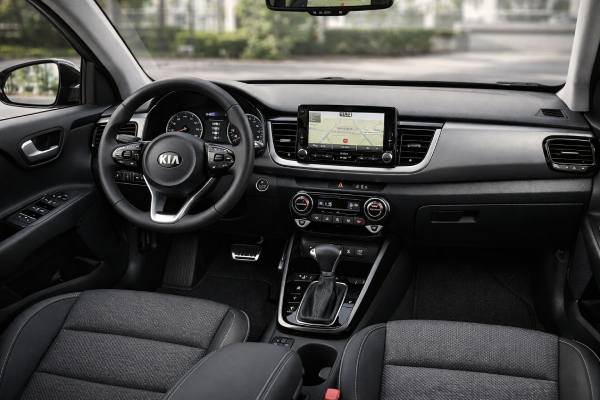

The facelift-era Kia Stonic 1.0 T-GDi 100 is one of those small crossovers that makes more sense the longer you look at it. It is light, compact, and easy to place in traffic, but it also avoids feeling underpowered in everyday use because the turbocharged 1.0-litre engine delivers its torque early. In 2023-onward form, the Stonic also benefits from a cleaner cabin layout, broader driver-assistance coverage in many markets, and a mature chassis that still feels closer to a supermini than a heavy SUV. One detail is worth clearing up early: Kia’s public documents are not fully consistent on engine naming. Some Kia material labels the current 1.0 turbo as Kappa, while other owner-manual material uses Smartstream wording for the same current small turbo petrol family. For owners, the safe rule is to verify by VIN and market-specific documentation rather than trust one label in isolation.
Quick Specs and Notes
- Strong points are low running costs, tidy handling, and a genuinely useful 352 L boot for a small crossover.
- The 1.0 turbo suits mixed driving far better than a base non-turbo engine, especially on faster roads.
- Current facelift cars usually have much better ADAS coverage than early Stonics, but equipment still depends heavily on trim and market.
- The main ownership caveat is not a major known defect pattern so far, but short-trip use and neglected oil changes are bad news for any small direct-injection turbo petrol.
- Kia’s public service guide lists the Stonic petrol interval as 10,000 miles or 12 months, whichever comes first.
What’s inside
- Kia Stonic facelift profile
- Kia Stonic facelift data
- Kia Stonic grades and ADAS
- Reliability and service actions
- Maintenance and buyer advice
- Driving feel and economy
- How it stacks up
Kia Stonic facelift profile
The 2023-onward facelift Stonic still uses the same basic YB formula: a B-segment hatchback platform with crossover styling, modest weight, front-wheel drive, and simple packaging. That is an advantage. The Stonic does not pretend to be a serious off-roader, so it keeps the benefits of a small car: easy parking, low fuel use, and fairly straightforward hardware. In facelift form, Kia sharpened the design, improved infotainment and digital display availability in many markets, and broadened the safety menu compared with early cars.
The exact 100 hp version sits in the middle of the range. That matters because it is often the sweet spot. It gives you a proper turbo petrol with 172 Nm, without pushing you into the pricier 48V 115 hp variant in markets where that model is also sold. Official current Kia documents show the engine as a 998 cc three-cylinder turbo petrol. Continental-market documents commonly round it to 100 hp, while UK material lists the equivalent engine at 98 bhp. In practice, both point to the same 74 kW class engine family.
There is also some naming confusion around this engine. Kia UK’s oil-capacity document still calls the Stonic’s current 1.0 turbo a Kappa (K) T-GDi from 2021-on, while other Kia owner-manual material uses Smartstream G1.0 T-GDi wording. That can mislead owners ordering parts or checking fluid charts online. The useful takeaway is simple: treat this as the facelift-era 1.0 T-GDi 100 PS class petrol Stonic, then confirm the exact engine code and transmission against the VIN before buying fluids, plugs, or gearbox parts.
As an ownership proposition, this Stonic works best for drivers who want crossover visibility but do not want the size, cost, or fuel penalty of a larger SUV. It is especially easy to recommend to people doing mixed commuting, school-run duty, and moderate motorway miles. It is less convincing for buyers who need a very large rear seat or class-leading luggage room, because rivals such as the Hyundai Bayon and Ford Puma are roomier in key areas. Still, the Stonic’s core strengths remain clear: honest size, good ergonomics, and an engine that is small on paper but well matched to the car.
Kia Stonic facelift data
The table below focuses on the facelift-era European-market 1.0 T-GDi 100 manual and DCT class cars. Because public Kia documents vary by country, I note where figures differ or where Kia does not publish a single open-access number for every market.
Powertrain and efficiency
| Item | Kia Stonic 1.0 T-GDi 100 |
|---|---|
| Code | 1.0 T-GDi petrol; Kia naming varies between Kappa and Smartstream in public documents |
| Engine layout and cylinders | Inline-3, DOHC, 12 valves |
| Bore × stroke | 71.0 × 84.0 mm (2.80 × 3.31 in) |
| Displacement | 1.0 L (998 cc) |
| Induction | Turbocharged |
| Fuel system | Direct injection |
| Compression ratio | 10.5:1 |
| Max power | 100 hp class / 73.6–74 kW @ 6,000 rpm |
| Max torque | 172 Nm (127 lb-ft) @ 1,500–3,500 rpm |
| Timing drive | Public Kia brochures do not consistently publish the timing-drive type in open spec sheets; verify by VIN |
| Rated efficiency | 5.9 L/100 km manual or 5.8 L/100 km DCT in one current Nordic spec sheet; some UK WLTP figures land at 5.7–5.6 depending on trim and wheel package |
| Real-world highway at 120 km/h | Typically low-6s L/100 km is the realistic target, rather than mid-5s, especially with passengers or 17-inch wheels |
Transmission and driveline
| Item | Kia Stonic 1.0 T-GDi 100 |
|---|---|
| Transmission | 6-speed manual or 7-speed DCT, market-dependent |
| Drive type | FWD |
| Differential | Open |
Chassis and dimensions
| Item | Kia Stonic 1.0 T-GDi 100 |
|---|---|
| Suspension front / rear | MacPherson strut / coupled torsion beam axle |
| Steering | Electric power steering |
| Steering ratio | Public open-access spec sheets do not consistently publish a ratio |
| Brakes | Front ventilated discs / rear discs |
| Brake diameter | Not consistently published in current open-access Kia spec sheets |
| Most common tyre size | 195/55 R16 |
| Other common tyre size | 205/55 R17 |
| Ground clearance | 165 mm (6.5 in) on 16-inch wheels; 183 mm (7.2 in) on 17-inch wheels |
| Length / width / height | 4,165 / 1,760 / about 1,520 mm (164.0 / 69.3 / 59.8 in); height varies slightly by market and trim |
| Wheelbase | 2,580 mm (101.6 in) |
| Turning circle | 10.4 m (34.1 ft) |
| Kerb weight | Roughly 1,205–1,240 kg (2,657–2,734 lb) in current UK spec sheets, with higher market “service weight” figures in some Nordic documents |
| GVWR | 1,650–1,680 kg (3,638–3,704 lb) |
| Fuel tank | 45 L (11.9 US gal / 9.9 UK gal) |
| Cargo volume | 352 L seats up / 1,155 L seats down (12.4 / 40.8 ft³, VDA) |
| Towing capacity | 900 kg braked / 450 kg unbraked (1,984 / 992 lb) |
| Payload | About 410–445 kg, depending on trim and market measurement basis |
Performance, fluids, and safety
| Item | Kia Stonic 1.0 T-GDi 100 |
|---|---|
| 0–100 km/h | 11.0 s manual / 12.1 s DCT |
| Top speed | 179 km/h manual (111 mph) |
| Engine oil | 3.6 L (3.8 US qt) |
| Oil specification | Public Kia docs show 0W-20 API SN PLUS or approved market-specific dealer 0W-30 products; always follow the VIN-linked oil chart for your country |
| Coolant | Public Kia owner-manual material for Smartstream G1.0 T-GDi lists about 5.7 L, but verify by VIN |
| Manual transmission fluid | Kia owner-manual material for Smartstream G1.0 T-GDi lists about 1.5–1.6 L, API GL-4 SAE 70W; verify by VIN |
| DCT fluid | DCT-fill figures vary by exact transmission and market; verify by VIN |
| Brake fluid | DOT 4 LV class fluid is the safe reference point; verify reservoir cap and market spec |
| A/C refrigerant and compressor oil | Not consistently published in open-access current Stonic spec sheets |
| Wheel nut torque | 107–127 Nm (79–94 lb-ft) |
| Crash ratings | Euro NCAP rating is expired; original Stonic results were published in 2017 and reviewed again for the facelift in 2020 |
| ADAS | FCA/AEB, lane support, speed-limit assist, blind-spot aid, rear-cross traffic functions, and cruise-control sophistication vary strongly by trim and market |
These figures combine current Kia technical sheets, current Kia maintenance documents, Euro NCAP data, and Kia owner-manual material for the present 1.0 T-GDi engine family. Where Kia’s public documents disagree, the VIN is the final authority.
One useful ownership insight hides in the numbers. The manual is not just cheaper in some markets; it is also the quicker 100 hp Stonic on paper. The DCT is easier in traffic, but official current data show it giving up around 1.1 seconds in the 0–100 km/h run in some market sheets. That does not make the DCT bad, but it does change the character of the car. The manual feels like the more natural pairing for buyers who want the lightest, simplest version.
Kia Stonic grades and ADAS
Trim naming is one of the hardest parts of researching a Stonic, because Kia uses different grade names across Europe. Current UK material shows trims such as Pure, GT-Line, and GT-Line S. Current Swedish material uses Action, Advance, and GT Line. France has also listed 100 hp and 120 hp versions with different packaging. So, when you read a used-car advert, focus less on the badge and more on the equipment list, wheel size, and transmission.
For the 100 hp facelift car, lower trims usually carry the essentials well: alloy wheels, touchscreen infotainment, reversing camera, parking sensors, and the basic lane and forward-collision systems that many buyers now expect. Higher trims add the equipment that changes day-to-day feel rather than mechanical performance: LED headlamps, climate control, digital cluster, heated seats, heated wheel, wireless charging, blind-spot support, smarter cruise control, and sometimes a larger ADAS bundle. The 100 hp car remains front-wheel drive throughout, so the trim walk-up is mostly about convenience and safety rather than chassis changes.
Safety needs more nuance than a simple star count. Euro NCAP currently flags the Stonic rating as expired. It also states that the Stonic rating was originally published in 2017, based on Kia Rio crash tests plus additional reviewed data, and that a facelift review and mild-hybrid addition were considered in August 2020. Early Stonic safety results also depended on equipment: the published 2017 safety-pack page showed 85% adult, 84% child, 62% VRU, and 25% Safety Assist, while Euro NCAP separately notes that equipment fitment varied. The practical lesson is that a 2023-present Stonic may have more modern active safety than an early car, but its published crash-test history is still rooted in an older test regime.
ADAS availability is much better on facelift cars than on early Stonics, but not universal in the same form everywhere. Current public Kia specs list Forward Collision-Avoidance Assist, Lane Keep Assist, Lane Follow Assist, Intelligent Speed Limit Assist, and Driver Attention Warning widely, while higher trims may add Smart Cruise Control, Highway Driving Assist, Blind-Spot Collision-Avoidance Assist, and rear cross-traffic support. After a windscreen replacement or front-end repair, cars with camera-based systems deserve proper recalibration. That is not unique to Kia, but it matters more now because the facelift Stonic can carry a much larger driver-assistance load than the original model.
Reliability and service actions
Because the facelift 2023-onward petrol Stonic is still relatively young, there is less hard public pattern data than there is for older Stonic diesels or first-wave small turbo engines from the late 2010s. That is actually an important point for buyers: there is not yet strong public evidence of a widespread, model-defining mechanical flaw in the facelift 100 hp petrol version from the official sources reviewed here. The main risk profile is still preventive maintenance, usage pattern, and trim complexity rather than a single known “fatal flaw.”
The one current-period service action worth calling out from an official public source is a narrow 2024 recall listed in Ireland. That recall covered certain Picanto and Stonic vehicles produced between 11 January 2024 and 14 February 2024, where a short circuit inside the EGR valve could cause the engine to stall before a warning light appeared. The affected population listed there was very small, but it is exactly the kind of VIN-specific check that matters on a young used car. Always verify recall completion with Kia’s official VIN checker and dealer history, not just the seller’s memory.
Beyond recalls, the likely watchpoints are logical ones for a small direct-injection turbo petrol. Short-trip use increases the chance of condensation and fuel dilution in the oil, while neglected air filtration and long service intervals are never ideal for a boosted three-cylinder that relies on clean oil and stable crankcase ventilation. Intake-valve deposits are a long-horizon concern on direct-injection petrol engines in general, so high-mileage cars that live on short urban runs deserve closer attention than lower-stress mixed-use cars. That is an engineering inference from the powertrain layout and service needs, not proof of a Stonic-specific epidemic.
Transmission choice changes the ownership feel. The manual is simpler and, on paper, quicker in this power band. The DCT can be a good fit for traffic, but any dual-clutch small crossover should be test-driven carefully at parking speeds, on inclines, and in repeated stop-start use to check for hesitation, shunt, or rough engagement. That does not mean the gearbox is faulty; it means the transmission character matters more than on a torque-converter automatic. Also inspect 12 V battery health, because weak batteries can cause misleading warning behavior in modern small cars with many driver aids.
Maintenance and buyer advice
The public Kia service guide for the petrol Stonic is straightforward: 10,000 miles or 12 months, whichever comes first. That is the headline interval. In real ownership, though, I would treat that as the outer limit for a car that does regular mixed driving, not as permission to stretch a turbo petrol through repeated cold starts and short urban trips without closer oil care. Kia owner-manual material for related 1.0 T-GDi engines also shows that severe-use schedules can be much shorter, which supports a conservative approach for low-speed, low-mileage urban cars.
Practical maintenance schedule
| Item | Practical plan for the facelift 1.0 T-GDi 100 |
|---|---|
| Engine oil and filter | Every 12 months or 10,000 miles max; shorten for repeated short-trip or severe-use driving |
| Engine air filter | Inspect annually; replace sooner in dusty use, typically around 20,000–30,000 km |
| Cabin air filter | Inspect annually; replace about every 2 years, sooner in dirty urban use |
| Spark plugs | Kia owner-manual material for Smartstream G1.0 T-GDi lists replacement every 75,000 km (50,000 miles) |
| Coolant | Kia owner-manual material for Smartstream G1.0 T-GDi commonly lists first replacement at 120 months / 210,000 km, then every 24 months / 30,000 km; verify by VIN |
| Brake fluid | Inspect at each service; replace on time per market service booklet rather than waiting for problems |
| MT or DCT fluid | Public owner-manual material often says no routine service under normal use, but fluid condition deserves inspection and severe-use owners should be more cautious |
| Drive belts and hoses | Inspect from about 72 months / 90,000 km onward, then at regular intervals |
| Tyres | Rotate about every 10,000–12,000 km if wear pattern allows; check alignment yearly |
| Brake pads and discs | Inspect at every service |
| 12 V battery | Test from year 4 onward |
| Timing components | Public open-access Stonic sheets do not publish a service replacement interval; monitor for noise, correlation faults, and poor cold running, and verify by VIN-specific service data |
Public Kia maintenance data also provides a few useful hard numbers. Engine oil capacity is 3.6 L. Kia’s public oil documents show a mix of approved viscosity references depending on market, including 0W-20 API SN PLUS and dealer-supplied approved 0W-30 products, so the best practice is to follow the oil chart tied to the VIN and country. Wheel nuts are tightened to 107–127 Nm. That is enough for routine ownership decisions, even though public documents do not consistently publish every coolant, refrigerant, or DCT fill figure for every Stonic market.
For buyers, the checklist is practical rather than exotic:
- verify recall completion by VIN,
- confirm whether the car is manual or DCT before ordering service parts,
- check that the infotainment and camera-based safety functions work cleanly,
- inspect for uneven tyre wear on 17-inch cars,
- look for evidence of annual oil changes rather than “whenever the mileage was low,”
- and drive the car from cold, not already warmed up by the seller.
The best cars are usually well-documented mixed-use examples, not ultra-low-mileage urban cars that have spent years doing only short hops. Long-term durability looks promising, but the model is still young enough that good maintenance discipline matters more than folklore.
Driving feel and economy
On the road, the facelift 100 hp Stonic still feels more like a tall supermini than a mini-SUV, and that is a compliment. The steering is light but accurate, the body is reasonably well controlled, and the car does not carry excess mass. At city speeds it feels easy and neat. On a country road it is predictable rather than playful, but it changes direction willingly and rarely feels clumsy. The ride depends a lot on wheel size: 16-inch cars are the better everyday choice, while 17-inch cars trade some compliance for appearance and grip.
The engine’s character suits the car. A naturally aspirated small petrol would leave the Stonic feeling flat, but the 1.0 T-GDi’s 172 Nm gives it enough mid-range pull to stay relaxed in normal use. The official manual-car figures of 11.0 seconds to 100 km/h and 179 km/h top speed are not exciting, yet they are entirely adequate for the class. More importantly, the torque arrives low enough to make the car feel stronger in real traffic than the power figure suggests. The DCT gives convenience, but the manual remains the sweeter match if you care about response and simplicity.
Fuel economy is one of the Stonic’s strongest arguments. Official current figures cluster around 5.8–5.9 L/100 km for the 100 hp manual and DCT in one Nordic market sheet, while UK WLTP numbers for the same power class sit around 5.6–5.7 L/100 km depending on trim and tyre package. In real use, a mixed-driving owner should expect numbers somewhere near those figures if the car is used sensibly. At a true 120 km/h, however, consumption usually rises into the low-6s; that is a practical inference from the extra-high and combined WLTP data, not a formal homologation result. Cold weather, short trips, and 17-inch tyres all push the number the wrong way.
Cabin refinement is acceptable rather than luxurious. You hear the three-cylinder engine under load, but once settled it does not dominate the experience. Wind and tyre noise are more noticeable on coarse surfaces than in some newer rivals, though the payoff is a car that still feels mechanically straightforward. For most buyers, that balance works. The Stonic 100 is not the most powerful, plush, or spacious crossover in this class. It is simply one of the more coherent ones.
How it stacks up
The facelift Stonic 100 sits in a very competitive part of the market, so the verdict depends on what you value most. Against the SEAT Arona 1.0 TSI 95, the Kia is very close on paper. The Arona’s official figures show 95 PS, 175 Nm, 11.1 seconds to 62 mph, and a 40 L fuel tank. That makes it a strong direct rival. The Kia counters with a 45 L tank, similar torque, and a broadly comparable performance band. In practice, the decision usually comes down to whether you prefer SEAT’s packaging and VW-group feel or Kia’s ownership reputation and simpler overall presentation.
Against the Hyundai Bayon 1.0 T-GDi 90, the Stonic is the tidier driver’s choice, while the Bayon leans harder into space and everyday practicality. Hyundai’s official UK material highlights a 90 PS 1.0 T-GDi engine and 411 litres of boot space, which is a meaningful advantage over the Stonic’s 352 litres. The Stonic answers with slightly stronger output in this 100 hp form and a shape that feels more planted and less purely utility-led. Since the two brands share engineering DNA, this comparison often becomes a question of size priorities and styling rather than basic quality.
Against the Ford Puma 1.0 EcoBoost Hybrid 125, the Kia loses on outright pace and, usually, on chassis sparkle. Ford’s current official material lists a 125 PS 1.0-litre mild-hybrid Puma, which places it above the Stonic on performance. The Puma is also widely regarded as one of the more engaging crossovers in this class. But the Stonic is usually the simpler buy: lower output, less to prove, and often lower running-cost anxiety for owners who want straightforward petrol crossover transport rather than the sharpest possible B-segment crossover.
That is why the facelift Stonic 1.0 T-GDi 100 remains easy to understand. It is not the roomiest, nor the fastest, nor the most upmarket. But it delivers a smart blend of compact size, honest performance, sensible fuel use, and useful equipment. If you buy one with the right trim, the right transmission for your use, and fully verified VIN-based service history, it is one of the better balanced small crossovers in the class.
References
- KIA STONIC. 2026 (Technical Specification)
- Engine Oil Grades and Capacities – Kia 2023 (Service Guide)
- Service Intervals 2026 (Service Guide)
- Official Kia Stonic safety rating 2017 (Safety Rating)
- Recalls by manufacturer (2024) 2024 (Recall Database)
Disclaimer
This article is for informational purposes only and is not a substitute for professional diagnosis, repair, or workshop-level inspection. Specifications, torque values, service intervals, fluids, procedures, recalls, and equipment can vary by VIN, market, trim, transmission, and production date. Always verify the exact details for your vehicle against official Kia service documentation and dealer VIN records before carrying out maintenance or repair work.
If this guide was useful, please consider sharing it on Facebook, X, or another platform to support our work.