
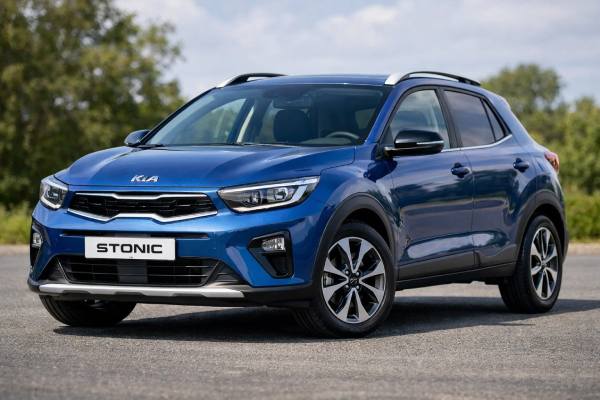
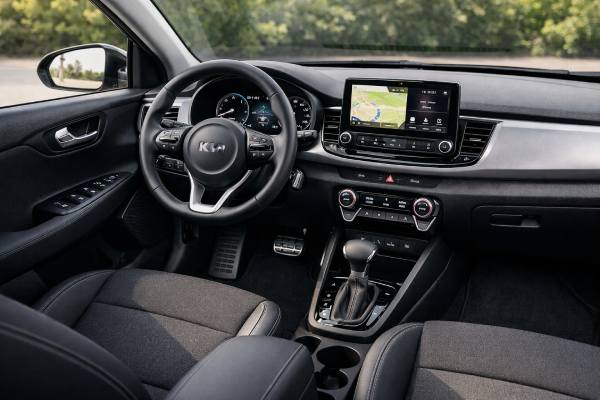
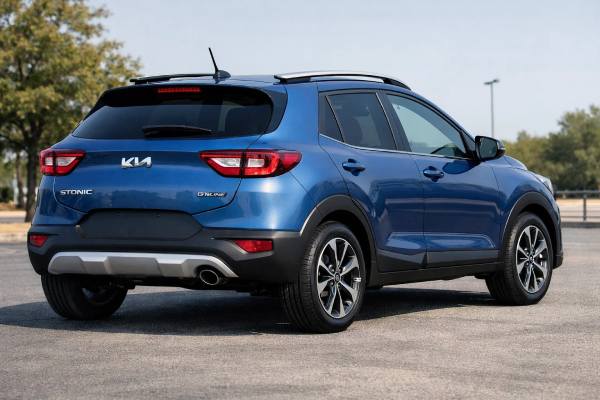
The facelift-era Kia Stonic 1.0 T-GDi MHEV sits in a useful middle ground. It keeps the compact footprint, easy maneuvering, and modest running costs that make the regular Stonic appealing, but the 48-volt mild-hybrid system adds a smarter energy strategy and a more relaxed powertrain feel on mixed roads. This is not a full hybrid and it will not run as an EV, yet it still matters in daily use. The mild-hybrid setup helps the engine restart more smoothly, recovers energy when slowing down, and can assist the engine under load. In the facelift years from 2023 onward, the Stonic also benefits from a more polished cabin, broader driver-assistance coverage in many markets, and a powertrain lineup that feels more mature than the car’s modest size suggests.
There is one naming detail worth noting from the start. Many buyers know this version as the 120 hp mild hybrid, but current Kia documents in several markets often list it as 115 ch or 118 bhp. Treat it as the same 88 kW class 48V mild-hybrid Stonic, then verify the exact VIN and local spec sheet before ordering parts or comparing insurance.
Essential Insights
- The 48V mild-hybrid system improves drivability more than headline speed, especially in stop-start traffic and rolling hills.
- It is one of the lighter and simpler electrified small crossovers, which helps both fuel economy and long-term ownership confidence.
- A 7-speed DCT version is common, but some markets also offered an intelligent manual; transmission choice changes the ownership feel more than trim level.
- This is still a turbo direct-injection three-cylinder, so regular oil changes matter more than the sales brochure suggests.
- Kia’s public service guide lists the Stonic hybrid service interval at 10,000 miles or 12 months, whichever comes first.
Explore the sections
- Kia Stonic MHEV identity
- Kia Stonic MHEV hard data
- Kia Stonic MHEV equipment map
- Ownership risks and remedies
- Service planning and used checks
- On-road behavior and efficiency
- Compared with class rivals
Kia Stonic MHEV identity
The facelift Stonic mild hybrid makes sense because it stays honest about what it is. It does not pretend to be a full hybrid, a plug-in, or a mini off-roader. Instead, it takes a small turbo petrol crossover and adds a 48-volt electrical layer that improves the weak points of that formula. The result is a car that feels a little smoother leaving a junction, a little calmer in traffic, and a little less thirsty than the non-hybrid equivalent when driven in the same way.
That matters more than the badge. Kia’s mild-hybrid system pairs the 1.0-litre turbo three-cylinder with a 48-volt lithium-ion battery and an integrated starter-generator system. In practice, the system can recover energy during deceleration, support the engine with torque assistance when accelerating, and allow extended stop-start and sailing functions in the right conditions. The Stonic still drives like a petrol crossover, but the system trims away some of the rough edges that small turbo engines can show in urban and suburban use.
This version also suits the Stonic’s platform well. The YB Stonic has always been more hatchback than SUV underneath, and that works in its favor. The car is light by crossover standards, easy to place in tight streets, and more agile than taller rivals that carry extra visual bulk. Adding a mild-hybrid system does not change that basic character. Instead, it strengthens the Stonic’s role as an efficient, everyday crossover for buyers who want a raised driving position without a large-car penalty in cost or weight.
The facelift years improved the package further. The styling became cleaner, the interior interface more modern, and the active-safety offering stronger in many markets. Those upgrades matter because the Stonic was already mechanically coherent. The facelift did not need to reinvent the car. It needed to make it feel more current, and it largely succeeds.
For ownership, the biggest strength is balance. The Stonic MHEV is more advanced than the simple 100 hp petrol without becoming especially complicated in the way a full hybrid or plug-in can. There is no charging cable, no plug-in routine, and no heavy traction battery filling the underfloor. Yet there is enough electrified assistance to make daily driving smoother and more efficient.
The main caveat is that this is still a small turbo petrol with direct injection. That means service discipline matters. The mild-hybrid hardware helps, but it does not change the need for clean oil, good battery health, proper software support, and sensible driving patterns. Buyers who understand that usually find the Stonic MHEV to be one of the more rational electrified small crossovers on the used market.
Kia Stonic MHEV hard data
The table below focuses on the facelift-era 48V mild-hybrid Stonic in its 120 hp class form. Current official Kia documents often list this engine at 115 ch or 118 bhp, which corresponds to about 88 kW. Because figures vary by market, trim, and transmission, the table notes where VIN-level confirmation is the right next step.
Powertrain and efficiency
| Item | Kia Stonic 1.0 T-GDi MHEV |
|---|---|
| Code | Smartstream / Kappa 1.0 T-GDi 48V MHEV, market naming varies |
| Engine layout and cylinders | Inline-3, DOHC, 12 valves |
| Displacement | 1.0 L (998 cc) |
| Bore × stroke | 71.0 × 84.0 mm (2.80 × 3.31 in) |
| Mild-hybrid hardware | 48V mild-hybrid system with integrated starter-generator |
| Battery | 48V lithium-ion battery |
| Induction | Turbocharged |
| Fuel system | Direct injection |
| Compression ratio | 10.5:1 |
| Max power | 120 hp class; current official public data commonly shows 88 kW @ 6,000 rpm |
| Max torque | Usually 200 Nm (148 lb-ft) @ 2,000–3,000 rpm in European 6iMT and 7DCT specs |
| Timing drive | Public open-access Kia sheets do not consistently publish chain or belt type for all markets; verify by VIN |
| Rated efficiency | Typically about 5.4–5.7 L/100 km depending on market, trim, and transmission |
| Real-world highway at 120 km/h | Usually around 6.0–6.6 L/100 km in calm conditions, higher with roof load or 17-inch wheels |
Transmission and driveline
| Item | Kia Stonic 1.0 T-GDi MHEV |
|---|---|
| Transmission | 6-speed intelligent manual in some markets, or 7-speed DCT |
| Drive type | FWD |
| Differential | Open |
Chassis and dimensions
| Item | Kia Stonic 1.0 T-GDi MHEV |
|---|---|
| Front suspension | MacPherson strut |
| Rear suspension | Coupled torsion beam axle |
| Steering | Electric power steering |
| Steering ratio | Not consistently published in current public facelift spec sheets |
| Front brakes | Ventilated disc |
| Rear brakes | Solid disc |
| Most common tyre size | 195/55 R16 |
| Optional common tyre size | 205/55 R17 |
| Ground clearance | 165 mm (6.5 in) on smaller wheels; up to 183 mm (7.2 in) with larger wheel package in some markets |
| Length | 4,165 mm (164.0 in) in current facelift spec sheets |
| Width | 1,760 mm (69.3 in) |
| Height | About 1,500–1,520 mm (59.1–59.8 in), market and trim dependent |
| Wheelbase | 2,580 mm (101.6 in) |
| Turning circle | 10.4 m (34.1 ft) |
| Kerb weight | Roughly 1,160–1,288 kg (2,557–2,840 lb), depending on market and transmission |
| GVWR | 1,680–1,710 kg (3,704–3,770 lb) |
| Fuel tank | 45 L (11.9 US gal / 9.9 UK gal) |
| Cargo volume | 352 L seats up / 1,155 L seats down (12.4 / 40.8 ft³, VDA) |
Performance and capability
| Item | Kia Stonic 1.0 T-GDi MHEV |
|---|---|
| 0–100 km/h | About 10.7 s for 6iMT and 10.8 s for 7DCT in current European-market data |
| Top speed | About 185 km/h (115 mph) in earlier official 120 PS mild-hybrid data |
| Towing capacity | 900 kg braked / 450 kg unbraked (1,984 / 992 lb) in many current markets |
| Payload | Typically around 390–500 kg depending on market, trim, and transmission |
Fluids, service, and safety
| Item | Practical guidance |
|---|---|
| Engine oil | 3.6 L (3.8 US qt), current Kia UK oil guide |
| Oil specification | Public Kia documents list 0W-20 full synthetic as a core reference, with some market-approved 0W-30 products also listed |
| Coolant | Owner-manual material for this engine family commonly lists about 5.7 L, but always verify by VIN |
| Manual transmission fluid | Inspect by schedule; fill data varies by exact gearbox and market |
| DCT fluid | Inspect by schedule; severe-use replacement may be appropriate earlier than “lifetime” language suggests |
| Brake fluid | DOT 4 LV / ISO 4925 Class 6 type is the safe starting point; verify cap and market spec |
| Wheel nut torque | 107–127 Nm (79–94 lb-ft) |
| Crash rating | Euro NCAP rating is expired and based on the Stonic’s earlier assessment, itself linked to the structurally related Kia Rio |
| ADAS | AEB, lane support, speed-limit aid, blind-spot systems, and cruise-control sophistication vary by trim and market |
One useful ownership detail hides in the power figures. The mild-hybrid Stonic is not dramatically quicker than the regular 100 hp car, but it does feel more complete. The extra torque and the way the 48V system fills the gaps in low-speed response matter more than the 0–100 km/h headline time.
Kia Stonic MHEV equipment map
Trim names vary a lot by country, so equipment matters more than the badge. In the UK you may see Pure, GT-Line, and GT-Line S. In other European markets you may see Motion, Active, Advance, Concept, Drive, Business, or GT-Line. The same mild-hybrid engine can appear in more than one of those grades, and the real differences usually come from wheels, ADAS, comfort equipment, and transmission rather than from any deeper chassis changes.
Lower or mid-grade mild-hybrid cars often give you the essentials: touchscreen infotainment, camera support, parking sensors, lane support, forward collision aid, alloy wheels, and climate-control basics. Higher trims bring the items that make the Stonic feel far more upmarket than its size suggests: LED headlamps, larger digital display content, heated seats, heated steering wheel, blind-spot support, smarter cruise-control logic, and nicer trim materials. In some markets, the MHEV powertrain was also the route to the more complete safety packages.
A useful rule for used buyers is this: buy the equipment you care about, not the trim name you think sounds best. A mid-grade car with the right safety pack, camera systems, and seat comfort is often the better choice than a sportier-looking version with fewer useful features. The Stonic’s mild-hybrid hardware does not create a dramatic visual signature from the outside, so the cabin equipment list and the VIN build record matter more than the badge on the tailgate.
Safety needs careful reading. Euro NCAP’s public Stonic rating is expired, and the original Stonic result was tied closely to the Kia Rio test structure. That makes the published crash story older than the current 2023-present facelift cars on sale. Still, the safety hardware on facelift examples is often meaningfully better than on early cars. Kia widened the availability of functions such as Forward Collision-Avoidance Assist, Lane Keep Assist, Lane Follow Assist, Driver Attention Warning, and Intelligent Speed Limit Assist. Higher trims in some markets also add Blind-Spot Collision-Avoidance Assist, rear cross-traffic support, and more advanced cruise features.
That equipment is useful, but it also changes ownership expectations. A simple early Stonic could shrug off minor glass replacement or front-end cosmetic repairs with less fuss. A facelift mild-hybrid with camera-based lane and collision systems needs correct recalibration after windscreen work or nose repairs. That does not make the car fragile. It just means the workshop standard matters more than it did on the older, simpler variants.
Airbag count and structure remain competitive for the class, with front, side, and curtain coverage on most European-market cars, plus ISOFIX points and the usual ESC, hill-start assist, and tyre-pressure monitoring. The Stonic is not the most advanced crossover in the class on paper, but the facelift MHEV versions can be much better equipped than many early used ads suggest. Always decode the actual equipment before buying.
Ownership risks and remedies
Because the facelift 2023-present Stonic MHEV is still fairly new, there is not yet a deep public history of age-related failures in the way there is for older diesel Stonics or early small turbo engines. That is good news, but it also means buyers should think in terms of risk patterns rather than famous failure lists.
Common, low to medium cost: deferred oil service. The biggest risk is not a dramatic hybrid failure. It is ordinary neglect. This engine is a small direct-injection turbo petrol, and those engines depend on clean oil and stable lubrication more than a simple naturally aspirated unit does. Symptoms of neglect can include timing-related noise, rough running, higher consumption, sluggish turbo response, or general loss of refinement. The remedy is prevention first: on-time full-synthetic oil changes and proper oil-grade control.
Occasional, low to medium cost: 12V and 48V battery-related drivability complaints. Mild hybrids rely heavily on correct low-voltage health. Weak batteries can trigger start-stop oddities, warning messages, slow restarts, or inconsistent hybrid assistance. The fix is often battery testing, software checks, and charging-system diagnosis rather than major parts replacement.
Occasional, low to medium cost: DCT behavior complaints. Where fitted, the 7-speed dual-clutch suits the Stonic well once moving, but in repeated crawling traffic, tight parking maneuvers, or hill starts, some drivers notice hesitation or abrupt take-up. Symptoms include shunt, clutch smell after abuse, or awkward take-up from rest. Often this is characteristic rather than failure, but poor adaptation, battery weakness, or worn clutch elements can make it worse. A careful test drive is the best filter.
Occasional, medium cost: intake and combustion-side deposit build-up over the long term. This is a direct-injection turbo petrol, so higher-mileage cars that spend most of their lives on short urban trips can collect carbon and crankcase deposits more quickly than mixed-use cars. Rough cold running, hesitation, or gradually reduced efficiency can point in that direction. Not every car will suffer noticeably, but it is a real long-term ownership theme for this engine layout.
Hybrid-specific watchpoint: the 48V system is simpler than a full hybrid, but not trivial. If a warning appears related to the mild-hybrid system, do not treat it like an ordinary stop-start glitch and ignore it. Proper diagnostic scanning matters because the integrated starter-generator and battery management are central to the car’s smoothness.
On official service actions, public recall data does not currently suggest a broad, model-defining reliability crisis for the facelift mild-hybrid Stonic. One narrow 2024 Ireland-market recall covered certain Picanto and Stonic vehicles produced over a short period where an EGR-valve short circuit could cause engine stall before a warning light came on. That does not make every facelift Stonic suspect, but it is a good reminder that recall completion must be checked by VIN and dealer history, not assumed from registration age.
For pre-purchase work, request a cold start, a full fault scan, proof of annual oil changes, and recall confirmation. Also ask whether the windscreen has been replaced and whether ADAS calibration paperwork exists. On a young mild-hybrid car, documentation quality tells you a lot.
Service planning and used checks
Kia’s public service guide gives the Stonic hybrid a 10,000-mile or 12-month service interval. That is reasonable as a headline figure, but it should not be treated as the only rule. For repeated short-trip driving, cold starts, low annual mileage, or hard urban stop-start use, a shorter oil interval is a sensible long-term strategy. Mild-hybrid assistance improves efficiency, but it does not reduce the engine’s need for good lubrication.
Practical maintenance schedule
| Item | Practical interval |
|---|---|
| Engine oil and filter | Every 12 months or 10,000 miles maximum; shorten for severe use |
| Engine air filter | Inspect yearly; replace around 20,000–30,000 km depending on dust load |
| Cabin air filter | Replace about every 24 months, sooner in city or dusty use |
| Spark plugs | Mild-hybrid owner-manual schedule commonly lists 150,000 km (100,000 miles), but inspect condition earlier in hard use |
| Coolant | First replacement around 210,000 km or 120 months, then every 30,000 km or 24 months |
| Brake fluid | Replace to schedule; do not wait for feel changes |
| Manual / iMT fluid | Inspect by schedule; replace earlier in severe use if operation degrades |
| DCT fluid | Inspect by schedule; severe-use change around 120,000 km is prudent |
| Drive belts and hoses | Inspect from 72 months / 90,000 km onward |
| Tyre rotation | Every 10,000–12,000 km if wear pattern allows |
| Alignment check | Yearly, or after impact damage or uneven wear |
| Brake pads and discs | Inspect at every service |
| 12V battery | Test from year 4 onward |
| 48V system | Check for stored faults and charging consistency during dealer-level inspections |
| Valve clearance | Inspect if excessive valvetrain noise or vibration appears |
Fluid and capacity notes
The hard public numbers that matter most are straightforward:
- engine oil capacity is 3.6 L,
- fuel tank capacity is 45 L,
- wheel-nut torque is 107–127 Nm,
- and the car uses full-synthetic low-viscosity oil with market-specific Kia approval.
Beyond that, coolant fill, transmission fill, and some hybrid-system service details are best confirmed by VIN and region. Kia’s public documents do not publish every fill figure consistently across all facelift Stonic markets.
Used-buyer checklist
- Confirm whether the car is 6iMT or 7DCT.
- Verify that the engine is the 48V mild-hybrid version, not the regular 100 hp petrol.
- Look for proof of annual servicing rather than mileage-only servicing.
- Check the condition of the 12V battery and any start-stop or hybrid warnings.
- Drive the car from cold and repeat several parking-speed maneuvers.
- Check tyre wear carefully on 17-inch cars.
- Verify windscreen replacements and ADAS calibration history.
- Confirm recall completion by VIN.
For most buyers, the best used mild-hybrid Stonic is a well-documented facelift car with moderate mileage, complete annual servicing, and equipment that matches how you actually drive. The trim hierarchy matters less than the maintenance file. Long-term durability looks promising, but the winners will be the cars that were serviced on time, not the ones that merely look newer.
On-road behavior and efficiency
The Stonic MHEV drives like a small crossover that has not forgotten how to be a small car. That is its best dynamic trait. The body is upright enough to give the driver the raised seating position many buyers want, but the chassis still feels light, narrow, and easy to guide through traffic. Steering is quick enough to make the car feel tidy, and the front axle responds with more precision than many buyers expect from a B-segment crossover.
Ride quality depends strongly on wheel size. Cars on 16-inch wheels are the more sensible all-rounders. They absorb broken surfaces better and keep the Stonic from feeling nervous over sharp ridges. Cars on 17s look stronger and often bring nicer trims, but they can feel firmer and a little busier over poor roads. The basic suspension layout is simple, which is good for ownership, but it means wheel and tyre choice has a visible effect on the final feel.
The mild-hybrid system improves the powertrain character more than it transforms it. Off idle, the car still feels like a turbo petrol, not a full hybrid. But the restarts are smoother, the throttle feels less strained in stop-start use, and the torque assistance helps the engine feel more relaxed when pulling away or reloading after a lift. Earlier Kia mild-hybrid material also described sailing and energy-recuperation functions, and those features help explain why the Stonic MHEV feels calmer in mixed driving than its modest size would suggest.
Performance is strong enough for the class. The typical 0–100 km/h time of around 10.7–10.8 seconds is not quick in a hot-hatch sense, but it is comfortably adequate for motorway merging and overtaking. More important is the way the car carries speed. The mild-hybrid torque delivery and low weight let it feel less busy on real roads than the regular 100 hp car.
Real-world fuel use is a clear strength. In mixed driving, a careful owner can often stay in the mid-5 L/100 km range. Highway use at 100–120 km/h usually moves the number toward the low-6s. Urban congestion can still push it up, especially in winter, but the mild-hybrid system helps the Stonic avoid the worst fuel penalty that small turbo petrol automatics can show in heavy traffic. Cold weather and short trips still matter, because the engine must warm up and because heater use reduces the benefits of early stop-start and sailing.
Noise and vibration are well controlled for the class rather than outstanding. You will still hear a three-cylinder character under load, but the facelift car generally feels mature enough for longer drives. Braking is predictable, and the light weight helps the car feel secure without pretending to be sporty. The mild-hybrid Stonic is not exciting. It is simply easy to drive well, which is often more valuable.
Compared with class rivals
The mild-hybrid Stonic competes in one of the most crowded small-crossover classes, so the right rival depends on your priorities.
Against the Hyundai Bayon 1.0 T-GDi 48V, the Stonic feels slightly more compact and a little tidier to drive, while the Bayon usually wins on rear-seat space and luggage volume. The two cars share some engineering logic, so the choice often comes down to styling, cabin layout, and whether you value the Hyundai’s packaging edge more than the Kia’s slightly more planted feel.
Against the Ford Puma 1.0 EcoBoost Hybrid, the Kia usually loses on outright driver appeal and broad dynamic polish. The Puma remains one of the best-driving cars in this class. But the Stonic can be the calmer ownership choice for buyers who want simpler packaging, a less aggressively tuned feel, and lower purchase pressure in the used market.
Against the SEAT Arona 1.0 eTSI or 1.0 TSI, the comparison is close. The Arona often feels slightly more mature in cabin layout and rear-seat packaging, but the Stonic counters with straightforward ergonomics, strong value, and a mild-hybrid setup that fits the car’s weight and mission well. The Kia’s 45 L tank is also useful for range compared with some smaller-tank rivals.
Against the Renault Captur mild-hybrid or E-Tech alternatives, the Kia wins on simplicity. The Captur can feel more modern and sometimes more spacious, but the Stonic is easier to understand mechanically. Buyers who want the least complicated electrified crossover ownership path often find the Kia easier to trust.
That is the Stonic MHEV’s real market position. It is not the flashiest, the roomiest, or the quickest. It is the crossover for buyers who want a small, light, efficient petrol car with just enough electrification to improve daily use without changing their habits. There is no charging cable, no plug-in routine, and no heavy full-hybrid hardware. Yet there is a noticeable gain in refinement, efficiency, and low-speed smoothness.
For the right owner, that is exactly enough. If you want a compact crossover that still feels mechanically honest, and you are willing to keep up with annual servicing, the facelift Kia Stonic 1.0 T-GDi MHEV remains one of the most sensible choices in the class.
References
- Catálogo – Kia 2025 (Technical Specification)
- Engine Oil Grades and Capacities – Kia 2023 (Service Guide)
- Service Intervals 2026 (Service Guide)
- Official Kia Stonic safety rating 2017 (Safety Rating)
- Recalls by manufacturer (2024) – RSA.ie 2024 (Recall Database)
Disclaimer
This article is for informational purposes only and is not a substitute for professional diagnosis, repair, or VIN-specific workshop data. Specifications, torque values, service intervals, procedures, fluid types, performance figures, and equipment can vary by VIN, market, transmission, trim, and model year. Always verify the exact details for your vehicle against official Kia service documentation and dealer records before carrying out maintenance or repairs.
If this guide helped you, please consider sharing it on Facebook, X, or another platform to support our work.