
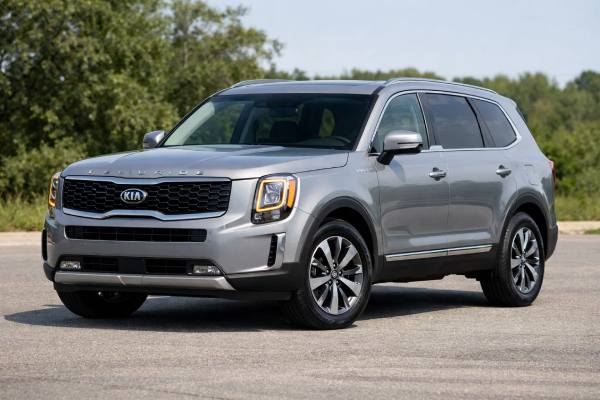
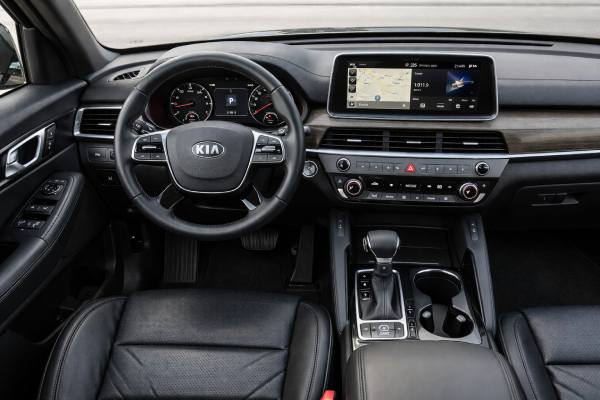
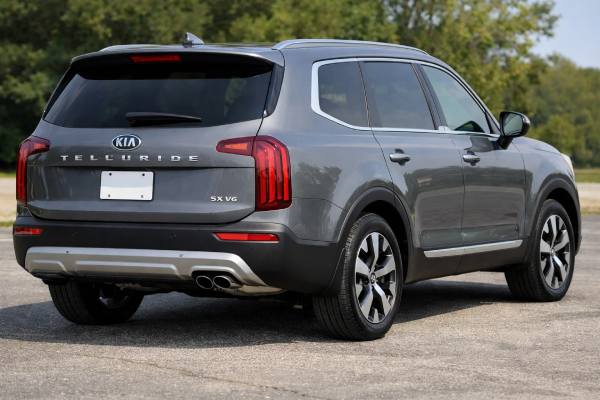
The 2020–2022 Kia Telluride AWD is the version that best captures why the model became such a strong family-SUV choice in North America. It combines a naturally aspirated 3.8-litre V6, a conventional 8-speed automatic, and an active on-demand all-wheel-drive system, so it feels more mechanical and more predictable than many turbocharged or hybrid rivals. That matters in daily use. The Telluride AWD is smooth in traffic, stable on the highway, and genuinely useful when fully loaded or towing. It also offers one of the better third rows in its class, strong standard safety equipment, and a cabin that still feels expensive for the money.
Its weak points are not hard to define. Fuel economy is average at best, some early AWD examples developed driveline vibration, and buyers must verify recall and software-campaign completion carefully. Still, for many owners, this is the Telluride sweet spot.
Essential Insights
- Smooth V6 power, a conventional 8-speed automatic, and on-demand AWD make this one of the easier three-row SUVs to live with.
- Cabin space, third-row access, and highway stability are real strengths, especially for family use and long trips.
- AWD models keep the full 5,000 lb towing rating and add useful traction modes for snow and low-grip roads.
- Check recall history, AWD vibration repairs, and rear self-leveling suspension noise before buying.
- Plan at least annual servicing, and shorten oil and driveline-fluid intervals if the vehicle tows, idles heavily, or sees severe use.
Section overview
- Telluride ON AWD foundations
- Telluride ON AWD data
- Telluride ON trims and safety tech
- Known problems and factory actions
- Care schedule and shopping advice
- Ride, power and towing
- Against Palisade, Highlander and CX-9
Telluride ON AWD foundations
The 2020–2022 Telluride AWD is a large unibody three-row SUV built around a simple idea: give families the space and road manners of a crossover, but keep enough traditional hardware to make towing, winter driving, and long-term ownership feel straightforward. The core of that idea is the 3.8-litre GDI V6, internally known as the G6DL. It sends 291 hp through a torque-converter 8-speed automatic, not a dual-clutch or CVT, and that choice shapes the whole vehicle. The drivetrain feels smooth and familiar rather than clever for its own sake.
The AWD system is active and on-demand. In normal driving, it behaves like a front-biased crossover, but it can send more torque rearward when needed. Kia also gave AWD models dedicated Snow and AWD Lock functions. That makes the Telluride more useful on wet roads, gravel, or winter surfaces, even though it is still not a true body-on-frame off-roader. Ground clearance is a useful 8.0 inches, and the approach and departure angles are decent for a family SUV, but the real advantage is traction and stability rather than trail work.
Structurally, the Telluride was engineered to feel substantial. Kia used a high percentage of advanced high-strength steel in the body, and the suspension layout is fully independent. That pays off in a way owners notice quickly: the Telluride feels planted and calm at speed. It is not especially sporty, but it resists float, tracks straight, and handles long family trips better than many softer rivals.
The AWD version also matters because of towing and load control. Properly equipped, it retains the full 5,000 lb towing capacity, and EX and SX trims could be fitted with self-leveling rear suspension. That option is useful for owners who tow medium trailers or carry a full load of passengers and luggage. It helps maintain ride height and front-axle control, though it also adds another system to inspect on used vehicles.
What makes this Telluride attractive in the used market is its balance. It is modern enough to feel current, but not so aggressively electrified or downsized that ownership becomes intimidating. You still get strong cabin technology and broad driver-assistance coverage, but the basic mechanical package stays easy to understand: V6, automatic, AWD, fully independent suspension, and generous interior packaging. That is exactly why many shoppers still view the 2020–2022 AWD Telluride as the core version of the range.
Telluride ON AWD data
The figures below focus on the 2020–2022 Kia Telluride AWD with the 3.8-litre V6 and 8-speed automatic. Some values vary slightly by trim, seating layout, wheel size, and optional equipment, so ranges are used where appropriate.
Powertrain and efficiency
| Item | Kia Telluride AWD 2020–2022 |
|---|---|
| Code | G6DL |
| Engine layout and cylinders | V6, 6 cylinders, DOHC, 4 valves per cylinder |
| Displacement | 3.8 L (3,778 cc) |
| Bore × stroke | 96.0 × 87.0 mm (3.78 × 3.43 in) |
| Induction | Naturally aspirated |
| Fuel system | Gasoline direct injection |
| Compression ratio | 13.0:1 |
| Max power | 291 hp (217 kW) @ 6,000 rpm |
| Max torque | 355 Nm (262 lb-ft) @ 5,200 rpm |
| Timing drive | Chain |
| Rated efficiency | 12.4 / 9.8 / 11.2 L/100 km city/highway/combined (19 / 24 / 21 mpg US) |
| Real-world highway @ 120 km/h | Usually around 10.0–11.5 L/100 km, depending on load, wheel size, terrain, and weather |
Transmission and driveline
| Item | Kia Telluride AWD 2020–2022 |
|---|---|
| Transmission | 8-speed automatic |
| Final drive | 3.648 |
| Drive type | Active on-demand AWD |
| Differential | Open, electronically managed torque distribution |
| Torque converter | Yes |
Chassis and dimensions
| Item | Kia Telluride AWD 2020–2022 |
|---|---|
| Front suspension | MacPherson strut with stabilizer bar |
| Rear suspension | Independent multi-link with stabilizer bar |
| Steering | Column-mounted motor-driven power steering |
| Steering ratio | 15.6:1 |
| Front brakes | Ventilated discs |
| Rear brakes | Solid discs |
| Most common tyre sizes | 245/60 R18 or 245/50 R20 |
| Ground clearance | 203 mm (8.0 in) |
| Approach / departure angles | 17.0° / 20.9° |
| Length | 5,001 mm (196.9 in) |
| Width | 1,989 mm (78.3 in) |
| Height | 1,750–1,760 mm (68.9–69.3 in) |
| Wheelbase | 2,901 mm (114.2 in) |
| Turning circle | Kia publishes a 19.4 ft turning radius figure; full turning circle is roughly double that |
| Kerb weight | About 1,930–2,033 kg (4,255–4,482 lb) |
| GVWR | About 2,602–2,684 kg (5,736–5,917 lb) |
| Fuel tank | 71.2 L (18.8 US gal / 15.7 UK gal) |
| Cargo volume | 595 / 1,303 / 2,464 L (21.0 / 46.0 / 87.0 ft³), SAE |
Performance and capability
| Item | Kia Telluride AWD 2020–2022 |
|---|---|
| 0–100 km/h | Kia does not publish an official figure; independent tests usually place it near 7.0 s |
| Top speed | Not officially published by Kia |
| Braking distance | Not officially published by Kia |
| Towing capacity | 2,268 kg (5,000 lb) braked |
| Payload | Trim-dependent; typically around 600–700 kg (1,320–1,540 lb) |
Fluids and service capacities
| Item | Specification |
|---|---|
| Engine oil | SAE 5W-30 full synthetic; 6.5 L (6.87 US qt) |
| Coolant | Ethylene-glycol based coolant for aluminium radiator; 12.2 L (12.9 US qt) |
| Transmission fluid | ATF SP-IV(M1); 7.0 L (7.4 US qt) |
| Rear differential | API GL-5 SAE 75W/85; 0.7 L (0.74 US qt) |
| Transfer case | API GL-5 SAE 75W/85; 0.7 L (0.74 US qt) |
| Brake fluid | DOT 4 LV / ISO 4925 Class-6; 0.44–0.48 L |
| A/C refrigerant | Verify by VIN and refrigerant label before service |
| Key torque specs | Confirm by VIN-specific workshop information before repair |
Safety and driver assistance
| Item | Kia Telluride AWD 2020–2022 |
|---|---|
| IIHS crash structure | Good in the main crash categories tested |
| IIHS headlight result | Varies by trim and headlight package |
| IIHS award status | Top Safety Pick when equipped with specific headlights |
| ADAS suite | FCA, lane keeping, lane following, blind-spot monitoring, rear cross-traffic alert, smart cruise functions, and more; exact content varies slightly by year and trim |
The spec sheet tells the same story owners usually report: this is a big, practical crossover with a traditional-feeling V6 and automatic, not a downsized drivetrain wrapped in a large body.
Telluride ON trims and safety tech
For 2020–2022, the Telluride AWD range was sold mainly in LX, S, EX, and SX trims, with special appearance or package variations layered on top. The basic hardware stayed the same across the lineup: the 3.8 V6, 8-speed automatic, and optional AWD system. What changed most by trim was wheel size, seating layout, self-leveling suspension availability, headlight specification, and the depth of convenience and safety equipment.
The LX is the simplest and often the best used buy for buyers who want value and fewer expensive extras. It usually rides on 18-inch wheels and can be configured with eight-passenger seating. That matters because smaller wheels help ride quality and tyre cost, and the eight-seat layout works well for larger families. The S adds cosmetic upgrades and typically moves to 20-inch wheels, which improve visual presence but also sharpen the ride and increase replacement-tyre cost.
The EX is the broad middle of the range. It usually delivers the strongest balance of equipment and practicality, with more upscale trim, stronger convenience features, and access to useful options. On AWD models, EX and SX trims could be equipped with self-leveling rear suspension, which is important for owners who tow or carry a full load regularly. It is a helpful feature, but it also creates a used-car inspection point because early units could develop rear-suspension noise over bumps.
The SX is the flagship and the one most likely to be remembered as a near-premium bargain when new. It adds more camera coverage, more upscale trim materials, larger displays, and the most advanced safety and visibility equipment. It can be the nicest Telluride to drive and own day to day, but it is also the most expensive to repair when parking sensors, camera systems, headlight assemblies, or larger wheels need attention.
The safety story is strong but nuanced. A major Telluride advantage is that Kia gave the model broad standard active-safety coverage from the start. Even early trims included forward collision assistance, lane-departure and lane-keeping support, and several core stability systems. Over time, Kia expanded equipment and made more advanced functions available lower in the range. For 2022, Highway Driving Assist and the larger 10.25-inch navigation screen spread further down the trim ladder.
Crash-test performance is also solid. Under IIHS testing, the Telluride scored very well in the main structural tests, and its front crash prevention systems performed strongly. The catch is headlights. Award status depended on which lamps the trim received, so not every 2020–2022 Telluride qualifies equally in real-world comparisons. That is important when buying used: a well-equipped SX may offer stronger night visibility and more complete camera and sensor support than an otherwise similar lower-trim vehicle.
In practical terms, the best trim depends on use. LX AWD is the rational choice. EX AWD is the family sweet spot. SX AWD is the richest version, but it asks the most from your repair budget once the vehicle ages.
Known problems and factory actions
The good news is that the 2020–2022 Telluride AWD is not known for a fragile engine or a fundamentally weak transmission. The 3.8 V6 and 8-speed automatic are generally solid when serviced properly. The concerns are more specific than that: a few AWD driveline issues on early vehicles, suspension noise on self-leveling setups, several recalls, and some important software campaigns.
Common or well-known issues
- AWD highway-speed vibration on early vehicles: One of the most important Telluride AWD issues is a factory bulletin for vibration at roughly 60–75 mph on some 2020 and early 2021 AWD vehicles. This is not a minor footnote for an AWD article. It is one of the main reasons a buyer should insist on road-testing the vehicle at real highway speed rather than relying on a short city loop. If a used Telluride shudders, drones, or develops a fine vibration under steady cruise, treat it seriously and ask for proof of inspection or repair history.
- Rear self-leveling suspension noise: Some 2020–2021 vehicles with the self-leveling rear setup can produce noise over bumps. The factory fix focused on the rear shock insulator and lock nut rather than automatically replacing the full shock assembly. This matters most on EX and SX vehicles.
Occasional issues
- 2020 transmission logic issue: Some early 2020 Tellurides could illuminate the check-engine light and store transmission-related fault information, with a TCM logic update used as the official remedy. That is exactly the kind of problem a dealer software history can clarify.
- FCA and smart-cruise calibration updates: Kia later issued a service campaign for 2020–2022 Tellurides to improve front radar logic and reduce false detection or misdetection behavior in the Forward Collision-Avoidance and Smart Cruise systems. If you buy one of these vehicles, software-campaign completion matters as much as hardware condition.
Recall and campaign items buyers should verify
- Tow-hitch harness fire recall: Certain 2020–2022 Tellurides equipped with a genuine Kia 4-pin tow-hitch harness accessory were recalled because contamination could create a fire risk. This is equipment-specific. A Telluride without that harness is a different case from one that has it installed.
- Front power seat motor fire-risk recall: Later recall action affecting 2020–2024 Tellurides warned owners to park outside until repaired because a stuck seat-slide knob could overheat the seat motor.
- Occupant detection system recall on some 2021 vehicles: A very small population of 2021 vehicles had an improperly calibrated occupant detection system, which could affect front-passenger airbag behavior with a child seat.
- 2022 spare tire-size recall: Some 2022 vehicles were delivered with the wrong-size spare, which could affect ABS or traction-control operation if fitted.
- EPB software update campaign: A later campaign affecting 2020–2024 models addressed a parking-brake software issue linked to potential driveline engagement concerns and unintended movement risk if the parking brake was not applied.
From a mechanical standpoint, the V6 itself is not the main worry. It is a modern direct-injection engine with a timing chain, not a routine timing-belt replacement engine. Still, it should not be treated casually. Neglected oil service, constant short-trip use, or heavy towing without fluid care will cost more here than on a small crossover. The best Telluride is the boringly maintained one with every campaign done on time.
Care schedule and shopping advice
The Telluride AWD responds well to preventive maintenance, especially if it tows, carries a family load often, or sees hot-weather idling and winter salt. Kia’s official service planning varies by normal and severe use, so the right approach is to treat the owner’s manual as the final authority and use the schedule below as a practical ownership guide.
Practical maintenance schedule
| Item | Practical interval |
|---|---|
| Engine oil and filter | Every 8,000 miles or 12 months at the long interval; sooner for towing, short trips, heat, dust, or heavy idling |
| Tyre rotation | Every oil service |
| Engine air filter | Inspect every service; replace around 30,000 miles or sooner in dusty use |
| Cabin air filter | Replace every 12–24 months depending on environment |
| Brake fluid | Inspect annually; many owners replace every 3 years |
| Spark plugs | Inspect by schedule; replacement is often considered around 90,000–100,000 miles |
| Coolant | Long-life, but inspect condition and level regularly; follow the manual for exact replacement timing |
| Automatic transmission fluid | Official schedules vary, but preventive service is wise for towing or hard use |
| Rear differential and transfer case oil | Inspect regularly; change earlier on tow vehicles or AWD vehicles used in severe service |
| Brake pads, rotors, and calipers | Inspect every service |
| Battery | Test annually after the first few years |
| Self-leveling rear suspension | Inspect for noise, leaks, and ride-height behavior on EX and SX |
| ADAS sensors and cameras | Check calibration after any windshield, bumper, or front-end repair |
Fluids and capacities that matter
- Engine oil: SAE 5W-30 full synthetic, 6.5 L.
- Transmission fluid: ATF SP-IV(M1), 7.0 L.
- Coolant: 12.2 L ethylene-glycol based coolant for aluminium radiator.
- Rear differential: API GL-5 SAE 75W/85, 0.7 L.
- Transfer case: API GL-5 SAE 75W/85, 0.7 L.
- Brake fluid: DOT 4 LV.
That list matters because this Telluride is not only an engine-oil vehicle. AWD hardware and towing use change the service picture. A buyer who plans to keep the vehicle long term should budget for driveline fluid care, not just oil changes.
Used-buyer checklist
- Ask for a complete service file, not just one-line oil-change receipts.
- Run the VIN for open recalls and service campaigns.
- Verify any tow-hitch wiring work, especially if an accessory harness is installed.
- Road-test the AWD vehicle at real highway speed to check for vibration.
- Inspect rear suspension behavior on EX and SX trims with self-leveling hardware.
- Confirm all ADAS features work normally and that no warning messages are stored.
- Check tyre brand, tread matching, and alignment wear. AWD systems dislike neglected tyre sets.
- Inspect the spare on 2022 vehicles and confirm the correct size is present.
The best 2020–2022 AWD Telluride is usually a well-maintained EX or LX with documented recall completion and sensible tyres. The worst is the flashy one with missing history, accessory tow wiring, and unexplained driveline vibration.
Ride, power and towing
On the road, the Telluride AWD earns its reputation the old-fashioned way: it feels solid, smooth, and easy to trust. The naturally aspirated V6 does not hit with turbo drama, but it delivers power in a linear, calm way that suits a big family SUV. Around town, throttle response is clean and predictable. On the highway, the engine pulls with enough confidence that the Telluride never feels underpowered, even when loaded.
The 8-speed automatic is a big part of that impression. It behaves like a well-sorted traditional automatic, not like a transmission constantly chasing fuel economy at the expense of smoothness. Downshifts are decisive enough, and normal cruising is relaxed. That matters because many three-row rivals from the same era leaned on smaller turbo engines, CVTs, or more complicated hybrid setups. The Telluride’s V6-and-automatic pairing feels refreshingly straightforward.
Ride quality depends heavily on wheel size. On 18-inch wheels, the Telluride is one of the more comfortable large crossovers in this class. It absorbs broken pavement well, stays composed over expansion joints, and does not crash into potholes. On 20-inch wheels, the SUV still feels controlled, but sharp edges are more noticeable and tyre replacement is more expensive. The trade is visual appeal versus comfort, and on a used vehicle the smaller-wheel setup usually ages better.
Steering is light and accurate, but not especially talkative. That is appropriate for the mission. The Telluride is not trying to be sporty; it is trying to feel secure and fatigue-free over long distances. In that, it succeeds. Straight-line stability is strong, lane-tracking is good, and the body remains settled at speed. Cabin noise is also well controlled for the segment. Wind and tyre noise rise as speed increases, but the Telluride still feels more refined than many mainstream three-row competitors from the same period.
The AWD system contributes most when conditions deteriorate. In Auto mode, it disappears into the background. In Snow or low-traction situations, it helps the Telluride launch cleanly and stay more composed. AWD Lock is useful in the right conditions, but it is not meant for normal dry-road driving. Used incorrectly, it can add driveline strain, noise, or odd behavior.
Towing is one of the Telluride AWD’s strongest practical traits. A 5,000 lb rating makes it genuinely useful for small campers, utility trailers, and family recreational gear. The V6’s smoothness helps here, and self-leveling rear suspension on some trims is a real benefit. Expect a noticeable fuel-use penalty under tow, often 25–40 percent depending on load and terrain, but the chassis itself remains stable and confident if the trailer is set up correctly.
Against Palisade, Highlander and CX-9
The Telluride AWD competes in a crowded field, but its appeal becomes clearer once you compare what it actually does well. Its closest relative is the Hyundai Palisade, which shares much of the underlying hardware. The Palisade tends to feel a little softer and more comfort-oriented, while the Telluride leans more rugged in appearance and often stronger in perceived value and design appeal. Mechanically, they are close enough that the decision often comes down to styling, trim content, and the specific used example in front of you.
Against the Toyota Highlander, the Telluride wins on interior room, especially in the third row, and often on cabin richness for the price. The Highlander counters with stronger fuel-economy options, especially in hybrid form, and Toyota’s long-standing reputation for conservative mechanical durability. But if you want a large-feeling three-row SUV with an easy-access third row and better towing confidence from a V6 AWD setup, the Telluride feels more natural.
Against the Mazda CX-9, the Kia takes a different path. The Mazda is more engaging to drive, with sharper steering feel and a more deliberately premium cabin atmosphere. But the Telluride is roomier, more useful in the third row, and usually better as a true family hauler. The CX-9’s turbo four also feels different from the Telluride’s V6. Some drivers prefer the turbo torque. Others prefer the smoother, more linear delivery of the Kia.
The Honda Pilot is another practical comparison point. It is roomy, functional, and easy to recommend, but many buyers found the Telluride’s cabin design, features, and road feel more special. The Kia often feels more upscale without stepping into luxury-brand pricing.
So where does the Telluride AWD land? It is the strong all-rounder. It may not be the fuel-economy leader, and it asks buyers to pay close attention to recalls and software campaigns. But for space, road-trip comfort, towing ability, standard safety coverage, and mechanical familiarity, it remains one of the most convincing three-row SUVs of its era.
The best reason to buy one is simple: it feels like a large family SUV should feel. The best reason to skip one is also simple: if maximum efficiency or minimum campaign complexity matters more than V6 smoothness and towing strength, a hybrid rival may suit you better.
References
- 2022 Kia Telluride Specifications 2021 (Specifications)
- 2022 Kia Telluride Features & Options 2021 (Features and Options)
- 2021 Telluride – What’s New 2020 (Model Update)
- 2022 Kia Telluride 2022 (Safety Rating)
- Kia Telluride Recall for Fire Risk | Park Outside | NHTSA 2024 (Recall Notice)
Disclaimer
This article is for informational purposes only and is not a substitute for professional diagnosis or repair. Specifications, torque values, intervals, capacities, and procedures vary by VIN, market, trim, and equipment, so always verify final details against the official Kia service documentation for your exact vehicle.
If this guide helped you, please consider sharing it on Facebook, X, or your preferred social platform to support our work.