


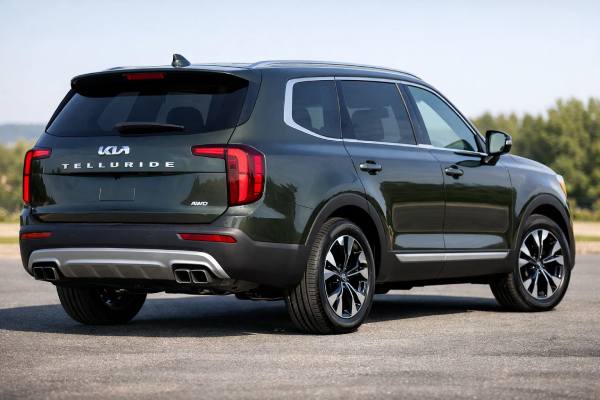
The facelifted Kia Telluride AWD is a large three-row SUV that succeeds by avoiding gimmicks. It uses a naturally aspirated 3.8-litre V6, a conventional 8-speed automatic, and a mechanical all-wheel-drive system rather than a smaller turbo engine or a hybrid setup. That gives it a clear character: smooth, predictable, and easy to understand for long-term owners. The 2023 refresh sharpened the styling, expanded the safety technology, and introduced more off-road-themed X-Line and X-Pro variants, but it did not change the core formula. This is still a family-focused SUV built around passenger comfort, strong packaging, and honest towing ability.
For buyers, the big appeal is balance. The Telluride is roomy, refined enough for long trips, and generally simpler to own than many turbocharged rivals. The main caution is that it is a heavy direct-injection V6 SUV, so fuel use, brake wear, and strict fluid service matter more than the glossy trim names suggest.
Essential Insights
- The AWD Telluride combines real three-row space with a straightforward V6 and conventional automatic transmission.
- X-Line and X-Pro trims add more than appearance, including raised ground clearance, Tow Mode, and self-leveling rear suspension.
- Cabin packaging is one of the strongest points in the class, with useful cargo space even behind the third row.
- The main ownership caveat is not chronic engine weakness, but keeping up with fluids, recalls, and heavy-SUV wear items.
- A practical oil-service interval is every 5,000 to 7,500 miles or 6 to 12 months, depending on towing, short-trip use, and climate.
Section overview
- Kia Telluride ON Facelift Overview
- Kia Telluride ON Specs and Data
- Kia Telluride ON Trims and ADAS
- Trouble Spots and Campaign History
- Service Schedule and Buying Advice
- On-Road Character and Fuel Use
- Telluride AWD Versus Three-Row Rivals
Kia Telluride ON Facelift Overview
The facelifted Telluride arrived for 2023 with a smarter exterior, revised lighting, more standard driver-assistance technology, and a broader trim strategy that split the lineup more clearly into road-focused luxury versions and tougher-looking X-Line and X-Pro variants. Under the skin, though, Kia kept the formula that made the Telluride successful in the first place. It still uses the 3.8-litre GDI V6, still sends power through an 8-speed automatic, and still offers an AWD system with a center-locking function and Snow mode.
That consistency matters, because the Telluride’s appeal has never depended on novelty. It depends on packaging and calibration. This is a big, square-shouldered crossover that uses its wheelbase and cabin height well. Adults fit in the first two rows comfortably, the third row is usable rather than decorative, and cargo space remains strong even when all seats are up. For many families, that matters more than headline speed or clever branding.
The facelift also broadened the vehicle’s personality. Standard AWD Tellurides already offer a solid everyday setup for snow, rain, and long-road stability. X-Line models add slightly more ground clearance, more aggressive approach and departure angles, Tow Mode, and self-leveling rear suspension. X-Pro versions go further with 18-inch wheels, all-terrain tires, and a higher tow rating. Those are real functional changes, not just trim marketing.
The V6 continues to suit the vehicle better than some downsized rivals suit their own platforms. It is not especially exotic, and it does not make the Telluride quick in a sporty sense, but it delivers smooth, linear power in a way that fits a three-row family SUV. That becomes especially valuable when the vehicle is loaded with passengers, luggage, or towing weight. A naturally aspirated V6 also tends to feel less busy than a small turbo four-cylinder when climbing grades or pulling onto fast highways.
The trade-off is predictable. This is a heavy, full-size-feeling crossover with a direct-injection petrol V6. It will not deliver hybrid-like fuel economy, and it puts meaningful load on tyres, brakes, and suspension components over time. Still, for buyers who prefer proven mechanical layouts and easy drivability, that compromise often looks reasonable.
In simple terms, the facelifted AWD Telluride remains one of the clearest examples of a vehicle that understands its job. It is not trying to be sporty, electric, or overly rugged. It is trying to be a roomy, capable, comfortable family SUV, and the facelift improved the details without upsetting the foundation.
Kia Telluride ON Specs and Data
The most useful way to understand the facelifted AWD Telluride is to break it into four areas: the V6 powertrain, the AWD hardware, the physical size, and the trim-dependent towing and off-pavement upgrades. Public Kia U.S. specifications are quite detailed on dimensions and major mechanical figures, while workshop-style fluid data is available through the owner’s documentation.
Powertrain and efficiency
| Item | Specification |
|---|---|
| Code | G6DL 3.8 GDI V6 |
| Engine layout and cylinders | V6, 6 cylinders, DOHC, 4 valves/cyl |
| Bore × stroke | 96.0 × 87.0 mm (3.78 × 3.43 in) |
| Displacement | 3.8 L (3,778 cc) |
| Induction | Naturally aspirated |
| Fuel system | Gasoline direct injection |
| Compression ratio | 13.0:1 |
| Max power | 291 hp (217 kW) @ 6,000 rpm |
| Max torque | 355 Nm (262 lb-ft) @ 5,200 rpm |
| Timing drive | Chain |
| Rated efficiency | Consumer spec pages used here do not publish a full AWD fuel-economy table for every trim |
| Real-world highway @ 120 km/h (75 mph) | Typically about 9.0–10.5 L/100 km (26.1–22.4 mpg US / 31.4–26.9 mpg UK), depending on tires, terrain, weather, and load |
Transmission and driveline
| Item | Specification |
|---|---|
| Transmission | 8-speed automatic |
| Drive type | AWD |
| Differential | On-demand AWD with center-locking function |
| Drive modes | Comfort, Eco, Sport, Smart, Snow |
| Tow-oriented hardware | Tow Mode and self-leveling rear suspension on X-Line and X-Pro |
| Fuel requirement | 87 octane or higher |
Chassis and dimensions
| Item | Specification |
|---|---|
| Suspension, front / rear | MacPherson strut / independent multi-link |
| Steering | Column-mounted electric power steering |
| Brakes | 4-wheel disc brakes |
| Front brake discs | 340 mm (13.4 in) |
| Rear brake discs | 305 mm (12.0 in) |
| Wheels and tyres | 245/60 R18, 245/50 R20, or 245/60 R18 all-terrain on X-Pro |
| Ground clearance | 203 mm (8.0 in) standard AWD; 213 mm (8.4 in) X-Line and X-Pro |
| Approach / departure angles | 17.0° / 22.4° standard; 17.7° / 23.0° X-Line; 17.9° / 23.2° X-Pro |
| Length / Width / Height | 5,001 / 1,989 / 1,760 mm (196.9 / 78.3 / 69.3 in) |
| Height, X-Line / X-Pro | 1,791 mm (70.5 in) |
| Wheelbase | 2,901 mm (114.2 in) |
| Kerb weight | About 1,951–2,052 kg (4,301–4,524 lb), depending on trim and seating |
| GVWR | 2,684 kg (5,917 lb) |
| Fuel tank | 71 L (18.8 US gal / 15.6 UK gal) |
| Cargo volume | 595 / 1,303 / 2,464 L (21 / 46 / 87 ft³), SAE: behind third row / behind second row / maximum |
Performance, fluids, and safety
| Item | Specification |
|---|---|
| 0–100 km/h (0–62 mph) | Kia does not publish an official consumer figure in the cited U.S. material |
| Top speed | Kia does not publish an official consumer figure in the cited U.S. material |
| Braking distance | Kia does not publish a certified consumer figure in the cited U.S. material |
| Towing capacity | 2,268 kg (5,000 lb) standard; 2,495 kg (5,500 lb) X-Pro |
| Payload | About 632–733 kg (1,393–1,616 lb), depending on trim |
| Engine oil | SAE 5W-30 full synthetic; about 6.5 L (6.87 US qt) |
| Coolant | Phosphate-based coolant; about 12.2 L (12.9 US qt) |
| ATF | SP-IV(M1); about 7.0 L (7.4 US qt) |
| Rear differential oil | API GL-5 SAE 75W/85; about 0.7 L (0.74 US qt) |
| Transfer case oil | API GL-5 SAE 75W/85; about 0.7 L (0.74 US qt) |
| Brake fluid | DOT-4 LV; about 0.44–0.48 L |
| A/C refrigerant | Verify by under-bonnet label and VIN before service |
| Key torque specs | Not published in Kia consumer documents; use VIN-specific service data |
| Crash ratings | IIHS Top Safety Pick+ for 2024; Euro NCAP not applicable for this North America-focused model |
| Headlight rating | Good |
| ADAS suite | AEB, ACC, LKA, lane following, blind-spot support, rear cross-traffic support, and more, with trim-dependent expansion |
These numbers show why the Telluride works. It is long, wide, and heavy enough to feel substantial, but the drivetrain and chassis remain conventional enough to keep servicing understandable.
Kia Telluride ON Trims and ADAS
Trim selection matters more on the facelifted Telluride than many buyers expect, because Kia uses trim level not just to change upholstery and wheel size, but also to shape towing hardware, AWD capability, and the depth of the safety tech. For an AWD buyer, the most relevant trims are EX X-Line, EX X-Pro, SX, SX X-Line, SX Prestige, SX Prestige X-Line, and SX Prestige X-Pro, although lower trims can also be configured with AWD in some markets.
The easiest way to understand the ladder is to separate it into three groups.
Regular AWD trims are the mainstream family versions. They deliver the core Telluride experience: V6 power, the 8-speed automatic, large-cabin usability, and strong standard safety content. These are the trims to target if you want the vehicle’s size and comfort without paying for the more rugged visual packages.
X-Line trims are the best balance for many private buyers. They bring AWD-specific visual changes, 20-inch wheels, increased ground clearance, improved approach and departure angles, Tow Mode, and self-leveling rear suspension. That is not serious off-road equipment in the body-on-frame sense, but it does make the Telluride more versatile for bad weather, gravel roads, and family towing duty.
X-Pro trims are the functional peak of the facelift range. They switch to 18-inch wheels with all-terrain tires, keep the raised ride height, add Tow Mode and self-leveling rear suspension, and raise tow capacity to 5,500 lb. They also feel slightly different on the road because the tire package changes steering response, ride texture, and noise behavior.
Quick identifiers help when viewing used vehicles:
- X-Line usually wears 20-inch wheels and a raised stance.
- X-Pro uses 18-inch wheels and all-terrain tires.
- Upper SX and SX Prestige trims are the ones most likely to carry the fullest surround-view, highway-assist, and comfort content.
- Seven-seat layouts with captain’s chairs are common on the richer trims, while some lower versions retain eight-passenger seating.
The ADAS story is one of the Telluride’s strongest points. The facelifted model is very well equipped by class standards. Forward collision avoidance, lane keeping, lane following, blind-spot warning, rear cross-traffic support, rear occupant reminder, and smart cruise functions are either standard or very widely available depending on trim. Higher trims add Highway Driving Assist 2, surround-view monitoring, and more advanced parking assistance.
Safety ratings remain a major selling point. The Telluride earned strong IIHS results in the facelift era, including good scores in the updated moderate-overlap and side tests, good headlight performance, and strong child-seat anchor results. Buyers still need to remember that technology features only help when they are functioning properly. After bumper repair, glass replacement, or front-end work, sensor and camera calibration should be verified, not assumed.
In used-market terms, the sweet spot is usually an EX X-Line or SX AWD if you want the best mix of equipment, simpler tyres, and strong family usability. X-Pro is the right choice if you will really tow, regularly travel on rougher surfaces, or simply prefer the smaller wheel and more compliant tire combination.
Trouble Spots and Campaign History
The facelifted Telluride AWD is generally regarded as a solid large crossover, but it is not maintenance-free, and it is not immune to recalls. The best way to think about reliability is by dividing it into wear-related issues, drivetrain sensitivity, and official campaign history.
Common and low-cost
- Brake wear: This is a heavy three-row SUV, so front pads and rotors can wear earlier than some owners expect, especially in suburban stop-go driving.
- Tyre wear: Twenty-inch wheel packages look good, but they can get expensive quickly if alignment is off or the vehicle spends its life on rough roads.
- Battery-related nuisance faults: Weak 12 V batteries can trigger stop-start complaints, warning messages, and occasional driver-assistance errors before the battery fully dies.
Occasional and medium-cost
- Direct-injection buildup over long mileage: The 3.8 V6 is generally strong, but like other GDI engines it can accumulate intake-valve deposits over time. Symptoms are usually rougher idle, less crisp throttle response, or cold-start unevenness rather than sudden failure.
- Transmission heat and fluid aging under towing: The 8-speed automatic is well matched to the engine, but repeated trailer use, mountain driving, and long fluid intervals can age the transmission faster than light-duty family use.
- Self-leveling rear suspension wear on X-Line and X-Pro: These trims add useful towing and load benefits, but they also add components that should be inspected more carefully as mileage climbs.
Rare but higher-priority
- AWD shaft and spline issues on affected recalled vehicles: One official recall covers 2020–2023 and certain 2024 Tellurides for incomplete engagement between the intermediate shaft and right front driveshaft. The concern is damaged splines and possible vehicle movement while parked if the shaft separates.
- Front power seat motor fire risk on affected vehicles: Another official recall affects certain 2020–2024 models because a stuck seat slide knob can lead to motor overheating and fire risk, even when parked.
Those recall items matter directly for facelift buyers because the 2023 and some 2024 vehicles fall inside the affected ranges. In practical terms, recall completion is not optional paperwork. It is part of the vehicle’s value and safety profile. Buyers should verify completion through a dealer history printout and VIN-based recall check, not just the seller’s word.
Software and calibration issues are also worth mentioning. Upper Tellurides use more driver-assistance tech than older crossovers did, which means software updates, sensor alignment, and clean ADAS health checks matter more. A vehicle with no warning lights can still have stored driver-assistance or parking-system faults if the front bumper, cameras, or radar have been disturbed.
The reliability takeaway is balanced rather than dramatic. The Telluride AWD does not have a reputation for a fatal engine or transmission flaw in this facelift run. Instead, it behaves like a modern heavy family SUV: generally durable, but dependent on good recall follow-through, sensible fluid service, and close inspection of tires, brakes, suspension, and electronics.
Service Schedule and Buying Advice
A Telluride AWD can age very well, but only if owners remember what it is. This is not a light hatchback with low component loads. It is a large, heavy, direct-injection SUV that may tow, carry families, idle in traffic, and spend winters on salted roads. The maintenance plan should reflect that reality.
Practical maintenance schedule
| Item | Sensible interval | Notes |
|---|---|---|
| Engine oil and filter | 5,000–7,500 miles / 6–12 months | Use the shorter interval for short trips, heat, towing, dust, or long idling |
| Engine air filter | Inspect every service; replace about every 20,000–30,000 miles | Earlier in dusty conditions |
| Cabin air filter | Every 15,000–20,000 miles or 12–24 months | Cheap and worth doing regularly |
| Coolant | Inspect yearly; replace by official schedule or sooner if contamination appears | Large cooling system, important on tow vehicles |
| Spark plugs | About every 60,000–90,000 miles | Sooner if drivability declines |
| ATF | Inspect condition regularly; refresh earlier on towing or hard-use vehicles | Conservative service is smart on a heavy SUV |
| Rear differential oil | About every 30,000–60,000 miles depending on use | Shorter interval for towing or rough-road use |
| Transfer case oil | About every 30,000–60,000 miles depending on use | Important on AWD vehicles used in poor weather |
| Brake fluid | Every 2–3 years | Moisture control matters |
| Brake pads and rotors | Inspect at every service | Weight and wheel size accelerate wear |
| Tyre rotation and alignment | Rotate about every 5,000–7,500 miles | Alignment matters especially on 20-inch trims |
| Auxiliary belts and hoses | Inspect from midlife onward | Heat cycles and load matter |
| 12 V battery | Test annually after year four | Replace proactively before winter if weak |
The Telluride’s published fluid capacities help owners budget for full services. The engine takes a healthy amount of oil, the cooling system is large, and the AWD hardware has separate rear differential and transfer case fluids. That makes skipping services look cheap in the short term and expensive later.
For a used Telluride AWD, ask for:
- complete service history, not just oil stickers
- proof that all recall work has been completed
- evidence of recent brake and tyre work
- clean AWD service records if mileage is high
- alignment or suspension inspection if tire wear looks uneven
- ADAS scan results if the vehicle has had bumper or windscreen work
- transmission behavior check during both cold and hot driving
The best-value trims often sit in the middle of the range. EX X-Line is attractive because it adds useful hardware rather than just decoration. SX AWD is a strong road-biased family choice with better tech. X-Pro is worth it only if you truly need the 5,500 lb rating or the all-terrain tyre setup.
The long-term durability outlook is good, provided the vehicle has not been neglected. The V6 and 8-speed automatic are conventional enough to be reassuring, but the mass of the vehicle and the number of electronic systems mean deferred maintenance shows up clearly and usually expensively.
On-Road Character and Fuel Use
On the road, the facelifted Telluride AWD feels exactly like a well-sorted family flagship should. It is not particularly sporty, but it is secure, stable, and easy to drive. The steering is light at parking speeds and calm on the highway, while the long wheelbase helps the vehicle settle into a steady, confident rhythm over broken pavement and expansion joints.
The V6 plays a large role in that refinement. It does not hit like a turbocharged engine, but it builds power smoothly and sounds more natural under load than many downsized rivals. That matters in a three-row SUV because most owners spend more time climbing grades, merging, or overtaking with passengers than they do trying to launch away from traffic lights. The 8-speed automatic also suits the engine well. It is usually unobtrusive, and it lets the Telluride feel more relaxed than some turbo-four competitors that hunt for gears.
Ride and handling depend heavily on trim. Standard AWD trims ride in a composed, family-oriented way. X-Line models stay similar but feel a touch more upright and slightly firmer depending on the tyre package. X-Pro models can actually feel more forgiving on rougher roads because the 18-inch all-terrain setup puts more sidewall between the vehicle and the surface, though they may introduce a little more tread noise.
Braking feel is solid and easy to judge, but this is still a large SUV. Hard repeated stops will expose the mass of the vehicle sooner than in lighter rivals. The same applies to cornering. The Telluride is tidy and confidence-inspiring, yet never tries to disguise its size.
Real-world fuel use is the clearest trade-off:
- City: about 12.5–14.0 L/100 km (18.8–16.8 mpg US / 22.6–20.2 mpg UK)
- Highway at 100–120 km/h: about 8.8–10.2 L/100 km (26.7–23.1 mpg US / 32.1–27.7 mpg UK)
- Mixed: about 10.7–12.4 L/100 km (22.0–19.0 mpg US / 26.4–22.8 mpg UK)
Those are practical expectations, not factory certification figures. Wheel size, tire type, terrain, climate, and speed make a visible difference. X-Pro models with all-terrain tyres generally give away a little efficiency. Short-trip winter use can add another 1.0–1.5 L/100 km.
Towing also changes the equation. The Telluride feels stable and capable with a moderate trailer, especially in X-Line and X-Pro form, but fuel use can rise by 20 to 35 percent depending on speed, grade, and trailer shape. That does not make it a poor tow vehicle. It simply reflects physics.
Overall, the Telluride AWD’s road manners are one of its biggest strengths. It feels mature, unhurried, and well calibrated, which is exactly what many buyers want in a family three-row SUV.
Telluride AWD Versus Three-Row Rivals
The Telluride AWD competes in one of the busiest parts of the market, but it remains easy to understand because it has a clear identity. It is a naturally aspirated V6 crossover with strong space efficiency, a premium-leaning interior, and straightforward family usability. Many rivals now chase efficiency or headline technology harder, but not all of them feel as balanced.
Against the Hyundai Palisade AWD, the comparison is naturally close because the two share core engineering. The Palisade often feels a touch more comfort-first in presentation, while the Telluride tends to look more assertive and a bit more adventurous, especially in X-Line and X-Pro form. The decision often comes down to styling and feature packaging more than mechanics.
Against the Honda Pilot AWD, the Telluride counters with a richer-feeling cabin in many trims and stronger infotainment presentation. The Pilot often feels more traditionally Honda in control weighting and practicality details. The Telluride tends to feel more upscale at first contact, while the Pilot can appeal to buyers who prioritize long-term familiarity and Honda packaging logic.
Against the Toyota Grand Highlander AWD, the Telluride loses out on available hybrid efficiency and, in some versions, ultimate fuel economy. It wins back ground with a more settled premium feel, a smoother V6 character than a turbo-four, and stronger trim identity.
Against the Mazda CX-90 AWD, the Telluride looks less ambitious on paper. The Mazda offers more technical drama, especially in higher-output powertrains and chassis tuning. The Kia responds with easier packaging, softer family-friendly behavior, and less of a learning curve for the average owner.
Where the Telluride AWD wins most clearly:
- genuinely usable three-row and cargo packaging
- smooth V6 drivability
- strong standard and available safety tech
- meaningful X-Line and X-Pro hardware differences
- a premium feel without luxury-brand ownership costs
Where it gives ground:
- fuel economy is average at best for today’s market
- 20-inch trims can be more expensive on tyres and brakes
- it is large and heavy, so upkeep is never cheap in the long term
- current and future rivals increasingly lean on hybrid efficiency
The final verdict is simple. The facelifted Telluride AWD is not the most advanced three-row crossover on paper, but it remains one of the easiest to recommend in the real world. It combines honest mechanicals, strong cabin usability, and confident road manners in a way that continues to make sense for family buyers who want substance more than novelty.
References
- 2024 Kia Telluride | Mid-Size SUV – Specs, Features & Trims | Kia 2024 (Technical Specifications)
- Recommended lubricants and capacities 2024 (Owner’s Manual)
- 2024 Kia Telluride 2024 (Safety Rating)
- Part 573 Safety Recall Report 24V-214 2024 (Recall Database)
- Part 573 Safety Recall Report 24V-407 2024 (Recall Database)
Disclaimer
This article is for informational purposes only and is not a substitute for professional diagnosis, repair, or VIN-specific service guidance. Specifications, torque values, maintenance intervals, procedures, recall applicability, and equipment can vary by model year, trim, market, and vehicle identification number, so always verify details against official Kia service documentation for the exact vehicle.
If this guide helped you, please consider sharing it on Facebook, X, or another social platform to support our work.