
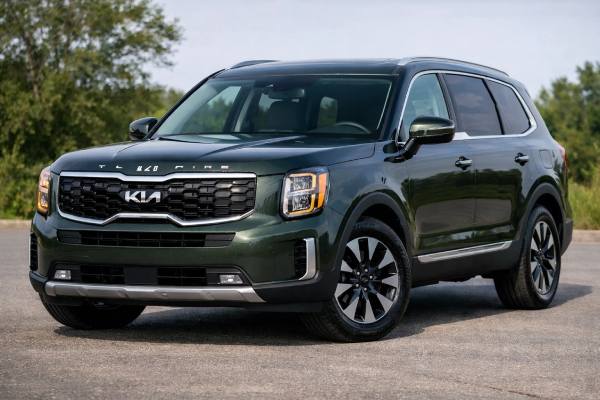
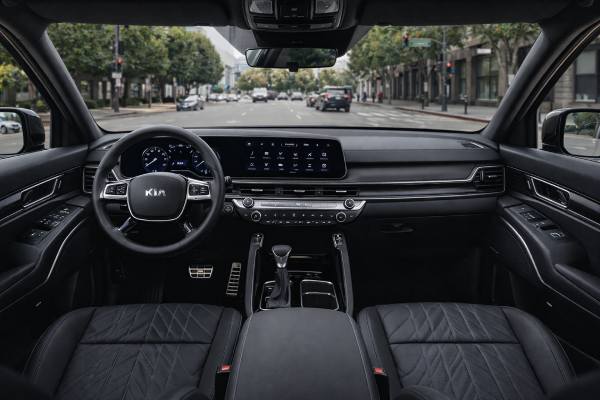
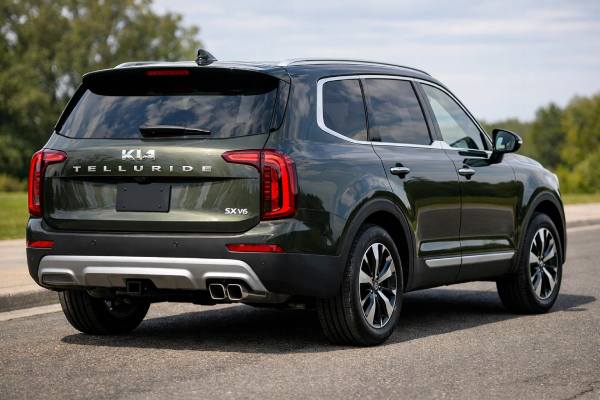
The facelifted Kia Telluride FWD from 2023 onward keeps the formula that made the original SUV so popular, but it sharpens the details that matter most to everyday owners. You still get the 3.8-litre G6DL V6, a conventional 8-speed automatic, and a roomy three-row body with strong towing ability. What changes after the facelift is the polish: a cleaner front-end design, updated digital displays, broader driver-assistance coverage, and a more cohesive trim structure. In front-wheel-drive form, the Telluride also makes a strong practical case. It is lighter, a little cheaper to run than AWD, and mechanically simpler because it avoids rear driveline hardware. That matters if your use is mostly paved-road commuting, family travel, and occasional towing rather than winter-heavy or off-pavement driving. The trade-off is simple too. You give up the extra traction and some trim choices, but you keep most of the Telluride’s comfort, space, and road-trip ease.
At a Glance
- Smooth V6 power and a conventional 8-speed automatic make this one of the easier large crossovers to live with long term.
- FWD keeps weight, tyre wear, and driveline complexity lower than AWD while preserving the same basic cabin and towing strengths.
- The facelift adds better screens, broader active-safety coverage, and a more upscale feel without changing the core powertrain.
- Verify recall completion carefully, especially on 2024 and 2025 examples with power-seat or exterior-trim campaign exposure.
- A sensible baseline is engine oil service every 8,000 miles or 12 months, with shorter intervals for towing, heavy idling, or repeated short trips.
Contents and shortcuts
- Telluride FWD facelift profile
- Telluride FWD spec sheet
- Telluride FWD grades and assist tech
- Trouble spots and recall watch
- Upkeep plan and used-buy checks
- Road manners and fuel use
- How FWD Telluride stacks up
Telluride FWD facelift profile
The facelifted Telluride did not reinvent the SUV. It refined it. That is exactly why the 2023-on front-wheel-drive version deserves attention. Kia kept the naturally aspirated 3.8-litre Lambda-II V6, the torque-converter 8-speed automatic, and the same broad cabin layout, but it updated the body, lighting, dashboard, infotainment, and trim logic. For buyers who liked the original Telluride because it felt roomy and mature rather than experimental, that was the right move.
In FWD form, the Telluride is the cleanest expression of the platform. You avoid the extra weight, extra service points, and extra cost of the active AWD system, rear differential, and transfer case. In return, you keep the same V6 output, the same core towing rating on standard trims, and the same generous interior volume. For buyers in warmer climates or those who spend almost all of their time on pavement, that matters. FWD is not only cheaper at purchase. It is also simpler to maintain over the long haul.
The facelift also changed how the lineup is organized. The FWD Telluride sits in the mainstream part of the range: LX, S, EX, and SX. If you want X-Line or X-Pro, you move into AWD territory. That makes the FWD model easier to define. It is the comfort and family-use Telluride, not the tougher-looking version with extra ground clearance and trail-themed branding. For many owners, that is a benefit. It keeps the vehicle focused on what it already does well: carrying people, luggage, and occasional trailer loads in a quiet, confident way.
The engineering story is equally straightforward. Kia’s G6DL V6 is a direct-injection engine with a timing chain, dual overhead cams, and 291 hp. It is not a high-strung motor. Peak torque arrives relatively high in the rev range, so the Telluride does not punch like a turbocharged rival at 1,500 rpm. Instead, it builds speed smoothly and predictably. Paired with the 8-speed automatic, that character suits family use well. The transmission does not hunt constantly, and the engine rarely feels stressed in normal driving.
The facelift’s biggest real-world gain is not horsepower. It is polish. Kia introduced the larger dual-screen display layout, improved convenience tech, and on later trims a more sophisticated Highway Driving Assist setup. At the same time, the updated body structure and safety equipment kept the Telluride current in crash testing. So although the drivetrain is mechanically familiar, the vehicle around it feels more modern. That is why the facelifted FWD version works so well in the used market: it gives you a current-looking, family-sized SUV without demanding AWD complexity you may never actually use.
Telluride FWD spec sheet
The table below focuses on the facelifted 2023–2025 front-wheel-drive Telluride, which is the currently documented facelift-era FWD configuration before the next-generation 2027 model transition. Numbers can vary slightly by trim, seating layout, roof equipment, and wheel size, so the most relevant FWD values are shown as single figures or tight ranges where necessary.
Powertrain and efficiency
| Item | Kia Telluride FWD facelift |
|---|---|
| Code | G6DL |
| Engine layout and cylinders | V6, 6 cylinders, DOHC, 4 valves per cylinder |
| Bore × stroke | 96.0 × 87.0 mm (3.78 × 3.43 in) |
| Displacement | 3.8 L (3,778 cc) |
| Induction | Naturally aspirated |
| Fuel system | Gasoline direct injection |
| Compression ratio | 13.0:1 |
| Max power | 291 hp (217 kW) @ 6,000 rpm |
| Max torque | 355 Nm (262 lb-ft) @ 5,200 rpm |
| Timing drive | Chain |
| Rated efficiency | 10.7 / 9.0 / 10.2 L/100 km city/highway/combined (20 / 26 / 22 mpg US) |
| Real-world highway @ 120 km/h (75 mph) | Usually about 9.4–10.8 L/100 km, depending on speed, tyre size, load, temperature, and terrain |
Transmission and driveline
| Item | Kia Telluride FWD facelift |
|---|---|
| Transmission | 8-speed automatic |
| First gear | 4.808:1 |
| Final drive | 3.510:1 |
| Clutch type | Torque converter |
| Drive type | FWD |
| Differential | Open |
Chassis and dimensions
| Item | Kia Telluride FWD facelift |
|---|---|
| Suspension, front | Independent MacPherson struts, coil springs, stabilizer bar |
| Suspension, rear | Independent multi-link, stabilizer bar |
| Steering | Column-mounted motor-driven power steering |
| Steering ratio | 15.6:1 |
| Brakes | 13.4 in front vented discs / 12.0 in rear solid discs |
| Wheels and tyres | 245/60 R18 or 245/50 R20 |
| Ground clearance | 203 mm (8.0 in) |
| Approach / departure angles | 17.0° / 22.4° |
| Length | 5,001 mm (196.9 in) |
| Width | 1,989 mm (78.3 in) |
| Height | 1,750 mm (68.9 in) without roof rails / 1,760 mm (69.3 in) with rails |
| Wheelbase | 2,901 mm (114.2 in) |
| Turning circle, kerb-to-kerb | About 11.8 m (38.8 ft) |
| Kerb weight | About 1,875–1,987 kg (4,134–4,381 lb) |
| GVWR | 2,620 kg (5,776 lb) |
| Fuel tank | 71 L (18.75 US gal / 15.6 UK gal) |
| Cargo volume | 595 / 1,303 / 2,464 L (21.0 / 46.0 / 87.0 ft³), SAE |
Performance and capability
| Item | Kia Telluride FWD facelift |
|---|---|
| 0–100 km/h | Kia does not publish an official figure; real-world testing is usually in the low-7-second range |
| Top speed | Not officially published by Kia for U.S.-market Telluride |
| Braking distance | Not officially published by Kia |
| Towing capacity | 2,268 kg (5,000 lb) braked |
| Payload | Usually about 630–700 kg (1,390–1,540 lb), depending on trim and seating configuration |
Fluids and service capacities
| Item | Specification |
|---|---|
| Engine oil | Full synthetic SAE 5W-30, ACEA A5/B5; 6.5 L (6.87 US qt) |
| Coolant | Ethylene-glycol based coolant for aluminium radiator; approx. 12.2 L (12.9 US qt) |
| Transmission fluid | ATF SP-IV(M1); 7.0 L (7.4 US qt) |
| Differential / transfer case | Not applicable on FWD |
| Brake fluid | SAE J1704 DOT-4 LV / ISO 4925 Class-6 / FMVSS 116 DOT-4; 0.44–0.48 L |
| A/C refrigerant | R-1234yf; 950 ±25 g (33.5 ±0.9 oz) |
| A/C compressor oil | FD46XG; 210 ±10 g (7.4 ±0.35 oz by listed service spec) |
| Key torque specs | Confirm by VIN-specific service literature before repair |
Safety and driver assistance
| Item | Kia Telluride FWD facelift context |
|---|---|
| IIHS crash ratings | Good in small overlap, updated moderate overlap, and updated side testing for facelift-era coverage |
| Headlight rating | Good |
| Child-seat anchor ease | Good |
| ADAS suite | Standard blind-spot warning, forward collision avoidance, lane following, lane keeping, smart cruise, rear cross-traffic assist, and more; HDA 1.5 or HDA 2.0 depends on trim |
What stands out here is not a wild power figure. It is how complete the hardware package is for a mainstream three-row crossover. The Telluride FWD keeps strong towing ability, useful economy for its size, and one of the better cabin-volume figures in the class.
Telluride FWD grades and assist tech
The facelifted FWD Telluride lives in four main trims: LX, S, EX, and SX. That matters because the FWD version is not available across the entire Telluride range. Kia reserves the X-Line and X-Pro identity for AWD models, so FWD buyers are shopping the mainstream family side of the lineup rather than the rugged-styled branch. In practice, that is not much of a loss unless you specifically want the lifted look, extra ground clearance, or the X-Pro’s higher tow rating.
The LX FWD is the simple choice. It rides on 18-inch wheels, comes with eight-passenger seating, and keeps the Telluride’s core strengths intact: space, comfort, and broad safety equipment. For many buyers, this is the smartest used buy because the smaller wheels help ride quality and tyre cost, and the trim avoids some of the more expensive high-end equipment that can age badly.
The S FWD adds style, usually with 20-inch wheels and more visual presence. It looks sharper than the LX, but that comes with firmer ride quality and pricier tyres. The EX FWD is often the real family sweet spot. It adds the features most owners actually use every day, such as richer interior trim, more convenience tech, power-folding mirrors, and a broader comfort package. The SX FWD is the luxury-leaning version of the front-drive lineup. It brings the bigger camera and monitoring suite, more advanced Highway Driving Assist, richer interior trim, and on the facelift model, self-leveling rear suspension.
That last point is important. On the facelift Telluride, self-leveling rear suspension is not only an AWD feature. It appears higher in the trim ladder, including SX FWD. That helps towing stability and load control, but it also creates an inspection point when buying used, because any advanced rear-suspension hardware is more expensive than a plain passive setup.
Safety technology is one of the Telluride’s strongest selling points. Kia’s 2025 feature sheet shows that blind-spot warning, forward collision avoidance with pedestrian and cyclist detection, junction-turning assistance, lane-following assist, lane-keeping assist, rear cross-traffic avoidance, smart cruise control with stop and go, and rear occupant alert are standard across the range. That is unusually broad coverage for a non-luxury three-row SUV. It means even a basic LX does not feel stripped in safety terms.
Higher trims add more sophisticated versions of the same theme. The SX and above bring Highway Driving Assist 2.0 instead of HDA 1.5, plus extra camera-based support systems such as Blind-Spot View Monitor, Surround View Monitor, forward parking-distance warning, rear parking-collision avoidance, and machine-learning smart cruise control. Those systems raise the convenience ceiling, but they also raise repair and calibration cost after bumper, mirror, windshield, or front-end work.
The facelift itself also matters in safety terms. IIHS notes that beginning with 2023 models, the Telluride received structural reinforcements plus front and rear side-airbag improvements for better side-impact performance. That makes the facelift more than cosmetic. It is the point where the Telluride’s already strong safety case became materially stronger.
Trouble spots and recall watch
The facelifted FWD Telluride has a relatively reassuring mechanical profile. There is no widespread public evidence that the G6DL 3.8 V6 or the 8-speed automatic suffers from a model-defining failure pattern in 2023–2025 form. That is a strong starting point. The bigger ownership story is campaign control, trim-related equipment complexity, and the usual stress points that show up when a large family SUV is used as intended.
Common, low to medium cost
- Tyres and brake wear: A heavy, front-driven three-row SUV wears front consumables faster than a smaller crossover. On 20-inch trims, that is more noticeable. Cheap replacement tyres make the Telluride noisier, harsher, and less precise.
- Battery and software-related nuisance behavior: Vehicles with heavy short-trip use, lots of power-seat operation, or repeated remote-function use can develop low-voltage battery complaints sooner than simpler vehicles. This is not unique to Telluride, but it matters more on sensor-heavy higher trims.
- Trim and cosmetic wear: Door trim, seat-side plastics, and glossy interior surfaces can age faster in family use than the underlying mechanical parts.
Occasional, medium cost
- Self-leveling rear suspension noise or wear on higher trims: FWD SX models can include self-leveling rear suspension. It is useful, especially with passengers or luggage, but it is a clear inspection point on used examples.
- ADAS calibration after repair: The facelift Telluride carries more radar, camera, and parking-assist hardware than the early model. After even modest body repair, poor calibration or cheap replacement work can leave warnings or odd system behavior.
Recall items that deserve real attention
- Front power seat motor fire-risk recall: A major recall covering 2020–2024 Tellurides warns that a stuck power-seat slide knob can overheat the seat motor. This is highly relevant to facelift 2023–2024 vehicles.
- 2025 front seatback recliner recall: In February 2026, Kia filed a recall for certain 2025 Tellurides with power front seats because improperly manufactured seatback recliners may not adequately restrain occupants in certain rear impacts.
- 2025 door-belt molding face-plate recall: Certain 2025 vehicles were recalled because exterior belt molding face plates could separate. It is not a powertrain issue, but it is still an official safety campaign and a sign that buyers should check VIN history carefully.
There is also a quiet advantage to the FWD Telluride in this section: it avoids AWD-specific service points and AWD-specific driveline complaints. No rear differential, no transfer case, and no need to worry about torque-coupling behavior or AWD vibration diagnosis. That alone makes the front-drive model easier to recommend to buyers who plan to keep the vehicle for a long time and use it mostly on paved roads.
From a reliability standpoint, the key pattern is clear. The Telluride FWD is not a fragile SUV. But it is a modern, feature-rich one. A neglected example with missing campaign history is far riskier than a plain-looking vehicle with complete records and boring maintenance receipts. That is the difference that matters most.
Upkeep plan and used-buy checks
The best maintenance strategy for a Telluride FWD is not complicated. It is simply more conservative than the marketing story. This is a large V6 crossover that often carries families, luggage, and sometimes trailers. That means fluid quality and inspection discipline matter more than stretching every service interval to its absolute limit.
A practical owner-focused schedule looks like this:
| Item | Practical interval |
|---|---|
| Engine oil and filter | Every 8,000 miles or 12 months normal use; shorten to 5,000–6,000 miles for towing, heat, idling, or repeated short trips |
| Tyre rotation | Every oil service |
| Engine air filter | Inspect every service; replace around 30,000 miles or sooner in dusty conditions |
| Cabin air filter | Replace every 12–24 months |
| Brake fluid | Inspect annually; replace about every 3 years as a practical real-world interval |
| Spark plugs | Inspect by schedule; many owners plan replacement around 90,000–100,000 miles |
| Coolant | Check level and condition regularly; follow the owner’s manual for long-life coolant replacement timing |
| Automatic transmission fluid | Not a casual “lifetime” fluid if the vehicle tows; consider preventive service in the 60,000–80,000 mile range for severe use |
| Accessory belts and hoses | Inspect regularly after year five |
| Brake pads and rotors | Inspect every service |
| Suspension and steering | Inspect at every tyre rotation once mileage climbs |
| 12 V battery | Test annually after the first three years |
For this FWD model, the fluid list is straightforward. Engine oil is full synthetic SAE 5W-30, with a 6.5-litre drain-and-refill capacity. Automatic transmission fluid is ATF SP-IV(M1), with a 7.0-litre capacity. Brake fluid is DOT 4 LV, and coolant capacity is about 12.2 litres. Because this is FWD, you do not have rear-differential or transfer-case service to budget for, which is a meaningful long-term cost advantage over AWD.
Timing components also deserve a realistic note. The 3.8 V6 uses a chain, not a belt. That means there is no routine timing-belt replacement interval to budget for. It does not mean the system should be ignored forever. On very high-mileage, poorly serviced engines, chain noise, tensioner wear, or timing-correlation faults are still possible. Clean oil and sensible intervals remain the best prevention.
For buyers, use this checklist:
- Verify all open recalls and service actions by VIN.
- Confirm the vehicle has correct tyre sizes and a matched tyre set.
- Test every seat function, especially on 2024 and 2025 vehicles with power seats.
- Check for suspension noise, especially on SX trims with self-leveling rear suspension.
- Make sure every ADAS feature initializes normally with no warnings.
- Inspect the liftgate, parking sensors, camera system, and infotainment screen carefully.
- Look under the front bumper and underbody for curb or parking damage, which can affect alignments and sensors.
- Ask whether the vehicle has towed and whether transmission service was ever done.
The best used facelift FWD Telluride is usually an EX or LX with clean records and sensible wheels. The worst is the fancy one with missing campaign work, mixed tyres, and unexplained warning messages.
Road manners and fuel use
The Telluride FWD drives the way a large family SUV should. It is calm, predictable, and easy to settle into for long trips. That is its main virtue. The 3.8-litre V6 does not hit like a turbocharged six-cylinder substitute, but it is smooth and progressive, and that matters more in a three-row crossover than drama does.
Around town, the throttle is clean and linear. Because torque peaks relatively high, the V6 does not feel as instantly punchy at very low rpm as some turbo-four rivals. But it also avoids the elastic, on-off feeling that some smaller turbo engines can produce in a heavy vehicle. Once moving, the Telluride feels more relaxed than its size suggests. The 8-speed automatic helps by shifting unobtrusively and not overreacting to every small pedal input.
Ride quality is one of the Telluride’s strongest cards, especially on 18-inch-wheel versions. LX FWD cars in particular tend to be the most comfortable because they combine the lighter front-drive setup with taller tyre sidewalls. S, EX, and SX trims on 20-inch wheels still ride well by class standards, but you notice more sharp-edged impacts and more tyre-generated noise over broken surfaces.
Handling is tidy rather than sporty. The steering is light, accurate, and well suited to parking and highway cruising, but it does not offer much genuine feedback. In a vehicle of this size, that is acceptable. The Telluride’s body control is stable, and its long wheelbase helps it feel settled on sweeping roads. FWD also gives it a slightly simpler, lighter nose than AWD, though the difference is not dramatic from behind the wheel.
Noise control is strong for the class. Wind and tyre noise are present at highway pace, but the Telluride still feels mature and well insulated. This is one reason it remains attractive in the used market. Even after a few years, a good one still feels like a bigger, more expensive SUV than its price would suggest.
Fuel economy is the obvious compromise. Official FWD numbers of 20 / 26 / 22 mpg US are decent for a naturally aspirated three-row V6, but no one should buy this Telluride for thrift. In real use, city driving often lands closer to 12–13 L/100 km, while steady highway runs can sit near 9.5–10.5 L/100 km. Mixed family use usually falls around 10.5–12.0 L/100 km depending on climate, speed, and wheel size. Winter, short trips, and 20-inch tyres all move consumption upward.
Towing remains a real strength even in FWD form. A 5,000 lb rating is not marketing fluff. The Telluride can handle a useful trailer, small camper, or boat properly, though traction on steep wet ramps is naturally better in AWD. Under tow, expect fuel use to climb by about 25–40 percent depending on speed and terrain. The chassis remains composed, but the right tyre condition and trailer setup matter.
How FWD Telluride stacks up
The FWD Telluride sits in an interesting place among mainstream three-row SUVs because it takes a now-uncommon route: a big naturally aspirated V6, a conventional automatic, and front-wheel drive. That gives it a clear identity against key rivals.
Against the Toyota Highlander, the Telluride wins on third-row room, overall cabin openness, and the premium feel of its interior layout. The Toyota counters with stronger efficiency in hybrid form and a more conservative reputation. If you want the most efficient family hauler, the Highlander Hybrid makes more sense. If you want a roomier and more relaxed-feeling V6 crossover, the Telluride is the better answer.
Against the Honda Pilot, the Kia feels more upscale inside and often more substantial on the highway. The Pilot is practical and easy to recommend, but the Telluride generally feels richer in presentation. The Pilot’s AWD TrailSport story is stronger if you want rough-road confidence. For a mostly paved-road family SUV, the Telluride FWD often feels like the more refined package.
Against the Mazda CX-90, the Kia plays a different game. The Mazda is more ambitious dynamically and more premium-leaning in design. But the Telluride is usually easier to understand as a family tool. It offers a simpler powertrain story, more straightforward packaging, and a more relaxed large-SUV character. Buyers who want sharper steering may prefer the Mazda. Buyers who want a comfortable, simple-feeling family vehicle often land with the Kia.
Against the Hyundai Palisade, the Telluride is effectively choosing style and trim tuning over shared fundamentals. The Palisade often leans softer and more comfort-first, while the Telluride feels a little more rugged and confident in design. Mechanically they are close, so the decision usually comes down to trim content, condition, and personal taste.
The real competitor to the FWD Telluride may be the AWD Telluride sitting next to it on a used lot. Here the decision is simpler than many buyers expect. Choose FWD if you live in a mild climate, want lower service complexity, and spend nearly all of your time on paved roads. Choose AWD if you regularly face snow, slick ramps, mountain trips, or just want the added security. The FWD model gives up traction and the X-Line/X-Pro trims, but it keeps nearly everything most owners actually love about the Telluride.
That is why the facelift FWD version works so well. It trims away the parts some owners do not need, while preserving the space, comfort, and mature road manners that made the Telluride successful in the first place.
References
- 2025 Telluride – Specifications 2024 (Specifications)
- 2025 Telluride – Features & Options 2024 (Features and Options)
- 2023 Telluride – Overview 2022 (Model Overview)
- 2025 Kia Telluride 2025 (Safety Rating)
- Part 573 Safety Recall Report 26V105 2026 (Recall Report)
Disclaimer
This article is for informational purposes only and is not a substitute for professional diagnosis or repair. Specifications, torque values, service intervals, capacities, procedures, and equipment can vary by VIN, trim, model year, market, and running production changes, so always verify final details against the official Kia service documentation for your exact vehicle.
If this guide helped you, please consider sharing it on Facebook, X, or your preferred platform to support our work.