
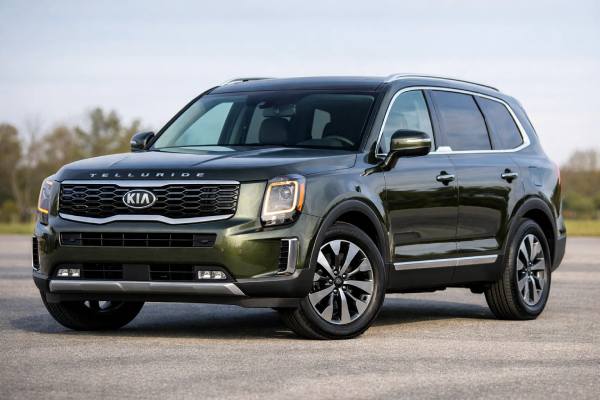
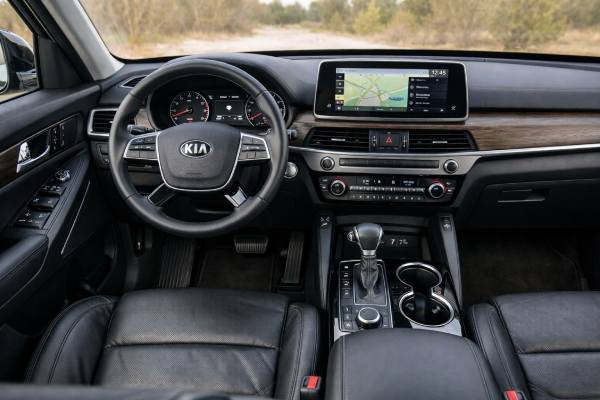
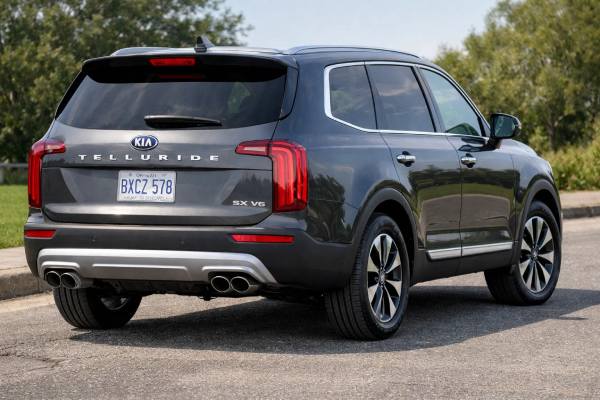
The 2020–2022 Kia Telluride FWD is one of those rare large family SUVs that feels straightforward for the right reasons. Its formula is simple: a naturally aspirated 3.8-liter V6, a conventional 8-speed automatic, front-wheel drive, and a roomy three-row body designed around real passenger and cargo needs. That combination matters. It gives the Telluride smooth throttle response, predictable low-speed behavior, and less drivetrain complexity than many turbocharged or partially electrified rivals from the same period. In FWD form, it is also the lightest and most efficient Telluride configuration, which makes it especially appealing for buyers who do not need extra winter traction. The wide cabin, adult-friendly second row, useful third row, and strong towing capacity all support the family-SUV brief. The main cautions are easy to understand: fuel economy is still average for a big V6, trim differences matter, and recall completion should be verified before purchase.
Quick Specs and Notes
- The FWD Telluride is lighter and more efficient than the AWD version while keeping the same 291 hp V6 and 8-speed automatic.
- Three-row space is a real strength, with 21.0 ft³ behind the third row and 87.0 ft³ with the rear seats folded.
- Standard safety equipment is strong, and 2022 models widened access to Highway Driving Assist and the 10.25-inch navigation screen.
- Recall and campaign history matters, especially for FCA software updates and driveshaft-related repair verification.
- A sensible service routine is every 7,500 miles or 12 months, with shorter oil intervals for towing, heat, or repeated short trips.
Contents and shortcuts
- Kia Telluride FWD Overview
- Kia Telluride FWD Specs and Numbers
- Kia Telluride FWD Grades and Safety
- Reliability, Faults and Campaigns
- Maintenance Schedule and Buyer Checks
- Ride, Power and Real Economy
- How It Stacks Up
Kia Telluride FWD Overview
The front-wheel-drive Telluride is the version that best explains why this model became so popular so quickly. It keeps the big, square-shouldered three-row body and the strong standard equipment list, but avoids the extra hardware, weight, and slight fuel-economy penalty of the AWD system. For owners in warm or moderate climates, that matters. It means fewer driveline components, slightly lower curb weight, and a cleaner value proposition without giving up the core features that make the Telluride attractive. Kia’s own model data shows the same 291 hp and 262 lb-ft output in both FWD and AWD, so the FWD model does not feel like the compromise powertrain. It is simply the simpler drivetrain choice.
That powertrain is part of the Telluride’s charm. The 3.8-liter G6DL V6 is naturally aspirated, so it delivers power in a smooth, linear way that suits a large family SUV. There is no turbo lag to mask, and the 8-speed torque-converter automatic is easier to live with in traffic, parking maneuvers, and towing than some smaller turbo engines paired with more aggressive shift logic. The Telluride does not try to be sporty. Instead, it aims for smooth, confident, low-stress driving, and that is exactly what most buyers in this class want.
Packaging is another reason the FWD Telluride works so well. The cabin is wide enough for real three-row family use, and the cargo area remains useful even with all seats in place. Behind the third row, there is 21.0 cubic feet of space. Fold the rear rows and that expands to 87.0 cubic feet. Those are not inflated-looking numbers that disappear in real life. They translate into practical advantages: stroller space without removing the third row, better airport-trip utility, and more flexibility for large family loads. The broad cabin also helps with shoulder room, which is one reason the Telluride feels larger inside than some rivals with similar outside dimensions.
The FWD version also sharpens the Telluride’s family-road bias. This is not the configuration to buy for mountain cabins, regular snow duty, or muddy trails. But if the vehicle’s main work is commuting, school runs, highway travel, and long family trips, FWD is the cleanest fit. It gives you the same body, same V6, same tow rating, and same strong safety base with slightly better EPA numbers and less mechanical complication. That is why the FWD Telluride often makes more sense than buyers expect. In the right environment, it is not the lesser Telluride. It is the most efficient, most straightforward version of the core idea.
Kia Telluride FWD Specs and Numbers
The 2020–2022 Telluride changed very little mechanically, which is good news for used buyers. The FWD versions across LX, S, EX, and SX trims kept the same engine, transmission, basic chassis layout, and core dimensional package. The most meaningful differences come from trim, seating layout, wheel size, and equipment, not from the engine itself. The figures below focus on the front-wheel-drive North American Telluride.
| Item | Kia Telluride FWD 2020–2022 |
|---|---|
| Engine code | G6DL |
| Engine family | Lambda II 3.8 GDI |
| Engine layout | V6, DOHC, 4 valves per cylinder |
| Cylinders | 6 |
| Bore × stroke | 96.0 × 87.0 mm (3.78 × 3.43 in) |
| Displacement | 3.8 L (3,778 cc) |
| Induction | Naturally aspirated |
| Fuel system | Gasoline direct injection |
| Compression ratio | 13.0:1 |
| Max power | 291 hp (217 kW) @ 6,000 rpm |
| Max torque | 355 Nm (262 lb-ft) @ 5,200 rpm |
| Timing drive | Chain |
| Rated efficiency | 10.2 / 9.0 / 12.4 L/100 km city / highway / combined equivalent from 20 / 26 / 23 mpg US |
| Real-world highway at 120 km/h | About 8.8–10.0 L/100 km in good conditions |
| Item | Transmission and Driveline |
|---|---|
| Transmission | 8-speed automatic |
| First gear | 4.808:1 |
| Final drive | 3.648:1 |
| Drive type | FWD |
| Differential | Open front differential |
| Drive modes | Comfort, Eco, Sport, Smart |
| Item | Chassis and Dimensions |
|---|---|
| Front suspension | Independent MacPherson strut, coil springs, stabilizer bar |
| Rear suspension | Independent multi-link, stabilizer bar |
| Steering | C-MDPS electric power steering |
| Steering ratio | 15.6:1 |
| Brakes | 340 mm (13.4 in) vented front / 305 mm (12.0 in) solid rear |
| Most common tyre sizes | P245/60 R18 or P245/50 R20 |
| Ground clearance | 203 mm (8.0 in) |
| Approach / departure angle | 17.0° / 20.9° |
| Length / width / height | 5,001 / 1,989 / 1,750 mm (196.9 / 78.3 / 68.9 in) without roof rails |
| Wheelbase | 2,900 mm (114.2 in) |
| Turning circle | About 11.8 m (38.8 ft) curb-to-curb |
| Kerb weight | About 1,865–1,958 kg (4,112–4,317 lb), trim dependent |
| GVWR | 2,530–2,620 kg (5,578–5,776 lb), seating and trim dependent |
| Fuel tank | 71.2 L (18.8 US gal / 15.7 UK gal) |
| Cargo volume | 595 / 1,303 / 2,464 L (21.0 / 46.0 / 87.0 ft³), SAE |
| Item | Performance and Capability |
|---|---|
| 0–100 km/h | Typically high-7-second range in instrumented tests |
| Top speed | Kia did not emphasize a U.S. top-speed figure in the sources reviewed |
| Towing capacity | 2,268 kg (5,000 lb) |
| Payload | Verify by door sticker, trim, and seating configuration |
| Item | Fluids and Service Notes |
|---|---|
| Engine oil | Full synthetic SAE 5W-30; capacity should be verified by VIN and manual before service |
| Coolant | Aluminum-safe ethylene glycol type; verify by VIN |
| Automatic transmission fluid | Kia-approved fluid for the 8-speed automatic; verify by VIN |
| Brake fluid | DOT 4 class fluid |
| A/C refrigerant | R-1234yf |
| Critical torque values | Verify against VIN-specific service documentation before repair |
| Item | Safety and ADAS |
|---|---|
| Euro NCAP | Not applicable |
| IIHS | Top Safety Pick for 2022 with specific headlights |
| Headlight rating | Trim dependent |
| Standard ADAS spread | FCA, LKA, LFA, BCA-R, RCCA, SCC with Stop & Go, and more, trim/year dependent |
These numbers are grounded in Kia’s official 2022 Telluride specification and feature sheets. The one important practical note is that several workshop figures, especially fluid capacities beyond fuel tank volume, should still be checked by VIN because U.S. open spec pages do not serve as full service manuals.
Kia Telluride FWD Grades and Safety
The Telluride’s trim structure looks simple on paper, but in real ownership terms it changes the vehicle a lot. LX, S, EX, and SX all get the same V6 and 8-speed automatic, and FWD was offered across the full trim walk. That means buyers are not choosing a different mechanical identity so much as a different equipment level and, sometimes, a different seating layout. For most people, that is actually a better situation than a powertrain-heavy range. It makes the used-buying decision more about priorities and less about chasing a rare engine or gearbox.
LX is the honest entry point. It delivers the Telluride’s core virtues: real three-row space, strong safety equipment, 18-inch wheels, an 8-passenger layout, and the same V6 drivetrain as the rest of the range. S adds visual punch, usually with 20-inch wheels and a more style-led look. EX is where the Telluride starts to feel noticeably more complete, thanks to features like leather trim, more comfort equipment, and stronger convenience content. SX is the fully loaded choice, adding the most upscale lighting, audio, display, and camera options. In practice, EX is often the most rational used buy, while SX is the one to choose if lighting quality, parking technology, and premium cabin details matter more than price discipline.
The 2022 model year is especially important. Kia expanded the larger 10.25-inch navigation display and Highway Driving Assist across more of the range, and the press release for 2022 specifically notes those features reaching LX and S trims, along with Navigation Based Smart Cruise Control-Curve across all trims. That matters in the used market because a 2022 LX or S can feel more complete and easier to recommend than an earlier version with a similar badge. It is one of those cases where the model year matters nearly as much as the trim name.
Safety is one of the Telluride’s strongest selling points, but it still needs nuance. Kia made a lot of advanced driver-assistance tech standard early, including forward collision avoidance, lane-keeping assist, lane-following assist, blind-spot collision-avoidance assist rear, rear cross-traffic collision-avoidance assist, smart cruise control with stop and go, and Safe Exit Assist. That base safety spread is stronger than many rivals from the same years. However, headlights and some convenience-linked safety aids vary by trim. IIHS gave the 2022 Telluride Top Safety Pick status, but only with specific headlights, so the exact trim still matters if nighttime driving is high on your list. IIHS also notes a mixed result in the updated side test, which is worth knowing because it keeps the safety picture honest rather than blindly celebratory.
For buyers, the practical conclusion is clear. The Telluride is broadly well equipped, but not every FWD example is equally desirable. A clean 2022 EX FWD often lands in the sweet spot. It usually offers the equipment most owners actually use, avoids some of the entry-trim compromises, and does not command the same premium as a top SX.
Reliability, Faults and Campaigns
The Telluride FWD benefits from having the least complicated drivetrain in the range. There is no rear driveline to maintain, no transfer case, and no extra coupling hardware. That does not make it trouble-free, but it does simplify the ownership picture. Most Tellurides that feel dependable long term do so for the same reason: the core hardware is conventional, well matched to the vehicle, and not highly stressed. The V6 does not rely on boost to move a large body, and the 8-speed automatic is a normal torque-converter unit, which usually ages better in family-SUV duty than more aggressive dual-clutch or CVT solutions.
Common wear items are predictable. Brake wear can be faster than some owners expect because the Telluride is a large vehicle with a lot of family-duty stop-start use. Front brakes do the hard work, and lightly driven vehicles can also develop rear rotor corrosion. Tyres matter more than many owners realize too. Cheap replacement tyres can create noise, imprecise steering feel, longer stops, and a generally duller vehicle that owners sometimes mistake for suspension wear. Battery life and alignment also deserve closer attention than on smaller cars because the Telluride carries more electrical load and more tire mass.
Engine-side issues are usually medium-cost rather than catastrophic. The direct-injection V6 can develop intake-valve carbon over high mileage, especially on short-trip vehicles. Ignition coils, plugs, and battery condition are ordinary maintenance concerns rather than surprises. Cooling-system health matters as mileage rises, and any rough idle, cold-start hesitation, or unexplained fuel-economy drop deserves a proper scan rather than guesswork. On FWD models specifically, you do avoid the AWD vibration bulletin that affected some AWD Tellurides, which is a small but real advantage of the simpler layout.
Software and campaign history are where Telluride buying gets serious. Kia ran a voluntary service campaign for certain 2020–2022 vehicles to update Forward Collision-Avoidance Assist software logic after it identified situations where radar blockage or misalignment could cause improper obstacle detection and partial braking without the warning lamp behaving as intended. That is exactly the kind of issue buyers should want documented as complete. Kia also ran a 2022 drive-belt inspection campaign after identifying belts that may not have met specification, with possible loss of A/C, battery warning illumination, and overheating risk if ignored. And in 2024, NHTSA published a major recall affecting 2020–2024 Tellurides for possible incomplete engagement between the intermediate shaft and right front driveshaft. For 2020–2022 vehicles, the recall documents even distinguish 2WD and 4WD component part numbers, which matters here because it confirms the FWD article is not being padded with AWD-only recall language.
So the reliability verdict is solid, but conditional. The Telluride FWD is mechanically sensible and usually easier to trust than many rivals. But the right used example is the one with campaign paperwork, not just a clean detail job and a good test drive.
Maintenance Schedule and Buyer Checks
The Telluride FWD rewards a conservative maintenance mindset. A 7,500-mile or 12-month routine is a good working baseline, and shorter oil intervals make sense for heavy traffic, very hot climates, repeated short trips, or towing. This is a large, naturally aspirated V6 SUV, not a fragile specialty vehicle, but it still responds well to regular fluid service and honest inspection intervals. The goal is not to over-maintain it with unnecessary flushes. The goal is to stay ahead of the normal wear that a big family vehicle accumulates quietly.
A practical owner-focused schedule looks like this:
| Item | Practical interval | Notes |
|---|---|---|
| Engine oil and filter | 7,500 miles / 12 months | Shorten to about 5,000 miles for severe use |
| Tire rotation | 7,500 miles | Helps even wear on a heavy FWD SUV |
| Engine air filter | Inspect every service, replace around 30,000 miles | Sooner in dusty use |
| Cabin air filter | 12 months or about 15,000 miles | Replace sooner if airflow drops |
| Spark plugs | Plan around 100,000 miles | Sooner if misfire or roughness appears |
| Brake fluid | Every 2–3 years | Useful on lightly used vehicles too |
| Coolant | Follow VIN-specific schedule | Inspect level and condition routinely |
| Automatic transmission fluid | Inspect condition; earlier service is sensible for towing or long-term ownership | Use VIN-correct fluid |
| Auxiliary belts and hoses | Inspect annually after year 4 | Replace on condition |
| Front drive shafts and boots | Inspect at routine services | Especially important after curb or pothole damage |
| 12 V battery test | Start testing from year 4 | Accessory-heavy SUVs can stress batteries |
| Brake pads and rotors | Inspect every service | Common wear point |
For fluid decisions, keep the approach simple. Use full-synthetic oil in the correct viscosity, use the correct Kia-approved automatic-transmission fluid when service is needed, and do not let generic shop habits replace factory procedure. Brake fluid, coolant condition, and tyre quality matter more in real Telluride ownership than many sellers admit. A badly maintained large SUV can still feel fine on a short test drive, but the first year of ownership often reveals the deferred costs all at once.
A smart used-buyer checklist should include the following:
- Full service history with consistent oil changes.
- Proof that FCA software campaign work was completed, if applicable.
- Proof that relevant recall work, especially driveshaft/EPB recall repair, was completed.
- Smooth transmission behavior in city and highway driving.
- No vibration through the wheel or body under acceleration.
- Straight, stable braking with no shimmy.
- Good-brand tyres with even wear.
- Fully working seat functions, camera systems, and ADAS features.
- No warning lights, even intermittent ones the seller claims are harmless.
- No signs of improvised tow wiring or aftermarket electrical shortcuts.
The best FWD used buys are usually 2022 EX or SX examples with complete records and clean recall history. A clean 2020 or 2021 can still be excellent value, but it needs stronger documentation to offset age and earlier software history. Long-term durability looks good if you buy carefully. The Telluride FWD is not unusually fragile. It simply rewards buyers who check the paperwork as closely as the paint.
Ride, Power and Real Economy
On the road, the FWD Telluride feels exactly like a well-sorted large family SUV should. Its main strengths are calmness and predictability. The suspension is compliant without being loose, the body stays composed over long highway undulations, and the steering is easy to trust. It does not pretend to be smaller than it is, but it also does not feel clumsy. That balance is a big reason the Telluride became such a strong highway-trip vehicle. You settle into it quickly, and long distances ask less of the driver than they do in many rivals that chase sportier responses.
The V6 is a major part of that relaxed feel. Throttle response is clean and linear, with none of the rubber-band delay or laggy step-in feel that can make some turbo four-cylinder three-row crossovers seem busy in normal traffic. There is enough power to merge confidently, climb with passengers on board, and make highway passes without drama. The 8-speed automatic mostly disappears into the background, which is praise in this class. Part-throttle shifts are smooth, kickdown response is sensible, and low-speed take-up is much more natural than in some smaller-engined competitors.
FWD also subtly changes the Telluride’s character in ways that many buyers will like. It is lighter than AWD, so the front-drive vehicle can feel a touch freer on initial response, and it avoids the extra weight and light driveline drag of the rear system. That does not transform performance, but it does reinforce the impression that the FWD Telluride is the cleanest version for road-biased family use. The trade-off is simple: you give up Snow mode and extra wet-weather traction in exchange for slightly better efficiency and fewer moving parts.
Fuel economy remains average rather than impressive. The official FWD EPA estimate is 20/26/23 mpg city/highway/combined. In real use, many owners should expect around 11.8–13.5 L/100 km in city driving, around 8.8–10.0 L/100 km at a true 120 km/h cruise, and roughly 10.2–12.0 L/100 km in mixed use. Roof boxes, big 20-inch wheels, short trips, winter weather, and heavy passenger loads all push those numbers upward. Under towing or full-family vacation load, a 20–30 percent consumption penalty is normal. That is not a flaw so much as the cost of moving a genuinely large V6 SUV honestly.
Noise, vibration, and harshness are strong points. The Telluride is not silent, but it is impressively refined for a mainstream three-row vehicle. Tyre choice matters a lot, and lower trims on 18-inch wheels often ride more sweetly than 20-inch S or SX models on rough pavement. If comfort is the priority, smaller wheels are the smarter real-world choice.
How It Stacks Up
The Telluride FWD competes best when you judge the whole ownership picture rather than chasing one headline number. Against the Hyundai Palisade FWD, it shares a lot of the same architecture and core virtues, but it projects a tougher, more squared-off character. The Palisade tends to lean slightly more toward softness and luxury presentation, while the Telluride feels a touch more truck-like in design language and a bit more restrained in a way many buyers actually prefer. Mechanically, neither is a wrong answer. The decision often comes down to styling, cabin taste, and price.
Against the Honda Pilot of the same era, the Telluride often feels richer and more resolved. The Pilot remains a very practical family SUV, but the Kia’s interior design, standard safety spread, and overall road-trip composure are what won so many buyers over. The Telluride also benefits from feeling more modern without forcing buyers into a more complicated powertrain. That last point matters more now on the used market than it did when both vehicles were new. Simpler, smoother drivetrains age well.
The Toyota Highlander is the strongest efficiency-minded alternative, especially if hybrid fuel economy is the first priority. But for buyers who need genuine third-row usefulness and cargo room behind it, the Telluride is usually the more convincing family-hauler. The Kia’s packaging advantage is visible the moment you use all three rows for real people and real luggage. If fuel cost dominates the decision, the Toyota makes a better case. If space, comfort, and a relaxed V6 driving experience matter more, the Telluride FWD remains compelling.
Ford Explorer and similar rivals offer more drivetrain variety and, in some trims, stronger straight-line punch. But the Telluride FWD wins its buyers by being broad-based good. It gives you the size, safety, seat comfort, cargo flexibility, towing ability, and daily drivability most families actually use, without hanging that experience on a temperamental high-output engine or a confusing trim strategy. That is why the Telluride FWD still stands out. It is not the flashiest answer in the segment. It is simply one of the most coherent ones. For owners who do not need AWD, it may also be the smartest version of the Telluride formula.
References
- 2022 Kia Telluride Specifications 2021 (Specifications)
- 2022 Kia Telluride Features & Options 2021 (Features and Options)
- 2022 Kia Telluride 2022 (Safety Rating)
- 2020-2022 MY TELLURIDE VEHICLES – FORWARD COLLISION-AVOIDANCE ASSIST SOFTWARE LOGIC UPDATE 2022 (Service Campaign)
- Part 573 Safety Recall Report 24V-214 2024 (Recall Database)
Disclaimer
This article is for informational purposes only and is not a substitute for professional diagnosis or repair. Specifications, torque values, service intervals, procedures, and equipment vary by VIN, market, trim, seating layout, and production date, so always verify critical details against official service documentation and dealer records before buying, maintaining, or repairing a vehicle.
If this guide was useful, please consider sharing it on Facebook, X, or another platform to support our work.