
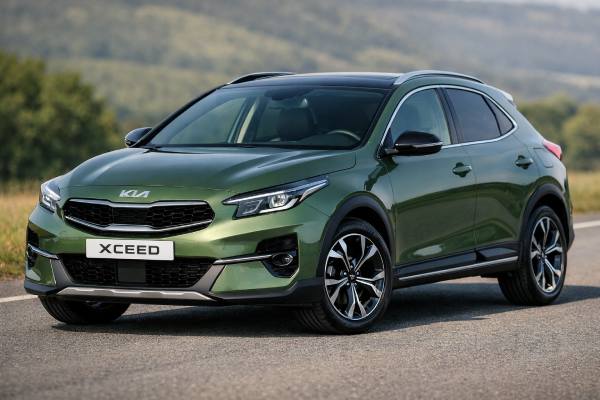
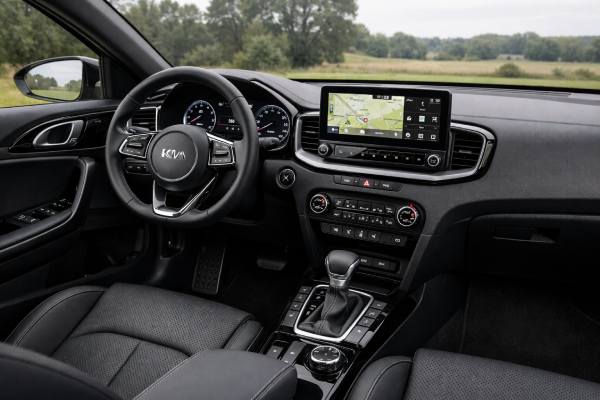
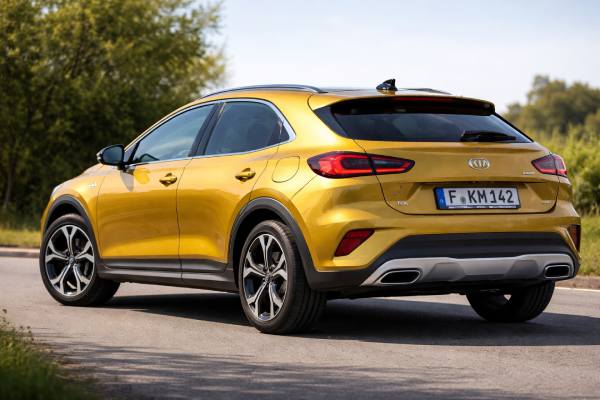
The facelifted Kia XCeed 1.6 T-GDi 204 is the version that turns this stylish crossover into something genuinely interesting. It keeps the XCeed’s higher seating position, useful boot, and compact family-car footprint, but adds the strongest petrol engine in the range, sharper GT-line presentation, and a more complete technology package after the 2022 update. That makes it more than a prettier Ceed. It becomes a quick, well-equipped crossover with enough performance to feel special, yet still practical enough for daily use.
This version suits buyers who want pace without moving into a larger SUV or a harsher hot hatch. The trade-offs are predictable. The direct-injection turbo petrol engine wants consistent servicing, the larger wheels and tyres raise running costs, and the dual-clutch transmission on most facelift cars needs to behave properly before you buy. Still, as an everyday performance crossover, it is one of Kia’s more overlooked strong points.
What to Know
- The 204 hp engine gives the facelift XCeed real pace while keeping the model’s practical 426-litre boot and compact size.
- GT-line styling, digital displays, and broader assistance tech make facelift cars feel more modern than early XCeeds.
- Front-wheel drive and a relatively low body help it feel more car-like than many compact crossover rivals.
- Buy on oil history, tyre quality, and DCT behaviour, because this version is less forgiving of neglected maintenance than the smaller engines.
- Treat 15,000 km or 12 months, or 10,000 miles or 12 months in UK guidance, as the basic service rhythm.
Start here
- Kia XCeed facelift explained
- Kia XCeed facelift figures
- Kia XCeed trim and ADAS guide
- Weak points and recall history
- Ownership plan and used-buy tips
- How the facelift drives
- Best rivals for the 204
Kia XCeed facelift explained
The 2022 facelift did not change the XCeed’s basic concept. It refined it. Kia kept the same CD-platform body, the same compact crossover proportions, and the same broad model idea: a Ceed-based family car with extra visual presence, a slightly raised seating position, and more style than a regular hatchback. What changed was the detail. The facelift introduced a revised front end, new lighting signatures, updated rear styling, fresher digital displays, and a much clearer GT-line identity. That matters for the 204 hp car because the strongest petrol engine now feels more deliberately matched to the sportier trim and sharper look.
Mechanically, the top petrol remained the 1.6-litre Gamma II T-GDi with 204 hp and 265 Nm. This is the same basic performance engine that gave the Ceed GT and ProCeed GT their appeal, but in the XCeed it serves a different mission. Instead of being the hot version of a hatchback, it becomes the fast version of a compact crossover. That means the focus is not lap-time energy or aggressive chassis tuning. It is strong real-world pace, relaxed overtaking ability, and a higher-spec driving experience in a body that still works for everyday life.
The facelift also matters because it kept the 204 hp version alive in several European markets beyond the original launch period. That is important to say clearly, because by the later years of the run the XCeed lineup became more market-dependent. In some countries the 204 hp version continued as a GT-line flagship, while others moved toward a lower-output 1.6 turbo petrol or simplified the range. So when this article says “2022–present,” it is referring to the facelift-era 204 hp XCeed where that exact engine remained available, not implying that every current European market still sells it in identical form.
Structurally, the XCeed remains one of the more convincing “crossover hatch” designs because it does not overdo the SUV idea. It is lower, lighter, and more car-like than a Sportage or similar C-SUV, but still offers easier access than a standard Ceed. The body dimensions stay compact, the wheelbase remains the same as the Ceed family, and the luggage space remains strong for the class. In practice, that means the 204 hp XCeed is not just a niche performance model. It is a useful family car that happens to be unusually quick.
That balance is what gives the facelift 204 its real appeal. It has enough torque and response to feel genuinely fast, but it still parks easily, carries luggage properly, and does not ask the buyer to accept the compromises of a much larger SUV. In Kia’s lineup, that makes it one of the more interesting hidden sweet spots.
Kia XCeed facelift figures
The table below focuses on the facelifted Kia XCeed 1.6 T-GDi 204 in its commonly documented European specification. In most facelift-era markets, that means front-wheel drive with the 7-speed dual-clutch transmission and GT-line positioning.
Powertrain and efficiency
| Item | Kia XCeed facelift 1.6 T-GDi 204 |
|---|---|
| Code | Gamma II T-GDi |
| Engine layout and cylinders | Inline-4, 4 cylinders, turbocharged |
| Valvetrain | DOHC, 16 valves, 4 valves per cylinder |
| Bore × stroke | 77.0 × 85.44 mm (3.03 × 3.36 in) |
| Displacement | 1.6 L (1,591 cc) |
| Induction | Turbo |
| Fuel system | Direct injection |
| Compression ratio | 10.0:1 |
| Max power | 204 hp (150 kW) @ 6,000 rpm |
| Max torque | 265 Nm (195 lb-ft) @ 1,500–4,500 rpm |
| Emissions hardware | Three-way catalyst and gasoline particulate filter |
| Timing drive | Chain |
| Rated efficiency | About 6.4–7.1 L/100 km, depending on market, trim, and wheel size |
| Real-world highway @ 120 km/h (75 mph) | Usually about 7.2–8.3 L/100 km |
Transmission and driveline
| Item | Kia XCeed facelift 1.6 T-GDi 204 |
|---|---|
| Transmission | 7-speed DCT in most facelift-market specifications |
| Drive type | FWD |
| Differential | Open |
| Drive modes | Normal / Sport |
Chassis and dimensions
| Item | Kia XCeed facelift 1.6 T-GDi 204 |
|---|---|
| Suspension, front | MacPherson struts |
| Suspension, rear | Independent multi-link |
| Steering | Rack-and-pinion with electric assistance |
| Steering ratio | 12.7:1 |
| Brakes | 320 mm front discs / 284 mm rear discs |
| Most common tyre size | 235/45 R18 |
| Ground clearance | About 184 mm on 18-inch wheels |
| Length | 4,395 mm (173.0 in) |
| Width | 1,826 mm (71.9 in) |
| Height | 1,495 mm (58.9 in) on 18-inch wheels |
| Wheelbase | 2,650 mm (104.3 in) |
| Turning circle | 10.6 m (34.8 ft) |
| Kerb weight | Roughly 1,350–1,390 kg (2,976–3,064 lb), depending on trim and equipment |
| GVWR | About 1,900–1,920 kg (4,189–4,233 lb) |
| Fuel tank | 50 L (13.2 US gal / 11.0 UK gal) |
| Cargo volume | 426–1,378 L, VDA |
Performance and capability
| Item | Kia XCeed facelift 1.6 T-GDi 204 |
|---|---|
| 0–100 km/h | 7.5 s |
| Top speed | 220 km/h (137 mph) |
| Towing capacity, braked | Up to 1,500 kg (3,307 lb), market and approval dependent |
| Towing capacity, unbraked | 650 kg (1,433 lb) |
| Roof load | 80 kg |
| Nose weight | 75 kg |
Fluids and service capacities
| Item | Specification |
|---|---|
| Engine oil | ACEA C2, commonly 5W-30; 4.0 L (4.2 US qt) |
| Coolant | Confirm by VIN-specific workshop literature before refill |
| DCT fluid | Confirm by VIN-specific workshop literature |
| Differential / transfer case | Not applicable |
| Brake fluid | DOT 4 low-viscosity fluid |
| A/C refrigerant | Verify under-bonnet label before service |
| A/C compressor oil | Verify by VIN and refrigerant type before service |
| Key torque specs | Confirm with official workshop literature before repair |
Safety and driver assistance
| Item | Kia XCeed facelift 1.6 T-GDi 204 context |
|---|---|
| Closest official Euro NCAP benchmark | 2019 Kia Ceed |
| Standard-equipment score | 4 stars |
| Safety-pack score | 5 stars |
| Adult / child / vulnerable road user / safety assist | 88% / 85% / 52–68% / 68–73%, depending on configuration |
| IIHS | Not applicable |
| ADAS availability | FCA, lane support, driver-attention warning, high-beam assist, blind-spot warning, rear cross-traffic alert, and richer cruise-control functions depending on trim and market |
The key takeaway from the numbers is that the facelift 204 remains a compact, front-drive family crossover with genuinely warm-hatch pace and stronger towing ability than many rivals in the class.
Kia XCeed trim and ADAS guide
For the facelift model, the 204 hp XCeed sits near the top of the range rather than blending into the middle of it. In several European markets it was tied directly to GT-line or GT-line Business Premium style positioning, which tells you most of what you need to know. This is not the value version of the XCeed. It is the style and performance flagship for buyers who want the strongest petrol engine and the richest specification short of moving to a different model altogether.
That trim positioning matters in the used market. A facelift 204 hp XCeed will usually have the exterior details that separate it from lower-power cars: GT-line styling, larger alloy wheels, darker trim finishes, richer upholstery, and in some markets extras such as a panoramic roof, power tailgate, heated seats, memory functions, or upgraded audio. The 2024 Finnish price list also shows the 204 hp engine paired with GT-Line Business Premium DCT specification, which reinforces the point that most facelift 204 cars are heavily equipped rather than lightly trimmed.
This creates both an advantage and a caution. The advantage is obvious. These cars feel special. They usually have the digital cluster, large infotainment display, richer interior trim, and stronger convenience equipment that make the XCeed feel more expensive than it is. The caution is just as important: the more equipment a compact crossover carries, the more there is to diagnose and recalibrate after an accident, battery issue, or poor-quality repair.
The safety story improved with the facelift, but it still needs careful explanation. There is no separate public Euro NCAP page for the facelift XCeed, so the most relevant official benchmark remains the 2019 Ceed result. That is reasonable because the XCeed shares the same core platform and much of the same structure. But even there, equipment matters. The Ceed achieved a 4-star rating with standard equipment and 5 stars with the optional safety pack. In other words, XCeed buyers should think in two layers: structural safety and feature content.
By MY23, many markets had broadened the assistance suite. Price-list data shows that lane-keeping support and ESC were widely available across the range, while higher trims gained stronger forward collision avoidance capability, including cyclist detection, plus blind-spot warning and rear cross-traffic systems. Current Kia Europe market pages also show forward collision avoidance, blind-spot collision-avoidance, rear cross-traffic functions, and richer connectivity as key facelift selling points. That means the facelift 204 is not only quick. It can also be one of the safest-feeling XCeeds in real everyday use, assuming it has the right equipment and that everything still works as intended.
For buyers, the simplest rule is this: treat badges as a clue, not proof. On a facelift 204, confirm the wheel size, brake package, digital cluster, blind-spot functions, cruise-control type, and camera support from the actual car or VIN-based specification sheet. Do that, and you will know exactly whether you are buying the full-fat flagship or just the fast engine in a lightly equipped shell.
Weak points and recall history
The facelift 204 hp XCeed is not defined by a single catastrophic public flaw. That is the good news. The 1.6 T-GDi engine and the CD-platform XCeed do not show an official pattern of broad structural failure or a model-defining engine defect. But this is still the most stressed petrol version in the line, and that makes maintenance discipline far more important than on the smaller engines.
The first area to watch is the engine’s basic operating environment. This is a turbocharged direct-injection petrol with a gasoline particulate filter. That means the car likes regular oil changes, good fuel, and enough running time to get fully warm. If those conditions are missing, the usual modern-turbo weaknesses become more likely: ignition misfires under load, carbon build-up over higher mileage, hot-running sensitivity, and turbo stress if oil quality is poor.
The second area is the transmission. Most facelift 204 cars are DCT models, and that matters. A healthy DCT-equipped XCeed should pull away cleanly, shuffle through gears smoothly once moving, and not deliver repeated clutch shudder or warning lights in traffic. Slightly mechanical low-speed behaviour is normal for a dual-clutch setup. What is not normal is a hot gearbox that becomes hesitant, jerky, or noisy in basic manoeuvres. That is one of the clearest used-car checks on this model.
There are also the usual performance-trim chassis realities. Because the 204 is commonly fitted with 18-inch wheels, large brakes, and richer GT-line trim, it tends to reveal neglect faster than lower-power XCeeds. Cheap tyres ruin its steering feel. Worn front suspension links make it feel loose. Uneven tyre wear often tells you more about the car than the seller’s description does. On a well-kept example, the XCeed feels tidy and planted. On a neglected one, it feels strangely brittle and less polished than it should.
From a recall point of view, the most relevant recent official action is the 2025 Kia Ireland recall for certain Ceed and Xceed vehicles involving contamination of the printed circuit board in the hydraulic clutch actuator. The concern was an electrical short that could potentially lead to a thermal incident in the engine compartment. That is important even if you are shopping a 2022-on facelift car, because the campaign is VIN-specific rather than trim-badge specific. It does not automatically mean every 204 hp DCT is affected, but it absolutely means that every buyer should check the VIN and ask for proof of completion.
Software and calibration history also matter. Facelift cars carry more driver-assistance functions, more digital display integration, and more convenience electronics than early XCeeds. Even when there is no headline recall, dealer software updates can still improve infotainment stability, warning-light logic, and system behaviour after component replacement. On a modern performance crossover, a clean scan history is worth more than a polished set of aftermarket wheels.
The overall reliability verdict is therefore fairly simple. The facelift 204 hp XCeed is not a fragile car, but it is a car that punishes lazy ownership faster than the simpler engines do. The best examples are boringly maintained. The worst ones are the tuned, cheaply tyred, vaguely serviced cars that look fast in photos and feel tired on the road.
Ownership plan and used-buy tips
The right maintenance approach for the facelift 204 is conservative and deliberate. Official interval guidance for petrol Ceed-family models varies slightly by market, but the useful ownership rule is consistent: service it every 12 months, and do not stretch the oil. In Ireland, Ceed-family petrol models are listed at 15,000 km or 12 months. In current UK XCeed specification literature, service intervals are shown as 12 months or 10,000 miles, whichever comes sooner. For a turbocharged 204 hp direct-injection car, that is the correct mindset.
A practical ownership schedule looks like this:
| Item | Practical interval |
|---|---|
| Engine oil and filter | Every 15,000 km or 12 months, or 10,000 miles / 12 months in UK guidance |
| Engine air filter | Inspect every service; replace around 30,000 km or sooner in dusty use |
| Cabin air filter | Replace every 12–24 months |
| Spark plugs | Inspect by schedule; practical replacement around 60,000 km is sensible |
| Brake fluid | Inspect yearly; replace every 2–3 years |
| Coolant | Follow VIN-specific service literature; do not guess the interval or specification |
| DCT fluid | Treat as a real long-term service item on hard-used or high-mileage cars |
| Brake pads and discs | Inspect every service |
| Tyre rotation and alignment | Check regularly, especially on 18-inch-wheel cars |
| 12 V battery | Test annually after the first few years |
| Timing chain | No routine replacement interval, but investigate noise or timing-correlation faults immediately |
The oil specification matters because this engine combines turbocharging, direct injection, and a particulate filter. That is not the place to improvise. Use the correct ACEA-grade 5W-30 oil and the correct 4.0-litre fill for the specific variant. Equally, do not assume the DCT is “sealed for life” in any meaningful enthusiast sense. If you plan to keep the car, a preventive transmission service is far cheaper than chasing shift problems later.
Buyer checks should focus on the places where fast compact crossovers hide neglect:
- Start it from cold and listen for unusual chain, injector, or top-end noise.
- Drive it gently and then hard enough to check for misfire or hesitation under boost.
- Test the DCT in stop-start traffic, on inclines, and after it is fully warm.
- Check tyre brand, age, and matching set. Mismatched cheap tyres are a bad sign.
- Inspect the front brakes for lip wear, steering-wheel vibration, and repeated hard-use heat marks.
- Confirm every driver-assistance system initializes correctly.
- Look for signs of remapping, intake changes, or exhaust modifications.
- Run the VIN through an official recall checker and ask for dealer proof of completed campaigns.
The best used facelift 204 is usually a standard, unmodified GT-line-type car with full service history, quality tyres, and no gearbox warnings. Avoid cars with vague maintenance records, heavily tinted electronics menus full of stored faults, or “tasteful” modifications that seem to have been done instead of proper servicing. The long-term durability outlook is good when the car is treated like a modern performance petrol, not like a basic runabout.
How the facelift drives
The facelift 204 hp XCeed drives exactly as the numbers suggest: faster than a typical compact crossover, but calmer and more grown-up than a hot hatch. That is the charm of it. It gives you real pace without demanding that every trip feel like an event.
The engine is the star. With 265 Nm available from low rpm and strong pull through the middle of the range, the car feels alert in the situations that matter most in real life: joining a motorway, passing slower traffic, or climbing away from a bend without waiting for the engine to wake up. It is not especially dramatic in sound, but it is effective. The 7-speed DCT also helps the car feel quicker than a similarly powered manual crossover would, because it keeps the engine in its useful band and makes the 7.5-second sprint to 100 km/h believable in normal driving.
Ride and handling are a classic compromise. The XCeed still rides better than many SUV-shaped rivals because its centre of gravity is lower and its body is not excessively tall. But the 18-inch GT-line setup is firmer than the smaller-wheel cars. On smooth roads the car feels tidy, planted, and more agile than its shape suggests. On broken urban surfaces, the firmer tyres and sporting trim remind you that this is the sharp XCeed, not the comfort-first one.
Steering is light but accurate. There is enough precision to place the car well, and the front end responds cleanly if the tyres are good. It is not the most communicative system in the class, yet it suits the XCeed’s mission. This is a compact crossover intended to feel stable and easy rather than hyperactive.
Noise control is decent for the segment. At urban speeds the car feels refined, and at motorway pace it settles into a mature cruise. Wind and tyre noise do rise on coarse surfaces, especially with 18-inch tyres, but the XCeed still feels more polished than many style-led rivals. Kia also highlighted improved acoustics and suspension tuning in facelift-era material, and that comes across on the road. It does not transform the car, but it does make it feel a little more finished than the earlier version.
Fuel use is acceptable for a 204 hp petrol crossover, but it is not a thrifty car. In the real world, expect roughly 8.5–10.0 L/100 km in urban use, around 7.2–8.3 L/100 km at a true 120 km/h motorway cruise, and around 7.8–9.0 L/100 km in mixed driving. Winter conditions, short trips, and repeated full-throttle use will push those numbers upward. On the other hand, steady long journeys can make the car feel less thirsty than its power figure implies.
The facelift 204 also retains useful towing ability. A 1,500 kg braked rating is substantial for a front-drive crossover of this size. It is not the ideal wet-ramp tow car, but it has enough power and stability for a small trailer, light caravan, or recreational load if the tyres and trailer setup are right.
Best rivals for the 204
The facelift 204 hp XCeed is not aimed at the broadest part of the crossover market. It sits in a narrower space where style, pace, and practicality overlap. That makes its best rivals different from those of a basic XCeed.
Against the Volkswagen T-Roc 1.5 or 2.0 TSI, the Kia often feels lower, less top-heavy, and more naturally tied down. The T-Roc wins on brand familiarity and, in some versions, a more polished SUV image. But the XCeed feels more like a fast family hatch in crossover clothing, and for many drivers that is exactly the better formula.
Against the Ford Puma ST-Line and higher-output petrol versions, the Ford counters with sharper low-speed agility and clever packaging. The Kia answers with stronger motorway composure, a larger-feeling boot area, and a more substantial long-distance character. If your driving is mostly urban and playful, the Ford is appealing. If you want speed plus maturity, the Kia feels more complete.
Against the Mazda CX-30, the choice is more about personality than numbers. The Mazda feels more premium inside and more carefully trimmed in a tactile sense. The Kia is quicker in this specific 204 hp form and generally feels more eager in the mid-range. The Mazda suits buyers who value interior ambience and polish. The Kia suits those who want performance without giving up crossover practicality.
There is also a strong in-house comparison. The Ceed GT and ProCeed GT use the same engine idea and remain the purer driver’s cars. They sit lower, feel more direct, and carry less of the crossover compromise. But the XCeed offers easier entry, more visual toughness, and a more versatile everyday package while keeping much of the same performance appeal. That is why it works. It is not the sharpest Kia in the family. It is the quickest-feeling practical one.
The final verdict is that the facelift 204 XCeed succeeds because it knows exactly what it is. It is not pretending to be an off-roader. It is not pretending to be a full hot hatch either. It is a compact, well-equipped crossover with real pace, strong everyday usability, and a more mature character than most performance-flavoured rivals. For the buyer who wants one car to do everything reasonably well and still feel special on an empty road, it remains one of the most underrated choices in the XCeed lineup.
References
- Technical Specifications – The new Kia XCeed.docx 2022 (Technical Specifications)
- Discover the Kia XCeed 2024 (Model Overview)
- Official Kia Cee’d 2019 safety rating 2019 (Safety Rating)
- Kia Service Intervals 2023 (Service Intervals)
- Recalls by manufacturer (2025) 2025 (Recall Database)
Disclaimer
This article is for informational purposes only and is not a substitute for professional diagnosis or repair. Specifications, torque values, capacities, service intervals, towing limits, procedures, and equipment can vary by VIN, market, trim, and model year, so always verify final details against the official Kia service documentation for your exact vehicle.
If this guide helped you, please consider sharing it on Facebook, X, or your preferred platform to support our work.