


The facelift-era Kia XCeed 1.6 CRDi 136 is one of the last genuinely appealing compact diesel crossovers in Europe. It combines long-leg motorway manners, low real-world fuel use, and stronger mid-range torque than the small petrol engines, while keeping the XCeed’s tidy size and more car-like chassis. That makes it especially interesting for drivers who cover serious annual mileage and want something easier to park and live with than a full-size SUV.
There is one technical point worth clearing up early. In facelift form, this 1.6 CRDi is commonly paired with 48-volt mild-hybrid support in many European markets, even though many listings simply call it a diesel XCeed. For owners, the bigger story is still practical use: this model suits long commutes and mixed-distance driving very well, but it is less convincing as a short-trip urban diesel. Used the right way and serviced properly, it remains one of the smartest XCeed variants.
Core Points
- Strong motorway efficiency and easy mid-range torque are the main reasons to choose this diesel over the petrol range.
- The XCeed keeps a more hatchback-like feel than most compact crossovers, with good comfort and stable high-speed manners.
- Facelift diesel models often include 48-volt mild-hybrid support, which improves stop-start smoothness and coasting behavior.
- Short-trip use can still create the usual diesel headaches with DPF, EGR, and SCR aftertreatment systems.
- Kia’s Ceed-family diesel service interval for 2022-present models is 20,000 km or 12 months.
Start here
- Kia XCeed diesel identity
- Kia XCeed facelift data
- Kia XCeed grades and protection
- Failure points and service actions
- Maintenance plan and buying guide
- Road feel and running costs
- XCeed against alternatives
Kia XCeed diesel identity
The facelift XCeed 1.6 CRDi 136 works because it answers a simple question that many newer crossovers ignore: what if you want crossover ride height and style, but still care about range, low running costs, and a chassis that feels closer to a hatchback than an SUV? That is exactly where this version fits.
Underneath, the XCeed remains a Ceed-family car, and that matters. It is lower, lighter, and more settled than many compact SUVs. You sit a little higher than in a normal hatchback, but the body does not move with the top-heavy feel that comes with larger crossovers. For long-distance drivers, that balance is a real strength. The diesel engine then adds the part the petrol range cannot match as easily: effortless in-gear pull and strong range between fill-ups.
The facelift diesel is also more modern than the badge alone suggests. In many European markets, the 1.6 CRDi 136 is tied to Kia’s mild-hybrid setup, with a 48-volt electrical system that improves stop-start operation and supports coasting functions. It does not turn the XCeed into a hybrid in the way a full HEV does, but it makes the diesel feel cleaner in traffic and slightly more polished in transitions. That is useful in everyday ownership, even if the biggest fuel benefit still comes from the engine’s basic efficiency on steady runs.
This version is especially well suited to people who do regular intercity miles, mixed commuting, or regional driving where a diesel still makes technical sense. It is less ideal for the buyer who spends most of the week on cold short trips, because the same diesel rules still apply here: particulate filter life, SCR aftertreatment health, and EGR cleanliness all depend on how the car is used. The fact that the XCeed is a compact crossover does not exempt it from those realities.
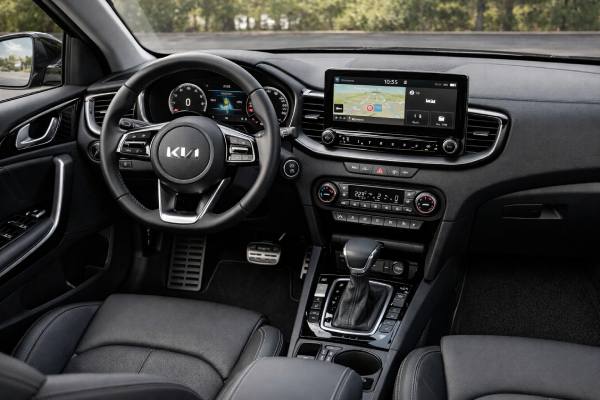
The facelift brought worthwhile improvements beyond the powertrain. Cabin presentation is cleaner, digital displays are more modern, and the available safety equipment is stronger than on the earlier car. The result is a diesel XCeed that feels mature without becoming heavy or overly complicated. It also helps that the engine is a better match for the car’s shape than many base petrol options. The XCeed is not a slow car with this diesel, but more importantly, it never feels strained.
If you want the short version, this model is not the emotional pick of the XCeed range. The 1.6 T-GDi is quicker, and the PHEV has obvious tax and short-trip advantages. But for long-distance ownership, the facelift 1.6 CRDi may be the most coherent all-round choice of the lot.
Kia XCeed facelift data
The table below focuses on the facelift-era European-market XCeed 1.6 CRDi 136. Some figures vary slightly by trim, wheel size, and whether the car uses the 6-speed iMT or 7-speed DCT, so VIN-level confirmation remains the safest route before ordering service parts.
Powertrain and efficiency
| Item | Kia XCeed 1.6 CRDi 136 facelift |
|---|---|
| Code | 1.6 CRDi 136 / New U-III diesel family |
| Engine layout and cylinders | Inline-4, 4 cylinders, 16 valves |
| Bore × stroke | 77.0 × 85.8 mm (3.03 × 3.38 in) |
| Displacement | 1.6 L (1,598 cc) |
| Mild-hybrid system | 48V mild-hybrid support in facelift European specs |
| Induction | Turbocharged |
| Fuel system | Common-rail direct injection with SCR aftertreatment |
| Max power | 136 hp (100 kW) @ 4,000 rpm |
| Max torque | 280 Nm (207 lb-ft) @ 1,500–3,000 rpm with iMT / 320 Nm (236 lb-ft) @ 2,000–2,250 rpm with DCT |
| Timing drive | Public open-access Kia service summaries do not consistently publish chain or belt detail for this exact facelift engine; verify by VIN |
| Rated efficiency | 5.0–5.2 L/100 km for iMT / 5.1–5.3 L/100 km for DCT |
| Real-world highway at 120 km/h | Typically around 5.5–6.2 L/100 km depending on wheel size, weather, and load |
Transmission and driveline
| Item | Kia XCeed 1.6 CRDi 136 facelift |
|---|---|
| Transmission | 6-speed iMT or 7-speed DCT |
| Drive type | FWD |
| Differential | Open |
Chassis and dimensions
| Item | Kia XCeed 1.6 CRDi 136 facelift |
|---|---|
| Front suspension | MacPherson strut |
| Rear suspension | Multi-link |
| Steering | Electrically assisted rack-and-pinion |
| Turning circle | 10.4 m (34.1 ft) |
| Front brakes | Ventilated discs, usually 305 × 25 mm; certain higher trims list 320 × 28 mm |
| Rear brakes | Disc, 284 × 10 mm |
| Most common tyre sizes | 205/60 R16 or 235/45 R18 |
| Ground clearance | 172 mm (6.8 in) on 16-inch wheels / 184 mm (7.2 in) on 18-inch wheels |
| Length | 4,395 mm (173.0 in) |
| Width | 1,826 mm (71.9 in) |
| Height | 1,483 mm on 16-inch wheels / 1,495 mm on 18-inch wheels (58.4 / 58.9 in) |
| Wheelbase | 2,650 mm (104.3 in) |
| Kerb weight | About 1,370–1,484 kg for iMT / 1,397–1,511 kg for DCT (3,020–3,272 / 3,080–3,331 lb) |
| GVWR | 1,920 kg iMT / 1,950 kg DCT (4,233 / 4,299 lb) |
| Fuel tank | 50 L (13.2 US gal / 11.0 UK gal) |
| Cargo volume | 380 L seats up / 1,332 L seats down (13.4 / 47.0 ft³, VDA) |
Performance and capability
| Item | Kia XCeed 1.6 CRDi 136 facelift |
|---|---|
| 0–100 km/h | 10.6 s iMT / 10.1 s DCT |
| 80–120 km/h | 10.5 s iMT / 7.4 s DCT |
| Top speed | 196 km/h (122 mph) iMT / 198 km/h (123 mph) DCT |
| Towing capacity | 1,500 kg braked / 650 kg unbraked (3,307 / 1,433 lb) |
| Payload | Typically around 439–550 kg depending on trim and transmission |
Fluids and service data
| Item | Practical guidance |
|---|---|
| Engine oil | 4.4 L (4.6 US qt) |
| Oil specification | ACEA C5 / C2 / C3 |
| Oil viscosity | 5W-30 |
| Coolant | Verify exact type and fill by VIN; do not assume generic Ceed petrol data |
| Transmission fluid | Use VIN-linked Kia spec for iMT or DCT; capacities vary by gearbox |
| Differential / transfer case | Not separate from the front transaxle on this FWD layout |
| A/C refrigerant | Verify by VIN and market-specific service data |
| A/C compressor oil | Verify by VIN and market-specific service data |
| Wheel nut torque | 107–127 Nm (79–94 lb-ft) |
Safety and driver assistance
| Item | Kia XCeed facelift diesel |
|---|---|
| Euro NCAP reference | No separate facelift XCeed diesel crash page; related Ceed platform had a dual 2019 Euro NCAP result |
| Euro NCAP result context | 4 stars standard equipment / 5 stars with safety pack on the related Ceed assessment |
| Euro NCAP sub-scores | 88% adult, 85% child, 52% vulnerable road users, 68% safety assist on the safety-pack assessment |
| IIHS | Not rated |
| Headlight rating | Not applicable |
| ADAS availability | FCA, LKA, LFA, smart cruise control, speed-sign recognition, blind-spot support, rear cross-traffic assist, and highway assist varied by trim and market |
The most useful takeaway from the data is that the diesel is not simply the economy choice. With the DCT especially, it is also the easiest long-distance XCeed short of the larger-engine petrol models.
Kia XCeed grades and protection
Trim naming varies a lot by country, which makes used-car research harder than it should be. In Finland, facelift diesel buyers saw grades such as LX, EX, Business Premium, GT-Line, and GT-Line Business Premium. Other markets used names such as Business, Style, GT-Line, or GT-Line Plus. That means the badge on the boot tells only part of the story. The equipment sheet matters more.
The diesel sits high enough in the range that most examples are not basic cars. Even so, there are meaningful differences. Lower trims typically run 16-inch wheels, simpler interior trim, and a more straightforward comfort spec. Higher trims add the elements that make the XCeed feel close to a junior premium car: 18-inch alloys, larger displays, upgraded upholstery, heated seats, JBL audio, power tailgate, wireless charging, and more complete parking and safety assistance.
There are also functional differences by trim. Wheel size affects both ride and ground clearance. A 16-inch car gives you 172 mm ground clearance and a more forgiving ride. An 18-inch car looks better, sits at 184 mm, and often belongs to a higher trim, but it also rides more firmly and can make tyre replacement noticeably pricier. On a used XCeed diesel, that is a real ownership factor, not a brochure detail.
Safety and driver assistance are better on the facelift than on earlier XCeeds, but buyers still need to inspect the actual fitted hardware. Depending on region and trim, the facelift car can include forward collision avoidance with vehicle, pedestrian, and cyclist detection, lane following assist, smart cruise control, speed-limit recognition, highway driving assist, blind-spot monitoring, and rear cross-traffic warning. Those features are valuable, but they are also repair-sensitive. Windscreen replacement, front-end crash repair, and alignment work on an ADAS-equipped XCeed should be followed by proper calibration.
The crash-test story also needs precision. Euro NCAP does not publish a separate facelift XCeed diesel rating page. The closest official reference is the related Ceed platform, which in 2019 earned a dual result: four stars with standard safety equipment and five stars with the safety pack. That result is now expired, and the XCeed has its own body style and equipment mix, so it should be treated as a strong guide rather than a direct one-to-one rating.
Passive safety hardware is strong for the class. You get front, side, and curtain airbags, ISOFIX on the outer rear seats, ESC, hill-start assist, and the usual modern restraint systems. The XCeed’s structure is also more robust-feeling than many small crossovers. It does not advertise itself as a safety leader in the same way some newer rivals do, but a well-specified facelift diesel is far from sparse in this area.
The practical buying rule is simple: prioritize the right equipment over the right badge. A mid-grade diesel with the useful safety systems is often a smarter choice than a prettier high-trim car with the wrong wheels, patchy history, or missing convenience features you actually care about.
Failure points and service actions
The facelift XCeed diesel is generally a sound long-distance car, but it still follows the normal rules for a modern Euro 6 diesel. That means the real problem areas are rarely mysterious. They usually come from usage pattern, missed maintenance, or a small number of known system risks.
Common, low to medium cost: DPF and regeneration trouble. This is still the most likely complaint on a poorly used car. Symptoms include frequent fan operation, regeneration warnings, reduced performance, rising oil level from dilution, or a soot-loaded filter. The root cause is usually repeated short, cold trips that never let regeneration finish properly. The best remedy is prevention through the right use pattern. Early issues may be solved with a proper hot run and diagnostic check. Late-stage issues can become a forced regeneration, sensor replacement, cleaning, or DPF replacement job.
Common, low to medium cost: SCR and NOx-system irritations. The engine uses SCR aftertreatment, so AdBlue or urea upkeep becomes part of ownership. Low reductant warnings, NOx sensor faults, dosing problems, or emissions warnings can show up on older or neglected examples. These are not unique to Kia, but they are part of the real cost of owning any modern diesel at this emissions level.
Occasional, medium cost: EGR contamination. Soot and short-trip use can leave the EGR valve and related intake passages sticky. Symptoms include hesitation, uneven idle, engine-management warnings, or limp-home behavior. Sometimes a re-learn or software update helps, but mechanical cleaning or replacement may be required.
Occasional, medium cost: DCT low-speed behavior and clutch wear. The 7-speed DCT makes the diesel feel stronger and more relaxed than the iMT, but it also adds one of the major used-car checkpoints. Hesitation, shunt, rough parking-speed engagement, or warning lights deserve closer inspection. On a test drive, make sure the car is driven slowly, from cold, on an incline, and through repeated stop-start traffic conditions.
Occasional, low to medium cost: 48V and 12V electrical complaints. Because this facelift diesel uses mild-hybrid support in many markets, battery condition matters more than on an older basic diesel. Weak 12V support can create misleading messages, stop-start faults, or rough restart behavior. The 48V hardware itself is not proving to be a common disaster point from public records, but it is still a diagnostic item, not just a background feature.
Chassis and wear items: rear brakes can corrode on gently driven cars, front anti-roll-bar links and bushes are normal wear items, and 18-inch wheel cars are more exposed to pothole damage and alignment drift.
The biggest official service action to know is the 2025 recall covering certain Ceed and XCeed vehicles built between 03 December 2019 and 14 August 2023. The issue involved the hydraulic clutch actuator printed circuit board becoming contaminated with fluid, which could create an electrical short and, in the worst case, a thermal incident in the engine bay while driving. This is especially important because the facelift diesel is commonly found with the DCT. On any used example, recall completion should be checked by VIN and dealer record, not assumed from age or seller confidence.
For a pre-purchase inspection, ask for:
- a cold start,
- full fault-code scan,
- proof of annual servicing,
- recall confirmation,
- evidence of DPF-friendly use,
- and recent brake and tyre condition.
On this car, the history file tells you almost as much as the test drive.
Maintenance plan and buying guide
The facelift XCeed diesel is straightforward to maintain if you treat it like the modern emissions-controlled diesel it is. Kia’s published interval for the 2022-present Ceed-family diesel is 20,000 km or 12 months, whichever comes first. That is a reasonable official baseline, but many owners doing lots of cold starts or mixed urban use will benefit from a more conservative oil approach.
Practical maintenance schedule
| Item | Practical interval |
|---|---|
| Engine oil and filter | Every 12 months or 20,000 km maximum; shorten for hard use or repeated short trips |
| Engine air filter | Inspect yearly; replace around 20,000–30,000 km depending on environment |
| Cabin air filter | Replace about every 24 months, sooner in dusty or urban use |
| Fuel filter | Inspect and replace by schedule, especially where fuel quality or water contamination is a concern |
| Coolant | Verify exact interval by VIN; do not guess from non-diesel Ceed data |
| Brake fluid | Replace on time, not by pedal feel |
| DCT or iMT fluid | Inspect by schedule; for long-term ownership, preventive service before very high mileage is sensible |
| Brake pads and discs | Inspect at every service, with special attention to rear-disc corrosion |
| Tyre rotation | Every 10,000–12,000 km if wear pattern allows |
| Wheel alignment | Check yearly or after pothole strikes and kerb impacts |
| 12V battery | Test from year 4 onward |
| 48V mild-hybrid system | Scan for stored faults during annual servicing |
| Timing components | Inspect by condition and fault-code history; replace if out of spec or noisy |
Fluid and decision-making data
The most useful public hard numbers are:
- engine oil capacity 4.4 L,
- engine oil spec ACEA C5 / C2 / C3,
- recommended viscosity 5W-30,
- service interval 20,000 km / 12 months,
- wheel-nut torque 107–127 Nm.
Other fluids, especially coolant and gearbox fill volumes, are best confirmed by VIN. On a mild-hybrid diesel with current emissions equipment, exact service data matters.
Buyer’s guide
The best facelift XCeed diesel is not just the cheapest DCT car with the nicest wheels. The smarter buy is usually:
- a moderate-mileage example with full annual service history,
- proof of recall completion,
- clean brake condition,
- no DPF or AdBlue warnings,
- and sensible tyre wear.
During inspection, check the following carefully:
- Cold-start behavior and smoke.
- DPF warning history and soot-load evidence.
- AdBlue or emissions-system messages.
- DCT engagement in slow maneuvers.
- Rear-brake condition.
- Uneven front-tyre wear on 18-inch cars.
- Windscreen replacement and ADAS calibration history.
- Underbody corrosion around the rear axle area, brake lines, and exhaust supports.
Recommended versions? For many buyers, the DCT is the nicer long-distance car, but only if its history is excellent and the recall is complete. The iMT is mechanically simpler, a little less refined in traffic, and a safer bet for buyers who want lower transmission risk. Mid-grade trims with 16-inch wheels are often the best long-term ownership choice because they combine lower running costs with the XCeed’s best ride quality.
Durability looks good when the car is used as intended. The risk comes from buying a short-trip diesel with a stylish body, not from the XCeed concept itself.
Road feel and running costs
The XCeed diesel’s biggest dynamic advantage is its balance. Many compact crossovers either feel soft and vague or try too hard to feel sporty. The XCeed lands in a better middle ground. It has enough ride height and visibility to satisfy crossover buyers, but on the move it still feels close to a well-sorted hatchback. That matters most on longer drives, where the car settles into a calm rhythm more easily than taller, heavier rivals.
Straight-line stability is good. The body does not wander, the steering stays accurate enough at motorway speed, and the suspension handles rough surfaces with more polish than some buyers expect from a Kia in this class. The multi-link rear suspension helps. It does not make the XCeed a sharp back-road car, but it gives the car more composure than a simple torsion-beam crossover would have.
Steering feel is light rather than rich, yet it is precise enough to inspire confidence. On 16-inch wheels, the XCeed rides particularly well and keeps a nice balance between body control and comfort. On 18-inch wheels, turn-in feels a little sharper, but sharp-edged impacts are more obvious and tyre noise is a little more intrusive. For most owners, the smaller wheel is the better long-term answer.
The diesel engine suits the car very well. There is the usual cold-start diesel note, but once warm it settles into a strong, quiet cruiser. The iMT version is perfectly usable, but the DCT makes the engine feel more muscular because it gets the higher torque figure and removes the need to work around gear changes in traffic. The trade-off is that the DCT still behaves like a dual-clutch, not a torque-converter automatic, so parking-speed smoothness is not always perfect.
Real-world economy is one of the strongest reasons to buy this version. A careful mixed-use driver should be able to see figures near the official low-5 L/100 km range. On steady motorway work at 100–120 km/h, around 5.5–6.2 L/100 km is realistic depending on speed, weather, wheel size, and load. Around town, the number can still be good for the class, but this is not the kind of diesel that loves endless short urban hops. Cold weather also matters, because regeneration frequency and warm-up demands rise.
In-gear response is where the car feels strongest. The official 80–120 km/h numbers tell the story better than the 0–100 run. The DCT’s 7.4-second figure in that band makes the car feel more relaxed and more capable than the headline 136 hp suggests. It is not fast in an absolute sense, but it is never breathless.
Running costs are also helped by the XCeed’s honest size. Tyres, brakes, and general wear tend to be more manageable than on larger SUVs. Insurance and fuel range usually land well for the class too. For drivers who actually do diesel-friendly mileage, the facelift XCeed 1.6 CRDi remains one of the more rational compact crossovers on sale or on the used market.
XCeed against alternatives
The facelift XCeed diesel is a niche car in a shrinking niche, so the right rival depends on what you care about most.
Against the Kia Ceed SW 1.6 CRDi, the XCeed trades space for style and ride height. The Ceed SW is the better pure practical tool, especially if you need real luggage capacity or maximum rear-seat usefulness. The XCeed, though, looks better to many buyers and feels more distinct without giving up the core Ceed-family strengths. If you want a diesel family car first, the wagon makes more sense. If you want the same engineering in a more desirable shape, the XCeed is easier to love.
Against the Peugeot 308 BlueHDi 130, the Kia usually feels simpler and more conservative. The Peugeot often has a more modern cabin concept and a slightly more refined overall impression. The Kia answers with clearer controls, more crossover-style seating, and a driving position many buyers find easier to like. Long-term, some owners may also prefer Kia’s more straightforward approach to interfaces and trim packaging.
Against the Ford Focus Active diesel, the Kia is the calmer car. The Ford tends to offer sharper steering and a more playful chassis, but the XCeed counters with a stronger sense of maturity, better perceived cabin quality in many trims, and a crossover body that still feels neatly tied down. The Ford is the driver’s pick. The Kia is the easier everyday companion.
Against larger diesel crossovers such as the Hyundai Tucson 1.6 CRDi, the XCeed wins on weight, economy, and ease of use in town. The Tucson gives you more rear-seat room and a more SUV-like feel, but it also asks you to carry more size and cost around every day. The XCeed is the better answer for buyers who want the look and seating position of a crossover without the penalty of a genuinely large vehicle.
That is the XCeed diesel’s real market position. It is not the roomiest option. It is not the newest-feeling digital product. It is not the most exciting to drive. But it gets the fundamentals right:
- strong diesel range,
- useful torque,
- good chassis balance,
- and sensible operating costs.
Its weak points are also clear:
- modern diesel systems still punish the wrong usage pattern,
- DCT cars need extra scrutiny,
- the safety story is based on the related Ceed platform rather than a dedicated facelift diesel test,
- and 18-inch high-trim cars can cost more to keep in shape than buyers expect.
For the right owner, though, none of those points are deal-breakers. If your driving pattern suits a diesel, and you want a compact crossover that still behaves like a car, the facelift Kia XCeed 1.6 CRDi 136 remains one of the better choices in the class.
References
- Kia XCeed 2022 (Technical Specification)
- Engine Oil Grades and Capacities 2023 (Service Guide)
- Kia Service Intervals 2023 (Service Guide)
- Kia Ceed – Euro NCAP 2019 Results – standard equipment 4 stars and with safety pack 5 stars 2019 (Safety Rating)
- Recalls by manufacturer (2025) 2025 (Recall Database)
Disclaimer
This article is for informational purposes only and is not a substitute for professional diagnosis, repair, or VIN-specific workshop guidance. Specifications, torque values, fluid types, service intervals, procedures, software status, and fitted equipment can vary by VIN, market, trim, wheel size, and transmission. Always verify the exact details for your vehicle against official Kia service documentation and dealer records before carrying out maintenance or repair work.
If this guide helped you, please consider sharing it on Facebook, X, or another platform to support our work.