
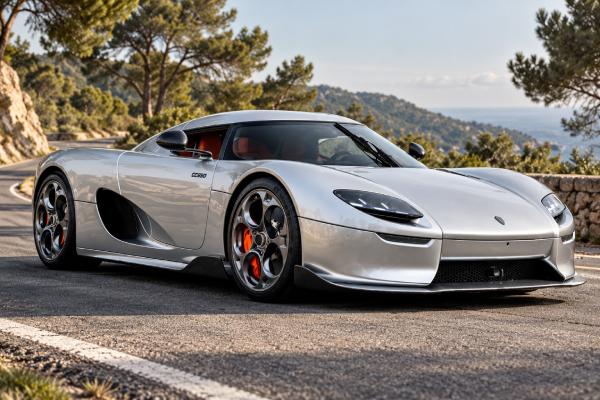
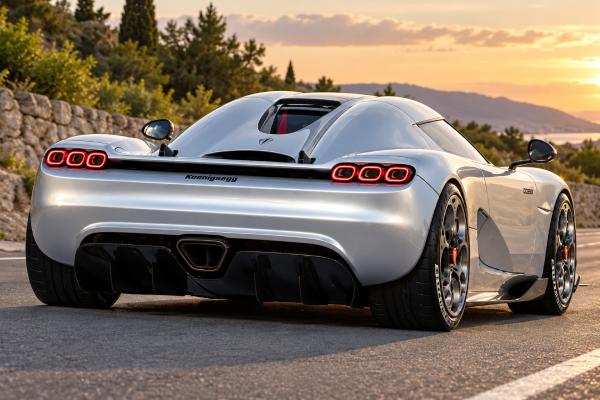
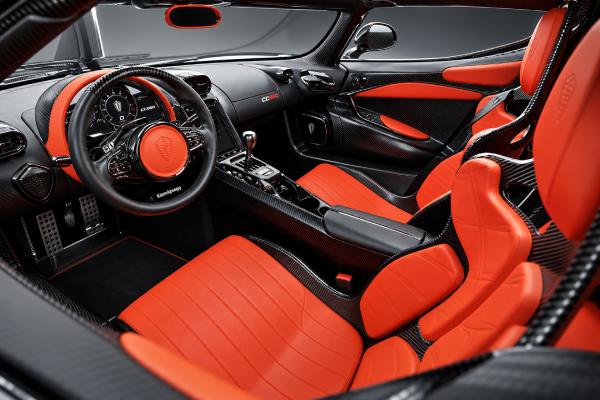
The Koenigsegg CC850 is a modern driver’s car built around an apparent contradiction: it has a gated six-speed manual with a clutch pedal, yet the same transmission can also operate as a nine-speed automatic. That is not a simulated manual mode added to an ordinary automatic. The Engage Shift System gives the driver direct control over clutch engagement and gear selection through electronic actuators, while the underlying Light Speed Transmission retains its full automatic capability. Power comes from a 5.0-liter twin-turbo V8 producing 1,185 hp on gasoline or 1,385 hp on E85, exactly matching the car’s 1,385 kg curb weight. The shape deliberately recalls the original CC8S, but the chassis, electronics, brakes, aerodynamics, and transmission belong to a much newer era. Koenigsegg expanded production from 50 to 70 cars after demand exceeded the initial allocation. For an owner or collector, the CC850’s appeal is therefore unusually specific: it combines early-Koenigsegg visual restraint with a driving interface that no other production hypercar uses in quite the same way.
Table of Contents
- A Modern CC8S With a Different Purpose
- The Engage Shift System Explained
- CC850 Specifications and Technical Details
- Performance Without a Record-Chasing Brief
- What Ownership Requires
- How to Assess a CC850 Before Purchase
- Why the CC850 Matters
A Modern CC8S With a Different Purpose
The CC850 is an homage rather than a remake. Its clean roofline, wraparound windshield, compact tail, telephone-dial wheels, and restrained body surfacing point directly to the CC8S, Koenigsegg’s first customer production car. Underneath, however, the CC850 is a contemporary carbon-monocoque megacar with active systems, a modern 5.0-liter V8, electronic differential control, and the transmission architecture first developed for the Jesko.
Koenigsegg unveiled the model in 2022 as a dual celebration. The company had reached 20 years since its first production-car deliveries, while founder Christian von Koenigsegg was turning 50. The original plan called for 50 cars. Demand was so strong that Koenigsegg added 20 more, linking the final total of 70 to the same two anniversary numbers. The limited run makes every allocation important, but the CC850’s significance is not mainly scarcity. Its purpose is to create driver involvement at a performance level where traditional manual gearboxes have almost disappeared.
That focus changes the car’s priorities. The Jesko Attack is designed around track downforce, while the Jesko Absolut pursues low drag and extreme speed. The CC850 is intended to make the act of driving absorbing even when the road does not permit maximum performance. A clutch pedal, an open gate, a physical lever, and the possibility of selecting the wrong gear demand attention at ordinary speeds. At the same time, automatic mode remains available for traffic, touring, or situations where the driver would rather let the control system use all nine ratios.
The body follows the same balanced philosophy. There is no towering fixed wing. Cooling openings and active elements are integrated without overwhelming the classic silhouette. The hardtop can be removed and stored beneath the front hood, preserving the open-air quality associated with earlier Koenigseggs. Inside, the second-generation Chronocluster presents speed, engine rpm, and boost through a rotating analog-style instrument that remains readable as the steering wheel moves.
The result is not retro in the usual sense. It does not use old hardware, reduced output, or deliberately softened performance to create nostalgia. Instead, Koenigsegg asks what made the early cars memorable—lightness, visibility, a compact shape, a mechanical-looking cabin, and driver responsibility—then recreates those qualities with current engineering.
The Engage Shift System Explained
The Engage Shift System, or ESS, turns the CC850’s nine-speed Light Speed Transmission into a genuine driver-operated six-speed manual without removing its automatic mode. The clutch pedal and lever do real control work, but they command hydraulic clutch packs and shift mechanisms electronically rather than moving a conventional single clutch and selector forks through direct mechanical linkage.
The underlying LST has several gearsets and seven clutches arranged so the transmission can connect different input and output combinations. This layout creates nine forward ratios while avoiding the long, heavy gear stack used in a traditional nine-speed unit. Because the system can preselect and change clutch combinations rapidly, automatic shifts can occur with very little interruption.
Manual mode adds a different control layer. Pressing the clutch pedal opens the clutch packs needed to disconnect drive. Moving the gated lever requests a specific ratio mapping, and releasing the pedal applies the selected clutch combination. The driver can slip the clutch when moving away, can stall the engine by releasing it badly, and can be prevented from selecting a downshift that would over-rev the engine. Those behaviors are important because they make the interface consequential rather than decorative.
The six lever positions do not always correspond to the same six of the nine internal ratios. Software can map different transmission ratios to the gate according to the selected drive mode. A road-oriented mapping can provide shorter, more closely useful steps for normal driving, while a track mapping can start with a taller first gear and select ratios suited to faster work. Automatic mode can still use all nine ratios.
This arrangement solves several problems at once:
- The driver receives a clutch pedal, gated lever, and manual responsibility.
- The car retains rapid automatic shifting when required.
- The transmission can handle 1,385 Nm without using an enormous conventional manual gearbox.
- Gear-ratio mapping can change without changing hardware.
- The same compact LST architecture supports both relaxed road use and maximum acceleration.
The experience is not identical to an old cable- or rod-operated gearbox. Force feedback in the pedal and lever must be generated and calibrated, and the computer remains an intermediary. Yet early demonstrations showed that the learning process is real: poor clutch control can produce a stall, the driver must coordinate revs and gear selection, and a clean shift is something to execute rather than merely request with a paddle.
That distinction is central to the CC850. Many modern performance cars offer manual-looking controls, but the software protects the driver from almost every meaningful error. The CC850 deliberately returns some of that responsibility while preserving the benefits of a modern automated transmission.
CC850 Specifications and Technical Details
The CC850 is a rear-wheel-drive, non-hybrid combustion car optimized for E85 flex fuel when maximum output is required. Its flat-plane-crank V8, nine-speed LST, carbon monocoque, electronic differential, and active damping form a compact package with a published 1:1 horsepower-to-kilogram ratio. Public technical data is extensive for the main systems but does not include every service fluid, performance figure, or aerodynamic coefficient, so unsupported rows are omitted below.
| Specification | Value |
|---|---|
| Engine layout | Rear-mid-mounted twin-turbo aluminum 5.0L V8 |
| Crankshaft | Flat-plane |
| Valve gear | DOHC, 4 valves per cylinder |
| Lubrication | Dry sump |
| Bore × stroke | 92 × 95.25 mm |
| Compression ratio | 8.71:1 |
| Boost pressure | 1.5 bar on gasoline; 1.7 bar on E85 |
| Fuel injection | Sequential multipoint injection with individual cylinder pressure and back-pressure sensing |
| Gasoline output | 1,185 hp at 7,800 rpm |
| E85 output | 1,385 hp at 7,800 rpm |
| Maximum torque | 1,385 Nm (1,022 lb-ft) at 4,800 rpm |
| Redline | 8,500 rpm |
| Engine weight | 185 kg (408 lb) |
| Specification | Configuration |
|---|---|
| Transmission | Koenigsegg 9-speed Light Speed Transmission |
| Driver interface | Engage Shift System with six-position gated lever and clutch pedal |
| Automatic operation | Full nine-speed automatic mode |
| Manual operation | Six driver-selected ratios mapped from the nine available internal ratios |
| Driven wheels | Rear-wheel drive |
| Differential | Koenigsegg Electronic Differential |
| Transmission control | Koenigsegg Transmission Control Module |
| Engine control | Koenigsegg Engine Control Module |
| Flex-fuel capability | Optional, required for the published 1,385 hp E85 output |
| Specification | Value |
|---|---|
| Monocoque | Carbon fiber with aluminum honeycomb and integrated fuel tanks |
| Torsional rigidity | 65,000 Nm per degree |
| Body construction | Pre-impregnated carbon fiber/Kevlar with sandwich reinforcements |
| Suspension | Double wishbones with electronically adjustable gas-hydraulic dampers |
| Rear suspension support | Koenigsegg Triplex dampers |
| Ride height | 70–100 mm front; 80–100 mm rear |
| Front lift | Adds 50 mm |
| Steering | Power-assisted rack and pinion |
| Steering turns | 2.5 lock-to-lock |
| Turning circle | 11.3 m (37.1 ft) |
| Stability-control modes | Wet, Normal, and Track |
| Specification | Front | Rear |
|---|---|---|
| Brake discs | 410 × 38 mm ventilated carbon-ceramic | 395 × 32 mm ventilated carbon-ceramic |
| Calipers | 6-piston Koenigsegg | 4-piston Koenigsegg |
| Brake assistance | Power-assisted with Sport ABS | Power-assisted with Sport ABS |
| Wheel size | 20 × 9.5 in | 21 × 12.25 in |
| Wheel design | Forged telephone-dial aluminum, center-lock | Forged telephone-dial aluminum, center-lock |
| Tire size | 265/35 R20 | 325/30 R21 |
| Published tire option | Michelin Pilot Sport 4S | Michelin Pilot Sport 4S |
| Specification | Value |
|---|---|
| Body style | Two-door, two-seat targa with removable hardtop |
| Length | 4,364 mm (171.8 in) |
| Width | 2,024 mm (79.7 in) |
| Height | 1,127 mm (44.4 in) |
| Wheelbase | 2,700 mm (106.3 in) |
| Curb weight | 1,385 kg (3,053 lb) |
| Fuel capacity | 72 L (19.0 US gal) |
| Power-to-weight headline | 1 hp per kg at the 1,385 hp E85 output |
| Roof storage | Removable hardtop stows under the front hood |
| Feature | Configuration |
|---|---|
| Doors and hoods | Autoskin electro-hydraulic operation with proximity protection |
| Driver display | Second-generation rotating Chronocluster |
| Pedals and steering column | Adjustable |
| Parking assistance | Bird’s-eye view, front and rear sensors, reversing camera |
| Infotainment | Digital audio, Apple CarPlay, USB, inductive phone charging |
| Climate system | Automatic climate control |
| Owner information | On-board digital owner’s manual |
| Safety restraint | Four smart airbags |
Performance Without a Record-Chasing Brief
The CC850 has the hardware for extreme acceleration, but Koenigsegg has not framed it as a top-speed or lap-record model. That matters because no official 0–100 km/h time or maximum-speed figure should be inserted simply by borrowing numbers from the Jesko. The CC850 shares engine and transmission concepts with newer Koenigseggs, yet its aerodynamics, tires, gearing maps, mass, and intended use are different.
Its performance case begins with power density. On E85, the 1,385 hp engine matches the 1,385 kg curb weight. Torque is also 1,385 Nm, producing a memorable numerical set without requiring a hybrid system. On premium gasoline, output falls to 1,185 hp, still far beyond the traction available to two road tires at low speed. Electronic differential control, stability management, and tire condition therefore have a major effect on how much performance can be used.
The flat-plane-crank V8 contributes more than a number. It is designed to rev to 8,500 rpm, uses individual cylinder pressure sensing, and combines fast-response turbochargers with a lightweight 3D-printed Inconel exhaust manifold system. The engine’s character should be sharper and more immediate than the large-displacement, low-rev turbo units found in many luxury performance cars. In manual mode, that response forces the driver to manage clutch take-up and rev matching with care.
The compact dimensions are equally important. At 4,364 mm long, the CC850 is shorter than the Regera and visually less aggressive than the Jesko Attack. A stiff carbon tub, adjustable dampers, Triplex rear support, and large carbon-ceramic brakes provide the expected dynamic foundation, but the car’s lack of a huge fixed rear wing signals a different balance between road use, speed, and downforce.
Early low-speed driving impressions of the ESS emphasized involvement rather than outright pace. The driver had to listen to the engine, plan shifts, and learn clutch behavior even while staying below ordinary highway speeds. That is exactly the point. A conventional paddle-shift hypercar often becomes fully engaging only when the car is moving very fast. The CC850 tries to make a slower corner, a downshift, or a clean departure from a junction feel worthwhile.
Automatic mode does not undermine that concept. It broadens the car’s operating range. In heavy traffic, during a long journey, or when attention is needed elsewhere, the control system can shift through all nine ratios. The driver can then return to the gated manual when the road and mood suit it. The CC850’s performance is therefore not just the maximum acceleration it can generate, but the number of different ways it can deliver that performance.
What Ownership Requires
CC850 ownership requires factory-level support for both familiar high-performance components and a transmission interface that is unique to this model. Routine care should be based on VIN-specific Koenigsegg documentation rather than generalized Jesko information, online fluid lists, or assumptions drawn from older CC-series cars.
The engine needs correct fuel management. Maximum output is specified on E85, while gasoline output is lower. Owners who switch fuels must follow the car’s approved procedure and allow the engine-management system to recognize the blend correctly. E85 can absorb moisture during storage, so a car kept idle for long periods needs a planned fuel strategy. The exact octane requirement, oil specification, capacities, and service intervals should be confirmed in the delivered documentation for the relevant market.
The ESS deserves its own maintenance mindset. Because clutch pedal feel, lever feedback, gear mapping, hydraulic pressure, clutch-pack operation, and software logic are interdependent, any change in engagement quality should be diagnosed with the proper system tools. A poor departure could be driver technique, clutch adaptation, actuator calibration, hydraulic condition, or software state. Replacing parts before checking data would be expensive and potentially ineffective.
Useful care priorities include:
- Keeping all engine, transmission, differential, stability-control, and body-system software at the approved revision.
- Recording clutch adaptation, fault history, and any ESS calibration work.
- Exercising manual and automatic modes regularly under suitable conditions.
- Checking Autoskin closures, front lift, dampers, cameras, and sensors for synchronized operation.
- Inspecting the carbon underbody and splitter after transport or ramp contact.
- Monitoring tire age and heat-cycle history, not only remaining tread.
- Using correct center-lock procedures and protecting the carbon-ceramic discs during wheel removal.
- Maintaining the 12-volt system with the official charging equipment when the car is stored.
The removable roof brings its own handling requirements. Seals, latches, storage bag, and the under-hood storage arrangement should remain clean and undamaged. A roof panel that is forced, stored incorrectly, or allowed to rub against grit can turn a useful feature into an expensive cosmetic repair.
Cosmetic care is highly specification-dependent. Exposed carbon, painted carbon, tinted clear coat, hand-finished metal, leather, Alcantara, and polished components may all require different products. Owners should preserve a record of the original materials and any protective film or coating applied after delivery. Aggressive paint correction can damage thin edges, exposed weave, or special finishes that are difficult to reproduce.
How to Assess a CC850 Before Purchase
A CC850 inspection must prove that the car’s identity, transmission behavior, fuel calibration, and factory history are correct. Low mileage is helpful only when the car has also been stored, charged, exercised, and serviced properly.
Start with the build specification. Confirm the VIN, allocation history, original exterior and interior choices, flex-fuel equipment, wheel and tire set, market homologation, roof panel, keys, charger, tools, manuals, and all loose accessories. Because the production run is small and personalization broad, documentation should make it possible to distinguish original configuration from later changes.
Then verify the ESS in both operating modes. A qualified driver should perform cold and warm checks, move away repeatedly, use every manual gate position, request automatic shifts, test mode changes, and scan for clutch or actuator faults. The clutch pedal should have consistent feedback, the lever should identify positions cleanly, and the system should reject unsafe downshifts without unexplained warnings. Any recent calibration or software campaign should be supported by an invoice or factory record.
The mechanical inspection should include the complete fuel, oil, intake, turbocharger, exhaust, and cooling systems. Look for evidence of overheated paint or carbon near the exhaust, disturbed clamps, unapproved modifications, fluid residue, or repair work around the rear structure. On a car capable of enormous torque, even a brief loss of control can damage wheels, suspension parts, underbody panels, or alignment without producing obvious exterior scars.
The chassis and body review should cover:
- Carbon monocoque, front and rear crash structures, suspension pickup points, and bonded areas.
- Splitter, flat floor, diffuser, wheel wells, and lifting points for transport or ramp damage.
- Door movement, Autoskin hydraulics, proximity sensing, hood alignment, and soft-close behavior.
- Ride-height adjustment, front lift, damper response, steering, and stability-control diagnostics.
- Carbon-ceramic disc condition, caliper damage, center-lock wheel condition, and correct tire date codes.
- Roof fit, seals, water management, storage hardware, and paint or carbon contact marks.
A road test should be planned around the car rather than improvised. The route needs safe space for temperature stabilization, low-speed clutch work, moderate acceleration, braking, and suspension assessment without requiring illegal speed. The goal is not to demonstrate 1,385 hp; it is to confirm that the CC850 is predictable, correctly calibrated, straight under load, and free from warnings.
Before purchase, the buyer should also establish a realistic support plan. That includes the nearest authorized service route, enclosed transport, insurance conditions, suitable E85 or approved gasoline supply, secure indoor storage, power for a maintainer, and future access to tires. An acquisition can be financially sound yet operationally frustrating if every minor issue requires an unplanned international shipment.
Why the CC850 Matters
The CC850 matters because it rejects the idea that progress must remove driver participation. Its transmission is more automated and electronically controlled than a classic manual, yet those technologies are used to return a clutch pedal and gated lever to a 1,385 hp car rather than eliminate them.
It also shows a mature form of Koenigsegg design. The early CC8S shape was clean partly because the company had limited resources and a simple mission. Two decades later, the CC850 achieves similar visual clarity while packaging far greater cooling demand, crash protection, electronic control, and performance. The homage works because it preserves proportions and intent instead of copying surface details alone.
For collectors, the 70-car run and anniversary story provide obvious appeal. For engineers, the more interesting legacy may be the ESS itself. It treats software, actuators, hydraulic clutches, and a multi-ratio transmission as tools for creating a human experience. That is a different use of advanced control technology from the usual pursuit of faster shifts or lower lap times.
The CC850 is therefore neither a nostalgic retreat nor a rebodied Jesko. It is a specialized answer to a modern hypercar problem: how to make extraordinary performance emotionally usable when a conventional manual cannot comfortably handle the torque and an automatic can make the driver feel unnecessary. Koenigsegg’s solution is complicated, but the desired result is simple—the driver still has something meaningful to do.
References
- CC850 – Technical Specifications | Koenigsegg (Technical Specifications)
- CC850 | Koenigsegg (Model Overview)
- The New Koenigsegg CC850: All Press Material 2022 (Press Material)
- Unprecedented response to the Koenigsegg CC850 2022 (Production Announcement)
- Does Koenigsegg’s complex CC850 gearbox feel like a proper manual? We try it 2024 (Driving Impression)
- Koenigsegg’s New Transmission Is a 6-Speed Manual and a 9-Speed Automatic 2022 (Technical Explanation)
Disclaimer
This article is for informational purposes only and is not a substitute for professional diagnosis, inspection, maintenance, or repair. Specifications, torque values, service intervals, fluids, calibration procedures, and equipment can vary by VIN, market, and production revision; verify every procedure against the car’s official Koenigsegg service documentation.
Please share this guide on Facebook, X/Twitter, or another enthusiast platform if it helped explain the CC850.