
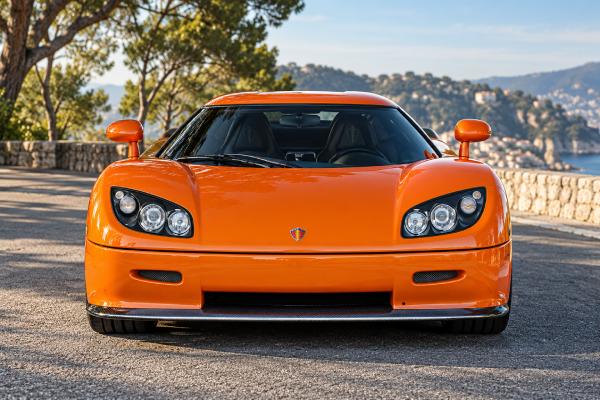
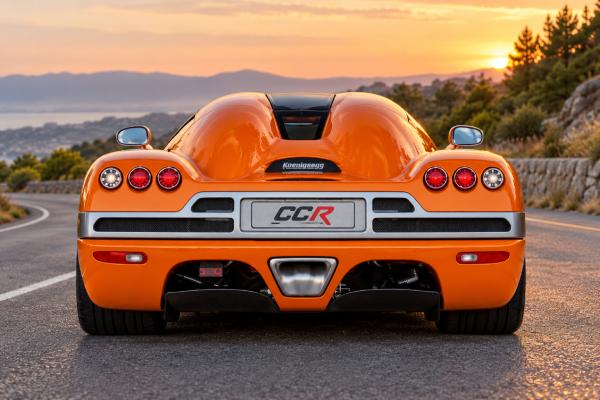
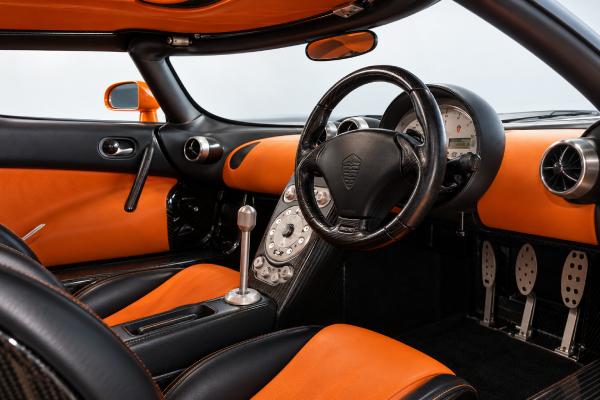
The Koenigsegg CCR is the car that turned a young Swedish manufacturer into a verified world-speed contender. Built from 2004 to 2006 in a run of only 14 cars, it developed the original CC8S formula with two centrifugal superchargers, 806 hp, larger brakes, revised aerodynamics, and a projected top speed beyond 395 km/h. On February 28, 2005, test driver Loris Bicocchi drove a technically standard CCR to 387.87 km/h at the Nardò circular test track, taking the production-car speed record associated with the McLaren F1. The achievement was more remarkable because the CCR remained compact, manually shifted, rear-wheel drive, and relatively light at a published 1,180 kg dry. Today, buying one is not simply a matter of finding an early Koenigsegg with low mileage. The car’s carbon structure, twin-supercharger system, Cima gearbox, electronically operated clutch, center-lock magnesium wheels, aging electronics, and highly specific parts supply all need specialist evaluation. A properly preserved CCR is both a usable analog supercar and a pivotal piece of Koenigsegg history.
Table of Contents
- From CC8S to World-Record Holder
- The Engineering Behind 806 hp
- Koenigsegg CCR Specifications
- What the Nardò Record Proved
- Maintaining an Early Koenigsegg
- Buyer Checks for a 14-Car Model
- The CCR as a Collector Car
From CC8S to World-Record Holder
The CCR was a focused evolution of the CC8S, not a clean-sheet replacement. Koenigsegg retained the compact carbon/Kevlar body, removable roof, dihedral synchro-helix doors, mid-mounted V8, six-speed manual transmission, and rear-wheel-drive layout. It then increased airflow, boost, cooling, braking capacity, and high-speed stability to create a car capable of challenging the fastest production vehicles in the world.
Visually, the changes were purposeful. Enlarged side intakes fed the more demanding engine and cooling systems. A deeper front splitter and revised body details controlled airflow, while the flat floor and rear Venturi tunnels generated useful underbody effect without requiring an enormous fixed rear wing on every car. Buyers could specify additional rear aerodynamic hardware, but the core body was designed to remain stable at very high speed in its normal configuration.
The engine was the central development. Koenigsegg’s 4.7-liter aluminum V8 used two Rotrex centrifugal superchargers at 1.2 bar of boost, an intercooler, sequential multipoint injection, dry-sump lubrication, and oil-spray piston cooling. Output rose to 806 bhp at 6,900 rpm, with 920 Nm at 5,700 rpm. In the mid-2000s, those figures placed the CCR ahead of most road cars by a wide margin, yet the engine still drove through a six-speed manual rather than an automated multi-clutch transmission.
The chassis philosophy was similarly direct. A carbon-fiber semi-monocoque with honeycomb reinforcement supported pushrod-operated double-wishbone suspension and adjustable Öhlins gas-hydraulic dampers. Magnesium center-lock wheels reduced unsprung mass. Carbon-ceramic brakes, unusual and expensive technology at the time, helped the CCR stop from 100 km/h in a published 31 meters.
Only 14 CCRs were produced between 2004 and 2006. That small number means the model cannot be understood through a single generic specification alone. Individual cars may have different aero packages, interior finishes, wheel revisions, later factory upgrades, market equipment, or conversion histories. Any serious buyer should study the exact chassis rather than assume that every CCR left Ängelholm in an identical state.
The Engineering Behind 806 hp
The CCR’s performance came from combining high specific output with low mass and low drag. It did not rely on all-wheel drive, electric torque fill, active rear steering, or modern launch software. The driver had to manage a manual gearbox, a powerful rear axle, and a relatively narrow performance tire using only the electronic assistance available in that period.
Centrifugal superchargers were well suited to Koenigsegg’s goals. Unlike a positive-displacement blower that can deliver very strong boost at low rpm, a centrifugal unit builds pressure with speed. The result is a power delivery that intensifies as the engine revs rise, fitting the character of a high-speed supercar. Using two Rotrex units allowed Koenigsegg to supply the airflow needed for more than 800 hp while keeping the installation compact.
The dry-sump system protects oil supply during sustained cornering, acceleration, and braking. A separate oil tank and scavenge arrangement also allow the engine to sit lower than it could with a deep conventional sump, helping the center of gravity. Oil-spray cooling beneath the pistons addresses the heat created by high boost and sustained high-speed operation. Koenigsegg publicly specified SAE 5W-30 fully synthetic racing oil and a 12-liter oil-tank capacity for the CCR, unusually useful service data for a low-volume supercar.
The Cima six-speed transmission incorporated its own oil pump and cooler. A torque-sensitive limited-slip differential distributed power across the rear axle, while a dual-plate 215 mm clutch was offered with organic or sintered friction material. The clutch was oil-cooled and electronically operated, an arrangement that separates the CCR from a purely mechanical manual car. The driver still used a conventional-looking lever and pedal, but clutch operation depended on control hardware that now deserves age-related inspection.
Aerodynamic efficiency was essential. Koenigsegg published a drag coefficient of 0.297 and a frontal area of 1.825 square meters. A flat underside and rear Venturi tunnels reduced lift and helped stability. These values also explain how 806 hp could produce a verified speed near 388 km/h despite the additional tire drag created by Nardò’s constant curve.
The combination was demanding but coherent: low mass reduced acceleration and braking loads; strong aerodynamics lowered the power needed at speed; the chassis concentrated mass near the center; and large brakes gave the driver confidence to use the performance. The CCR’s record was therefore not an isolated engine achievement. It validated the whole vehicle package.
Koenigsegg CCR Specifications
The CCR is a gasoline-only internal-combustion car with a twin-supercharged V8, six-speed manual transaxle, rear-wheel drive, and carbon-fiber semi-monocoque. The tables below prioritize manufacturer and period-brochure data specific to the CCR. Values should not be borrowed from the later CCX or CCXR, even where those models look similar.
| Specification | Value |
|---|---|
| Engine | Cast-aluminum 4.7L V8 |
| Valve gear | DOHC, 4 valves per cylinder |
| Induction | Twin Rotrex centrifugal superchargers with intercooler |
| Boost pressure | 1.2 bar |
| Fuel injection | Sequential multipoint |
| Required fuel | 98 RON unleaded gasoline |
| Compression ratio | 8.6:1 |
| Lubrication | Dry sump with oil-spray piston cooling and oil cooler |
| Engine weight | 215 kg (474 lb) |
| Maximum output | 806 bhp (601 kW) at 6,900 rpm |
| Maximum torque | 920 Nm (678 lb-ft) at 5,700 rpm |
| Maximum engine speed | 7,250 rpm in the current technical specification |
| Specification | Configuration |
|---|---|
| Transmission | Cima 6-speed manual transaxle |
| Transmission lubrication | Internal oil pump and oil cooler |
| Driven wheels | Rear-wheel drive |
| Differential | Torque-sensitive limited-slip differential |
| Clutch | Dual-plate, 215 mm diameter |
| Clutch friction material | Organic or sintered specification |
| Clutch control | Oil-cooled and electronically operated |
| Gear ratios | 2.875, 1.772, 1.266, 1.000, 0.830, and 0.711:1 in period published data |
| Specification | Value or condition |
|---|---|
| 0–100 km/h (0–62 mph) | 3.2 seconds |
| Standing quarter mile | Published as 9 seconds at 235 km/h (146 mph) |
| Manufacturer top-speed claim | 395+ km/h (242+ mph) |
| Verified Nardò speed | 387.87 km/h (241.01 mph) on February 28, 2005 |
| 100–0 km/h braking distance | 31 m (102 ft) |
| Published lateral acceleration | 1.3 g |
| Combined fuel consumption | 17 L/100 km (13.8 mpg US) |
| Highway fuel consumption | 13 L/100 km (18.1 mpg US) |
| Drag coefficient | 0.297 |
| Frontal area | 1.825 m² (19.64 sq ft) |
| Underbody | Flat floor with rear Venturi tunnels |
| Specification | Value |
|---|---|
| Structure | Pre-impregnated carbon-fiber semi-monocoque with honeycomb reinforcement |
| Body | Carbon fiber/Kevlar sandwich construction |
| Front suspension | Pushrod-operated double wishbones with adjustable Öhlins gas-hydraulic dampers |
| Rear suspension | Pushrod-operated double wishbones with adjustable Öhlins gas-hydraulic dampers |
| Ride height | Electronically adjustable |
| Steering | Power-assisted rack and pinion, 2.7 turns lock-to-lock |
| Turning circle | 11 m (36.1 ft) |
| Front brakes | 362 × 32 mm carbon-ceramic discs, 8-piston Brembo monoblock calipers |
| Rear brakes | 362 × 32 mm carbon-ceramic discs, 6-piston AP Racing calipers |
| Brake assistance | Power-assisted with ABS |
| Specification | Value |
|---|---|
| Body style | Two-door, two-seat coupe/targa with removable roof |
| Length | 4,190 mm (165.0 in) in period brochure data |
| Width | 1,990 mm (78.3 in) in period brochure data |
| Height | 1,070 mm (42.1 in) in period brochure data |
| Ground clearance | 100 mm (3.9 in) |
| Dry weight | 1,180 kg (2,601 lb) |
| Published weight distribution | 43% front, 57% rear |
| Fuel capacity | 80 L (21.1 US gal) |
| Luggage capacity | 120 L (4.2 cu ft) |
| Front wheels | 19 × 9.5 in center-lock magnesium alloy |
| Rear wheels | 20 × 12.5 in center-lock magnesium alloy |
| Rear tires | 335/30 R20 (Y) Michelin Pilot Sport 2 |
| Item | Published specification |
|---|---|
| Engine oil | SAE 5W-30 fully synthetic racing oil |
| Oil-tank capacity | 12 L (12.7 US qt) |
| Engine oil system | Dry sump with separate cooler and piston oil spray |
| Fuel | 98 RON unleaded gasoline |
| Transmission cooling | Integrated oil pump and oil cooler |
| Wheel attachment | Center-lock; tightening procedure and torque must be verified in chassis-specific service documentation |
What the Nardò Record Proved
The 2005 record proved that the CCR could convert a projected specification into verified speed under difficult conditions. Nardò’s high-speed ring is circular, so a car at maximum velocity is always cornering. The steering remains turned, the tires develop additional scrub and load, and the engine must overcome more resistance than it would on a sufficiently long straight road.
Koenigsegg’s team brought a technically standard car. Contemporary reporting described standard road fuel, Michelin road tires, production ride height, normal wheel alignment, standard gearbox, clutch, brakes, engine configuration, and production boost pressure. Nardò technicians measured the average speed over one kilometer with fixed timing equipment. The recorded 387.87 km/h exceeded the recognized McLaren F1 figure and was submitted for Guinness recognition.
The CCR reached its maximum at approximately 6,790 rpm, below the engine’s 6,900 rpm power peak. Koenigsegg argued that the curved track’s added drag prevented the car from reaching the projected 395 km/h-plus speed possible on a straight. Whether or not a customer car would ever test that claim, the run showed that cooling, tire stability, aerodynamics, gearing, and engine durability could sustain nearly 388 km/h.
The record also had commercial meaning. Koenigsegg was still a tiny manufacturer, and buyers were being asked to trust an unfamiliar company with a highly stressed carbon-bodied supercar. A third-party-verified speed run demonstrated that the engineering was not merely show-car ambition. The CCR could operate at the level promised in its sales material.
The record’s reign was brief because Bugatti soon introduced the Veyron, but duration is not the right measure of its importance. The CCR ended the perception that only a large established manufacturer could challenge the McLaren F1. It also established a pattern Koenigsegg would repeat: use a customer-relevant production car, document the conditions, and treat acceleration, braking, and top-speed records as validation of the complete vehicle.
Driving a CCR at ordinary speed is a different challenge. Boost builds with rpm, the clutch is heavy and specialized, the gearbox requires deliberate inputs, and rear-wheel drive leaves the driver responsible for managing more than 900 Nm. The steering and compact dimensions can make the car feel precise, but the absence of modern traction systems means cold tires, damp roads, or abrupt throttle inputs demand respect.
Maintaining an Early Koenigsegg
A CCR should be treated as a historically important low-volume machine with modern-supercar performance but early-2000s component aging. The maintenance question is not only whether the engine has been serviced. It is whether every system remains safe and supportable after two decades.
The published 5W-30 racing-oil specification and 12-liter tank are useful starting points, but the correct current product, filter, fill procedure, and interval must still come from Koenigsegg or an approved specialist. Oil technology and approved parts may have changed since the original brochure. The dry-sump system also requires the correct temperature and checking method; reading the level like a conventional wet-sump car can produce a false result.
The twin-supercharger system needs close inspection. Belts, tensioners, bearings, oil supply where applicable, intercooler plumbing, bypass hardware, clamps, hoses, and pressure sensors can deteriorate even when mileage is low. A car that has sat for years may look pristine while rubber parts, seals, and lubrication films have aged. Boost should be verified under controlled conditions only after fluid, fuel, and temperature checks.
Fuel age is especially important because the engine requires 98 RON gasoline. Deposits, moisture, degraded pumps, or stale fuel can produce detonation or lean running in an engine with little margin for error. Injectors and pumps should be assessed through data rather than assumed healthy because the car starts.
The electronically operated clutch and Cima gearbox need a technician who understands the CCR’s control strategy. Check hydraulic condition, clutch wear, adaptation, engagement consistency, transmission oil cooling, differential behavior, and any historic replacement. An owner should retain removed original parts and all supporting invoices because authenticity and future troubleshooting both benefit from a complete record.
Age-sensitive chassis items include damper seals, suspension joints, wheel bearings, brake hoses, accumulator systems, ride-height hydraulics, steering assistance, and bonded body mounts. Magnesium wheels require careful crack and corrosion inspection. Carbon-ceramic discs should be assessed by condition and the manufacturer’s wear method, not judged only by visible thickness.
Tires are a non-negotiable safety item. A low-mileage CCR may still wear obsolete or hardened rubber kept for originality. Those tires can be retained for display, but driving requires a current, approved fitment with the correct dimensions, load capability, and high-speed rating. Any deviation should be discussed with Koenigsegg because changing diameter or construction can affect gearing, clearance, and handling.
Buyer Checks for a 14-Car Model
A CCR purchase should begin with chassis provenance and factory history, then proceed to a specialist mechanical and structural inspection. With only 14 cars, each example has an individual story that can materially affect value and usability.
Confirm the exact identity first. Match the VIN to original build records, exterior color, exposed-carbon treatment, interior, wheel design, aero equipment, market specification, and delivery documents. Determine whether the car has been repainted, retrimmed, converted to a later appearance, upgraded by the factory, or repaired after an incident. A modification performed or documented by Koenigsegg is fundamentally different from an undocumented change.
The carbon structure needs examination by someone familiar with bonded composite construction. Look beyond visible body panels to the semi-monocoque, front and rear structures, suspension pickups, underfloor, door apertures, roof mounting points, and areas near lifting pads. Paint cracks may be cosmetic, while a seemingly minor impact can affect a bonded joint or hidden laminate.
A complete inspection should cover:
- Cold start, hot restart, idle stability, fuel pressure, ignition data, and fault memory.
- Supercharger condition, belt drive, boost control, intercooler integrity, and intake leaks.
- Dry-sump pressure, oil condition, coolant stability, and evidence of previous overheating.
- Clutch engagement, electronic actuation, gearbox selection, synchromesh behavior, and differential noise.
- Suspension joints, Öhlins dampers, ride-height operation, steering play, and wheel bearings.
- Magnesium wheels, center-lock hardware, tire dates, and approved replacement fitment.
- Carbon-ceramic discs, calipers, ABS operation, brake hoses, and pedal consistency.
- Door mechanisms, removable roof, seals, windows, climate control, instruments, alarm, and charging system.
- Presence of tools, keys, roof bag, covers, manuals, invoices, and original parts.
A road test should follow mechanical clearance, not precede it. The engine must reach temperature gradually, boost should be introduced progressively, and braking should be assessed without attempting a high-speed demonstration. The aim is to confirm predictable response, stable temperatures, straight tracking, clean shifts, and absence of fluid or pressure faults.
Before completion, the buyer should obtain written estimates for all identified work and verify where the car will be serviced. Parts for an early Koenigsegg may require factory manufacture, refurbishment, or long lead times. Enclosed transport, insurance, secure climate-controlled storage, and periodic exercise should all be planned in advance.
The CCR as a Collector Car
The CCR combines three qualities that rarely appear together: a tiny production run, a documented world-speed record, and a driving experience from the final years before high-output hypercars became dominated by automated gearboxes and dense electronic control. That combination gives it importance beyond rarity alone.
Collectors should still distinguish historical significance from condition. A record-associated chassis, unusual factory specification, documented event history, or complete original equipment can create a premium. At the same time, a heavily neglected car can consume large sums before it is safe, and excessive recommissioning may replace original components that would have survived with better storage.
The ideal preservation strategy is therefore active rather than static. Fluids circulate, seals move, the clutch and gearbox operate, tires remain current for driving, and every intervention is documented. Original removed parts can be stored even when safety requires modern replacements. Paint correction and retrimming should be conservative because period materials and factory craftsmanship are part of the car’s identity.
The CCR’s place in the Koenigsegg story is secure. The CC8S proved that the company could build and homologate a production car. The CCR proved that it could outperform the world’s established benchmarks. Later Koenigseggs became more powerful, more sophisticated, and faster, but the CCR was the model that made those claims credible.
References
- CCR – Technical Specifications | Koenigsegg (Technical Specifications)
- CCR | Koenigsegg (Model History)
- Koenigsegg CC8S and CCR 2004 (Period Brochure)
- Koenigsegg CCR Breaks World Speed Record for Production Cars 2005 (Record Reporting)
- Koenigsegg CCR breaks speed record 2005 (Period Record Report)
- 2004 Koenigsegg CCR (Historical Model Guide)
Disclaimer
This article is for informational purposes only and is not a substitute for professional diagnosis, inspection, maintenance, or repair. Specifications, torque values, service intervals, fluids, procedures, and equipment can vary by VIN, market, and factory update; verify all work against the vehicle’s official Koenigsegg service documentation.
Please share this article on Facebook, X/Twitter, or an enthusiast forum if it helped preserve accurate knowledge about the CCR.