
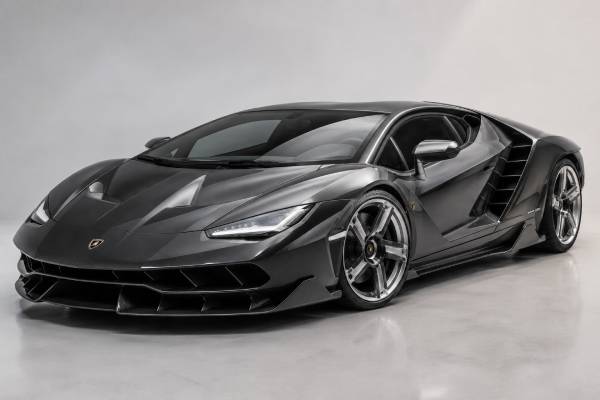
The Lamborghini Centenario LP 770-4 is a 40-unit, V12-powered few-off model built to celebrate the 100th anniversary of Ferruccio Lamborghini’s birth. Unveiled in coupé form at the 2016 Geneva Motor Show and followed by the Roadster during Monterey Car Week, it used the Aventador’s carbon-fiber core and L539 6.5-liter naturally aspirated V12, raised to 770 CV. The “LP 770-4” name tells the story: Longitudinale Posteriore engine layout, 770 metric horsepower, and four driven wheels.
Collectors still care because the Centenario sits at a turning point in modern Lamborghini history. It was not just a rebodied Aventador; it previewed rear-wheel steering, advanced aero thinking, a new infotainment/telemetry interface, and the brand’s modern few-off strategy. For buyers, the real questions are no longer only speed. Originality, documentation, carbon-body condition, low-mile authenticity, service history, and market provenance matter just as much.
Table of Contents
- Why the Centenario Still Matters
- L539 V12 Specs and Chassis Data
- Production, Versions, and Factory Specification
- Carbon Body, Aero, and Centenario Firsts
- How the LP 770-4 Drives
- Maintenance Risks and Specialist Care
- Values, Inspection, and Buying Advice
Why the Centenario Still Matters
The Centenario matters because it turned a founder’s centenary tribute into a working technology showcase. It honored Ferruccio Lamborghini, but it also pointed toward the next generation of Sant’Agata V12 cars.
Lamborghini revealed the Centenario in 2016, exactly 100 years after Ferruccio Lamborghini was born. The timing gave the car a clear historical purpose, but the project followed a modern brand pattern already shaped by cars such as the Reventón, Sesto Elemento, and Veneno. These few-off Lamborghinis are not ordinary special editions. They are low-volume halo cars used to test styling, materials, aero ideas, and customer demand at the top of the market.
The Centenario was based around the Aventador architecture, but it was not simply an Aventador with a different nose. It used a carbon-fiber monocoque, carbon bodywork, all-wheel drive, a 7-speed ISR automated manual gearbox, and a sharper version of the L539 V12. It also introduced rear-wheel steering to a Lamborghini production car before that technology reached the Aventador S.
Its place in Lamborghini history is unusual. The Miura made the mid-engine supercar famous. The Countach defined the wedge-shaped Lamborghini image. The Diablo and Murciélago carried the V12 line through changing ownership and emissions rules. The Aventador modernized the V12 flagship with a carbon tub. The Centenario took that platform and turned it into a bridge between analog V12 drama and software-assisted chassis control.
For collectors, its importance comes from four main points:
- Total production was only 40 cars: 20 Coupés and 20 Roadsters.
- It was linked directly to Ferruccio Lamborghini’s 100th birthday.
- It was the first Lamborghini production model with rear-wheel steering.
- It represented one of the last naturally aspirated, non-hybrid V12 few-off Lamborghinis before the brand’s electrified era.
That last point has become more important with time. Later Lamborghini V12 halo cars, including the Sián and Revuelto-based models, moved into hybrid assistance. The Centenario remains purely combustion-powered: a 6.5-liter V12, no turbochargers, no electric boost, and no hybrid battery. For some buyers, that gives it a special kind of purity.
The Centenario’s reputation today is split between two groups. Enthusiasts see it as an extreme Aventador-era machine with sharper responses, wilder aero, and rare public appearances. Collectors see it as a documented, numbered, invitation-only Lamborghini that trades more like modern art than a normal used exotic. Both views are valid, but the collector view controls the market.
L539 V12 Specs and Chassis Data
The Centenario’s key specification is simple: a 6,498 cc naturally aspirated L539 V12 producing 770 CV, mounted behind the cabin and driving all four wheels. The details matter because small differences in equipment, documentation, and condition can change both value and usability.
| Item | Specification |
|---|---|
| Model | Lamborghini Centenario LP 770-4 |
| Production period | 2016–2017, with customer deliveries from 2017 |
| Body styles | 2-door Coupé and 2-door Roadster |
| Engine code | L539 |
| Engine type | 6.5-liter naturally aspirated V12 |
| Displacement | 6,498 cc |
| Maximum power | 770 CV / 566 kW at 8,500 rpm |
| Maximum torque | 690 Nm at 5,500 rpm |
| Transmission | 7-speed ISR automated manual |
| Drivetrain | Electronically controlled all-wheel drive with Haldex Gen IV and rear mechanical self-locking differential |
| Chassis | Carbon-fiber monocoque with front and rear subframes |
| Body | Carbon-fiber exterior panels |
The L539 V12 is the same engine family that powered the Aventador, but in Centenario form it was tuned to 770 CV. That made it Lamborghini’s most powerful road-car engine at launch. It breathes without forced induction, so the car’s character depends on revs, intake noise, exhaust pressure, and throttle calibration rather than turbo boost.
The ISR gearbox is also central to the car’s feel. ISR means Independent Shifting Rods. It is a single-clutch automated manual, not a dual-clutch transmission. It can shift very quickly in aggressive modes, but it has a more mechanical, dramatic action than the smoother dual-clutch gearboxes used in many later supercars. This matters for buyers because the clutch, actuators, calibration, and driving style all affect long-term condition.
| Item | Figure |
|---|---|
| 0–100 km/h | 2.8 seconds |
| 0–300 km/h | 23.5 seconds |
| Top speed | More than 350 km/h / 217 mph |
| 100–0 km/h braking distance | 30 meters |
| Dry weight, Coupé | 1,520 kg |
| Dry weight, Roadster | About 1,570 kg |
| Wheelbase | 2,700 mm |
| Length | 4,924 mm |
| Width | 2,062 mm |
| Height, Coupé | 1,143 mm |
| Front tires | 255/30 ZR20 |
| Rear tires | 355/25 ZR21 |
The braking system uses carbon-ceramic hardware suitable for very high road speeds and occasional circuit use. The commonly quoted layout is 400 mm front discs with 6-piston calipers and 380 mm rear discs with 4-piston calipers. On a car this valuable, brake condition should be checked by measurement and specialist inspection, not by a quick glance through the wheel.
The Centenario’s width, tire stagger, and low front overhang make it a wide, serious machine on public roads. The rear-wheel steering helps at low speed, but the car is still a low, long, expensive carbon-fiber object. Even small cosmetic damage can become a major repair issue.
Production, Versions, and Factory Specification
The Centenario was built in two versions only: 20 Coupés and 20 Roadsters. Every car was sold before public launch, so factory allocation, original buyer status, and Lamborghini documentation are major parts of its identity.
| Version | Production | Key difference | Collector notes |
|---|---|---|---|
| Centenario Coupé | 20 units | Fixed roof, lighter dry weight, Geneva debut | Purest body form and closest to the original reveal car |
| Centenario Roadster | 20 units | Open-top body, added reinforcement, Monterey debut | Often prized for rarity plus open V12 sound and visual drama |
Unlike normal Lamborghini model lines, the Centenario did not have a long list of mechanical trims. There was no base model, no S model, no SV version, and no later facelift. The meaningful differences come from body style, market specification, paint and carbon finish, interior materials, factory personalization, mileage, and documentation.
The Ad Personam personalization program is especially important. Many Centenarios were specified to suit long-term collectors, so colors and interior treatments can be highly individual. Some cars use exposed carbon fiber with accent colors. Others use special paint, contrast striping, Alcantara, leather, colored stitching, embroidered details, or unique trim combinations.
For identification and authenticity, a buyer should focus on paperwork before emotion. The most useful records include:
- original purchase and delivery documents
- Lamborghini factory build information
- Certificato di Edizione Limitata or Polo Storico documentation where supplied
- service invoices from authorized Lamborghini dealers or recognized specialists
- import, tax, and registration documents
- factory accessories such as tool kit, charger, covers, books, keys, and special items supplied with the car
- any evidence of paint protection film, refinishing, carbon repair, or replacement panels
Matching-numbers concerns are different from a 1960s Lamborghini, but originality still matters. A Centenario with its original engine, gearbox, carbon tub, body panels, color scheme, and factory interior will carry the strongest collector profile. Replaced parts are not automatically fatal, especially if Lamborghini performed the work, but they must be documented clearly.
Market specification also matters. A car built for Europe, Japan, the Middle East, or the United States may involve different paperwork, compliance, lighting, labeling, emissions documentation, and registration effort. The NHTSA recall affecting certain 2017 Centenario Coupé and Roadster vehicles involved an incorrect manufacturer certification label, so U.S.-market buyers should verify that any affected car has the corrected label and closed recall status.
Mileage is a delicate subject. Many Centenarios have covered only delivery, testing, storage, or event mileage. Extremely low odometer readings help value, but only when they match the records. A car showing very low mileage but lacking regular maintenance, battery records, tire date checks, or fluid service may be less attractive than a lightly used car maintained correctly.
Carbon Body, Aero, and Centenario Firsts
The Centenario’s design is functional theater: every opening, blade, diffuser surface, and wing element is meant to manage air or announce the car’s purpose. It is dramatic, but it is not random decoration.
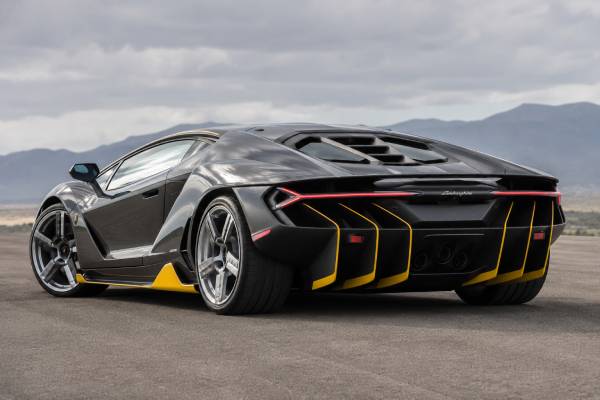
The body is made from carbon fiber and sits over a carbon-fiber monocoque. Lamborghini used the Centenario to explore a cleaner but still aggressive shape than the Veneno. The front uses a deep splitter and layered intakes to direct air under and around the car. Side channels manage flow toward the rear, while the rear structure is dominated by open vents, a large diffuser, and a three-outlet exhaust.
The active rear wing is one of the car’s key visual and aerodynamic features. It extends and adjusts to support high-speed stability, while the rear diffuser gives the back of the car a race-car-like exposed structure. The rear bodywork removes visual mass rather than hiding everything behind a conventional bumper. This gives the Centenario a lighter, skeletal look from behind.
The car also introduced rear-wheel steering to Lamborghini road-car production. At low speeds, the rear wheels can steer opposite the fronts to make the car feel shorter and more agile. At higher speeds, they can steer in phase with the fronts to improve stability. The effect is not just about lap times. It changes how a very wide, mid-engine V12 car behaves in tight spaces, fast sweepers, and direction changes.
Interior and interface
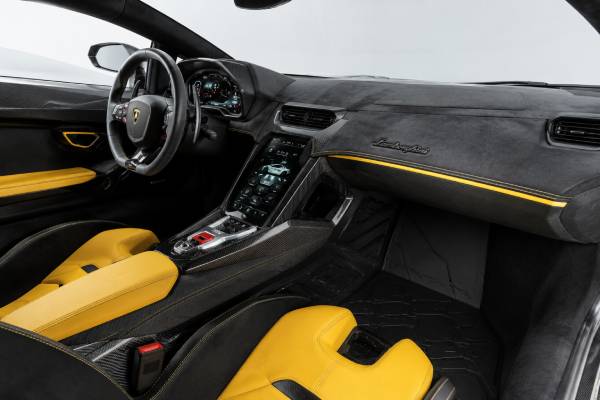
The cockpit is still recognizably Aventador-era, but the Centenario added a large portrait-style touchscreen with telemetry, connectivity, and performance data functions. This was a meaningful change at the time because Lamborghini had usually focused more on mechanical drama than infotainment innovation.
The driver sits low, facing a digital instrument display and paddle shifters. Visibility is typical for a modern Lamborghini flagship: acceptable forward, limited rearward, and heavily dependent on cameras and careful positioning. The doors deliver the expected scissor-door theater, but the cabin remains tight, low, and focused.
Sound and sensory identity
The Centenario’s sound is a major part of its value. The naturally aspirated V12 has a sharp, rising voice that becomes more intense near the 8,500 rpm power peak. The three central exhaust outlets give the rear view a signature detail and help separate the car from the Aventador family visually.
Because there is no hybrid system and no turbocharger muffling the response, throttle inputs feel immediate and honest. That quality is central to the Centenario’s appeal. Later cars may be quicker, but few deliver the same combination of induction noise, mechanical shift shock, and high-rev V12 character.
How the LP 770-4 Drives
The Centenario drives like a more alert, more theatrical Aventador-era flagship. It is brutally fast, but the more interesting part is how the rear-wheel steering, ISR gearbox, and naturally aspirated V12 shape the experience.
The engine dominates the car. Below the upper rev range it has enough torque to move cleanly, but it rewards commitment. Past the midrange it hardens, and near the top end it feels like the whole car is built around the climb to maximum revs. This is very different from turbocharged performance, where huge torque often arrives early and masks the upper range. In the Centenario, the reward is the build.
The ISR gearbox adds drama. In Strada, it is more manageable but still not as seamless as a dual-clutch gearbox. In Sport or Corsa, shifts are sharper and more physical. Some drivers love that because it makes each full-throttle upshift feel like an event. Others may find it less polished than newer transmissions. A buyer should understand this before comparing the car with later hybrid or dual-clutch supercars.
The steering and chassis are where the Centenario feels most distinct from earlier Aventador variants. Rear-wheel steering reduces the sense of length at lower speeds and gives the car quicker rotation in tighter corners. At high speed, it helps stability, making the car feel more settled during fast lane changes and sweeping bends.
Ride quality depends heavily on tires, surface, temperature, and mode. The car is not soft, but it is not a stripped racing prototype either. It was designed for wealthy owners who might drive on public roads, attend events, and use the car occasionally on track. Still, the ground clearance, front overhang, tire width, and carbon aero pieces make careless city driving expensive.
Braking performance is huge, but carbon-ceramic brakes need heat and condition. On the road, they should feel strong and stable, not grabby, pulsing, or noisy beyond normal material behavior. On track, they can handle major loads, but repeated high-speed use will make inspection essential.
The Centenario is not a relaxed daily driver. It is wide, loud, low, and attention-heavy. But compared with older V12 Lamborghinis, it is far more controlled. All-wheel drive gives traction, rear-wheel steering helps agility, stability systems add a safety net, and the carbon chassis gives a stiff base. The result is a car that feels outrageous without feeling crude.
For owners who actually drive their cars, tire condition is one of the biggest variables. The 20-inch front and 21-inch rear tire setup uses very wide, high-performance rubber. Old tires can make the car feel nervous, reduce braking performance, and damage confidence. A low-mile Centenario on aged original tires may be valuable as a preserved object, but it should not be driven hard until the tires are assessed and replaced if needed.
Maintenance Risks and Specialist Care
Centenario maintenance is less about common failure rates and more about protecting an ultra-low-volume carbon V12 asset. There are too few cars and too few miles for normal reliability patterns to mean much.
A properly stored Centenario may have very little wear, but storage creates its own problems. Batteries weaken, tires age, seals dry, fluids absorb moisture, and electronics dislike long inactivity. A car that has spent years in a private collection still needs scheduled attention, even if the odometer barely moves.
The drivetrain should be inspected by Lamborghini diagnostic equipment or a specialist with Aventador-era experience. The ISR gearbox and clutch system deserve special attention. Clutch wear can depend on low-speed maneuvering, launch use, hill starts, traffic, and calibration. A car with very low mileage can still have clutch stress if it was moved repeatedly in tight garages or used for demonstrations.
Key maintenance and inspection areas include:
- clutch wear readings and ISR gearbox operation
- engine ECU fault history and over-rev or abnormal event data where available
- cooling system condition, including radiators, fans, hoses, and leaks
- carbon-ceramic brake disc condition, pad life, and heat damage
- suspension lift operation if fitted and hydraulic leakage checks
- adaptive damper behavior and suspension bushing condition
- all-wheel-drive system service condition and driveline noises
- tire age, flat-spotting, cracking, and correct specification
- battery health, charger use, and control-module voltage history
- infotainment, telemetry, cameras, sensors, and display operation
- door struts, latches, window operation, and seal condition
- paint protection film condition and whether it has damaged clearcoat or exposed carbon finish
The carbon body is one of the largest ownership risks. A scrape that might be routine on a steel-bodied car can become a specialist carbon repair. Exposed carbon finishes require even more care because weave alignment, clearcoat depth, UV exposure, and panel finish are part of the car’s visible value. Poor repairs can be easy to miss in photos and costly to correct.
Carbon-ceramic brakes are another major cost area. They can last a long time in careful road use, but track use, overheating, stone damage, or improper handling can shorten life. Buyers should not rely only on mileage. Brake discs should be inspected for cracking, wear, surface condition, and remaining serviceability according to the correct procedure.
The official recall history should also be checked by VIN. The known U.S. recall involved incorrect weight information on the certification label for certain 2017 cars. The remedy was a corrected manufacturer certification label. This is not a mechanical defect, but unresolved recall paperwork can complicate registration, import, or resale.
Storage matters as much as servicing
Many Centenarios live in collections, so the storage environment affects condition. The ideal car has been kept in a climate-controlled space, maintained on the correct battery tender, started and moved properly, serviced on time, and protected from flat-spotted tires, fuel degradation, and moisture.
Long-term storage should not mean casual idling. Cold starts without proper warm-up, repeated short movements, and old fuel are not ideal for a high-output V12. A good specialist will know how to recommission the car before hard use.
Originality versus upgrades
Aftermarket exhausts, non-factory paint changes, wheel changes, and cosmetic modifications can reduce collector confidence. Some buyers may enjoy a louder exhaust or custom look, but the strongest market usually favors factory specification. If modifications exist, the original parts should come with the car, and the work should be reversible.
Values, Inspection, and Buying Advice
The safest way to value a Centenario is to treat it as a documented collector asset, not a normal used supercar. Public sales are rare, private deals are opaque, and asking prices can be far above proven transaction prices.
The launch price was about €1.75 million plus tax, and all 40 cars were already sold when the model was presented. Recent public auction results show that real transactions can sit around the low-$2 million range, while special specifications, very low mileage, roadster desirability, tax status, and private-sale patience can push asking prices higher. A low advertised mileage alone is not enough to justify a premium unless the history supports it.
| Value factor | Why it matters |
|---|---|
| Documentation | Confirms authenticity, original specification, ownership, service, and limited-edition status |
| Mileage | Lower mileage often helps, but only when matched by maintenance and storage records |
| Body style | Both versions are limited to 20 units; Roadsters may attract open-top V12 buyers, while Coupés appeal to purists |
| Factory specification | Exposed carbon, special colors, Ad Personam interiors, and tasteful original combinations can improve desirability |
| Condition | Carbon body, brake, tire, suspension, and interior condition can alter ownership risk dramatically |
| Market location | Import duties, temporary import status, emissions compliance, and registration can change the real cost |
| Provenance | Single ownership, known collections, factory links, and clean history help serious buyers bid with confidence |
A serious pre-purchase inspection should be performed by Lamborghini or a trusted exotic specialist before any deposit becomes non-refundable. The inspection should not be limited to a visual report. It should include diagnostic scans, service record review, body and paint assessment, brake measurement, tire date checks, lift and suspension operation, and confirmation of all accessories.
A practical Centenario buying checklist should include:
- Confirm the VIN, chassis identity, body style, market specification, and original build details.
- Verify Lamborghini limited-edition documentation and factory paperwork.
- Review every service invoice, not just stamped books or seller summaries.
- Check recall completion and market-specific compliance labels.
- Inspect exposed carbon, painted panels, underbody aero, splitter, diffuser, and wheel areas for damage.
- Measure carbon-ceramic brake condition using the correct procedure.
- Check tire age and condition, even if tread depth looks new.
- Run a full diagnostic scan and inspect battery voltage history where available.
- Confirm all keys, books, charger, covers, tools, and special accessories.
- Review import status, taxes, registration history, and any temporary bond conditions.
Examples to seek are easy to describe but hard to find: one-owner or well-known cars, original paint or exposed carbon in excellent condition, complete Lamborghini documentation, regular authorized servicing, no unresolved import or tax complications, and no unexplained body repairs.
Examples to avoid include cars with missing records, unclear mileage, unresolved recall or registration issues, aftermarket modifications without original parts, old tires presented as “new because mileage is low,” weak battery history, damaged paint protection film, or vague claims about factory specification.
The long-term collectability outlook is strong, but not risk-free. The Centenario has the right ingredients: low production, V12 power, founder-anniversary meaning, Lamborghini firsts, carbon construction, and dramatic design. The risk is liquidity. With only 40 cars, there are few comparable sales, and buyers at this level are selective. A poor specification, weak documentation, or complicated import situation can sit unsold while a cleaner car trades quietly.
For an enthusiast, the Centenario is one of the most exciting Aventador-era cars because it keeps the raw V12 experience while adding sharper chassis technology. For a collector, it is a high-value object where provenance is almost as important as horsepower. The best cars satisfy both sides: they are complete, original, documented, properly maintained, and still capable of delivering the full 770 CV experience when driven.
References
- Lamborghini Centenario | Lamborghini.com 2026 (Manufacturer Specifications)
- The Lamborghini Centenario at 2016 International Geneva Motor Show: futuristic design honours the Lamborghini legend − New content available 2016 (Press Release)
- Part 573 Safety Recall Report 18V-244 2018 (Recall Database)
- 2017 Lamborghini Centenario LP770-4 Coupé | Dubai | RM Sotheby’s 2024 (Auction Result)
- 2017 Lamborghini Centenario LP770-4 Roadster | Dubai | RM Sotheby’s 2024 (Auction Result)
Disclaimer
This article is for informational purposes only and is not a substitute for professional diagnosis, inspection, repair, valuation, or legal import advice. Specifications, torque values, service intervals, software versions, recalls, and repair procedures can vary by VIN, market, equipment, and later factory updates. Owners and buyers should verify all technical work against official Lamborghini service documentation and use qualified Lamborghini technicians or recognized exotic-car specialists.
If you found this guide useful, please consider sharing it on Facebook, X/Twitter, or your favorite automotive community to support our work.