
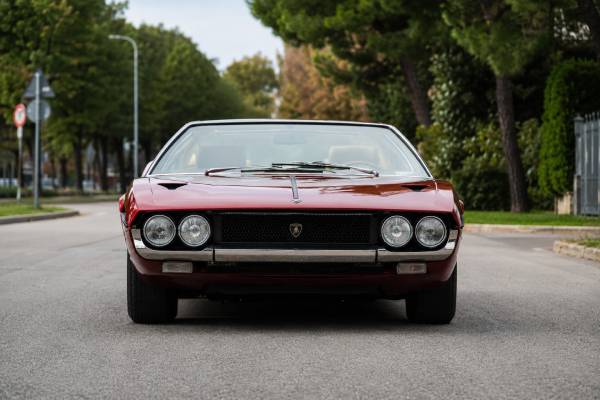
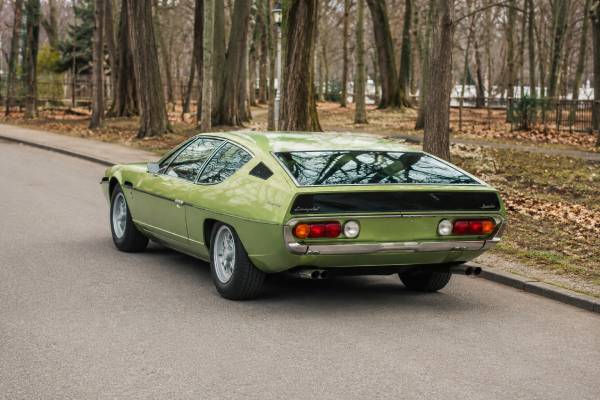
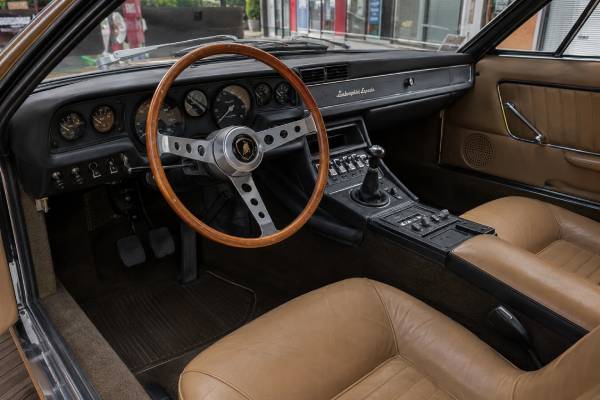
The Lamborghini Espada VIP is the rarest and most lavish version of Lamborghini’s front-engined V12 four-seat grand tourer. Built from the Tipo 108 Espada Series II platform and presented as a special 1971 luxury specification, it paired the 3.9-liter quad-cam Lamborghini V12 with an unusually extravagant rear-seat package: two-tone leather, a mini-bar, refrigerator, and a Brionvega Algol 11 television. That made it more than a trim package. It showed how far Lamborghini could push a fast Italian GT toward private-jet-style road travel.
For collectors, the VIP matters because only about a dozen examples were made, and the correct equipment is difficult to replace. For enthusiasts, it matters because the Series II is arguably the sweet spot of the Espada line: cleaner early styling, a stronger 350 hp engine, better brakes, and the revised cockpit that made the car easier to live with.
Table of Contents
- Why the Espada VIP Matters
- V12 Specs and Chassis Details
- Series II Production and VIP Identifiers
- Bertone Design and VIP Features
- How the Espada VIP Drives
- Maintenance Risks and Restoration Work
- Values, Inspection, and Buying Strategy
Why the Espada VIP Matters
The Espada VIP matters because it turns Lamborghini’s first proper four-seat V12 GT into a coachbuilt-style luxury statement. It is not simply a Series II Espada with extra leather; it is a rare factory expression of what wealthy early-1970s Lamborghini customers could order when comfort, status, and novelty mattered as much as speed.
The standard Espada arrived in 1968 as Lamborghini’s answer to a difficult brief: build a genuine four-seat grand tourer that still felt worthy of the badge. The company already had the Miura, which made Lamborghini famous as a maker of dramatic mid-engined supercars, but Ferruccio Lamborghini still believed deeply in the refined front-engined GT. The Espada gave the brand that car at a larger scale than the earlier 350 GT and 400 GT.
The design came from Carrozzeria Bertone, with Marcello Gandini’s sharp, low, glassy shape translating ideas from the Marzal concept into something usable on the road. The production Espada dropped the Marzal’s glass gullwing doors, but it kept the futuristic proportions: a long hood, very low roofline, steeply raked rear glass, and a broad Kamm-style tail. It was strange, elegant, and practical in a way few exotic cars have ever managed.
The Series II, also known as the Espada 400 GTE, is important because Lamborghini fixed many of the early car’s weak points while preserving the dramatic original body. The cabin became more conventional and easier to read, the V12 gained power, and the braking system was upgraded with ventilated discs. For many buyers, this makes the Series II more desirable than the Series I for regular use while still feeling earlier and purer than the later Series III.
The VIP sits at the top of that Series II story. Lamborghini used it to show the Espada’s luxury potential, adding equipment that was extraordinary for a production road car in 1971. A rear-seat television was not a normal option in a European GT at the time. A mini-bar and refrigerator belonged more naturally in a limousine, yacht, or aircraft cabin. In the Espada, they created a fast four-seat Lamborghini for owners who wanted to be driven as much as they wanted to drive.
The car’s significance today rests on four points:
- It is tied to Lamborghini’s early V12 identity, before the Countach changed the public image of the brand.
- It belongs to the Series II, the most powerful and best-developed early Espada generation.
- It carries rare VIP equipment that is central to value and identity.
- It shows Lamborghini’s hand-built flexibility before modern option programs formalized personalization.
The Espada was also commercially important. It became one of Lamborghini’s strongest sellers of the period and proved that the company could build something more useful than a two-seat supercar without losing its character. The VIP version narrows that history to a collector-grade niche: a low-production, high-specification, highly visible variant that appeals to people who care about factory originality and period eccentricity.
V12 Specs and Chassis Details
The 1971 Espada VIP uses the Series II 3,929 cc Lamborghini V12, usually quoted at 350 hp at 7,500 rpm. The key engineering story is simple: a sophisticated quad-cam V12, a steel monocoque body, independent suspension, and upgraded ventilated brakes made the Espada a true high-speed GT rather than a luxury coupe with a famous badge.
| Item | Specification |
|---|---|
| Model | Lamborghini Espada VIP, based on Tipo 108 Series II / Espada 400 GTE |
| Production year covered | 1971 |
| Body style | Two-door, four-seat grand touring coupe |
| Engine | 60-degree Lamborghini V12, aluminum block and heads |
| Displacement | 3,929 cc |
| Bore x stroke | 82 mm x 62 mm |
| Valvetrain | Dual overhead camshafts per bank, 24 valves |
| Fuel system | Six Weber 40 DCOE side-draft carburetors |
| Output | 350 hp at 7,500 rpm |
| Torque | About 290 lb-ft at 5,500 rpm |
| Transmission | Five-speed manual gearbox |
| Drivetrain | Front engine, rear-wheel drive |
| Chassis/body | Pressed-steel monocoque with aluminum hood |
| Front suspension | Double wishbones, coil springs, telescopic dampers, anti-roll bar |
| Rear suspension | Double wishbones, coil springs, telescopic dampers, anti-roll bar |
| Brakes | Servo-assisted ventilated discs front and rear |
| Wheels | 15-inch Campagnolo magnesium alloy wheels |
| Wheelbase | 2,650 mm |
| Approximate weight | About 1,635 kg, depending on equipment and measurement basis |
| Fuel capacity | About 95 liters in twin tanks |
| Top speed | About 155 mph / 250 km/h |
| 0–100 km/h | About 6.4–6.6 seconds, depending on test conditions |
The V12 is the car’s centerpiece. It traces its roots to Lamborghini’s first production engine family and uses a short-stroke layout that encourages revs. In Series II form, the Espada engine received a stronger state of tune than the early Series I car. The six side-draft Webers helped keep the hoodline low, which mattered because the Espada’s profile was central to the design.
This is not a lazy luxury engine. It has enough torque for relaxed touring, but it comes alive with revs and proper carburetor setup. A healthy car should pull cleanly from low speed, sharpen through the middle of the tachometer, and feel urgent above 4,000 rpm. A flat, smoky, hesitant, or overheating car is not showing normal Espada character.
The chassis is also more advanced than many people expect. The Espada used a pressed-steel monocoque rather than a separate ladder frame, with independent suspension at all four corners. This helped the car feel modern for its size. The long wheelbase gave the cabin usable rear space, while the low center of gravity and broad track helped it behave more like a fast GT than a formal luxury coupe.
Series II brakes are a major reason this generation is desirable. The ventilated discs gave the car better stopping ability and heat management than the early setup, although a buyer should not expect modern brake feel. Servo assistance, old rubber hoses, tired calipers, aged fluid, and worn boosters can all change how the pedal feels.
The steering is another important detail. Most cars have unassisted rack-and-pinion steering, which can feel heavy at parking speed but more natural once moving. Power assistance became available on the Series II, and cars so equipped should be checked for leaks, correct installation, and steering feel that does not mask worn suspension joints.
Series II Production and VIP Identifiers
The VIP is best understood as a tiny special run within the Series II Espada, not as a separate mechanical model. The important collector question is whether a car is a genuine VIP with correct factory or period documentation, because missing or recreated VIP equipment can make a large difference to value.
Lamborghini built the Espada in three main series. The Series I covered the earliest cars from 1968 into 1969. The Series II followed for the 1970–1972 period. The Series III then carried the model through the rest of production into 1978. Published production counts vary slightly depending on how late builds and factory records are counted, but the Series II was the large middle run, with roughly 575 to 578 examples.
The VIP was based on the Series II. Lamborghini’s own historical material describes it as a 1971 special series of only 12 examples. Its defining features were not engine changes; they were luxury and entertainment equipment aimed at rear-seat occupants.
A genuine VIP should be evaluated around evidence, not stories. The basic Series II chassis can be restored or modified, and some VIP-style features can be copied. A serious buyer should look for several layers of support:
- factory build record, heritage documentation, or recognized marque historian report
- early ownership file showing VIP specification or unusual interior equipment
- period photographs, restoration records, or invoices describing the VIP cabin
- correct rear-seat mini-bar and refrigerator arrangement
- correct Brionvega Algol 11 television installation, if still present
- two-tone VIP upholstery or credible evidence of original trim
- consistency between chassis number, engine number, gearbox, body details, and production date
The Series II itself has several identifiers. Compared with the Series I, it uses a revised dashboard, redesigned center console, different switchgear, improved interior ventilation, and stronger mechanical specification. The exterior changed less dramatically. One obvious Series II detail is the cleaner rear glass treatment, as the earlier rear grille over the vertical glass panel was removed.
The dashboard is one of the easiest places to separate Series I and Series II cars. The Series I has a more unusual instrument layout with a strong 1960s show-car feel. The Series II has a more conventional rectangular instrument cluster, wood trim, revised center console, and a more mature cabin design. That makes the car less shocking but easier to use.
Factory options and special-order details matter a great deal. Air conditioning and electric windows are part of the Espada ownership experience, but their condition varies widely. Some Series II cars were ordered with power steering. Interior colors, leather type, carpets, wood veneer, and radio placement should all be checked against records when originality is important.
Matching numbers are important but need context. The Espada was an expensive, complex car that often went through periods of low value before the market began taking it seriously. Engines, gearboxes, wheels, seats, instruments, and trim pieces may have been swapped. A non-matching but well-restored standard Series II can still be enjoyable, but a VIP without convincing identity and correct equipment loses much of what makes it special.
The most valuable VIP examples are not merely pretty cars. They are the ones that combine rare specification, correct numbers, strong documentation, careful restoration, and original VIP details that have not been lost. A restored mini-bar or TV installation may be acceptable if documented, but a vague “VIP-style” car should be priced very differently from a proven original VIP.
Bertone Design and VIP Features
The Espada looks the way it does because Lamborghini wanted four-seat usability without giving up exotic-car drama. The VIP adds a second layer: it turns the rear cabin into the car’s signature space, making passengers part of the story rather than an afterthought.
The exterior is one of Bertone’s most distinctive late-1960s designs. The Espada is long, wide, low, and sharply edged, with a huge glass area and a tail treatment that looks more like an architectural object than a conventional coupe. The roofline sits unusually low for a four-seat GT, which is why the packaging is so interesting. Lamborghini pushed the V12 forward enough to improve cabin space, and the rear hatch area gave the car useful luggage capacity.
The body is mostly steel, with an aluminum hood. This matters for restoration because the car is not simple to repair. Panel fit, door shut lines, hood alignment, tailgate fit, and glass sealing all require specialist care. The Espada was hand-finished, so tiny variations are normal, but poor symmetry, uneven gaps, or signs of heavy filler should raise concern.
The Series II preserved the dramatic exterior while improving usability. The cleaner rear glass treatment helped rear visibility, and the revised cockpit made the car feel more like a finished luxury GT than a show-car translation. The car still feels exotic, but the controls are easier to understand than on early cars.
The VIP rear compartment
The VIP equipment is the most memorable part of this version. The mini-bar and refrigerator were installed for rear-seat passengers, and the Brionvega Algol 11 television sat on the center console. In 1971, that was extraordinary. Today it is the detail that makes the car instantly different from a standard Espada.
These features also create restoration challenges. The television may be missing, damaged, obsolete, or disconnected. The mini-bar and refrigerator may have been removed during retrimming, especially when the car was treated as an old used exotic rather than a collector item. Correct materials, correct placement, and correct period hardware matter. Recreating them is possible only with deep research and careful craftsmanship.
The VIP interior should feel plush but not modernized beyond recognition. Two-tone leather is part of the period character. Wood veneer, rocker switches, instruments, door trim, carpets, and seat pleating should look like early-1970s Lamborghini work, not a generic custom retrim. A fresh interior can still hurt value if it erases the original design.
Sound, cooling, and packaging
The engine bay is both beautiful and busy. The six Weber carburetors sit proudly along the V12, and the long intake layout helps define the sound. A healthy Espada has a layered mechanical note: carburetor induction, cam-chain and valvetrain texture, exhaust resonance, and a hard-edged V12 climb as revs rise.
Cooling is critical because the Espada combines a large engine, air conditioning, a low nose, and a cabin designed for long-distance travel. The radiator, fans, hoses, thermostat, water pump, and coolant passages must all work properly. A car that stays cool in light traffic, climbs, and hot-weather running is far more valuable than one that only behaves during a short test drive.
The VIP also adds electrical and accessory complexity. The more original equipment a car retains, the more carefully it must be serviced. That is part of the appeal, but it also means the best cars tend to belong to owners who treat the Espada as a specialist classic rather than an occasional toy.
How the Espada VIP Drives
A good Espada VIP drives like a fast, mature, front-engined V12 GT, not like a Miura and not like a modern supercar. Its appeal is the mix of speed, sound, long-distance comfort, and unusual cabin atmosphere.
Start-up should be treated with patience. The carbureted V12 needs proper warm-up, especially after sitting. A cold engine may need careful throttle use, but it should not flood constantly, smoke heavily, or refuse to settle once warm. Oil pressure should be healthy, coolant temperature should stabilize, and the charging system should cope with lights, fans, and accessories.
Once underway, the Series II engine feels flexible but happiest when used with intent. Below 3,000 rpm, it should be smooth enough for town driving. From the midrange upward, the car begins to feel properly exotic. The short-stroke V12 rewards revs, and the 350 hp rating gives the Series II strong period performance. It is fast enough to remain exciting today, but the car’s value is not about drag-strip numbers. It is about sustained high-speed travel with four seats and a soundtrack few luxury GTs can match.
The five-speed manual gearbox is central to the experience. It should feel mechanical and deliberate, with clean synchromesh once warm. A baulky second gear, jumping out of gear, rumbling bearings, or heavy clutch action can point to expensive work. The clutch is not supposed to feel like a small modern car, but it should be progressive and manageable.
Steering effort depends on speed and equipment. Manual-steering cars can be heavy when parking because of the front-mounted V12 and broad tires. On the road, that weight becomes part of the charm. The steering should feel stable, accurate, and honest. Wandering, tramlining, vibration, or a vague center can come from old tires, worn bushings, poor alignment, tired dampers, or wheel issues.
The ride is more compliant than many expect. The Espada was built as a grand tourer, so it should absorb roads better than a low two-seat supercar. That said, it is not a soft luxury car. The chassis should feel planted, with a long-wheelbase stability that suits fast A-roads and motorways. A tired car may feel heavy, loose, and reluctant; a well-sorted car feels much more coherent.
Braking needs period expectations. The ventilated discs are a major Series II advantage, but old boosters, calipers, hoses, and pads can make the pedal inconsistent. A properly maintained car should stop straight and confidently. Pulling, pulsing, long pedal travel, or a hard pedal are all reasons for inspection.
Visibility is better than the dramatic shape suggests, helped by the large glass area, though the long nose and low seating position require adjustment. Cabin heat, fuel smell, wind noise, and air-conditioning performance vary widely depending on restoration quality. A good Espada feels usable. A neglected one feels like a list of problems moving under its own power.
The VIP features do not transform the driving dynamics, but they change the mood. This is a car where the rear passengers matter. The driver gets the V12, the gearbox, and the long hood; the rear occupants get the lounge-like view, the special trim, and the famous entertainment equipment. That combination is what makes the VIP so different from other classic Lamborghinis.
Maintenance Risks and Restoration Work
The Espada VIP is reliable only when it has been maintained like a complex hand-built V12 Lamborghini. Neglect is expensive, and cosmetic restoration without mechanical depth is one of the biggest buying risks.
The engine is strong in principle, but it is not simple. It has four camshafts, twelve cylinders, six carburetors, a high-performance ignition system, and many age-sensitive parts. Carburetor balance matters. Valve adjustment matters. Cooling health matters. Fuel delivery matters. A car that has covered very few miles but has sat for years may need more work than a regularly used example.
Important engine checks include:
- cold and hot oil pressure
- compression and leak-down test results
- coolant temperature in traffic and at speed
- radiator, fan, water pump, and hose condition
- fuel hose age and routing
- Weber carburetor wear, jetting, balance, and throttle-shaft condition
- cam-chain noise and valve-train adjustment history
- ignition distributor, coils, leads, and plug condition
- oil leaks from cam covers, timing covers, sump, and rear main area
- exhaust smoke during start-up, overrun, and hard acceleration
The gearbox and clutch deserve equal attention. Synchro wear, bearing noise, clutch slip, hydraulic leaks, and poor shift linkage adjustment can all be costly. Because the Espada has long periods of low-speed maneuvering in many modern use cases, clutch condition should not be assumed from mileage alone.
Cooling and fuel systems are common ownership priorities. The twin fuel tanks can suffer from internal corrosion, old sealants, blocked pickups, and tired senders. Fuel smell inside the car should never be dismissed. Old rubber lines near a hot V12 are a serious concern. Radiators can look fine externally while being inefficient internally, and weak fans can make a car appear healthy on the open road but marginal in traffic.
Body condition can make or break an Espada purchase. Rust repair is expensive because the car is large, low, and structurally complex. Paint can hide problems for years. The inspection should focus on:
- sills and jacking points
- floorpans and footwells
- lower doors and door bottoms
- wheel arches and inner arches
- front structure around suspension pickup areas
- windshield and rear glass surrounds
- tailgate frame and luggage area
- fuel tank areas
- lower front valance and nose repairs
- evidence of accident damage or poor panel replacement
The magnesium Campagnolo wheels are another specialist concern. Magnesium can corrode, crack, and become unsafe if neglected. Original wheels are valuable, but safety comes first. They should be inspected by someone familiar with classic magnesium wheels, not merely cleaned and repainted.
The interior is especially important on a VIP. A standard Espada interior is already expensive to restore; a VIP interior is harder because the rare equipment and trim details define the car. Missing Brionvega hardware, incorrect refrigerator components, wrong leather pattern, poor woodwork, or modern stereo and switch modifications can all reduce authenticity.
Electrical issues are common in hand-built Italian classics of this age. Electric windows, gauges, lighting, fans, air conditioning, relays, grounds, and accessory wiring all need patient diagnosis. A VIP adds more potential problems because of the entertainment and refrigeration equipment. The goal is not just to make everything light up for a sale; it is to make the wiring safe, correctly fused, and reliable.
Maintenance should be proactive. Even when mileage is low, fluids age, seals harden, brake hydraulics absorb moisture, tires expire, and fuel systems deteriorate. A sensible ownership plan includes regular oil and filter changes, brake fluid renewal, coolant service, carburetor synchronization, ignition checks, tire-age monitoring, and annual inspection by a Lamborghini classic specialist.
Restoration decisions should respect originality. Modern upgrades can make an Espada easier to use, but a VIP is not the best candidate for heavy personalization. Reversible improvements, such as discreet cooling upgrades or modern internal materials inside original-looking components, are easier to justify than visible changes that erase period character. The more complete and original the VIP equipment, the more carefully the car should be preserved.
Values, Inspection, and Buying Strategy
Buy the best-documented Espada VIP you can find, because rarity alone does not protect you from restoration cost. The right car is a verified VIP with complete equipment, sound structure, healthy mechanicals, and a clear ownership file; the wrong car is a shiny standard Series II with a story.
The public Series II Espada market has moved into serious collector territory, but it still sits below the Miura and Countach in Lamborghini hierarchy. That can make the Espada look like value, but only if the car is genuinely good. A low purchase price can disappear quickly if the V12, body, trim, and VIP equipment all need work.
As of the 2026 market, public sales and listings place many Series II Espadas in the low-to-mid six-figure range, with strong examples and unusual specifications achieving more. Public market trackers show recent Series II sales from project or driver-level money to more than $200,000 for especially desirable cars. VIP examples are harder to price because they trade rarely, and the premium depends heavily on proof.
| Value factor | Why it matters |
|---|---|
| VIP documentation | Confirms the car is one of the rare special examples, not a later recreation. |
| Original VIP equipment | The mini-bar, refrigerator, TV, and trim are central to identity and difficult to replace. |
| Matching numbers | Supports authenticity and collector confidence, especially with factory records. |
| Body condition | Rust and accident repair can cost more than mechanical sorting. |
| Mechanical health | A V12 rebuild, gearbox work, or full brake overhaul can be major expenses. |
| Interior correctness | VIP trim errors are visible and can be hard to reverse. |
| Color and provenance | Period-correct colors, notable ownership, and early records help desirability. |
| Restoration quality | A high-quality older restoration can be better than a fresh cosmetic job with hidden issues. |
A proper pre-purchase inspection should be specialist-led. A normal exotic-car inspection is not enough, because the Espada combines a rare body, vintage V12 mechanicals, and trim that many shops have never seen. The inspection should include a lift check, road test, compression or leak-down testing where possible, paint-depth readings, magnet checks in corrosion-prone areas, wheel inspection, electrical test, and document review.
Prioritize the inspection in this order:
- Confirm identity and VIP provenance.
- Check structural rust and accident history.
- Verify engine, gearbox, and major numbers.
- Inspect the VIP interior equipment and trim.
- Test cooling, brakes, steering, suspension, and electrics.
- Review invoices for real specialist work, not just cosmetic spending.
- Price the car based on total ownership risk, not asking price alone.
Cars to seek are complete, documented, and usable. A slightly aged but honest VIP with original equipment and strong records may be far better than a freshly restored car with missing parts and vague provenance. Cars to avoid include examples with unexplained identity gaps, heavy filler, missing VIP hardware, overheating, poor oil pressure, serious fuel smell, incorrect interior retrims, or seller claims that cannot be backed by records.
Budgeting should be realistic. Even a good Espada can need expensive recommissioning after shipping, storage, or light use. Tires, fluids, brake hydraulics, carburetor work, fuel hoses, battery, cooling repairs, and electrical sorting are normal first-year items. A poor car can require engine, body, and interior work that exceeds the difference between a cheap example and a great one.
Long-term collectability looks strong for the VIP because it combines several desirable traits: Lamborghini V12 power, Bertone design, genuine four-seat usability, very low production, and a story that is easy to explain. It is also visually and culturally distinct. Many rare cars are rare because nobody wanted them; the VIP is rare because it represented an extreme version of an already expensive GT.
The best ownership mindset is preservation with use. The Espada was built to cover distance, and cars that are driven carefully often stay healthier than cars treated as static displays. Keep the VIP equipment intact, maintain the V12 properly, protect the body from corrosion, and document every service. That is the path to enjoying the car while preserving what makes it one of the most unusual Lamborghinis of its era.
References
- Lamborghini History – Espada | Lamborghini.com 2026
- Espada 400 GT: the legendary Lamborghini four-seater V12 2022
- 1971 Lamborghini Espada Series II | Gooding Christie’s 2018
- Lamborghini Espada – Series II Market – CLASSIC.COM 2026
- Lamborghini Espada Series 2 Guide — Supercar Nostalgia 2022
Disclaimer
This article is for informational purposes only and is not a substitute for professional diagnosis, repair, valuation, or restoration advice. Specifications, torque values, service intervals, procedures, and original equipment can vary by VIN, market, build date, and individual factory specification. Always verify details against official service documentation, factory records, and a qualified Lamborghini classic specialist before buying, repairing, or restoring a vehicle.
If you found this guide useful, please share it on Facebook, X/Twitter, or your preferred enthusiast community to support our work.